
Virtual Bowling holds a title no game wants and every collector knows: it is the rarest commercially released Virtual Boy game, the last title Athena published for the system in Japan in late 1995, printed in tiny numbers for a market that had already stopped listening. Complete copies change hands for sums that would buy a car. The danger of such a reputation is that it eats the game — so it is worth stating plainly, at the top of a review, that Virtual Bowling is also genuinely excellent: the best bowling game on the system, and one of the most polished sports titles in the whole catalogue.

Athena knew bowling — the company had a long arcade and console bowling lineage — and Virtual Bowling is built like a culmination. The throwing system is the most complete the Virtual Boy hosted: stance, approach timing, release, spin applied with the twin pads in a way that becomes second nature, and a lane whose oil pattern genuinely governs the hook. Where Nester’s Funky Bowling plays its physics for charm, Virtual Bowling plays for truth: ball weight, entry angle and pin action are modelled with a care you can feel in your third game, when the spares start falling to shots you actually planned.
Depth as instrumentation
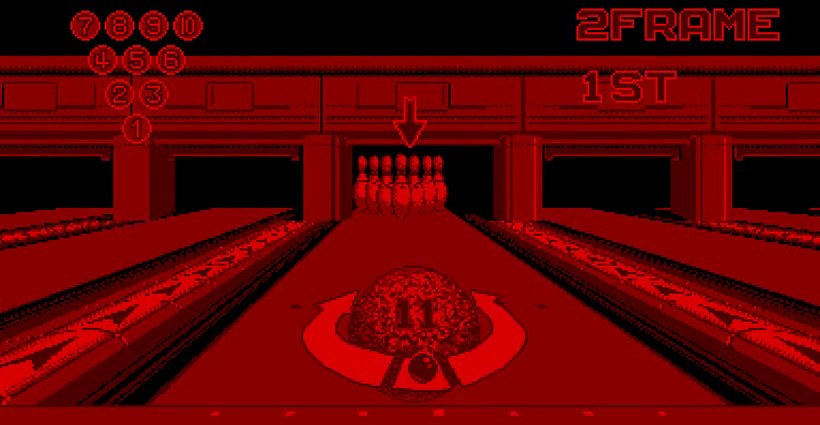
The stereoscopy here is not a view, it is instrumentation. You watch the ball’s entire journey in depth — the skid through the oil, the bite as it finds friction, the drive through the pins — and you learn to read your mistakes at the exact board where they happened. It is the clearest example in the entire library of the Virtual Boy’s depth functioning as information rather than effect, the same trick Mario’s Tennis played with a ball and a net, perfected and made serious. Tournament and league structures give the mastery somewhere to go, and the computer opponents are calibrated to punish lazy spare shooting.
Presentation is a step above the system’s sports norm: clean, characterful bowler sprites, a proper alley atmosphere, and little celebratory touches that stay the right side of tasteful. The soundtrack is light and unobtrusive. Even the menus — the graveyard of Virtual Boy sports games — are brisk. It plays, throughout, like a game made by people who expected it to be played for years, which is the saddest and most impressive thing about it.

The price of the last cartridge
And then there is the market. Virtual Bowling’s December 1995 Japanese release, into the teeth of the system’s collapse, gave it a print run that turned it into the library’s grail within a decade. The honest review must separate the two judgements, because the price is not a quality the game possesses — it is an accident of timing and print runs — while the quality is real and would be real at any price. Emulation and flash cartridges have, happily, made the game itself accessible to anyone who wants to judge it, and judged, it holds up: this is an 8-out-of-10 bowling game that happens to wear a five-figure coat.
It also closes the library’s strangest circle. The Virtual Boy’s most valuable game is a Japan-only sports simulation with no characters, no licence and no spectacle — just craft, depth and physics. The market, for once, is not entirely wrong about which cartridge matters. It is simply wrong about why.
Athena’s craft, examined
Athena’s bowling lineage is the game’s foundation, and it shows in the places lesser bowling games skip. The approach is a rhythm, not a formality: mistime it and the release window punishes you in ways that feel like bowling rather than like a failed quick-time event. The spin system rewards restraint — a modest hook, honestly thrown, beats a violent one — and the pin physics produce the leaves and splits that real bowlers recognise, including the occasional strike that falls to a lucky messenger pin and feels earned anyway. Tournament progression is structured as a genuine climb, and the game’s difficulty curve respects the player’s improving eye: this is a sports simulation built by specialists, at a moment when the Virtual Boy mostly received conversions and curiosities.
It also completes an odd symmetry in the library. The Virtual Boy received two bowling games — this and Nester’s Funky Bowling — for a catalogue of twenty-two titles, a duplication that looks absurd until you play both and discover they are opposite philosophies wearing the same sport: Nester’s is bowling as a party, Athena’s is bowling as a discipline. That the definitive one was released only in Japan, at the platform’s death, in numbers that made it an instant rarity, is the Virtual Boy story in a single cartridge: the good stuff existed; the distribution didn’t.
Rarity, value and the honest player
Because the price will always enter the room first, let it be addressed completely. Virtual Bowling’s market value is a function of its print run and the Virtual Boy completionist culture, full stop; it tells you nothing about the game, and this review’s score was assigned as if the cartridge cost the price of a sandwich. What the value does do is distort access, and access is where the modern scene earns its keep again: flash cartridges and faithful emulation have returned the game to players, and the consensus of those who have actually bowled it — rather than merely priced it — is the consensus recorded here. It is an excellent bowling game. The legend and the quality are separate facts that happen to share a cartridge.
There is a final, quieter distinction worth recording. The Virtual Boy’s library is often summarised as potential unfulfilled — demos of a future that never arrived. Virtual Bowling is not potential. It is a finished, polished, complete piece of work that arrived exactly on time and found no one there. Of all the library’s what-ifs, it is the one that asks the least imagination: just an audience.
Practical closure, for the player rather than the collector: everything this review praises is available without the auction house. The game runs beautifully in emulation, its depth translating intact, and on flash cartridges in original hardware it is indistinguishable from the grail on the shelf — because it is the same game, and the game was always the point. Athena’s bowlers do not know what their cartridge costs. They only know the oil pattern, the entry angle and the leave on the third frame. Join them on those terms, and Virtual Bowling becomes what it should have been in December 1995: simply the best sports game on the Virtual Boy.
And when the last frame is bowled, what remains is the simplest summary in this library’s whole story: the best game in the room was the one nobody was given the chance to buy. Virtual Bowling did everything right. History did the rest.
Verdict
Play it however you can — flash cart, emulation, a friend’s improbable shelf — and you will find the Virtual Boy’s finest sports game. The legend is about scarcity. The game is about craft.
Virtual Bowling — 8.0/10. The library’s rarest cartridge is also one of its best: bowling as instrumentation, depth as information, craft throughout.