
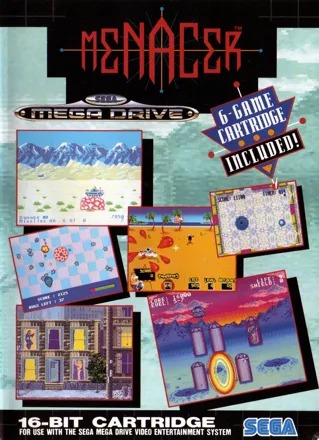
At a glance: Sega Menacer 6-in-1 · Genesis · developed by Western Technologies · published by Sega of America · 1992 · light-gun compilation · six mini-games · requires the Menacer gun (infrared, CRT televisions only) · one or two players depending on game
Judge the cartridge and you must first judge the gun, because the gun is the better product. Sega’s answer to Nintendo’s bazooka-like Super Scope was the Menacer: a modular light gun built from a base unit with twin grips, a detachable shoulder stock and a twin sight that clipped on top — no lenses, just an adjustable plastic notch, each half sliding on separately. It ran wirelessly by infrared to a receiver in the second controller port, drank six AAA batteries, and worked only with the CRT televisions whose scan patterns all light guns read. As industrial design it is genuinely thoughtful: hip-fired like a submachine gun, stocked like a rifle, never the shoulder-mounted plank Nintendo shipped. It also drifts, which is why every game on its pack-in cartridge opens with a calibration screen, and it offers an Accu-Sight option — an on-screen crosshair — that makes snap-shooting easy by quietly cancelling the point of the fancy sight you clipped on. The hardware, in short, is a good idea executed with care. Then Sega had to give it something to shoot at.
The commercial context explains the haste. The bundle launched in North America at around a hundred dollars, gun and cartridge together, aimed at the 1992 Christmas market Nintendo’s Scope was already working; neither company, after a decade of headlines about realistic toy guns, wanted to sell a plain pistol, so both sold sculptures instead. Time has not been kind to either sculpture’s usability: the Menacer’s whole arrangement presumes a cathode-ray television, and on any modern flat panel the gun is inert — a handsome paperweight whose receiver blinks at screens it cannot read. Whatever value the package holds now is archaeological, which makes the quality of its one bundled cartridge matter more, not less: for most owners, then and now, the 6-in-1 IS the Menacer’s library.
Licensed Dreams, Replacement Parts
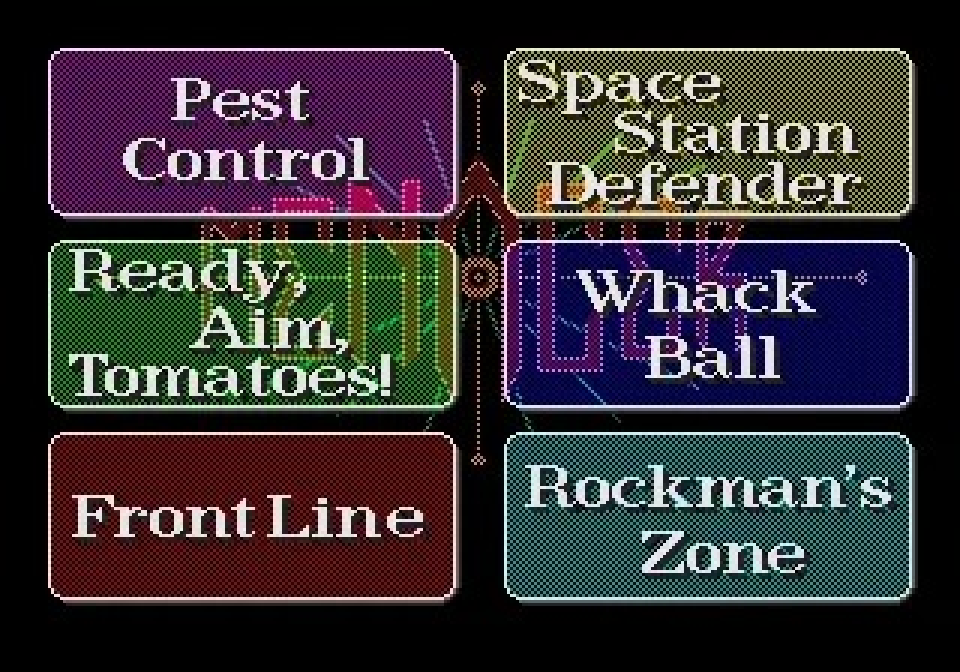
The compilation was not supposed to look like this. The plan, by the oft-told account of producer Mac Senour, was a cartridge of Sega licences — Joe Montana throwing passes, baseball under Tommy Lasorda’s name, the catalogue the company actually owned. Headquarters declined the licence fees, the licensed concepts evaporated late in the day, and Western Technologies was left to fill a cartridge with original mini-games built at speed. What shipped in 1992 is exactly what that story predicts: six exercises in pointing the gun at things, each individually slight, collectively exhausting.
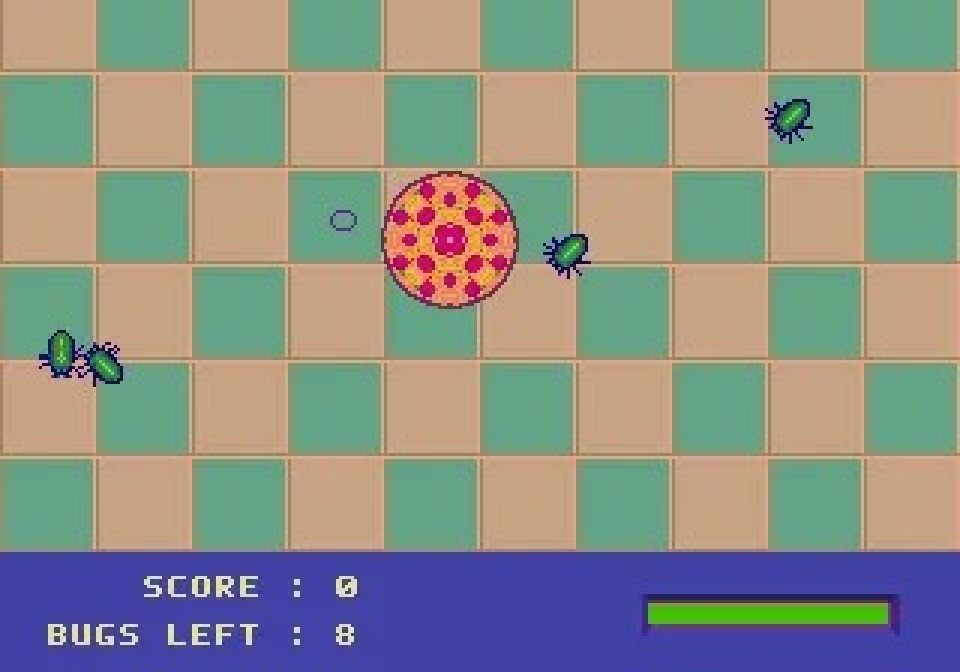
Pest Control is the strongest of the shooting five, if only by structure. A pizza sits on a kitchen floor; insects stream in to carry it away piece by piece. Your weapon is a flashlight beam in a darkened room — shoot to burst bugs, mind the recharge bar that punishes panic fire, and use the foregrip button to flood the room with light and take stock, during which you cannot shoot at all. Bigger specimens split into smaller ones when burst. It is a workable loop for ten minutes. Space Station Defender is a memory test in a spacesuit: up to eight pods materialise, open in sequence or — in Random mode — all at once, and the alien inside each must be shot before it shoots you, with your aim pulled down to a Power bar between waves to reload. Front Line scrolls Soviet armour and aircraft past a fixed position, machine gun unlimited, ten rockets each for tanks and aircraft per stage, damage carrying between stages with only a sliver handed back; the far row of tanks is tiny, the jets eventually stop mid-air to duel you, and the whole thing induces a trance its designers presumably didn’t intend. Rockman’s Zone pastiches Hogan’s Alley with cardboard citizens and cardboard crooks in an endlessly tiling city, and removes its own challenge with a shouted “SHOOT!” that announces every criminal — miss one anyway and a life vanishes without the courtesy of an explanation. Whack Ball is Breakout steered by light gun, the paddle following your aim around a frame of colour-changing blocks, with a wandering bonus tile dispensing extra balls or, spitefully, a stage reset; it is the cartridge’s one attempt to use the gun as something other than a gun, and the one its owners played least.
One Good Idea, Wearing Tomatoes

The exception proves what the cartridge might have been. Ready, Aim, Tomatoes! borrows ToeJam & Earl — Sega’s own licence, no fee dispute — and builds a scrolling gallery in which ToeJam lobs tomatoes at Cupids, dentists, devils and boogie men while the screen drifts right. Shootable signposts scroll you backwards to mop up misses, power-ups grant rapid fire, slow time or a screen clear, tornadoes catch your tomatoes and throw them back, and each level sets a score target, accuracy and leftover ammunition included, with one retry if you fall short. It has three pieces of music from the parent game, while the other five games share a single looped menu theme between them, unmutable and, within the hour, unbearable. Tomatoes is charming for a handful of levels before its difficulty curve turns sour, but it alone suggests a development team with ideas — a suggestion the rest of the cartridge spends its length retracting. Nothing anywhere on the cart saves a high score, so the sole incentive structure these endurance games possess evaporates when you switch off.
A Good Gun, Abandoned
The aftermath writes itself. Sega supported its gun with only a bare handful of cartridge titles; the library’s real bulk arrived later as American Laser Games’ Sega CD ports, most of which also accepted Konami’s Justifier — the unglamorous pistol-shaped gun that both platform holders should have built in the first place, and which had Lethal Enforcers exclusively besides. The Menacer’s own finest hour was somebody else’s game, T2: The Arcade Game, eventually bundled with the gun in an admission of how the arithmetic looked. The peripheral deserved better and the pack-in is why it never got it: a launch cartridge is a promise about everything that follows, and this one promised six shallow endurance tests and a looped tune. The gun on a shelf still looks like the future of something. The cartridge is the record of Sega losing interest in that future before it shipped.
“A thoughtfully designed gun betrayed by a cartridge of leftovers: five tech demos, one real game, and no high-score table to make any of it matter.”
The Verdict
Menacer owners in 1992 had no choice, which is the only circumstance under which this cartridge earns its keep — it was in the box. Judged as software it is slapdash in concept and in finish, redeemed partially by Pest Control’s structure and genuinely by its ToeJam & Earl finale. Collectors will want it because the gun needs its companion piece. Players should know the companion piece is the weakest thing the gun ever pointed at.
Verdict: the pack-in that sank a promising peripheral — slapdash, repetitive, and saved from the bottom drawer only by tomatoes — 3.5.
Keep reading: the Genesis system archive