
At a glance: Serpentine · VIC-20 · Creative Software, 1982 · Maze chase · Score: 8.0/10
Serpentine starts from a brilliant inversion: in a maze full of snakes, you are one of them, and the food chain is decided by length. David Snider’s design, first published by Brøderbund for the Apple II, reached the VIC-20 through Creative Software, and it remains one of the cleverest maze games of its generation. Your serpent grows by eating the frogs that hop through the maze; enemy serpents hunt you with the same appetite. Meet a rival head-on and the shorter snake dies — so the whole game becomes an exercise in relative length, cornering, and timing: grow fast, cut rivals off, attack their tails, and never, ever turn into a corridor against a longer snake. Add egg-laying, which produces new serpents, and a maze that repopulates with menace, and you have a game that thinks more like chess than Pac-Man.

Length is life
The elegance is in how every mechanic feeds the central measure. Frogs are not points; they are length, and length is both weapon and vulnerability — a long serpent strikes from safety but turns like a tanker and presents a bigger target. Enemy snakes shrink when you bite their tails and grow when left to feed, so the maze holds a living economy you are constantly perturbing. Eggs raise the stakes beautifully: destroy them and you thin the next generation; let them hatch and the maze fills with fresh rivals while you are still digesting. It creates stories in a way few 1982 games manage — the desperate reversal, the hunted becoming the hunter after one good frog run, is a narrative the game generates fresh every session.
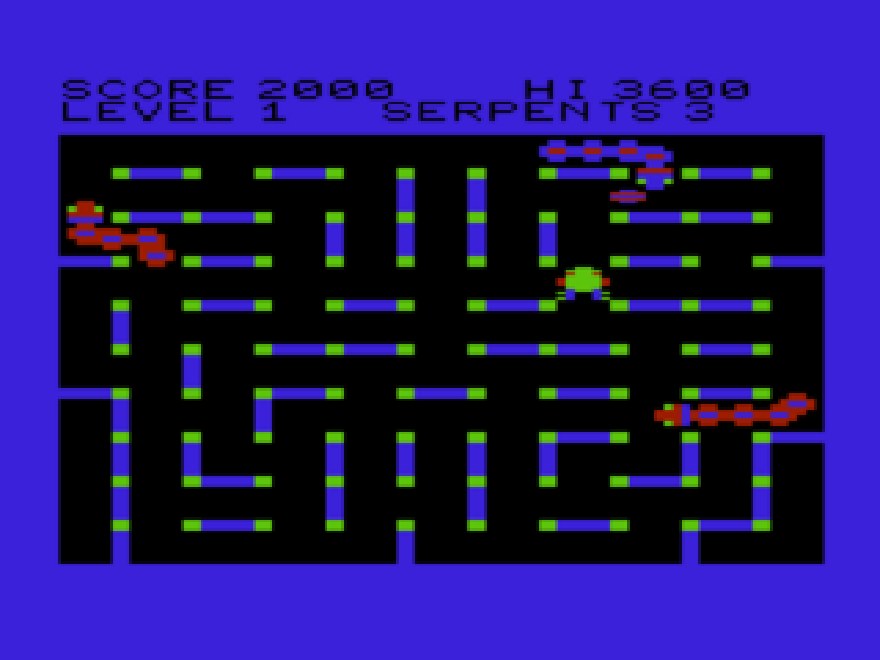
Creative Software’s VIC conversion is a model of clarity. The maze is bold, the serpents are instantly distinguishable by colour, and movement is smooth and quick — essential in a game where one late turn is death. The VIC’s low resolution actually serves the design: everything on screen is information, and the screen is never so crowded that you cannot read the food chain at a glance. Sound is sparse but functional, and the cartridge format suits the game’s short, escalating lives perfectly. What the port cannot do is add the Apple original’s finer visual detail, and it does not try; this is the same intelligent game, wearing the VIC’s chunky uniform with pride.
The thinking player’s maze game
Serpentine’s reputation has grown as retro players have rediscovered it, because its ideas were genuinely ahead of the maze-chase pack. Pac-Man taught pattern memorisation; Serpentine teaches opportunism. There is no single route to learn — the frogs wander, the rivals grow, the eggs hatch on their own schedule — so skill expresses itself as judgement rather than choreography. That makes it one of the most modern-feeling games in the VIC-20’s early library, and one of the easiest to hand to a sceptic who thinks 1982 maze games are all the same game in different hats.

Its demands are honesty itself: the controls are one joystick, the rules fit in a paragraph, and mastery is visible. If the VIC version has a flaw, it is that the escalating speed and serpent count can tip from tense to overwhelming in the later stages — but that is the genre’s bargain, and Serpentine’s sessions are so quick to restart that the ‘one more go’ pull is powerful. As a showcase for the machine it is also quietly instructive: proof that the VIC-20’s best games were often not arcade conversions at all, but clever computer games that used the hardware’s clarity as a feature.
A maze game with a food chain
Spend an evening with Serpentine and its difference from the maze-chase mainstream becomes a difference of philosophy. The Pac-Man family is about routes — knowledge carried from maze to maze, patterns burned into memory. Serpentine is about situations. The frogs wander where they will, rival serpents grow or shrink by their own fortunes, eggs hatch on schedules you can influence but never own, and so the expert player is not the one who memorised the maze but the one who reads it fastest: where the food is, who is longest, which corridor is about to become a trap. That is a strikingly modern design sensibility to find in a 1982 cartridge, and it explains the game’s growing reputation among retro players who missed it the first time. It does not play like a museum piece. It plays like an idea the industry should have stolen more often.
The VIC-20 version deserves its share of that reputation. Creative Software could have treated the conversion as a quick port of a computer-game hit; instead the VIC edition is tuned to its machine — the bold colours separating the serpents at a glance, the pace brisk, the maze proportioned so the whole food chain stays readable on a family television. Judged strictly on the VIC, it stands as one of the machine’s handful of essential third-party cartridges, and the one most likely to convert a visitor who believes all early maze games are identical. They are not. One of them has a food chain.
In the slot today
Two further credits belong on the record. David Snider’s design originated on the Apple II, a machine whose games library is rightly celebrated for intelligence, and Serpentine travelled — to the VIC, to the C64, to the Atari — because every platform’s players recognised the same thing: a maze game with an ecology. Creative Software’s role in bringing it to the VIC deserves its line, too. The company’s VIC catalogue was small and chosen with unusual taste, and Serpentine alongside Choplifter and Apple Panic forms a trio of conversions any publisher would be proud of. The VIC-20’s third-party story is often told as Commodore-and-clones. This cartridge is the correction, in a maze, eating a frog.
And the frog deserves a sentence. In a genre built on dots and pellets, Serpentine’s wandering frogs — food with its own agenda, hopping through the food chain — are a tiny masterpiece of liveliness. Chase one and you understand the whole game: nothing here is stationary, nothing is merely a score, and the maze is alive. That aliveness is why the cartridge endures.
Length is both weapon and vulnerability — Serpentine teaches opportunism where Pac-Man taught choreography.
Serpentine is a small masterpiece of maze design and a first-class VIC-20 cartridge: intelligent, tense and endlessly replayable. It asks little of the hardware and everything of the player, which is exactly why it has aged so well. If your VIC collection leans toward shooters, this is the game that broadens it — the maze chase for people who like to think.
Verdict: grow long, hunt smart, and mind the eggs. One of the smartest games on the machine.
Bring a rival, if you can find one willing to learn the length rules, and Serpentine becomes a household championship in an evening. Bring only yourself, and it remains what it was in 1982: the smartest serpent in the maze. Eat well, grow long, and never trust a corridor.