
At a glance: Shamus · VIC-20 · HES, 1983 · Maze shooter · Score: 8.0/10
Shamus casts you as a robotic private eye — hat, coat and blaster — clearing the maze-like lair of the Shadow, room by room, in a game that fuses Stern’s arcade Berzerk with a detective-noir wink. Synapse Software’s original, by William Mataga, was a hit on the Atari 8-bits, and HES’ VIC-20 edition carries the formula across to a machine with a fraction of the memory: dozens of interconnected rooms across multiple levels, each patrolled by robotic guards that shoot back, with keys, extra lives and question-mark bonuses hidden in alcoves — and the Shadow itself, an invulnerable horror that oozes through the wall whenever you linger too long, to hurry you along or end you. It is Berzerk’s formula, expanded into something closer to an adventure, and on the VIC it absolutely flies.
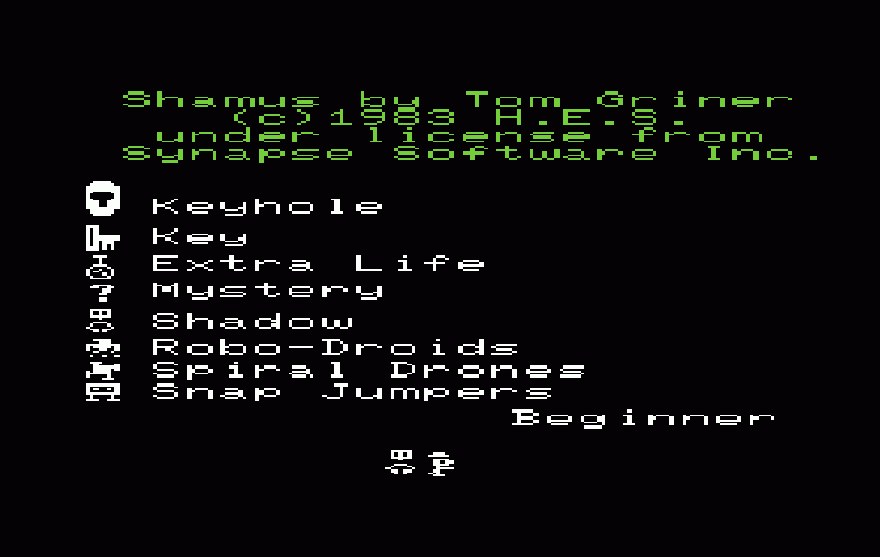
Rooms, robots and the Shadow
The room-to-room structure is what separates Shamus from its arcade inspiration. Berzerk gave you an endless maze; Shamus gives you a lair with a geography — levels connected by locked doors and an elevator, rooms that reward mapping, and a genuine sense of territory being cleared. The enemy robots come in flavours with different movement and firing habits, the walls themselves are deadly to touch in classic Berzerk style, and your shiv — the game’s name for your thrown weapon — can be in flight only under strict rules that force you to commit to attacks. Linger in a room to farm points and the Shadow arrives, passing through walls, immune to your fire, and fatal to touch. Every design element pushes the same way: keep moving, keep clearing, keep descending.
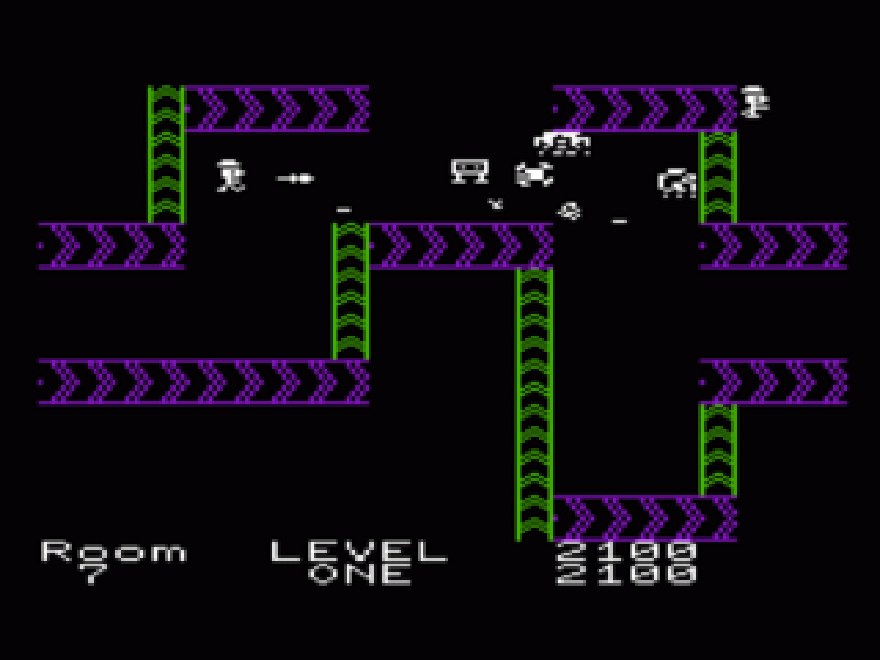
On the VIC-20 the game is a technical flex. Rooms render in bold character graphics with a different colour identity per level, enemies move without the flicker and crawl that plague lesser VIC shooters, and the pace is properly arcade — fast enough that the machine’s single joystick becomes a genuine test. HES built a reputation on quality VIC conversions in the machine’s American market, and Shamus is Exhibit A: it does not feel like a scaled-down Atari game, it feels like a VIC game, designed around chunky clarity. The cost of that pace is difficulty. Shamus was never forgiving, and the VIC edition’s tighter screen and instant deaths make early sessions brutal. This is a game you learn in layers — first survival, then routes, then the score economy of bonuses and extra Shamus pods.
A lair worth mapping
Because the lair is finite and learnable, Shamus rewards exactly the kind of play the cartridge era encouraged: graph paper, route notes, and the slow conversion of a hostile maze into home turf. That gives it a longer life than the pure score-chasers alongside it on the shelf. It is also a useful reminder that the VIC-20’s library did not end with Commodore’s own cartridges — third-party publishers like HES were bringing the wider software world’s hits to the machine, and sometimes, as here, the results matched the originals’ reputations. The VIC port lacks nothing essential: not the extra-life pods, not the key hunts, not the Shadow’s entrances, which remain one of early gaming’s great pieces of pressure design.
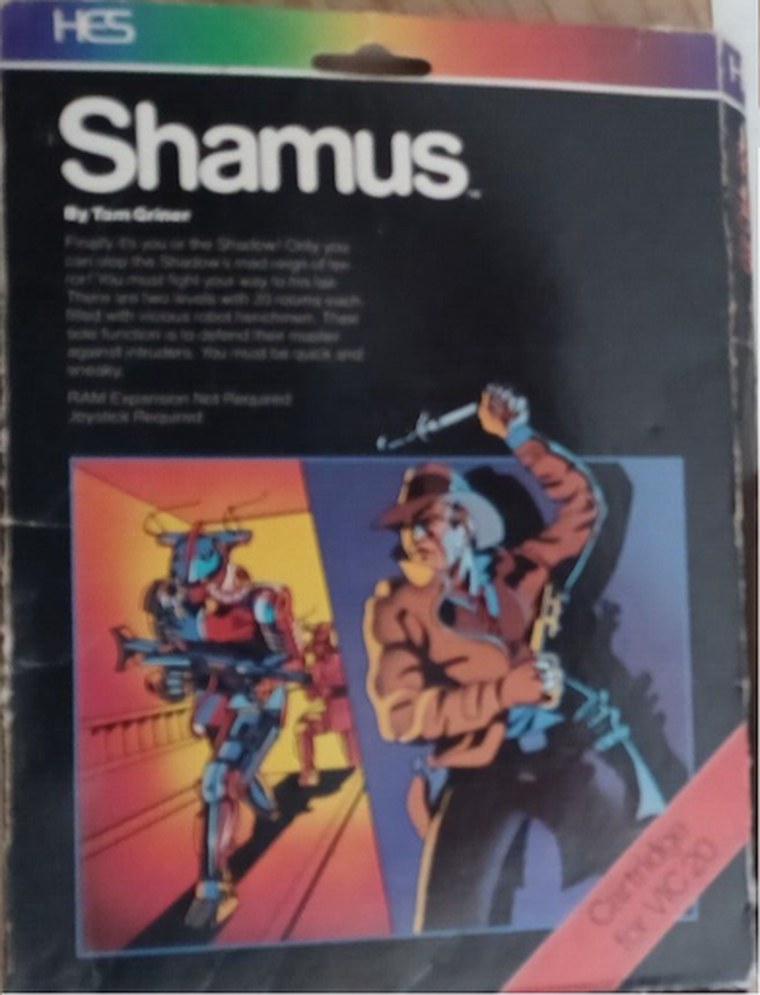
If you come to Shamus from the C64 version, adjust expectations in one direction only: the VIC game is rawer, louder in colour, and a touch more cramped — and in a Berzerk-family game, cramped is a compliment, because it shortens every decision. Newcomers should expect to die quickly and often for the first hour; the players who push through that hour tend to become evangelists. The private eye deserves his audience.
The Shadow knows
A word for the Shadow, because the Shadow deserves it. Plenty of games hurry the player with timers; Shamus hurries you with a presence — a shifting, wall-passing shape that enters with the game’s most dreaded sound and converts any room, however thoroughly cleared, into a countdown. It is one of the great pressure mechanics of the early era precisely because it is unfair in a fair way: you always know it is coming, it always comes for the same reason — your lingering — and the counterplay is always the same honest instruction. Move. On the VIC-20, where the rooms are tight and the robots are quick, the Shadow’s entrances land harder than on any other home version, and veterans of the Atari original may find this edition’s lair the most claustrophobic of all. That is meant, and received, as praise.
Shamus also sits at an interesting junction in the VIC library: an American software-house hit, converted under licence by the machine’s most reliable third-party publisher, at a moment when the VIC’s catalogue was splitting between Commodore’s cartridges and a growing tape scene. It represents the road the machine’s commercial library might have taken further — more big-name conversions, done this well — had the C64 not arrived to absorb the industry’s attention. As it stands, it is a high-water mark: proof that in 1983, a VIC-20 owner with the right cartridge lacked nothing.
In the slot today
Practical intelligence for new detectives: Shamus is a game that rewards system knowledge, and the VIC edition is no exception. Learn which rooms hold the question-mark bonuses and which hold only death; learn that your thrown weapon’s return is a rhythm to be played, not a delay to be cursed; learn the elevator’s geography before you need it at speed, with the Shadow in the wall behind you. None of this is written in the game, because 1983 assumed a player with graph paper and patience. Supply both, and the lair transforms from a meat grinder into a beat you can walk — right up to the level where it speeds up and takes the beat away again.
That assumption — that the player would meet the game halfway, with notes and nerve — is the era’s signature, and Shamus may be its finest VIC expression. Modern design would tutorialise the lair into politeness. HES and SynSoft trusted you to crack it. The trust, forty years on, still feels like a compliment, and the cracking still feels like an achievement. Few cartridges on any 8-bit machine can say as much.
Linger to farm points and the Shadow arrives, passing through walls — one of early gaming’s great pieces of pressure design.
Shamus is one of the VIC-20’s finest third-party cartridges: a fast, deep maze shooter that turns Berzerk’s endless rooms into a lair worth conquering. Its difficulty is real and its graphics are unapologetically chunky, but the gameplay loop — clear, descend, survive the Shadow — is as compulsive now as it was in 1983. Highly recommended for shooter fans with patience.
Verdict: the android detective’s case is still open, and still worth taking. Keep moving.
The case remains open for a reason: the lair is deep, the Shadow is patient, and the detective’s hat still fits. New players should expect a hard first hour and a hooked first evening. The Shadow knows you will be back. The Shadow is right.