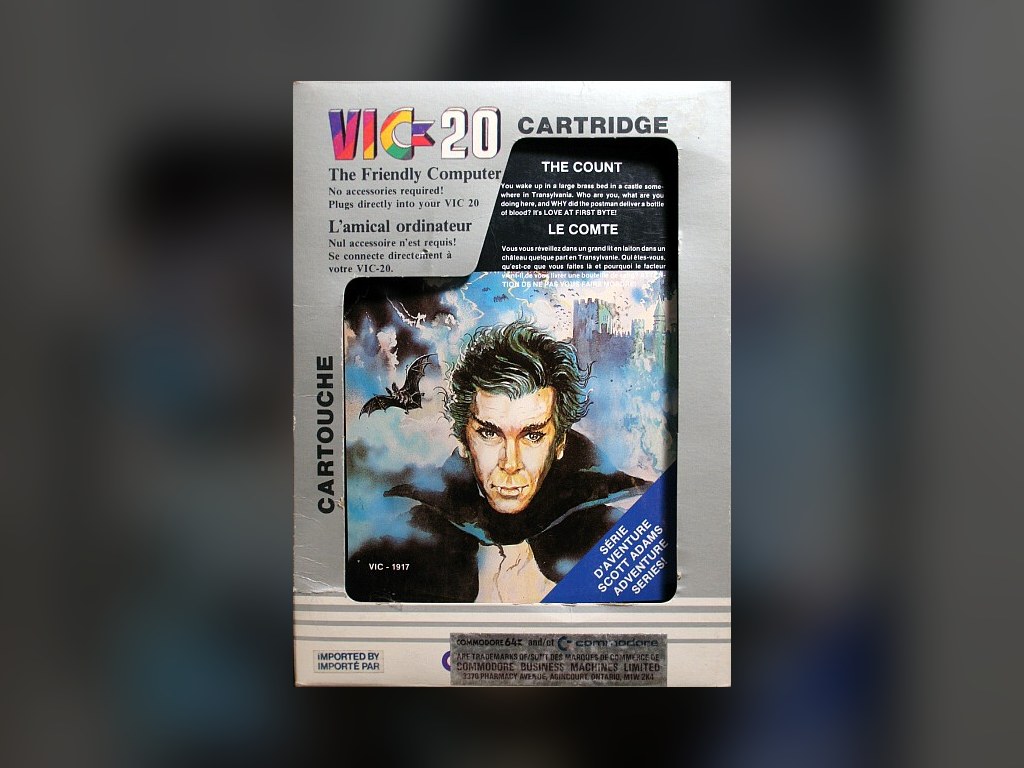
At a glance: The Count · VIC-20 · Commodore, 1981 · Text adventure · Score: 7.0/10
You wake up in a brass bed in a castle bedroom, with a note pinned to the pillow telling you that the local villagers would very much like you to deal with their vampire problem. That is the whole introduction to The Count, Scott Adams’ fifth text adventure, published for the VIC-20 by Commodore in the machine’s adventure cartridge line — and it remains one of the most atmospheric things you can do with 22 columns of text. The Count draws its power from compression. Adams had built his reputation squeezing entire worlds into tiny memory footprints for the TRS-80, and the VIC cartridge versions brought that discipline to Commodore’s machine: two-word commands, terse descriptions, and puzzles built from a small set of objects used with absolute precision. There are no graphics to hide behind. The castle exists because the writing puts it there.

Three days in the castle
The Count’s structure is its masterstroke. The adventure runs on a clock: days pass, night falls, and the castle’s master keeps his own schedule whether you are ready or not. You explore by day — a compact map of bedrooms, laboratories, dungeons and gardens, every location earning its place — gathering the classic toolkit of vampire destruction and learning the castle’s secrets, while the game quietly counts down to the confrontations its title promises. The time system gives a small adventure unusual tension and replay value: early runs are reconnaissance, learning what exists and when, and the winning run is an act of choreography. It is a design idea well ahead of 1981 adventure norms, and it fits the VIC’s pick-up-and-play cartridge format perfectly — a run is an evening’s entertainment, not a month’s campaign.

The parser is the era’s standard Adams two-word system — GO, GET, OPEN, plus a noun — and the VIC’s 22-column screen means descriptions arrive in dense little blocks that scroll like a paperback being read by torchlight. Modern players may bounce off the narrow display, but there is a real argument that it helps: the castle feels close, the text feels urgent, and your own imagination does the rendering work that the VIC chip never could. Commodore deserves credit here, too. Putting serious text adventures on cartridge for a launch-window games machine was a statement that the VIC’s audience wanted to think as well as blast, and The Count was the strongest title in that first adventure line.
Small castle, long shadow
Fair criticisms exist and should be stated plainly. The puzzle logic is pure 1981 — some solutions depend on Adams’ particular way of thinking, and the limited vocabulary will cost you turns as you guess the exact verb the game wants. The adventure is also genuinely short once known: an expert can finish in a sitting. But brevity is the wrong stick to beat a 5K-era cartridge with. The Count was designed like a short story rather than a novel, and its influence — adventures with schedules, NPC routines and time pressure — echoes through the genre’s later, bigger works. On the VIC-20 specifically, it stands with Pirate’s Cove as the twin pillars of the machine’s text adventure library.
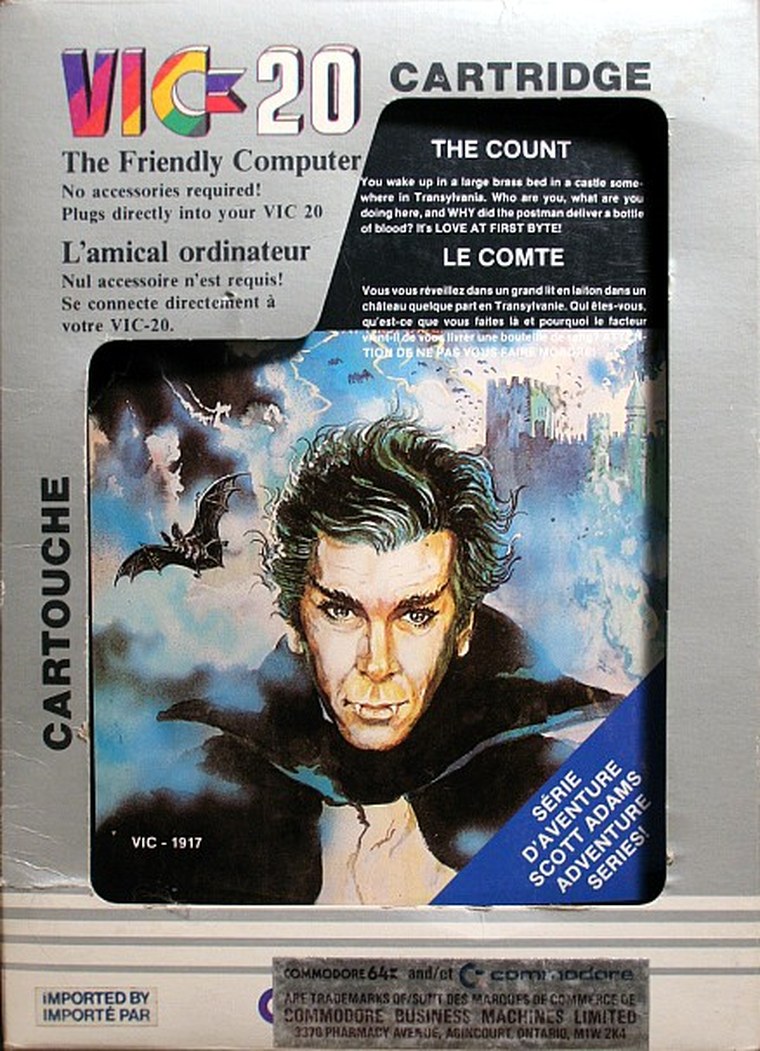
Revisiting it now, what surprises is how modern the pacing feels. No filler rooms, no mazes drawn purely to waste your mapping paper, no random deaths unearned by the fiction — the castle’s dangers are telegraphed by the premise itself. If you have never played a Scott Adams adventure, this is the one to start with on the VIC-20: the theme is universal, the goal is unmistakable, and the final confrontation rewards every scrap of preparation. Bring a notebook, mind the sunset, and whatever you do, be somewhere safe when the coffin lid moves.
Playing The Count today
Modern players approaching The Count need two period adjustments, both worth making. The first is the parser: Adams’ two-word vocabulary accepts a small, learnable set of verbs, and the game is best played with the verb list beside you and a notebook open — not as homework, but as ritual, the way its first players played. The second is the save situation: the cartridge era expected adventures to be finished in sittings and runs, and The Count’s three-day structure is built for that rhythm — a failed run is short, informative and immediately replayable, a roguelike loop decades before the term existed. Judged by the standards of its own machine — the standard that matters here — those are not flaws. They are the design, and the design is tight enough that the game teaches it to you as you play.
The Count also marks a fork in the VIC-20’s identity that is easy to miss. Commodore marketed the friendly computer to families, and the games catalogue mostly chased the arcade — but the adventure cartridges, The Count foremost among them, treated VIC owners as readers. They sold the machine into dens and studies as well as bedrooms, and they gave the VIC a grown-up shelf that rival machines at the price could not match. When the history of the machine is told as a pure games story, the Adams cartridges are the counter-argument, and The Count is their gothic masterpiece: a vampire, a castle, a deadline, and a few kilobytes that still raise a chill.
In the slot today
Collectors should know the Adams cartridges form a natural set — Adventureland, Pirate’s Cove, The Count, Voodoo Castle and their siblings share the parser, the presentation and the SYS-start lineage of the TRS-80 originals — and The Count is the one that completes the set’s argument. Where Adventureland proves the system works and Pirate’s Cove proves it can charm, The Count proves it can frighten: a genuine atmosphere of dread sustained by text alone, in a machine sold on colour and sound. That range, across three small cartridges, is the strongest evidence that the VIC-20’s software library was broader in ambition than its hardware was in kilobytes.
Play it in the evening. That is not a joke about theme; the game’s own clock makes nightfall its central mechanic, and there is a small, real pleasure in synchronising your session with the castle’s — exploring your first day as your own day ends, and facing the third night with the house quiet. Scott Adams could not have designed for that in 1981. He did anyway, in the only way that matters: he built a clock, and let the players bring the darkness.
The castle exists because the writing puts it there — The Count’s atmosphere is pure parser and nerve.
The Count is a landmark in miniature: a scheduled, atmospheric vampire hunt squeezed onto a launch-era cartridge. Its parser shows its age and its length is modest, but as a piece of design it punches far above its memory footprint, and it remains the VIC-20’s most replayable text adventure. Essential for adventure fans; a fascinating curio for everyone else.
Verdict: stake, mallet, three days, no graphics — and still one of the tensest games on the machine.
Approach it as its first players did — lights low, notebook ready, sunset dreaded — and The Count delivers an evening no modern remaster has improved on its own terms. The coffin is waiting, the villagers are counting on you, and the VIC-20’s smallest world still casts its longest shadow.