
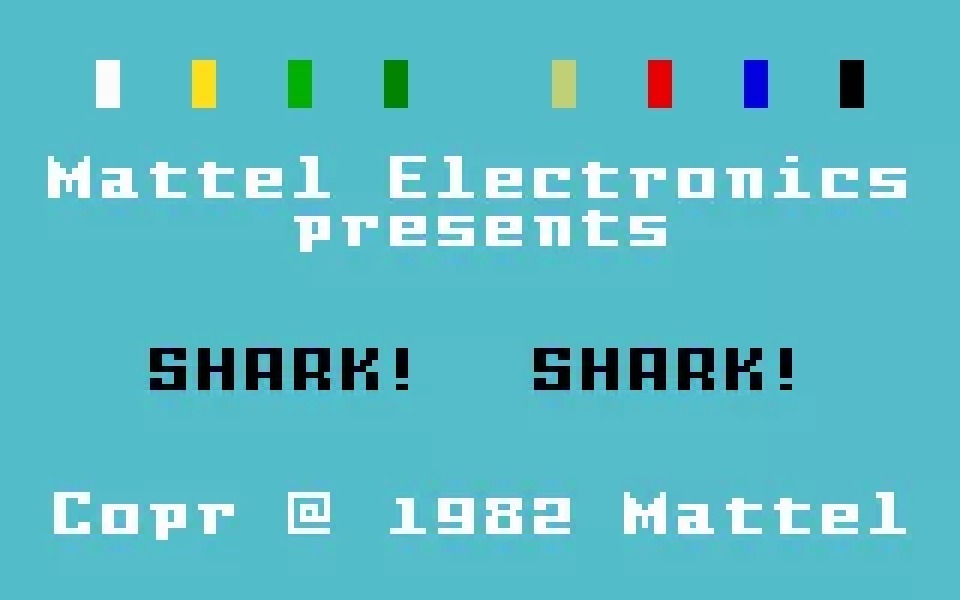
At a glance: Shark! Shark! · Intellivision · Mattel Electronics, 1982 · Action · Score: 8.5/10
Long before “feeding frenzy” was a genre with a name, Mattel published its purest expression. Shark! Shark!, released in 1982 and programmed by Ji-Wen Tsao, puts you in the fins of a small fish in a bright, scrolling sea with one rule that contains the whole game: you may eat anything smaller than you, anything bigger eats you, and eating makes you bigger. That is it. No levels in the conventional sense, no weapons, no maze — just appetite, growth, and a large black shark whose arrival rearranges every priority on the screen. It is one of the most elegant designs on the Intellivision, and one of the most quietly influential: the eat-to-grow loop that later powered everything from Feeding Frenzy to a hundred mobile games is here, complete, in 1982.
The food chain, rendered honestly
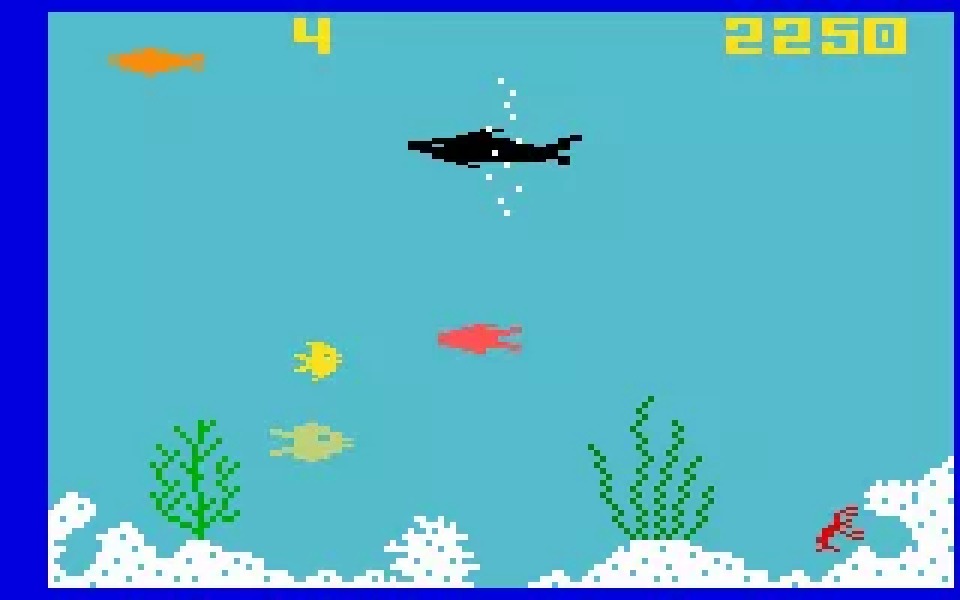
Your fish begins life near the bottom of the food chain, able to swallow only the smallest fry that drift through the water. Every meal inches your growth along — visibly, satisfyingly — and as you grow, the set of fish you can safely attack expands while the set that can kill you shrinks. The design’s honesty is in the middle of that ladder: at every size, there is something you are hunting and something hunting you, and the screen is a constant negotiation between hunger and fear. Other creatures fill out the ecosystem — crabs and lobsters along the seabed, seahorses drifting, jellyfish to avoid — and the seabed itself matters, because the bottom of the screen is both a hunting ground and a trap when something big comes calling.
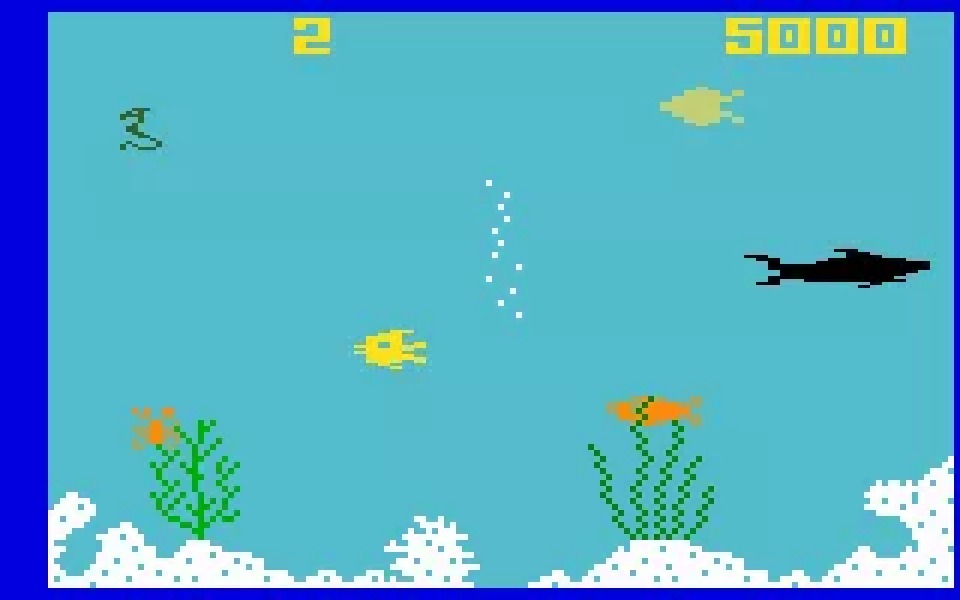
Then there is the shark. The shark enters like weather: a long black shape, dramatically bigger than anything else in the game, fast, and single-minded. Early in your life you cannot fight it at all — you can only flee, and the game becomes a pure chase, ducking into the seaweed and praying. But Shark! Shark! has a trick up its sleeve that still delights players who discover it: a grown fish can turn and bite the shark’s tail. Nip it enough times and the shark dies, in a shower of points and profound satisfaction. It is one of the earliest and best “the hunter becomes the hunted” reversals in the medium, and it transforms the shark from an act of god into the game’s ultimate prize — dangerous exactly in proportion to how ready you are to take it on.
A two-player sea
The cartridge supports two players, and the mode is more thoughtful than the era’s usual alternating turns: two fish share the sea, growing in parallel, able to help or — inevitably — to hinder, competing for the same food while the same shark threatens both. Cooperative instincts and sibling rivalry in the same tank. The game’s presentation supports the social mode beautifully: the water is a luminous blue-green, the fish are plump and characterful, bubbles rise, and the whole scene scrolls gently as the action drifts. It is one of the prettiest games on the system, not through detail but through palette and motion — a screensaver you can die in.
Sound is kept to blips, gulps and warnings, which suits a game about vigilance. The real audio cue is absence: when the shark is near, experienced players tense before they see it, because the whole rhythm of the screen changes. Shark! Shark! also deserves credit for difficulty honesty. Deaths are almost always legible — you got greedy, you chased one fish too far into open water, you mistook your size by one rank. The game kills you with your own appetite, and it teaches you to read a food chain the way Night Stalker teaches you to read a maze.
Why it endures
Part of the cartridge’s afterlife is its designer. Ji-Wen Tsao was among the very few women programming commercial console games in the early 1980s, part of Mattel’s in-house team, and Shark! Shark! stands as evidence of how much range that small group of programmers — the people fans later called the Blue Sky Rangers — actually had: the same building produced Utopia’s political economy and this perfect little ecosystem. The game’s reputation has only grown with time; it is a fixture of best-of-Intellivision lists and retro compilations, and newcomers consistently name it as the surprise of the catalogue — the one that sounds like a children’s game and plays like a knife fight.
That accessibility is real, by the way. A five-year-old can understand Shark! Shark! in ten seconds, and a veteran can spend an evening on the question of exactly how big is big enough to turn on the shark. Games that span that range without changing a single rule are rarer than classics. This is one.
The design lesson in the tail bite
The tail-biting mechanic deserves a moment of pure design appreciation, because it solves the oldest problem in score-attack games: what do you do with an invincible threat once the player is skilled? Most 1982 answers were speed — the same danger, faster. Shark! Shark!’s answer is transformation. The shark never changes; you change, meal by meal, until the relationship inverts. That means the game’s most dangerous object becomes its most valuable target at exactly the moment the player’s power peaks, converting endgame boredom into endgame ambition. It also creates the game’s best stories, which every owner can tell: the first turn, the first nip, the first kill — and the overconfident lunge that fed a medium fish to the shark it had just learned to hunt. Designers of eat-and-grow games have been re-deriving this trick ever since, usually with more graphics and less elegance.
There is one more quiet innovation worth recording: the game trusts children and adults with the same ruleset and no difficulty condescension. The food chain is the difficulty setting — self-administered, moment to moment, by appetite. Few games of any era manage that trick, and none of Shark! Shark!’s contemporaries managed it in a package a new player could understand before their first death.
The verdict
Shark! Shark! is the Intellivision at its most charming and most cunning: a complete ecosystem in a cartridge, a growth curve you can feel in your fins, and a shark that doubles as the best risk-reward proposition of 1982. It belongs in the first rank of the system’s games — the ones you lend to people to explain what the console was about. Just remember the only rule. It applies to the cartridge’s reputation too: it eats bigger games for breakfast.
A closing thought on shelf placement: Shark! Shark! is the cartridge to leave in the console when non-collectors visit. It needs no manual, no overlay, no patience for 1982 interface conventions — thirty seconds and a stranger is playing it properly, five minutes and they’re telling you about the shark. In a library of brilliant, demanding, manual-hungry games, that instant hospitality is its own form of genius, and part of why this modest little ecosystem has outswum so many bigger fish.
Just keep swimming — carefully, hungrily, and always one eye on the deep water.
Score: 8.5/10