
At a glance: Utopia · Intellivision · Mattel Electronics, 1981 · Strategy · Designed by Don Daglow · Score: 9.0/10
Every genre has a patient zero, and for the god game — for SimCity, for Populous, for the whole idea that building and governing could be the game — patient zero is a 1981 Intellivision cartridge called Utopia. Designed by Don Daglow when he was one of Mattel’s original group of programmers, Utopia hands two players an island each and a simple, radical brief: rule well. Build housing, plant crops, raise fishing boats and factories, fund schools and hospitals, weather storms and pirates and your own people’s rebellions — and be judged, at the end of your term, by a score that measures not conquest but the welfare of your population. There is nothing to shoot. In 1981, on a home console, that was not a limitation. It was a manifesto.
Two islands, one ledger of gold bars
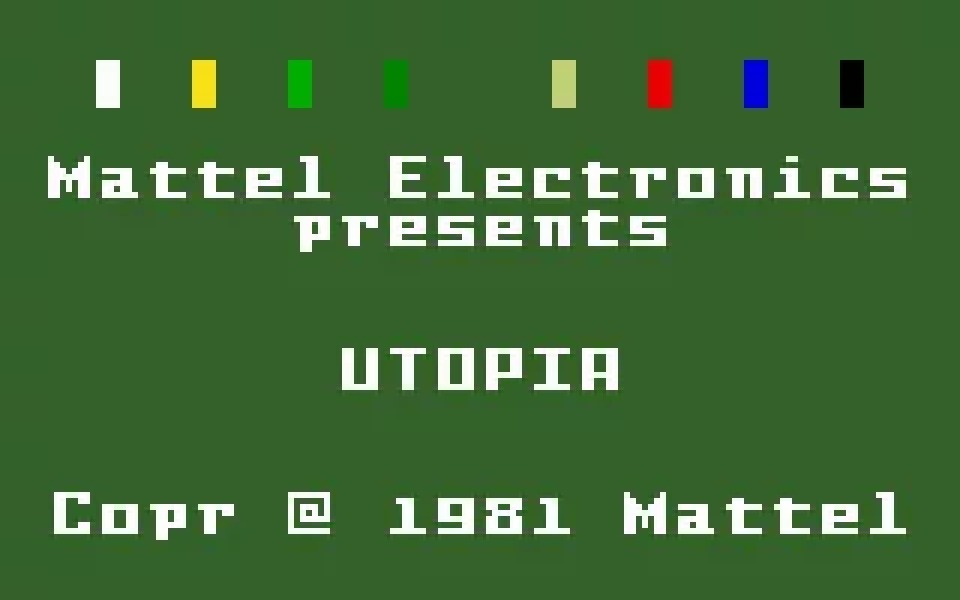
The setup is elegantly spare. Each ruler governs an island — one in the west of the shared screen, one in the east — with a treasury measured in gold bars and a term of office you set before play: a number of rounds, each round a fixed span of real time in which you spend, build and scheme. Your instruments are two boats and a cursor. A PT boat patrols against the pirates who prey on your fishing fleet; a fishing boat works the schools of fish that drift through the straits between the islands; and the cursor places your investments on the island grid — houses, crops, factories, schools, hospitals, forts — each with a cost, each with consequences that only declare themselves over time.
The genius of the design is that nearly every good thing you build is also a claim on your people’s happiness and your score, while the island itself pushes back. Crops need rain, and the weather system sends storms — occasionally a hurricane — that can flatten buildings, sink boats and wreck a term’s careful planning in seconds. Factories raise income and lower contentment. Housing without schools and hospitals produces restless citizens; restless citizens produce rebels, and rebels appear on your island as a problem no amount of wishing will remove. Fishing is a shared commons problem: the fish are finite, both rulers draw from the same waters, and overharvesting is a strategy with a bill attached. Daglow, who would go on to design some of the most respected strategy and role-playing work of the following decades, packed a functioning little political economy into a cartridge at a time when most home games were still variations on shooting galleries.
The first real-time strategy argument

Utopia is routinely credited as an early — often the earliest — real-time strategy game, and playing it makes the case. The rounds are not turns in the board-game sense: the clock runs, the fish move, the storms gather, and both rulers act simultaneously. That simultaneity is the soul of the thing in two-player mode, which is where Utopia was designed to live. You are not merely optimising an island; you are racing a rival’s development, watching their island across the water, weighing whether your gold buys another factory or the fort your people are beginning to demand. In single-player the computer rules the other island with respectable competence, but the cartridge’s reputation rests on two rulers, two controllers and one screen of shared weather.
The scoring system deserves its fame. Periodically and at term’s end, the game tallies a welfare score for each island — a judgement on how your people actually live, not how much you extracted from them. A ruler who strip-mines the island for income will watch the number sag; a ruler who invests in the unglamorous infrastructure of schools and hospitals sees it climb. As a piece of design philosophy in 1981 — on hardware sold for shooting galleries — the decision to score governance rather than conquest is the moment Utopia steps out of its decade. Daglow has discussed the game’s origins in the era’s mainframe strategy experiments, and that lineage shows: this is a university-computing idea, compressed with extraordinary discipline into a living-room cartridge.
Presentation: a map, a ledger, and weather

Nobody will mistake Utopia for a graphical showcase, and that is fair — the islands are flat tan landmasses on blue water, your buildings are tidy little icons, and the whole game could be mistaken at a glance for a weather map. But the presentation is in service of legibility: at any moment you can read both islands’ development, the position of the fish, the approach of a storm. The sound is minimal. What the game asks of your imagination it repays in clarity, and there is a genuine austere charm to its map-room aesthetic, like a war-game table repurposed for peace. Modern players should know what they’re bringing to it: patience, a second player if at all possible, and a willingness to learn a ruleset the manual explains better than the screen can. The learning curve is real. So is the reward.
Daglow, and what Utopia started
Don Daglow’s later career reads like a strategy-game hall of fame — foundational work in computer role-playing and strategy through the following decades — and Utopia is where the signature first appears in full: systems that model a society rather than a battlefield, victory measured in welfare rather than annihilation, and a trust in the player’s intelligence that bordered on the reckless for a 1981 toy. The game’s descendants are not only the obvious god games and city builders. Its real-time-with-simultaneous-opponents structure fed the RTS tradition; its welfare scoring fed the management sim; its whole posture — that a console audience would sit still for economics — fed Mattel’s identity as the thinking person’s machine. It is difficult to name five cartridges on any system of the period that cast longer shadows.
One honest note for modern players: Utopia shows its age in its interface, and its single-player mode, while worthwhile, is the rehearsal rather than the performance. Find the second player. The game was designed as an argument between two rulers conducted in weather, fish and gold, and as an argument it remains gloriously unresolved — no dominant strategy has ever been settled, which is why the cartridge still gets played at retro gatherings by people who could be playing anything.
The verdict
Utopia is not just historically important — plenty of historically important games are museums you visit once. It is a genuinely absorbing two-player strategy contest whose systems interlock with a sophistication that shames many later, bigger games, and its central idea — that you win by governing well — has never stopped being radical. As the founding document of an entire genre and one of the crown jewels of the Intellivision library, it is essential. Bring a friend, set a long term, and mind the weather.
Practical note for buyers: Utopia is common and inexpensive, as befits a game Mattel printed in quantity — which means the founding document of a genre can sit on your shelf for the price of a sandwich. There is no better value-per-historical-significance ratio in the entire Intellivision library.
Score: 9.0/10