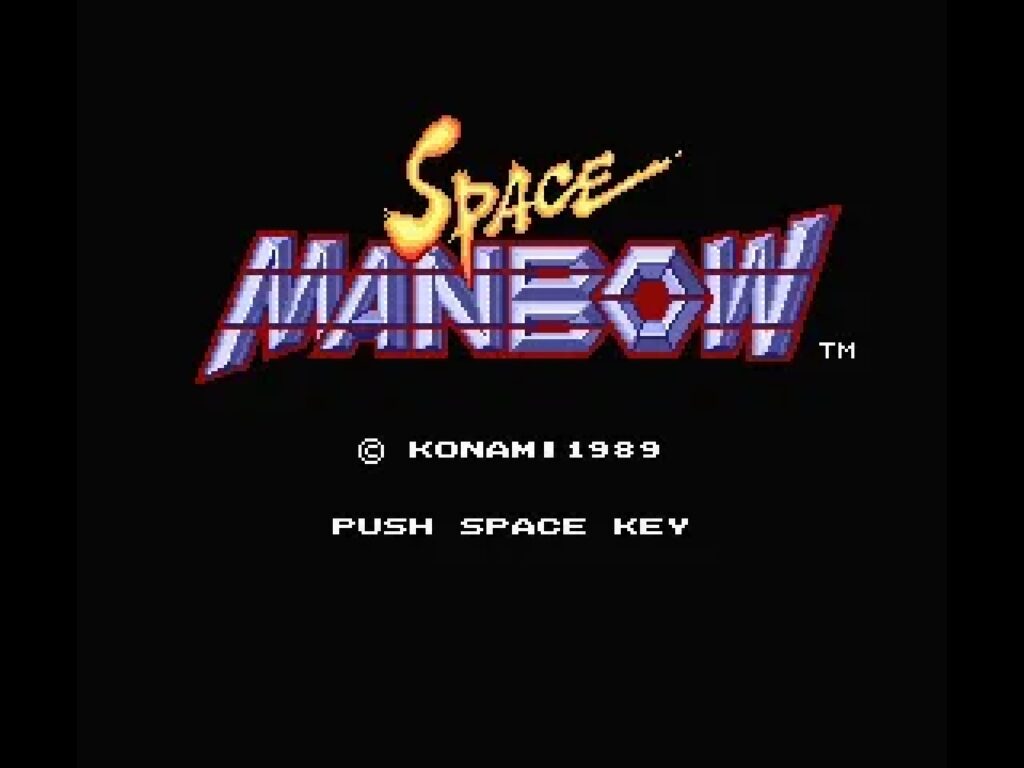
By 1989 the MSX2 was a veteran standard and Konami its master craftsman — and Space Manbow is the game that partnership built to show off. A horizontal shooter named for the ocean sunfish it vaguely resembles (the Japanese title mashes “space” and “manbo”), it arrived dressed like an arcade board: parallax worlds, screen-filling bosses, an animated introduction, and an SCC soundtrack that still gets cited in best-of lists for the whole platform. It is the MSX2 shooter as spectacle — and it plays as well as it parades.
At a glance: Konami, 1989 · MSX2 · Horizontal shooter · SCC sound
An Arcade Game in a Cartridge
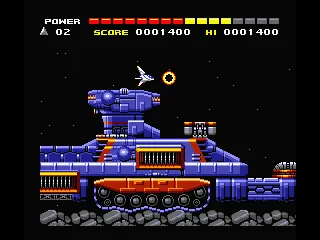
The first stage makes the argument in seconds: your fighter launches against a planet’s surface while a tank the size of a small town assembles itself as the opening boss — multi-part, multi-weapon, and utterly unbothered by the hardware’s supposed limits. From there the game tours the solar system’s greatest hits: asteroid fields, mechanical fortresses, organic horrors, each stage layering parallax and mid-bosses with a confidence that feels imported from the arcades Konami ruled. The smoothness is the scandal. The MSX2’s video chip famously resists horizontal scrolling; Konami’s team simply engineered around it so thoroughly that the resistance is invisible. This is programming as sleight of hand.
The Manbow System
Beneath the spectacle, the mechanics are considered. The titular ship carries an option system of satellite guns whose formation you manage; a power meter governs your arsenal’s strength, filling as you collect capsules and draining as punishment for death — a risk economy that makes every hit a strategic event, not just a lost life. Weapon types switch the ship’s character substantially, from spread coverage to piercing lances, and the stages are designed to argue for different loadouts. It is Gradius’s thoughtful cousin: less about memorized routes, more about managing a growing machine.
Swansong Energy
Space Manbow’s release date gives it a particular glow. The 16-bit consoles were landing; the MSX standard’s commercial era was closing; and here was Konami spending arcade-grade effort on the faithful — a game with a cinematic intro (rare on the platform), elaborate bosses, and a score that uses the SCC cartridge chip like a small orchestra. It never received the arcade or console port that might have canonized it, which makes it one of those treasures the MSX kept for itself. Emulation has since smuggled it to the world, where it reliably lands on visitors like a revelation.
The Set Pieces, Catalogued
Indulge a catalogue, because Space Manbow is best remembered as a sequence of escalating impossibilities. The opening tank, treads grinding across a scrolling battlefield, sets a scale the game then refuses to drop: a stage inside a cavern of mechanical waterfalls; a fortress whose defense grid must be dismantled in layers; an organic stage whose walls suggest the whole level is digesting you; bosses that arrive as architecture rather than enemies. Each set piece is also a small technical paper — on sprite multiplexing, on scroll routines, on how to make the MSX2’s video chip do the thing the datasheet discouraged — presented as entertainment. Konami’s MSX division by 1989 was a team at the absolute top of its craft, working for an audience it knew by heart, and Space Manbow is what that intimacy produced: a game that spends its entire budget on delighting the already-converted, and ends up converting everyone else by accident.
The Meter Is the Message
A word for the power meter, the game’s quietest innovation. Where most shooters treat death as a full reset of your arsenal, Space Manbow’s gauge makes firepower a fluid resource — built by aggression, leaked by damage — so the emotional graph of a run oscillates rather than collapsing. Strong players ride the top of the meter like surfers; struggling players are never quite disarmed, only diminished, which keeps comebacks permanently on the table. It is the same design intelligence Konami applied to the Gradius option system, rotated ninety degrees: the ship is a system to be managed, and mastery is management. Modern shooter designers speak of “comeback mechanics” and “rubber-banding” as recent inventions. The MSX2 was running them, gracefully, in 1989, inside a fish.
The Intro Alone
Permit a moment on the introduction, because Space Manbow’s opening minutes announce its ambitions before a shot is fired. An animated sequence — a rarity on a platform where intros were usually a title screen and a prayer — establishes the Manbow, its pilot and its mission with the confidence of an arcade attract mode. It tells the player, in the game’s own language, that the production values here are not home-computer values. That promise-keeping matters to the game’s legend: many late-era releases on aging standards talk big and deliver small, and Space Manbow is the famous counterexample, the cartridge that spent its whole inheritance on being magnificent. When the first boss assembles itself a few minutes later, the intro’s boast has already been redeemed in full.
An Import That Stayed Home
There is a final, poignant dimension to the game’s reputation: it is one of the great what-ifs of localization. Had Space Manbow received the console port or Western release its quality deserved, it would sit in the general canon beside the era’s famous shooters rather than in the MSX’s private pantheon. Instead it remained Japan’s — and the standard’s — secret, passed between enthusiasts like a rumor with a soundtrack. The internet age has ended the secrecy without ending the specialness: to play Space Manbow now is still to feel like an initiate, let in on something the mainstream missed entirely. The MSX shelf on this site exists to make exactly such introductions. Consider yourself introduced.
Verdict
Arcade opulence on a home computer that had no business hosting it — the most beautiful shooter on the MSX2, and one of its finest games.
Nine out of ten. Space Manbow is the cartridge to produce when someone claims the MSX was a footnote: a full-blooded Konami epic that its hardware was never supposed to allow, delivered anyway, in the platform’s final commercial spring.
The Stages Between the Bosses
Space Manbow’s bosses get the posters, but the stages between them carry the game’s argument about pacing. Konami understood that spectacle needs rhythm — that a screen-filling tank means more after a corridor of quiet precision, that a swarm section earns the next set piece — and the Manbow’s journey is paced like a concert: movements of tension, release and crescendo, with the SCC score keeping the program. The mid-bosses arrive as punctuation rather than interruption, the environments keep changing the terms of movement — open sky, crushing machinery, organic claustrophobia — and the option-management system gives the quiet stretches a low, pleasant hum of decision. Many shooters are remembered as boss rushes with commutes. Space Manbow is remembered as a journey, and on a platform not built for journeys at this speed, that memory is the achievement entire.
One more laurel, for the road: Space Manbow may be the single most persuasive cartridge to place in a skeptic’s hands. Thirty seconds of its first stage — the music, the motion, that tank — and the argument about whether the MSX mattered is over. Konami built the machine’s most beautiful rebuttal and shipped it in a fish.