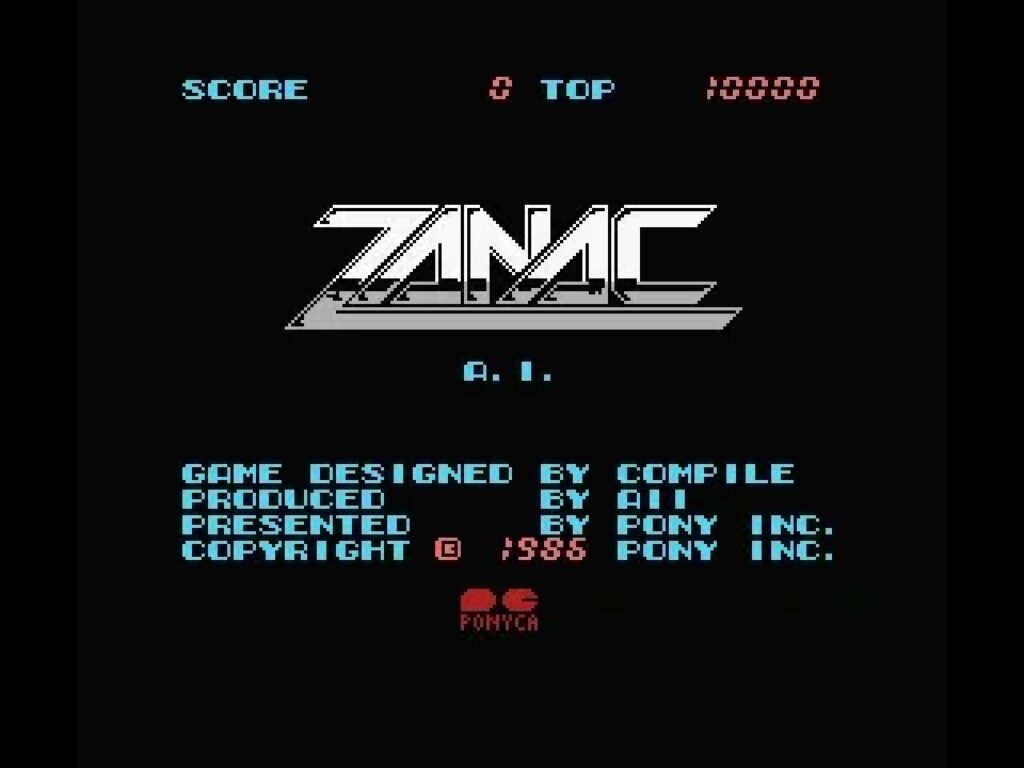
In 1986, Compile built a shooter that studied its player. Zanac, released for the MSX a year before its better-known NES incarnation, is governed by the Automatic Level of difficulty Control — the ALC — a system that tracks how you play and adjusts the enemy’s aggression in response. Hoard power-ups and the game hardens; struggle, and it quietly relents. Adaptive difficulty is a marketing bullet point today. On a 1986 home computer cartridge, it was sorcery — and it makes Zanac one of the most forward-thinking shooters of its decade.
At a glance: Compile, 1986 · MSX · Vertical shooter · The ALC system
The Director in the Machine
The ALC’s fingerprints are everywhere once you know to look. Enemy formations thicken when you fly carelessly invincible; certain aggressive plays summon retaliatory waves; the game seems to have opinions about you. Compile’s programmers were effectively building a tiny referee for fairness — an acknowledgment, decades ahead of the mainstream, that a shooter’s difficulty is a relationship, not a setting. It keeps Zanac perpetually at the edge of your ability, which is why veterans describe sessions as conversations. You are not playing against a tape recording of a design. You are playing against a system that is, within its 8-bit means, listening.
Eight Ways to Say Firepower
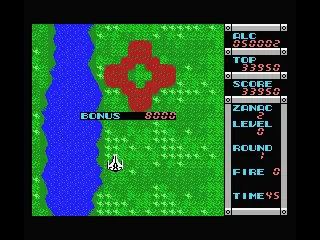
Around the director sits Compile’s emerging signature: a deep weapon system. Numbered power chips cycle through eight distinct armaments — all-direction shots, piercing lasers, shields, and screen-clearing specials — and the art is in the choosing, since each weapon rewrites your relationship with the formations the ALC sends. Ground installations anchor the vertical rush: bunkers and fortresses that must be dismantled piece by piece, feeding the weapon economy and giving the scroll a tactical floor. The presentation is early-Compile functional — clean sprites, relentless speed, and a soundtrack that pushes the PSG toward urgency — but the structure is the star.
Why the MSX Version Matters
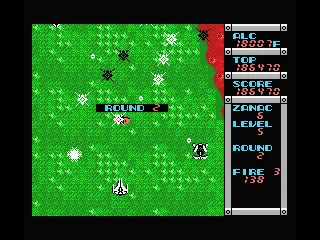
The NES Zanac is the famous one, and a fine game; but the MSX original is the concept’s birthplace, released into the standard where Compile learned its trade. The differences are of flavor more than quality — palettes, pacing, the particular density of the MSX’s shooter culture — but playing the original closes a historical circuit: this game’s ideas run forward through Aleste (its own sibling on this shelf) to the whole Compile canon and, through the industry’s long memory, to every modern shooter that quietly tunes itself to its player. Adaptive systems in today’s blockbusters have an ancestor, and it flies a little ship over MSX bunkers.
How the ALC Feels in the Hands
Systems are only as good as their sensation, so here is Zanac’s: the first minutes are a parade you can handle, the weapon chips cycling generously, the bunkers crumbling on schedule — and then, imperceptibly, the parade becomes a riot. A formation arrives half a second sooner than it should. A retaliatory wave answers the special weapon you were saving. The game has noticed your confidence, and it disapproves. Conversely, burn your lives early and the sky measurably thins, the director quietly shaving the challenge back toward the possible. The effect is a shooter that always seems to be playing at exactly your level’s ceiling — a personalized duel that no static difficulty menu could replicate. It is not true intelligence, of course; it is counters and thresholds. But in play, the distinction vanishes. Zanac feels alive in a way its contemporaries simply do not, and that feeling is the invention the industry took thirty years to standardize.
Compile’s First Principles
Zanac is also the Rosetta Stone for everything Compile did afterward. The numbered weapon dialect, the ground-target economy, the screen-filling crescendos, the insistence that a shooter’s difficulty should breathe — all of it is present here in first form, before Aleste polished it and before the 16-bit era gilded it. Playing Zanac after its descendants is like reading a great novelist’s first book and finding the voice already formed, the obsessions already in place. For the MSX specifically, it marks the moment the standard’s shooter culture found its defining studio — a culture that would make this computer, improbably, one of the genre’s capitals. Begin the Compile story anywhere you like. It begins, in truth, here, with a little ship and a machine that watches.
The NES Shadow
Zanac’s reputation in the West was long filtered through its NES conversion — a beloved cartridge that spread the concept to millions while necessarily sanding its edges for a different audience and different hardware. Returning to the MSX original is therefore a double pleasure: the game you remember, and the game as designed. The pacing breathes differently, the waves compose themselves with the home-computer audience’s patience in mind, and the whole feels less like a port’s source than like the main text from which a fine translation was made. None of this diminishes the NES edition, which earned its own legend honestly. It simply restores the order of things: the MSX is where Compile’s revolution was drafted, tested and shipped — and where, on this shelf, it is honored first.
Who Should Play It
Everyone who suspects that “adaptive difficulty” is a recent software feature owes Zanac an evening, if only to watch a Z80 do in 1986 what takes modern engines a settings menu. Shooter players will find the deeper pleasure: a game whose challenge is a live negotiation, whose weapons reward experimentation across runs, and whose director still feels faintly uncanny after all these years — the sensation of being read by your entertainment. That sensation, more than any single formation or bunker, is Zanac’s bequest to the medium. The little ship is still up there, the counters are still turning, and the game is still watching you play. Go and be watched.
Verdict
A shooter with a brain in 1986 — fast, flexible and uncannily modern. Compile’s first masterpiece.
Eight and a half. Zanac rewards the curious and the skilled in the same gesture: it watches how you play, and answers. Very few games of any era can honestly say that.
Reading the Director’s Mind
Play Zanac long enough and a second game emerges inside the first: reading the director. Veterans learn its tells — the formation that means the ALC has judged your weapon too strong, the carrier placement that offers mercy disguised as risk — and sessions become negotiations with a personality. That personality is the game’s great bequest. Every modern system that watches its player — the director AI in celebrated co-op shooters, the dynamic difficulty in racing games and survival horror — is practicing a craft that a 1986 MSX cartridge demonstrated to anyone who cared to look: that a game’s challenge is a living thing, and that fairness feels like attention. Zanac pays attention. Forty years of design evolution later, that remains the rarest thing a shooter can do, and the reason this unassuming Compile cartridge belongs in the medium’s permanent collection — not behind glass, but in the slot, watching.
And so the recommendation writes itself: historians for the ALC, shooter fans for the storm, Compile completists for the cornerstone. Zanac is the rare game that is simultaneously a document and a duel — a 1986 argument about the future that you can still lose, happily, today.