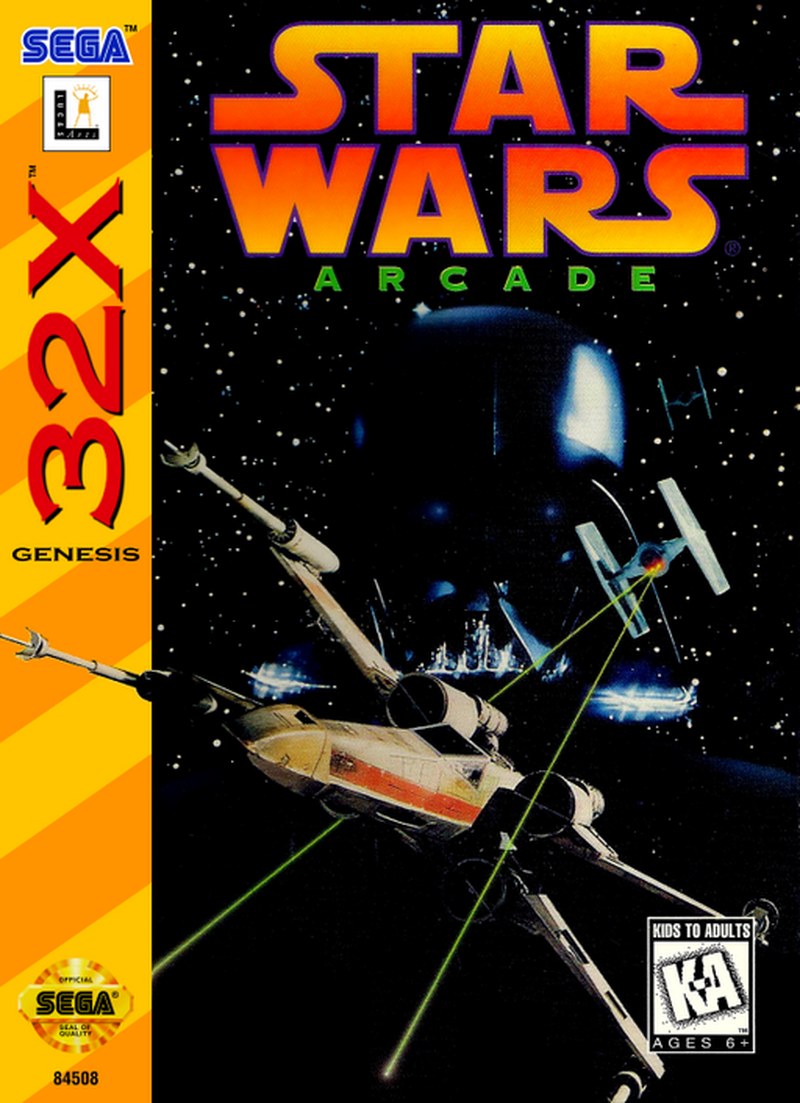
At a glance: Star Wars Arcade · 32X · Sega / LucasArts, 1994 · Rail shooter / space combat · Score: 8.5/10
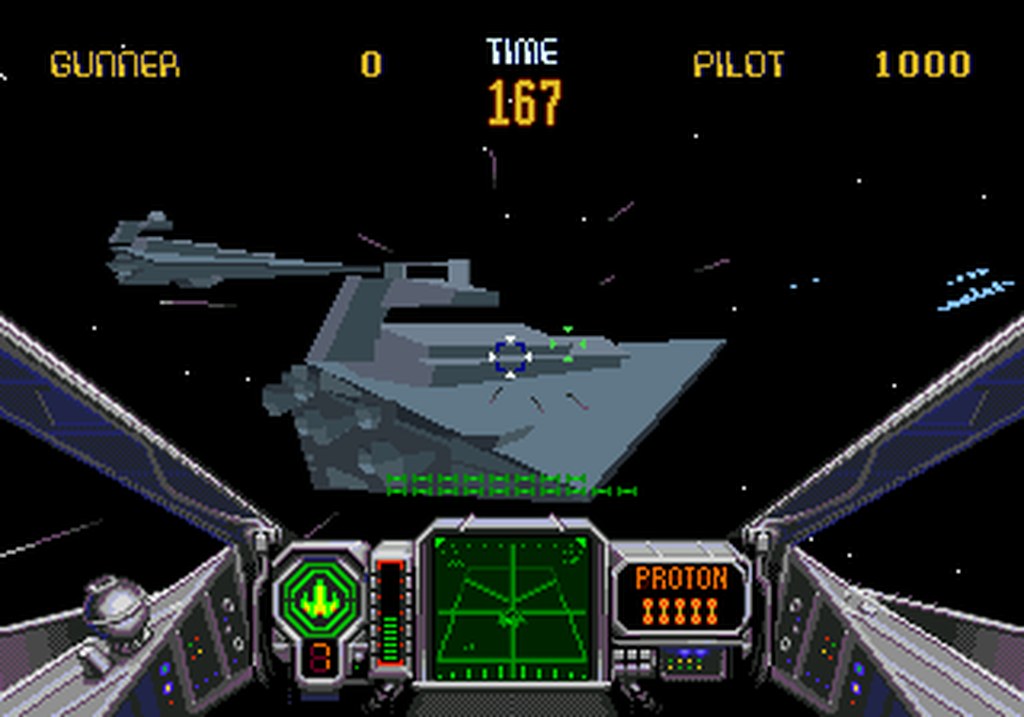
Of all the games Sega chose to launch the 32X with, Star Wars Arcade was the statement of intent. The coin-op ran on the Model 1 board — the same flat-shaded polygon hardware family as Virtua Racing — and putting it in a Mega Drive cartridge slot was a way of saying the add-on could do real arcade 3D. Remarkably, it could. This is a faithful, fast, properly exciting conversion: X-wings and Y-wings against waves of TIE fighters, turbolaser towers, Star Destroyers, and the trench run itself, all drawn in clean untextured polygons that have aged far better than the murky texture-mapping that replaced them.
The structure is the arcade’s: a campaign of timed missions across space battles and Death Star assaults, with your score and remaining shields carrying the pressure. You do not fly freely — the game steers the broad course while you aim, shoot and manage your speed — but within that rail-shooter frame it gives you real agency: targets of opportunity everywhere, bonus craft to protect or abandon, and a constant triage between the TIE on your tail and the tower lining up its shot. The film’s music and sampled shouts are compressed but unmistakable, and John Williams’ themes, even in cartridge miniature, do heavy lifting for the atmosphere.
Two seats in the cockpit
The home version’s masterstroke is its two-player mode. In the arcade you flew alone; here, a second player takes a pad as your gunner, working an independent crosshair while player one flies and shoots. It transforms the game into a co-operative shouting match — one set of eyes on the flight path, one on the targets neither of you can afford to miss — and it is, quietly, one of the best co-op experiences on any Sega cartridge of the era. Solo players get a computer-assisted version of the same arrangement, but the sofa version is the real game.
Difficulty is arcade-honest: shields are finite, continues are limited in spirit, and later missions — the second Death Star assault, the Super Star Destroyer’s gauntlet — demand target discipline the early waves only hint at. Mission variety is the honest weakness. The campaign recycles its set-pieces across escalating waves, and at full price in 1994 the package could feel thin next to a 40-hour RPG. At the distance of decades, its arcade purity reads differently: this is a score-attack game, and its replay value is measured in cleaner runs, not new content.
One set of eyes on the flight path, one on the guns: Star Wars Arcade’s co-op cockpit is the best seat-sharing act on any Sega cartridge.
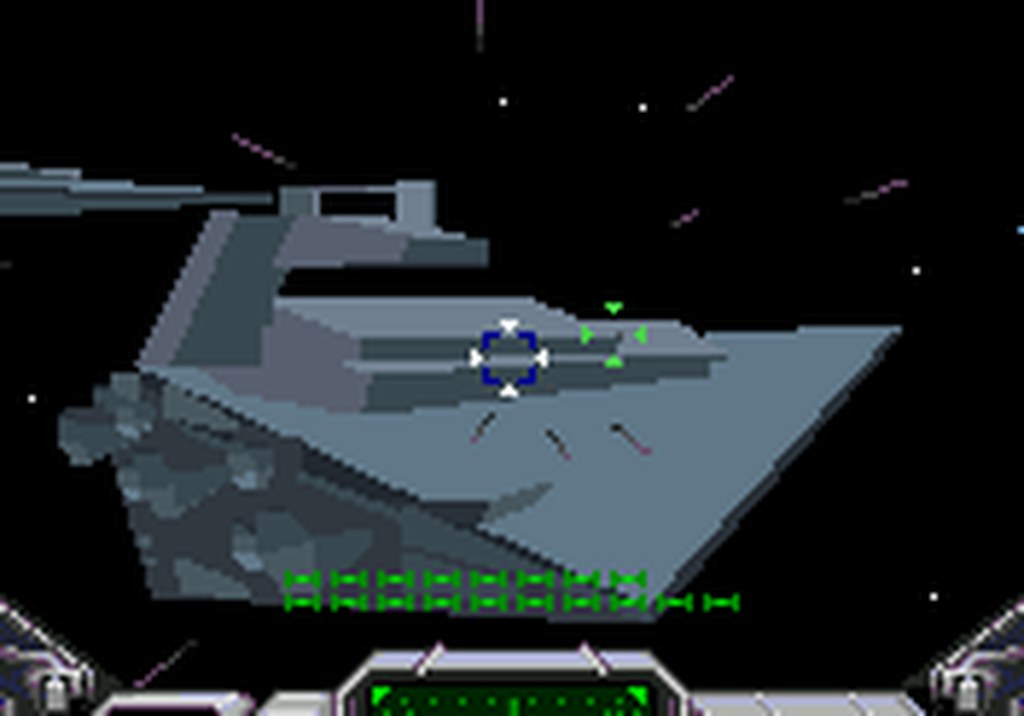
Technically, this is the 32X showing off without breaking a sweat. The polygon counts are modest but the frame rate is brave, the scaling of capital ships as they loom overhead sells real mass, and the Death Star surface — a grey plain of towers and trenches stretching to a polygonal horizon — remains genuinely evocative. Slowdown arrives only in the busiest crossfire, and even then it reads as drama rather than failure.
The 32X version, specifically
There was no other home version to compete with it for a decade — this was the only way to play the Model 1 game outside an arcade, and it honoured the source. Against the Mega Drive’s library it looks like a transmission from the future; against the Saturn’s later Star Wars efforts it still holds its own on feel. As a launch title it made the add-on’s argument better than any other cartridge: here is arcade polygon hardware, running in your front room, for the price of a game.
Verdict: the 32X’s finest launch title and one of its three or four best games outright. Brief, yes; thin, occasionally — but as pure, co-operative, polygon Star Wars, nothing else in the 16-bit era comes close.
Time has sorted the 32X library into the famous, the infamous and the forgotten, and Star Wars Arcade rewards being met on its own terms rather than through any of those reputations. Played today — on a serviced stack, through a clean video path, with the six-button pad the era intended — it is a reminder that the mushroom’s forty games were never its problem. The problem was the calendar they were born into, and calendars cannot be replayed. Games can.
There is also the matter of what Star Wars Arcade says about its machine. The 32X was sold as a bridge to the 32-bit future and remembered as a dead end, but its best cartridges argue a subtler case: that for eighteen months it was simply a good games platform with a small, strange, high-quality library, judged at the speed of a market panic rather than at the pace games deserve. Revisiting it now, without the panic, is the closest thing the platform will ever get to a fair trial — and on the evidence of this cartridge, the defence rests well.
For collectors, Star Wars Arcade sits in the honest middle of the 32X market: neither the loose-change common nor the four-figure grail, but a cartridge that rewards the hunt and justifies its shelf space every time the stack is powered up. In a library this small, every game is a significant fraction of the whole. This one earns its fraction.
What lingers after the credits is how completely Star Wars Arcade belongs to its moment — and how well that moment has kept. The early polygon years are often treated as an embarrassing adolescence for the medium, all jagged edges and experimentation. The best 32X games suggest otherwise: the experiments were the point, the edges were the aesthetic, and a generation of designers was learning 3D in public, at full speed, on hardware like this. Star Wars Arcade is one of their better lessons.