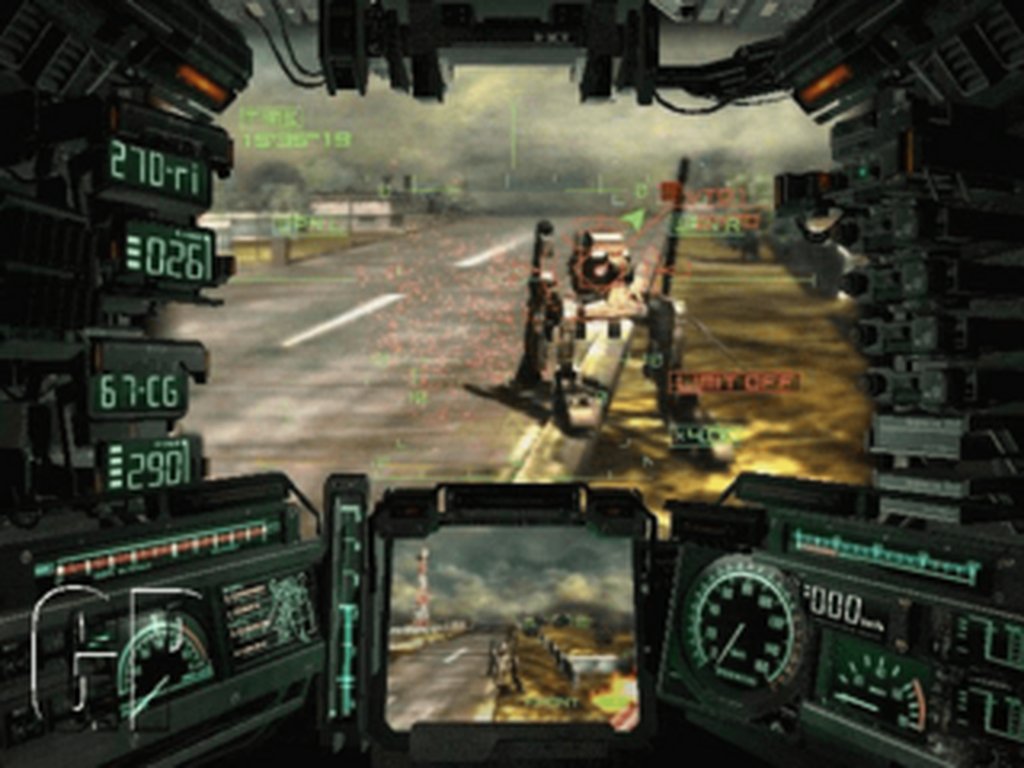
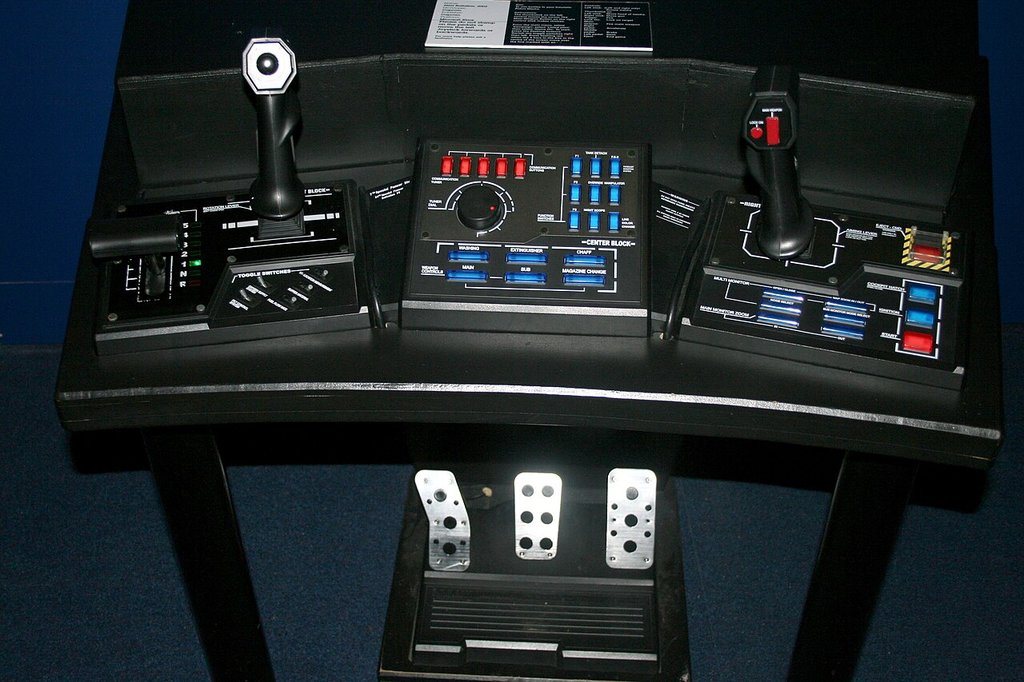
Every console generation has one artefact that makes visitors to a collection stop and say: they actually sold that? For the original Xbox, it is a three-panel steel control deck roughly a metre wide, carrying some forty buttons, two joysticks, three foot pedals, a gear lever, toggle switches under safety covers and an eject button you press exactly once per catastrophe — sold in a box the size of a coffee table, for around two hundred dollars, in 2002, bundled with a game that deletes your save file if you die. Steel Battalion, Capcom’s mech simulator, is gaming’s most excessive controller and one of its most honourable experiments: an attempt to sell immersion at any price, taken completely seriously by everyone involved.
The premise demands the hardware. You pilot a Vertical Tank — a walking war machine — for the nation of Hai Shi Dao in a near-future Pacific war, and Capcom’s design team, led by producer Atsushi Inaba’s colleagues at Production Studio 4, decided early that a standard controller would betray the fantasy. A VT is not flown; it is operated. So they built the operation: a start-up sequence of switches and toggles that genuinely boots the machine’s systems in order, a manual gear shift, a right stick for aiming, a left stick for steering the hull, a sight-change control, an aiming hat, toggles for fuel and fire control, a radio dial for communicating with your platoon, and pedals for acceleration, braking and the sidestep dash. The famous eject button sits under a flip cover, lit, and it matters: if your VT is destroyed and you fail to eject, the game erases your campaign save — death with administrative consequences, the most hardcore design decision ever shipped in a box with a power cord.
The game wrapped around this magnificent furniture is a genuine simulation campaign: a dozen-plus missions across two campaigns (the original and the harder second loop), fought at walking pace through cities, deserts and river crossings where your forty-ton machine feels its weight in every turn. Visibility comes through a grainy cockpit monitor with wipers for the rain of debris — there is, gloriously, a windshield-wiper button — and damage modelling tracks systems rather than hit points. Resupply and repair between missions cost from a persistent budget, so the campaign has an economy of caution: every sortie is an investment decision. Reviews in 2002 were respectful, sales were limited by the obvious, and the controller’s production run sold through — twice, across two printings — to the faithful who remain, two decades later, its custodians.
Line of Contact: the online war
In 2004 Capcom doubled down with Steel Battalion: Line of Contact, an Xbox Live sequel that removed the single-player campaign entirely and put platoons of human VT pilots into persistent online warfare — factions fighting over a map of territories, with mechs earned, customised and permanently lost in battle. It was a live-service war game years before the term, running on the same enormous controller, and its community fought organised campaigns that remain legend among original Xbox Live veterans. When the original Live closed in 2010, Line of Contact’s war ended with it; today the community keeps the machines alive through LAN play and revival networks, and the campaign disc remains fully playable forever, as single-player artefacts are.
Steel Battalion did not ask whether a controller could be a cockpit. It assumed the answer and invoiced you for the difference.
Context makes the excess legible. The early Xbox was Microsoft buying credibility with spectacle — Halo proved the software, Live proved the network, and Steel Battalion proved the platform would host ideas too impractical for anyone else’s balance sheet. Capcom, for its part, treated the project as prestige engineering: the controller’s build quality — steel-framed panels, positive-action switches, sticks with real resistance — shames most modern specialty hardware. Its descendants are the flight-sim HOTAS rigs, racing cockpits and streaming decks of today, all built on the same wager that some players will pay for physicality. Steel Battalion simply made the wager first, largest, and with an eject button.
Owning one today is the collector’s final exam for the system. Complete sets — controller, pedals, game, and ideally the green-button first or blue-button second edition distinguished by their button colours — command serious money, and the failure points are known: pedal springs tire, the sticks’ centres drift, and the sheer size means most survivors live in storage rather than on desks, which is its own preservation crisis. Test before you buy, budget a table, and respect the ritual: switches up, systems green, gear forward. There will never be another product like it at retail. The industry grew up, ran the numbers, and filed the lesson: immersion sells, but only so much furniture fits through a shop door. Steel Battalion remains the glorious exception — two hundred dollars of proof that for one winter, the answer to “how far can we take this?” was: all the way to the eject button.
The ritual of the start-up sequence
Ask any owner for their Steel Battalion story and they will not describe a mission. They will describe starting the machine. Cover up, ignition switches in sequence, the cockpit monitor flickering to life with the system’s grainy boot graphics, the throttle test, the gear check, the moment the hatch seals and the hangar noise dies — a ninety-second liturgy that turned inserting a disc into reporting for duty. Games have chased that ceremony ever since, in flight sims and mech games and VR cockpits, and none has matched the physicality of doing it with your actual hands on actual switches. The controller’s second genius is its refusal to abstract: the wiper button exists because rain exists, the fuel toggle exists because logistics exist, and the eject button exists because consequences exist. Simulators are usually about fidelity to a machine. This one is about fidelity to a job.
That job’s afterlife in the hobby is secure. Dedicated owners maintain registries, repair guides and replacement-part projects; Line of Contact veterans still organise; and the controller has become the centrepiece photograph of a thousand collection rooms — the object that tells a visitor, instantly, how deep this particular rabbit hole goes. Capcom never repeated the experiment, and no publisher has since dared a required peripheral at this scale. The deck stands as the high-water mark of an idea the industry keeps circling: that some fantasies are worth furniture.
Somewhere in Japan there is presumably a warehouse figure for how many controllers survive; the community’s working estimate is that most of the two production runs still exist, treasured by exactly the sort of people who bought them new. Excess, it turns out, is a preservation strategy: nobody throws away a metre of steel.
The verdict of the object
Stand in front of the controller — and you do stand; it is furniture — and the whole original Xbox project comes into focus: overbuilt, over-ambitious, sincere to a fault, and aimed at players who wanted more machine than the market thought decent. The Duke was too big for hands; the Steel Battalion deck was too big for rooms, and both are beloved for exactly that. If your collection can hold one outrageous object, make it this one. Just clear the table first. And cover the eject button. You will want to press it. Everyone does. That is the point of it — the whole wonderful point.