
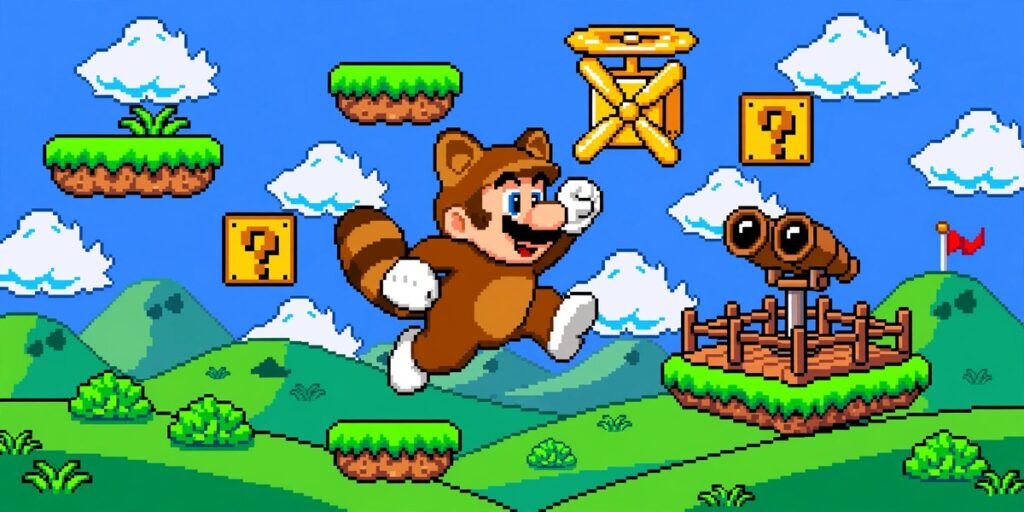
At a glance: Super Mario 3D Land (2011) · Developer: Nintendo EAD Tokyo · Publisher: Nintendo · Platform: Nintendo 3DS · Release: 3 November 2011 (JP) · Players: 1 · Genre: 3D platformer · Score: 9.2/10
Fifteen years ago today — 3 November 2011 — Super Mario 3D Land went on sale in Japan, and Nintendo needed it to work. The 3DS had stumbled out of the gate earlier that year: a $249.99 price tag, a thin launch library, and sales soft enough that Nintendo cut the price by eighty dollars inside six months and apologised to early buyers with twenty free games. The obituaries were already being drafted. Phones had eaten the handheld market, the story went, and Nintendo’s little glasses-free 3D machine was a relic on arrival.
Into that walked the Galaxy team. Nintendo EAD Tokyo — the studio that had just made the two most acclaimed platformers of the Wii era — was asked to build the first original 3D Mario for a handheld, and director Koichi Hayashida’s brief was a sentence that could have been a riddle: a 3D Mario that plays like a 2D Mario. What they shipped was not a compromise. It was a rescue mission executed in level design — the game that proved the 3DS’s thesis, became the first 3DS title to sell five million copies, and quietly wrote the template Mario still uses today.
A 2D Mario Brain in a 3D Mario Body
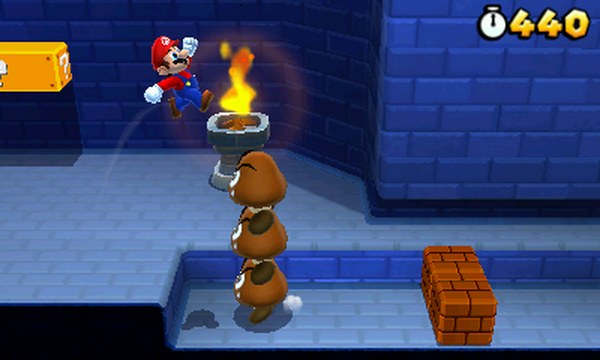
Every 3D Mario before this one — 64, Sunshine, both Galaxies — was built around places: open spaces to explore, stars to earn, progress measured in collectables. 3D Land throws the whole philosophy out. Its courses are linear obstacle courses in the Super Mario Bros. tradition, each one ending at a flagpole, each one run against a ticking clock. There is no hub to wander, no mission select, no star count standing between you and the next level. You run, you jump, you grab the pole. Next.
The control scheme tells the same story. Where Galaxy read your speed from an analogue stick, 3D Land goes back to a button: walk by default, hold to dash, exactly as on the NES. The camera, meanwhile, is practically a fixed rig — framed by the designers, angled for readability, never something you wrestle. And the courses themselves are sized for the machine they live on: three or four minutes each, one idea per course, sized for a bus ride or a lunch break. Galaxy’s invention is all here, but compressed into discipline. Nothing in this game is allowed to sprawl.
Depth Is the Mechanic
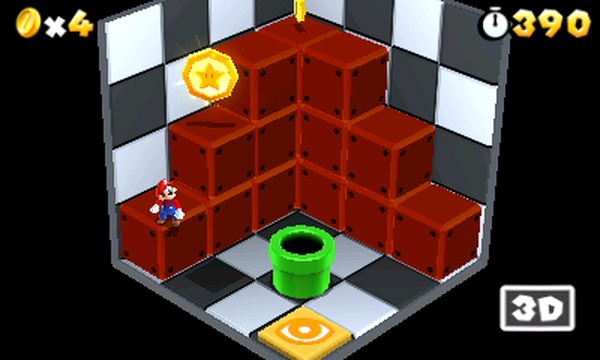
The cleverest thing about 3D Land is that its headline gimmick is not a gimmick. Stereoscopic depth is information. Blocks hover at genuinely different distances, gaps have true widths, and the skill the game teaches — the skill every course tests — is judging a jump with your eyes. Push the 3D slider up and distances snap into focus in a way flat screens can’t fake: a platform that looked adjacent reveals itself as a long, honest leap away.
The game builds whole set pieces on the trick. Optical-illusion rooms arrange floating blocks into shapes that read one way from the entrance and entirely another way once the depth resolves — an Escher drawing you can stand on, with a Star Medal hidden in the seam. Viewing stands dotted through the courses let Mario peer through binoculars in first person, scouting the route ahead and occasionally catching a Toad holding a power-up. And the design is belt-and-braces about it: Mario casts a fat drop shadow directly beneath him, a landing marker your eye learns to steer by, so even a player squinting at a sunlit screen knows exactly where he’ll touch down. Crucially, none of it is mandatory: every course stays perfectly readable with the slider off, which is why the game survives happily on the flat-screened 2DS. Depth is the teacher, never the toll.
“Every 3D Mario before it handed you a place to explore. 3D Land hands you an obstacle course — and a stopwatch.”
The Tanooki Comes Home
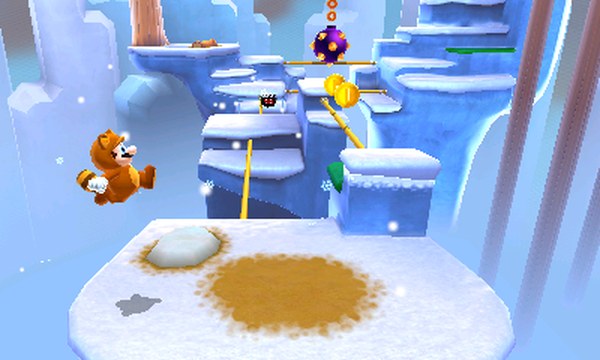
Twenty-three years after Super Mario Bros. 3, the tail came back. 3D Land’s Super Leaf grants the full Tanooki Suit at once — ears, tail, the works — and it is perfectly judged. The tail swipe gives Mario a melee answer to everything at ankle height, and the glide, that gentle held-button descent, is a forgiveness mechanic disguised as a power-up: every mistimed jump in the game becomes recoverable, every gap an invitation rather than a threat. It’s the friendliest power-up Mario has ever had, and it reshapes how boldly you’re willing to play.
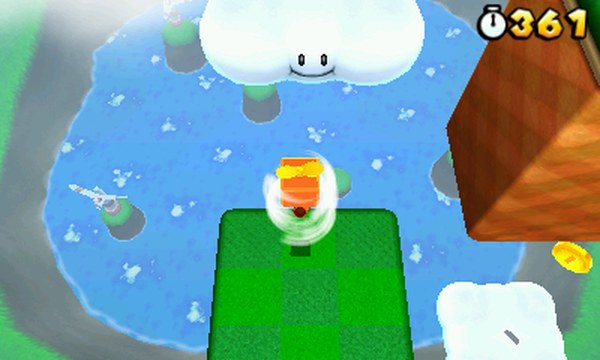
The supporting cast of new toys keeps the same inventive pitch. The Boomerang Flower — new here — throws a returning projectile that arcs through enemies and drags distant coins back to your hand. The Propeller Box turns Mario into a one-shot helicopter for vertical courses. The Prize Box is a ? Block worn as a hat, paying out coins as you run. Even the enemies have been to the same tailor: Tail Goombas, Tail Bob-ombs, tanooki-tailed everything. And underneath it all sits the era’s kindest safety net — lose five lives in one course and an Invincibility Leaf appears, sparkling, offering you an untouchable Tanooki to get past the wall. No judgement. Just help.
Airships and the One Real Flaw
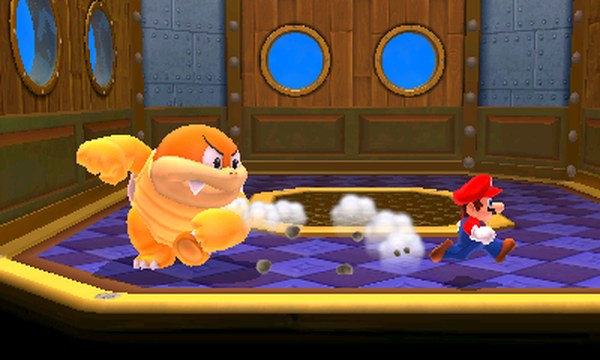
If 3D Land has a weakness, it lives at the end of its airships. Boom Boom — another Bros. 3 homecoming — and his new boomerang-slinging counterpart Pom Pom serve as the game’s recurring bosses, and the rotation repeats: you’ll spin-dodge the same two opponents, in escalating variations with an extra trick each time, all the way through both halves of the game. They’re never bad fights. But in a game this dense with ideas, they’re the one place the invention visibly runs on a loop.
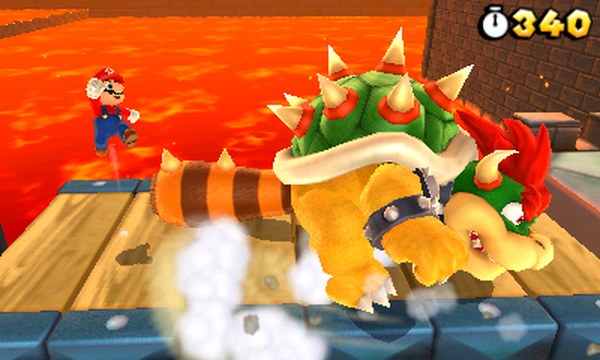
The castle finales are smarter. The Bowser waiting at the end of World 1 is a fake — and the game tells you so, if you’re looking: the impostor wears a Tanooki tail, and defeating him earns you a Super Leaf for your trouble. It’s a wink at the original Super Mario Bros., where every early Bowser was a disguised minion, delivered in a single visual detail. The real Bowser, when he finally shows in World 8, gets the finale the idea deserves: not an arena fight but a sprint, a collapsing bridge and a button, the 1985 axe trick rebuilt as a chase.
Beaten It? You’re Halfway There
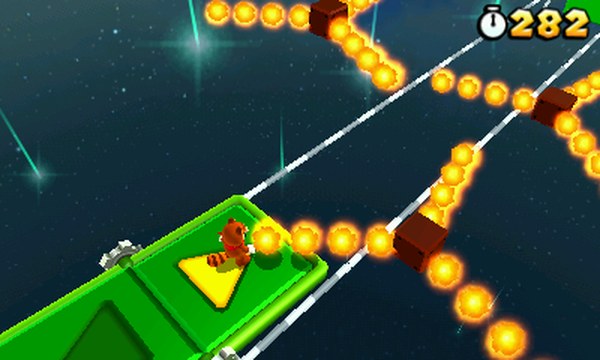
Roll the credits on World 8 and 3D Land does something modern games rarely dare: it doubles. Eight Special Worlds unlock, remixing every course in the game with a meaner imagination — Cosmic Mario races where a shadow double chases you through levels you thought you’d mastered, courses that start with thirty seconds on the clock and make you kill enemies to buy more, layouts rebuilt around tricks the main game only hinted at. Luigi is rescued in Special World 1 and playable from there, all higher jumps and looser landings. The Statue Leaf, a golden deep cut from Bros. 3, turns a ground-pound into a statue drop.
Threaded through all of it are the Star Medals — three hidden in every course, some merely unfriendly to reach — and they gate your progress through the back half. Tucked alongside are the Mystery Boxes, ten-second micro-courses hiding yet more medals, which refresh not just on their own schedule but through StreetPass: every 3DS you walked past in 2011 could deliver a stranger’s box to your game, a tiny social layer for a machine that was meant to travel in pockets. Then, at the very end of everything, sits Special 8-Crown: a single merciless course that only opens once you’ve collected every Star Medal, cleared every level with both brothers, and taken the gold flag at the top of every pole. It is, by wide agreement, one of the hardest levels Nintendo has ever shipped — and this breezy little handheld game makes you earn the right to even attempt it.
The Game That Saved the 3DS
Remember the context this game landed in. By November 2011 the 3DS had been marked down by a third, its early adopters placated with the Ambassador Programme’s free downloads, and the smart money said phones had ended the dedicated handheld for good. 3D Land arrived in Japan on 3 November (North America followed on the 13th, Europe on the 18th), Mario Kart 7 landed weeks later, and the two of them simply ended the argument. 3D Land became the first 3DS title to sell five million copies — it sits north of twelve million today, with a 90 on Metacritic — and, more than the numbers, it proved the machine’s thesis: here was a game whose central pleasure, depth you could play, only made sense on this hardware.
Its influence travelled home, too. When the series returned to consoles with Super Mario 3D World in 2013, it didn’t go back to the Galaxy well — it took 3D Land’s blueprint wholesale: flagpole courses, a framed camera, the dash button, bite-size invention, and added multiplayer and a bigger budget. The “3D” branch of Mario that now defines the series’ modern identity starts here, on a handheld that was supposed to be dead.
Fifteen Years On
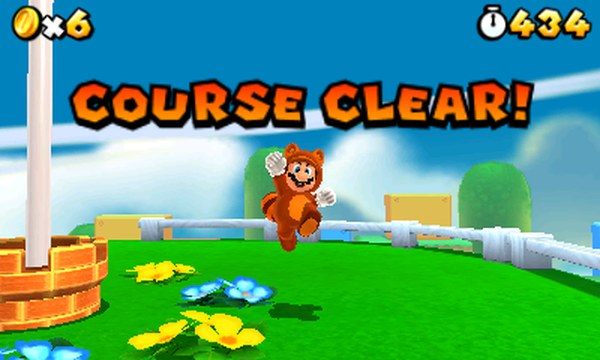
One oddity defines 3D Land in 2026: Nintendo has never ported it. While Galaxy, 3D World and nearly every other Mario of its era have been reissued, this one remains exactly where it was born — a 3DS exclusive, playable today on any 3DS or 2DS via cartridge (the eShop closed in March 2023, so the cart is the reliable door in). Revisited now, what strikes you is the economy. There is no filler in this game, no padding, no course that outstays its idea. The main eight worlds run easy for veterans, it’s true — but that was always the front door, not the house. The challenge was filed in the Special Worlds, waiting.
Verdict: 9.2/10. Super Mario 3D Land is the most disciplined Mario Nintendo has ever made — a game that looked at twenty-five years of the series, kept the flagpole, the clock and the tail, and rebuilt everything else around a single question: what does depth let a jump mean? If Galaxy is the series’ symphony, 3D Land is its perfect single — three minutes long, not a note wasted, and the record that saved the machine it played on.