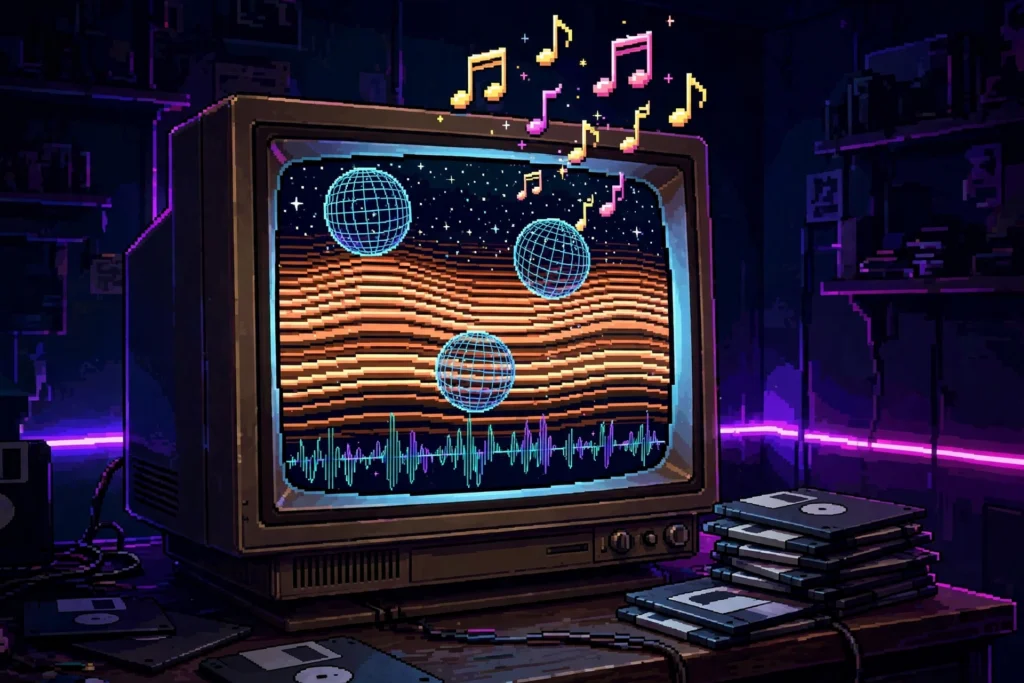
In the late eighties and early nineties, some of the most technically astonishing digital art ever made was produced by teenagers, in bedrooms, for free, and distributed on floppy disks passed hand to hand. The Amiga demoscene didn’t just push a computer to its limits — it turned programming into a spectator sport, and it never asked for a dime.
If you’ve never watched an Amiga demo, you’ve missed one of computing’s great folk arts. These were programs with no gameplay, no score, no purpose beyond showing off. A few kilobytes of code that made a 1985 home computer do things Commodore’s own engineers never imagined: thousands of bouncing vector balls, plasma fields, rotating 3D objects, copper-bar gradients rippling across the screen — all synced to four-channel MOD music squeezed through the Paula audio chip.
The impossible made routine
Watch State of the Art by Spaceballs (1992) and remember: this ran on a machine with 1MB of RAM and a 7.16 MHz processor. Demo coders treated hardware limitations as a dare. The Amiga’s custom chips — Agnus, Denise, Paula — gave them a playground, and the scene’s competitive ladder (local groups, copy parties, crack intros) gave them a reason to outdo each other every single month.
The rivalry was the engine. Groups like The Silents, Fairlight, Kefrens, and later the PC-era Future Crew weren’t companies; they were crews with reputations to defend. A new demo wasn’t a product launch. It was a challenge: beat this.
Why it mattered
The demoscene is the invisible ancestor of half the games industry. The founders of DICE (Battlefield, Mirror’s Edge) were demosceners. Remedy’s roots run through Future Crew. The procedural graphics techniques, the real-time effects, the tracker music culture — all of it leaked from demos into games, VJing, motion graphics, and the entire culture of making art out of code.
And it invented an aesthetic that still hasn’t died. Every time you see a generative-art piece, a shader toy, or a musician wringing melodies from a Game Boy, you’re looking at the demoscene’s grandchildren.
It’s still going
Here’s the part nobody expects: the scene never stopped. Every Easter, thousands of people gather at the Revision demoparty — some traveling across the world — to watch brand-new demos coded for hardware older than many attendees. People are still writing Amiga demos today, still finding tricks in chips designed when Reagan was president.
The demoscene treated hardware limits as a dare — and turned programming into a spectator sport.
Games are wonderful. But there’s something pure about an art form whose entire economy ran on reputation and floppies. No budgets, no market research, no shareholders. Just coders trying to make the machine sing a song nobody had heard yet. The Amiga demoscene was the most honest deal in computing history, and it still echoes every time a tiny program does something impossible.