
At a glance: Halo: Reach · Xbox 360 · Bungie / Microsoft Game Studios, 2010 · First-person shooter · Score: 9.5/10
Every Halo fan knew how Reach ended before the disc ever spun up. The planet falls. The Covenant glass it. Almost everybody on it dies — the whole story of the war’s darkest defeat was written into the first game’s opening crawl in 2001. Bungie’s final Halo game, made after the studio had already signed its independence papers, is built entirely inside that foreknowledge, and it turns what could have been a gloomy footnote into the most human, most beautifully crafted campaign the series ever produced. Reach is not a victory lap. It is a farewell letter.
Noble Team
You are Noble Six, the new replacement in a squad of Spartan-IIIs — cheaper, more expendable super-soldiers than the Master Chief, a fact the game never lets you forget. Around you: Carter, the commander; Kat, the intelligence officer with a robot arm and a dry wit; Jun, the sniper; Emile, the skull-carved hothead; and Jorge, the gentle giant Spartan-II who speaks Hungarian and treats the planet’s colonists as people rather than assets. Bungie writes them economically — a line here, a gesture there — but by the campaign’s midpoint their losses land like hammer blows, because the game has made you fight beside them through the slow collapse of a world.
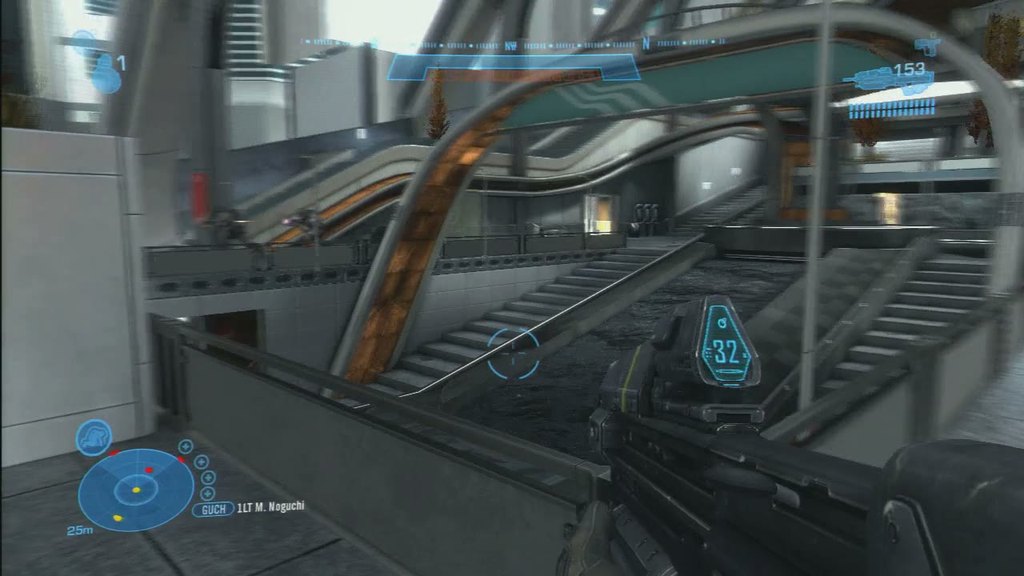
The structure is a long, grim escalation. It opens with mist, farmland and a mystery — Reach under a blue sky, the war not yet arrived — and proceeds mission by mission through investigation, invasion, counter-attack and catastrophe. Nightfall’s sniper infiltration, the desperate evacuation of New Alexandria as the city burns around your Falcon, the space combat of Long Night of Solace — a genuine starfighter sequence, Sabres against Seraphs above the planet, dropped into the middle of a ground-war FPS without breaking stride. Then the endgame: a series of last stands, sacrifices and impossible errands, building to one of the bravest final missions in any shooter. Your last objective is a single word. Survive. You cannot. The game knows it, you know it, and it makes you play it anyway.
The sandbox, perfected
Mechanically, Reach is where Bungie’s Halo formula peaks. The big addition is armour abilities: sprint — finally, sprint — plus a jetpack, active camouflage, the lock-down armour lock, a deployable hologram and more, all swappable in the field. Each one opens the sandbox differently, and the Elites who headline the enemy roster are the smartest, fastest, most aggressive opponents the series ever fielded. Fighting a pair of Ultras on Legendary, shields flaring as they sidestep your grenades, remains a benchmark AI duel.

The DMR — the single-shot designated marksman rifle — replaces the battle rifle as the precision workhorse and gives Reach’s combat a distinct, deliberate rhythm. Vehicles get their fullest workout in the series: Warthog convoys, Falcon gunship runs, a Scorpion charge across a bridge under fire from half the Covenant army. And it all runs on a heavily reworked engine that filled Reach with weather, smoke and a painterly, melancholic light. The planet itself is the game’s real lead character, and Bungie shoots it like one.
Multiplayer and the Forge World
Reach’s competitive side iterates on Halo 3’s in every direction: new modes like Invasion — a multi-stage Spartans-versus-Elites assault that remains a series highlight — plus Headhunter, Stockpile and the return of Firefight, now customisable down to the skulls and weapon drops. The credit system pays you for everything, funding an armoury of helmets and chest pieces that let your Spartan be yours, in campaign and multiplayer alike.
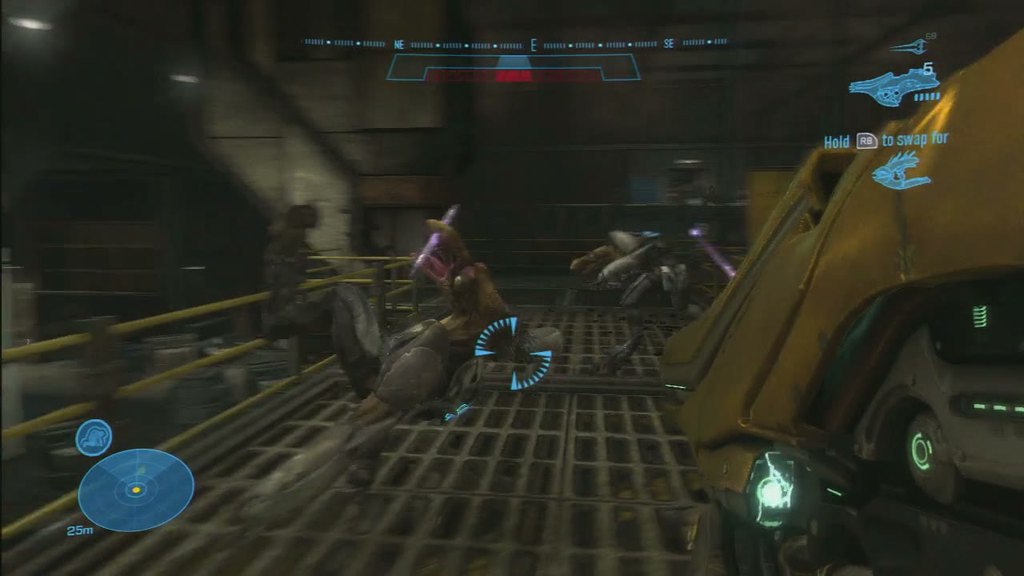
Forge, meanwhile, went from toybox to construction kit. Forge World — a single colossal canvas of islands, canyon and hangar — plus proper object snapping, rotation and phasing tools turned the community into map designers overnight. Thousands of remakes, race tracks, puzzle maps and entirely new sports poured out of it. Add full Theatre support, four-player campaign co-op and split-screen, and Reach is arguably the most generous package Bungie ever shipped — fitting, for a goodbye.
A studio saying goodbye properly
The circumstances of Reach’s making are woven through every level. Bungie had negotiated its independence from Microsoft in 2007, and everyone in the studio knew this was the last Halo they would build: the franchise was passing to the newly formed 343 Industries. Where a team might have coasted, Bungie spent. Reach’s engine was substantially rebuilt, its campaign stuffed with one-off systems — a space combat sequence, a stealth mission, civilian evacuations, jetpack assaults — that each appear exactly once. Its credits thank the fans by name for a decade of support. Even its marketing, the “Remember Reach” campaign of live-action shorts about ordinary colonists in the invasion’s path, treated the fiction with a gravity game advertising rarely attempts.
The armoury of player expression deserves mention, too, because it changed Halo permanently. Your Noble Six is yours: gender, armour configuration assembled piece by piece from the credit economy, colours, emblem — and that same Spartan appears in campaign, co-op and multiplayer, a single persistent identity across the whole game. It sounds like a small thing. In 2010, in a series whose hero famously never showed his face, it was a quiet revolution — and the direct ancestor of how the series, and most shooters, handle player identity now.
Reception at launch was excellent (91 on Metacritic), though a vocal slice of the competitive community quarrelled with armour abilities and the DMR’s reticle bloom for years. The broader verdict has long since settled the argument in the game’s favour: its campaign regularly tops series rankings, its ending is cited in “greatest of all time” conversations, and its tone — elegy rather than triumph — opened narrative space the franchise’s later custodians are still exploring.
The last word on Lone Wolf
Return, finally, to that last mission, because it is the bravest design decision in the series and the reason Reach endures in conversation. Lone Wolf drops you alone in a ruined farmstead, armour failing, visor cracking, against an endless Covenant advance — no extraction, no objective but resistance itself, scored in minutes. It is the game’s whole argument made playable: that how a thing ends can matter more than that it ends. Players hold out and compare times the way they compare speedruns, and the final cutscene — your helmet in the grass of a reborn Reach, decades later, under a healed sky — performs the series’ only act of pure hope. Bungie buried its Spartan and planted a world over him. It is the finest farewell any studio has ever shipped.
The verdict
Reach is the rare prequel that deepens everything around it: you will never watch the Pillar of Autumn jump away at the start of Halo: Combat Evolved the same way again.
Time has been kind to Reach. Its campaign’s reputation has only grown — plenty of players now call it the series’ best — and while the original 360 servers are retired, every local mode on the disc works exactly as it did in 2010. As Bungie’s sign-off to the universe it built, it is close to perfect: elegiac, spectacular and quietly devastating. From the beginning, you know the end. Play it anyway.
Score: 9.5/10