
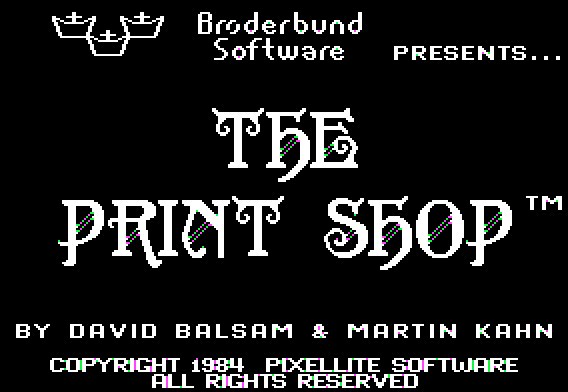
For about five years in the mid-1980s, you could walk into almost any school fête, church hall, scout meeting or office party in America and know, instantly, whether the organisers owned an Apple II. The evidence was strung across the wall: a banner, ten feet of fan-fold printer paper, letters a foot tall, reading HAPPY BIRTHDAY or WELCOME HOME or BAKE SALE SATURDAY — produced by The Print Shop, the 1984 Brøderbund program by David Balsam and Martin Kahn that turned the home computer and the dot-matrix printer into a one-household print works. It is not a game. It is on this shelf because few pieces of software of any kind were ever more loved, more used, or more responsible for what the neighbours thought a computer was for.
The concept was democratic to its core. Before The Print Shop, making a decent greeting card or sign meant either artistic talent, expensive print-shop minimums, or the felt-tip pen of shame. Balsam and Kahn — the program was developed at Pixellite Software — wrapped the whole business in menus a child could operate: choose what you want to make (greeting card, sign, letterhead, banner, calendar, or the free-form Screen Magic mode), choose a border, choose a graphic from the built-in library of clip-art, choose a typeface, type your message, and print. The program handled layout, scaling and the dot-matrix printer’s moods. The results, by the standards of hand-lettering, were miraculous: symmetrical, confident, professional-ish. The results by any other standard were unmistakable — those borders, those fonts, that clip-art — and became a visual dialect of the decade, the look of every amateur celebration in America.
A Printer in Every Pot
The timing was perfect, and it is worth pausing on why. The Apple II had spent years as the machine of schools and hobbyists; the dot-matrix printer had spent years as its underused accessory, good for program listings and little else. The Print Shop gave the printer a public job — output you could hold, fold, post and hang — and in doing so it gave the computer a social one. Software historians reach for the phrase “desktop publishing” here, and while that term belongs properly to the Macintosh and the laser printer a year later, The Print Shop was doing the essential act earlier and cheaper: letting ordinary people compose printed matter on a screen and hold it minutes later. Brøderbund, a games publisher, suddenly had the closest thing the young industry had to a universal utility hit, and the program spread far beyond the Apple II to the Commodore 64, the Atari 8-bits and the IBM PC — though the Apple II, with its school-installed base, was its heartland and its first home.
Then came the ecosystem, which is where the story gets prophetic. Brøderbund sold Graphics Library disks — more clip-art, more fonts, more borders, themed for holidays and occasions. It sold a Companion with more tools. Third parties sold libraries of their own. Users designed their own graphics in the built-in editor, pixel by pixel, and traded them. If that model sounds familiar — a creative platform, a library of assets, an add-on economy, user creations circulating hand to hand — it should: The Print Shop was running the playbook of the modern creative app in 1984, on a 64K machine, with output that emerged smelling of warm ribbon ink. Schools built whole units around it. Clubs ran their newsletters on it. The greeting-card companies, eventually, took notice of the idea and built empires on it.
The Banner Unfurls

And the banner — the banner deserves its own testimony. Banner printing used the printer’s continuous fan-fold paper sideways, letter by enormous letter, in a process that took long enough to become an event in itself: the household gathered as H-A-P-P-Y emerged at dot-matrix tempo, and the finished streamer, perforated edges torn away, was the decade’s definitive party decoration. Entire childhoods are measured in Print Shop banners. The program’s cultural penetration was such that “Print Shop” became, for a while, the generic name for the activity itself, the way later software categories would be named after their first conqueror. It stayed in print, in version after version, for years — one of the longest-lived productivity titles of the 8-bit era.
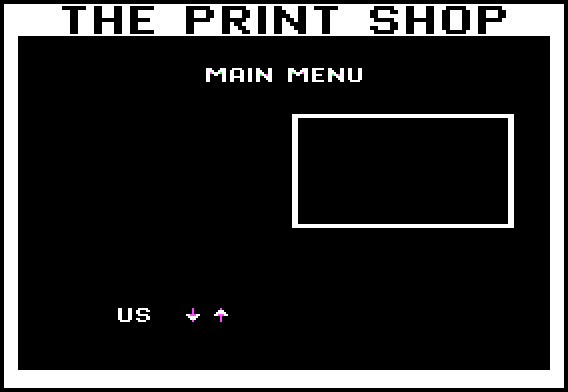
What does it look like revisited? The interface is pure 1984 menu-and-prompt, the clip-art library is small beside modern abundance, and the output resolution is a dot-matrix printer’s — which is to say, an aesthetic now, sought after by designers who pay for fonts that imitate it. But the core experience — choose, compose, print, hold — is intact and still satisfying, especially on real hardware with a real ImageWriter chattering beside the Apple II, producing a physical object in a hobby that mostly deals in light. Few programs on this shelf can claim to have decorated the real world. This one decorated millions of walls.
Its afterlife was long and appropriately paper-strewn. The Print Shop line continued for years — Deluxe editions, companion disks of fonts and borders, versions for the machines that succeeded the Apple II — and Brøderbund’s little desktop publisher became one of the reference points for what “productivity” could mean at home: not a spreadsheet, not a word processor, but a thing the whole family queued to use. The dot-matrix symphony it conducted — the line-feed percussion of a banner crossing a room — is one of the era’s defining sounds, and the banners themselves, pinned in school halls and office corridors, were for many people the first computer printout they ever actually looked at. Software history tends to crown the tools of business. This one crowned the tools of the birthday party, and there were more of those.
The ecosystem around it kept the presses fed. Brøderbund and its ecosystem supplied companion disks of additional fonts, borders and graphics, seasonal and novelty collections, and a Print Shop Companion that added tools like a border editor and an envelope printer for those who had exhausted the original’s generous stock — an early, friendly model of software as an expandable hobby rather than a finished product. The program’s menus, meanwhile, became a quiet benchmark for humane design: plain language, visible choices, the preview always one key away. Teachers used it for classroom posters, churches for bulletins, small businesses for letterhead they could finally afford to be proud of — the Apple II as the neighbourhood print works, one ImageWriter at a time.
If you find a boxed copy, open it carefully: the manual, the sample paper and the disk sleeves are a time capsule of the moment home computing turned domestic. Then load it up and print a banner. Some software you study. This one you use, exactly as intended, forty years on.
Verdict
The Print Shop is the Apple II’s great folk-art machine: not a game, not a business tool, but a printing press for people who had never wanted one until it fit on the kitchen table. Its menus taught a generation that computers make things, its libraries invented the add-on pack, and its banners are quite possibly still hanging in a hall somewhere, faded but legible. A phenomenon, honestly earned.
Score: 8.0/10 — At a glance: Developer David Balsam & Martin Kahn / Pixellite, Brøderbund · Year 1984 · Genre Creative printing software · The banner across America’s party halls started here.