
Every platform has the program that justifies the hardware. For the Apple II, it arrived on October 17, 1979, on a single floppy disk, for under a hundred dollars: VisiCalc, the first electronic spreadsheet, written by Dan Bricklin and Bob Frankston of Software Arts and published by Personal Software — the company that would rename itself VisiCorp on the strength of it. The claim in this article’s title is not ours and it is not hype. It is the verdict of the era itself, repeated by dealers, journalists and Steve Wozniak alike: for a crucial period, people did not buy Apple IIs and then look for software. They saw VisiCalc, understood it in five minutes, and bought the computer it required. The Apple II was, in the phrase of the day, the box VisiCalc came in.
The conception is one of computing’s great classroom stories, and unusually, it is well documented by its own author. Bricklin, an MIT-trained programmer studying at Harvard Business School, sat in case-study classes watching professors build financial models on blackboards ruled into grids — and watching the misery when one assumption changed and column after column had to be erased and recomputed by hand. His insight was to make the blackboard electronic: a sheet of cells, each holding a number or a formula referring to other cells, where changing any value recalculated everything that depended on it, instantly. He took the idea to Bob Frankston, a friend from MIT with deep systems experience, and over the winter of 1978–79 the two built it — Bricklin designing and writing the user-facing program in the attic of his Arlington, Massachusetts home, Frankston engineering the calculation engine and the formidable machinery underneath, the pair developing with tools they had built on a rented timesharing system because that is what you did in 1978.
The Magic Sheet of Paper
What they shipped was, by the standards of business software then, a marvel of restraint. The screen showed a window of the sheet — columns lettered, rows numbered, the A1 notation VisiCalc established and every spreadsheet since has kept. You moved the cursor, typed numbers, labels and formulas, and the sheet answered. Build a five-year projection, change the growth assumption in one cell, and watch the whole model re-derive itself before your eyes. Financial modelling on mainframes existed, at institutional prices, mediated by specialists and overnight batch runs. VisiCalc put the same act on a desk, interactively, for the price of a good calculator — and the effect on small businesses, accountants, planners and managers was closer to revelation than to product launch. Ben Rosen, the influential analyst, predicted in 1979 that VisiCalc might become “the software tail that wags the personal computer dog.” It is among the most accurate predictions in the industry’s history.
The numbers tell the story, carefully phrased because the era’s figures deserve care. VisiCalc was exclusive to the Apple II for its first year or so — a fact directly credited with driving the Apple’s business adoption; contemporary accounts report that a substantial share of Apple IIs sold in that period were bought to run it, and Wozniak himself observed that small businesses, not the hobbyists Apple expected, were buying the great majority of machines. Over its commercial life VisiCalc sold, by the most commonly cited reckoning, in the region of a million copies across all platforms, at prices that rose over time from under $100 to around $250 — revenue that essentially created the idea of a software bestseller. It was ported widely, to the PET, the Atari 8-bit line, the TRS-80, CP/M machines and, fatefully, the IBM PC at its 1981 launch, where it was among the new machine’s first essential programs.
Rise, and the Lesson of the Fall

The fall, when it came, was as instructive as the rise. VisiCalc’s makers spent crucial years entangled — in an ill-fated focus on the troubled Apple III, in a bitter legal war between Software Arts and VisiCorp over rights and royalties — while the IBM PC’s larger memory and 80-column screen invited a successor built natively for it. That successor, Lotus 1-2-3, was created by Mitch Kapor, himself a former VisiCorp product manager, and launched in 1983 with VisiCalc compatibility as a deliberate migration path. Within a remarkably short time the pioneer was eclipsed; by 1985 Lotus had acquired Software Arts and ended VisiCalc’s sale. The whole arc — invention, category creation, dominance, disruption — played out in six years, and business schools have been teaching it ever since, which is fitting for a program born in one.
It is worth being precise about what VisiCalc did and did not invent, because its legend invites overclaim. Spreadsheets as a mainframe concept existed; what Bricklin and Frankston invented was the personal spreadsheet — interactive, immediate, on hardware a single person could own — and with it the very idea of a “killer app,” a program so valuable it sells its platform. The term itself entered the language in VisiCalc’s wake. They did not patent it, a decision Bricklin has discussed publicly and thoughtfully ever since; the counterfactual in which they had is one of computing history’s great what-ifs, and Bricklin’s own website — where he has long offered the original PC version as a free download with Lotus’s permission, alongside a rich first-hand history — is required reading for anyone who wants the story from the men who lived it.
One famous footnote belongs in any honest account: Bricklin chose not to patent VisiCalc — software patents were uncertain ground in 1979, and the decision, defensible then, meant the idea could be (and was) cloned at will once it was proven. The spreadsheet’s inventor thus watched the category enrich nearly everyone except, proportionally, its inventors; Bricklin has spent a distinguished later career, among other things, as the industry’s thoughtful witness on exactly such questions, and his own history of the program, maintained online, remains the primary source this feature leaned on. The Computer History Museum and its peers keep the Apple II VisiCalc as a first-rank artefact. Some software is remembered. This piece is load-bearing: remove it, and the personal computer’s first decade collapses into a hobbyist’s cul-de-sac.
The human coda is instructive. Software Arts and VisiCorp — the company formed to publish the program — fell into a bitter dispute as the money grew, and by 1983 the partners were in court while Lotus 1-2-3 took the business world the spreadsheet had revealed. VisiCalc was discontinued in 1985, six years after it changed everything; Bricklin, characteristically, has spent the years since documenting the story with a candour the industry rarely manages, source notes and all, which is why the history above can be told with unusual confidence. Frankston went on to a long career as one of software’s quiet architects. The program’s inventors did not get the category’s fortune. They got the category named, eventually, in their honour — “Bricklin’s invention” — and the first exhibit in the museum of the industry it created.
Verdict
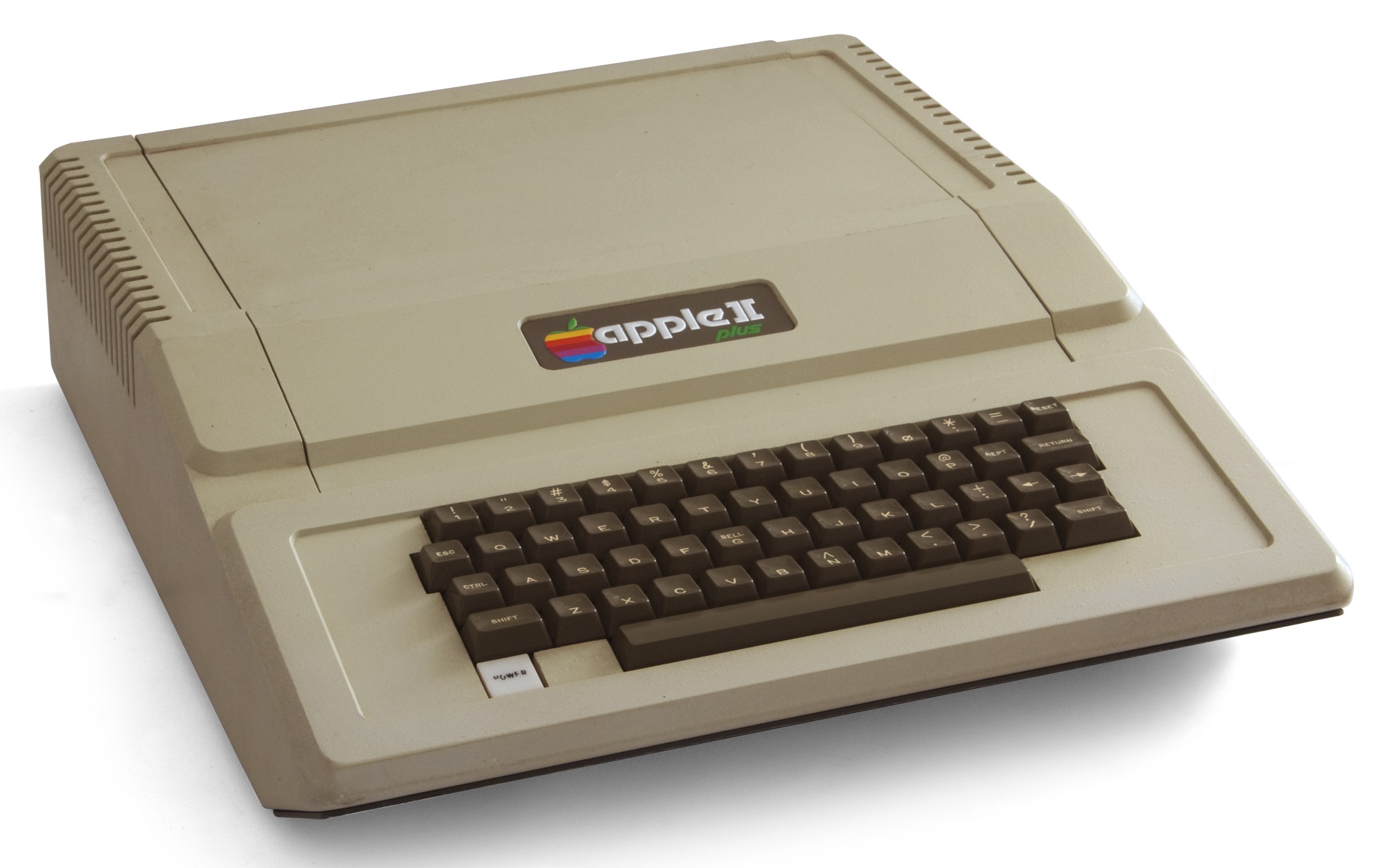
Open VisiCalc on an Apple II today — forty-column text, a grid, a cursor — and the shock is how little explanation it needs. Rows, columns, formulas, recalculation: the grammar is the grammar of Excel and Sheets and every grid of numbers glowing on every desk on earth, present at the creation in 1979, on this machine, written by two men in an attic in Arlington. The Apple II sold the spreadsheet to the world. The spreadsheet, for a while there, sold the Apple II right back.
Filed under Features rather than Hardware: this is the story of a piece of software — the most consequential ever written for the platform.