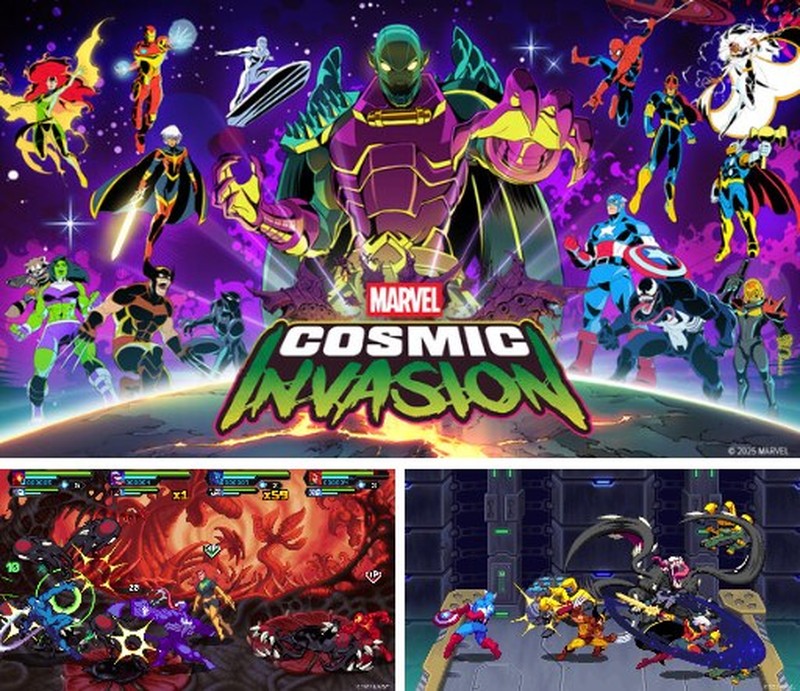
Announced in March 2025, Marvel Cosmic Invasion is the game a certain kind of player has been requesting, in so many words, for thirty years. Tribute Games — the Montreal studio behind Teenage Mutant Ninja Turtles: Shredder’s Revenge — has teamed with publisher Dotemu and Marvel to build an all-new, pixel-art beat-’em-up in the direct lineage of Konami’s 1992 X-Men arcade game and Capcom’s licensed brawlers. The premise is pure comic-book event: Annihilus and his Annihilation Wave are invading the galaxy, and a roster of Marvel heroes must punch a road from New York City to the Negative Zone to stop them. If Shredder’s Revenge was a love letter, this is the same handwriting addressed to a bigger universe.
The roster, and the tag system at the game’s heart
Fifteen playable heroes were promised at announcement, with the revealed line-up reading like a deliberate tour of Marvel’s eras: Captain America, Wolverine, Spider-Man, Storm, Phyla-Vell, Venom, Nova, Rocket Raccoon, Beta Ray Bill, She-Hulk, Cosmic Ghost Rider, Black Panther, Iron Man and more as reveals continued. The selection mixes the inevitable with the inspired — Beta Ray Bill alone signals a team that reads comics rather than just licensing sheets. The crucial mechanical idea is the Cosmic Swap: you pick two heroes before each stage and tag between them mid-fight, building combos across characters and calling your partner in for assists. It is the tag DNA of Marvel’s fighting games transplanted into a belt-scroller, and it transforms the genre’s rhythm — your second character is not a spare life, it is a combo tool.
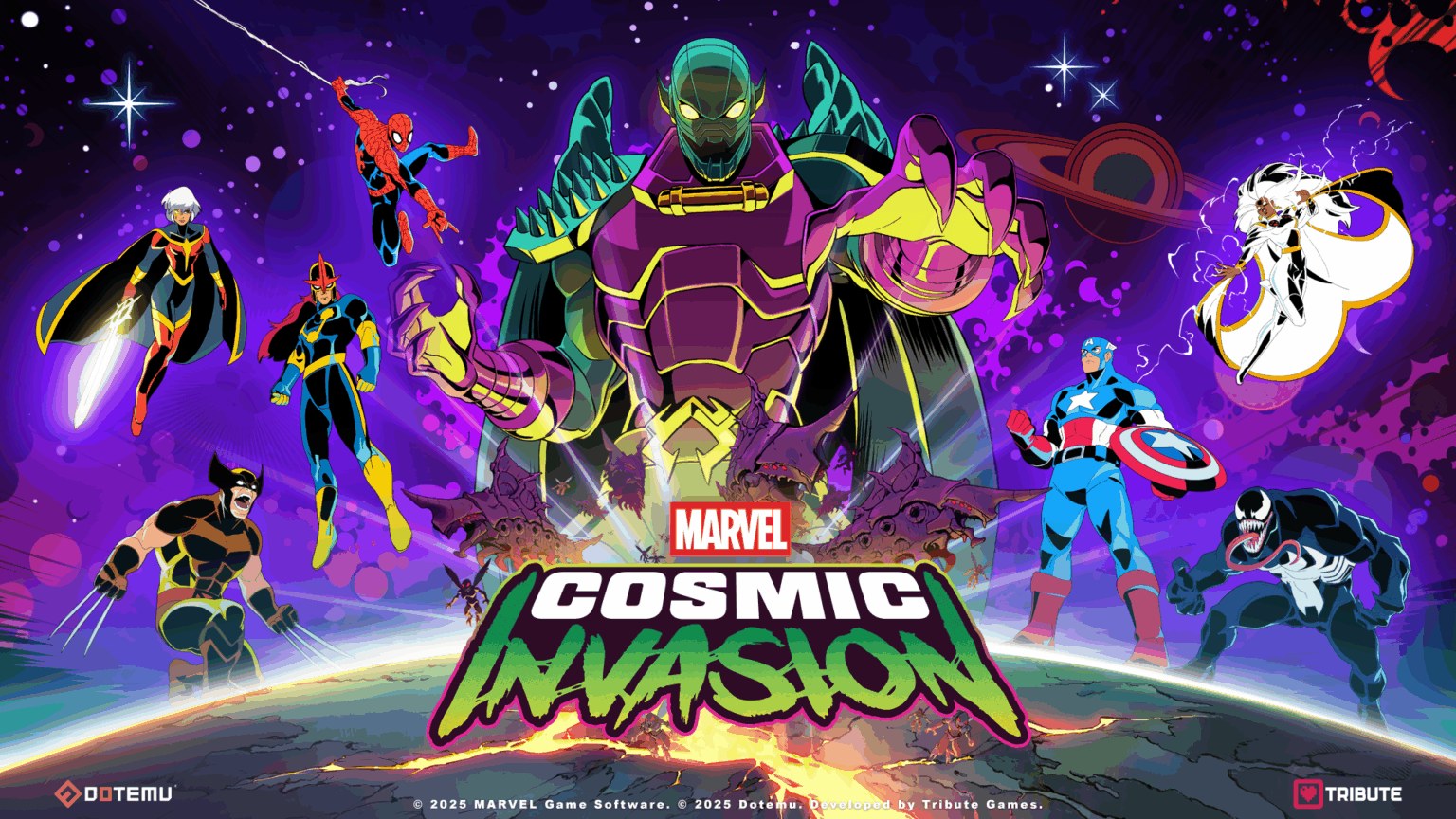
Standing on the shoulders of 1992
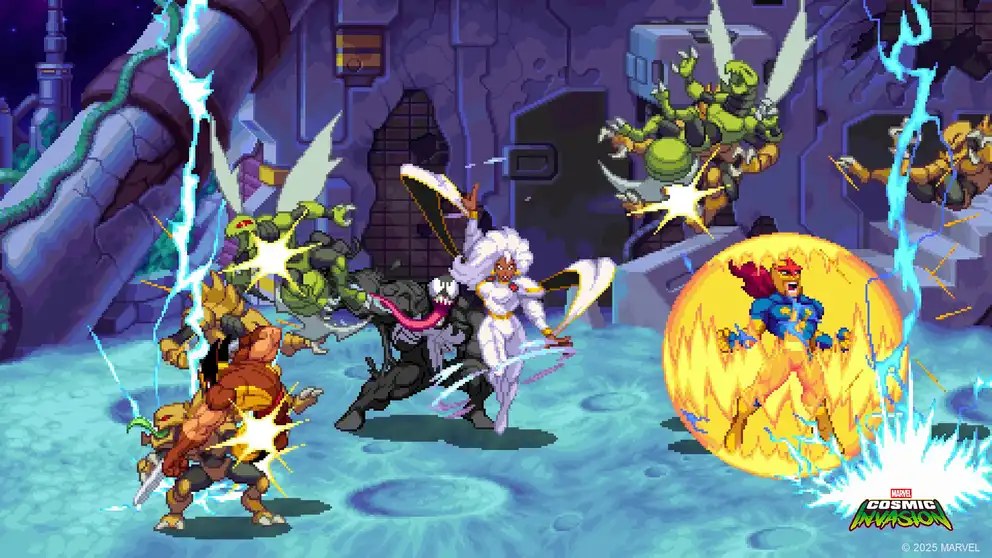
The lineage here deserves precision, because Cosmic Invasion is braiding two traditions. From Konami’s X-Men and The Simpsons it takes the wide-screen, multi-hero brawl, the special moves that cost health, and the sheer joy of four players clearing a screen together — the game supports up to four players, local and online, with drop-in play. From Capcom’s Dungeons & Dragons and Punisher-era brawlers it takes denser movesets: character-specific combos, throws, aerial options and defensive tools that reward learning one hero properly. Tribute’s own contribution, proven across Mercenary Kings, Flinthook and Shredder’s Revenge, is feel — hit-stop, weight, readability — the invisible engineering that separates a tribute act from a true successor.

Visually, the game commits fully to hand-crafted pixel art in the manner of Shredder’s Revenge, which means the animation carries the expression. Cosmic Invasion’s stages range across Marvel geography — the streets and rooftops of New York, the Savage Land, Genosha, a helicarrier under assault, and stranger destinations as the campaign leaves Earth — with boss encounters drawing on the Annihilation saga’s deep bench. Adam Warlock and Galactus loom over the story’s edges, which tells comic readers exactly how large the stakes intend to get.
Why Shredder’s Revenge earned this team the keys
Context matters for expectations. Shredder’s Revenge sold millions, revived a genre commercially, and did it by respecting the source while modernising the friction points — generous checkpoints, unlockable depth, online play that worked. Dotemu’s broader catalogue, from Streets of Rage 4 onward, has made the publisher the default custodian of the brawler revival. Cosmic Invasion is therefore not a gamble on an unknown quantity; it is the revival’s leading team graduating to the biggest licence in the genre’s history, with a tag mechanic that gives the game its own identity rather than a reskin. The announced platforms cover all modern systems, and the game is slated as a premium release rather than free-to-play — a detail brawler fans greeted with audible relief.
What to play while you wait
The genre’s modern canon offers a perfect preparation syllabus. Shredder’s Revenge is the obvious first credit — its campaign teaches the exact fundamentals Cosmic Invasion builds on, and its DLC expanded the roster in ways that hint at this team’s post-launch ambitions. Streets of Rage 4, from Dotemu’s wider stable, demonstrates the genre’s depth ceiling when modern design meets classic structure. For the source material, the X-Men arcade game itself remains available in retro collections and arcade cabinets, and an hour with it explains every design decision Cosmic Invasion is making — the screen-filling casts, the mutant-power spectacle, the joy of a boss who requires four people’s worth of violence. Capcom’s brawler bundle, headlined by Final Fight and Captain Commando, completes the education. A player who arrives at Cosmic Invasion fluent in those four conversations will hear everything the new game is saying.
A word, too, for the soundtrack expectations. Shredder’s Revenge enlisted Tee Lopes and a parade of guest artists to produce one of the decade’s great game soundtracks, and the Marvel licence opens a toybox of themes that fans hold as sacred texts. Cosmic Invasion’s music has been teased sparingly, but the pedigree suggests the audio is being treated as a headline feature rather than backing. In a genre born in noisy arcades, where a great stage theme had to fight a hundred other cabinets for your attention, that instinct is historically correct.
The brawler revival, measured honestly
A little perspective keeps the excitement calibrated. The beat-’em-up revival is real but it is also a decade old now, and its releases have sorted themselves into a clear hierarchy: a few genuine classics that advanced the genre, a warm middle tier of faithful tributes, and a long tail of licensed cash-ins that the revival’s goodwill briefly floated. Everything about Cosmic Invasion’s pedigree places it in contention for the top tier — the developer’s track record, the publisher’s curation, the mechanical ambition of the tag system, the roster’s deep-cut literacy — but the genre’s history also teaches that brawlers live or die on enemy variety, stage pacing and the last third’s difficulty manners, none of which can be judged from trailers. The correct posture is informed optimism with the couch cleared. If Tribute lands this, it will not merely have revived a beloved genre twice. It will own the genre’s modern definition, with both the Turtles and Marvel on its record, and the rest of the industry will be negotiating for the privilege of following.
The road to release
As announced, Marvel Cosmic Invasion was targeting a 2025 release window across PC, PlayStation, Xbox and Switch, with further roster and stage reveals rolling through the year. The sensible posture for fans is the one this genre has taught us: watch the character trailers, argue about the roster omissions — it is a fifteen-slot Marvel roster, so the arguing is half the fun — and prepare a couch. The 90s arcade brawler never really died; it waited in the corner of the arcade for a team worthy of its credits. On the evidence of everything Tribute has shipped, the wait is nearly over.
Postscript: the roster argument, settled democratically
One tradition must be honoured before we leave the announcement behind. A fifteen-hero Marvel roster is, by design, an argument generator — for every Beta Ray Bill celebrated there is a favourite omitted, and the omissions are where the fan conversation lives. So let the record show the correct posture: the revealed roster is unusually literate, spanning the Avengers’ core, the X-Men’s icons, the cosmic bench that the story’s Annihilation premise demands, and enough left-field choices to prove the developers read past the film posters. The remaining slots, the downloadable possibilities, and the inevitable sequel conversations will keep the argument running happily until release and beyond. That argument is not a flaw in the game’s marketing. It is the marketing, the community and — if the Shredder’s Revenge precedent holds — the beginning of a very long life for the game. Choose your two heroes. Defend them loudly. The tag system means, for once, that you do not have to choose just one.