
At a glance: Thunder Castle · Intellivision · INTV Corporation, 1986 (developed by Mattel Electronics) · Fantasy maze action · Designed by Connie Goldman · Score: 8.5/10
The Intellivision was supposed to be dead by 1986. Mattel had closed its electronics division in the crash, the console’s rights had passed to the scrappy INTV Corporation, and the industry had moved on to Nintendo. And yet one of the finest games ever made for the system arrived in that afterlife: Thunder Castle, a fantasy maze game of knights, dragons and wizards, developed inside Mattel before the closure and published by INTV in 1986. It is the system’s late masterpiece — the most atmospheric Intellivision game, the best-sounding, and the one that most clearly shows what the hardware’s second generation of programmers had learned.
Three mazes, three guardians, one knight

The quest is structured as a triptych. In the forest maze, your knight hunts a green dragon through hedge-lined corridors. In the castle, the guardians are wizards. In the dungeon depths, demons. Each maze is a living space of gates that open and close, passages that rearrange the traffic, and roaming lesser creatures — bats, rats and their kin — who are not merely hazards but instruments: catching the right creature at the right moment empowers your knight, briefly turning the hunted into the hunter, because guardians can only be fought when your knight is energised. That single rule gives every screen a rhythm of stalking and retreat. You circle the dragon, wait for your moment of power, and commit — or misjudge it, and spend the next half-minute running for your life through the hedges while the advantage drains away.
It is, structurally, a descendant of the maze-chase tradition, but the fantasy theme is not decoration here — it is load-bearing. The knight is slow. The guardians are faster and kill on contact except in your powered moments. The mazes themselves, especially the castle with its shifting gates, conspire to cut off escape routes you were counting on. Thunder Castle is a hard game, honestly hard, in the manner of a quest designed by people who had watched players master everything else the system offered and decided to test them properly. Designed by Connie Goldman — one of the standout talents of Mattel’s later period — it plays like the work of a team with nothing left to prove and a score to settle with easy games.
The sound of a tiny orchestra
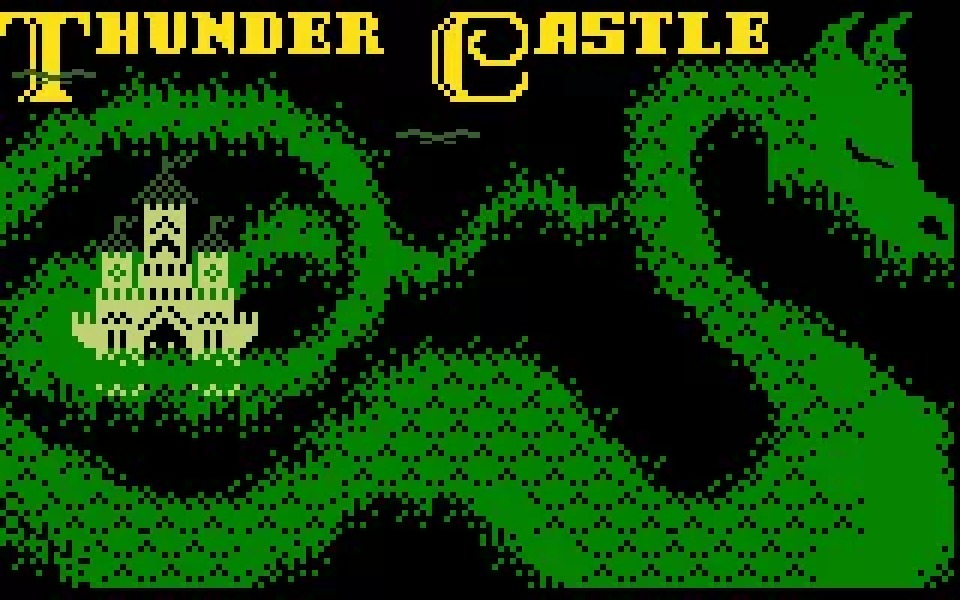
No review of Thunder Castle is complete without stopping for the music, because this cartridge is the Intellivision’s great argument that its modest sound hardware was a composition problem, not a limitation. The game is scored with arrangements of classical music — most famously passages associated with Beethoven’s Sixth Symphony, the Pastoral, woven through the action — rendered in multiple voices with a richness no other cartridge on the system approaches. Between stages, the game pauses for full illustrated intermissions: a dragon coiled around the castle, a wizard’s portrait, a demon rendered in the system’s chunky pixels with genuine menace. These splash screens were showing off, unmistakably — look what the old machine can still do — and the showing off works, because the art direction is superb. The forest is deep green and genuinely labyrinthine to the eye; the castle is stone and torchlight tones; the dungeon is grey dread. Thunder Castle is the Intellivision game you show people who think the system only did primary colours and sports.
The sound design beyond the music is equally considered: the clash of a successful guardian kill, the scurry of the power creatures, the little fanfares. In an era when most console games beeped politely, Thunder Castle performs.
Scarcity, reputation and the INTV years

Because it arrived in 1986 through INTV’s mail-order-scale operation rather than Mattel’s mass-market machine, Thunder Castle never had the audience its quality deserved, and original cartridges have carried a collector’s premium ever since — the honest market signal of a game people seek out on purpose. The afterlife has been kind: it is a fixture near the very top of best-Intellivision-games lists, a favourite of the system’s programmers’ own retrospectives, and a standard exhibit in arguments that the crash-era narrative — everything before Nintendo was primitive — is simply wrong. A console in its seventh year, orphaned by its maker, should not have been producing its best-looking, best-sounding game. Thunder Castle did anyway.
New players should expect a learning curve with teeth: the knight’s deliberate pace and the guardians’ speed will kill you while you calibrate, and the game keeps its secrets (which creatures grant which powers, how the gates breathe) for the manual and for experience. Give it an evening rather than a credit and it opens up into the most rewarding maze game on the system.
Small details, long shadows
Thunder Castle rewards the kind of attention most reviews skip. The gates in the castle maze do not merely open and close on timers — they change the maze’s traffic logic, periodically converting safe corridors into traps and dead ends into escapes, so a route memorised five minutes ago is a rumour now. The lesser creatures are placed with similar intent: the rat is not scenery, it is a timed opportunity with legs, and learning each maze’s fauna — what empowers you, for how long, at what risk — is the game’s true skill curve, far more than raw dodging. Even the knight himself is a statement: he is small on the screen, deliberately outscaled by his guardians, and that visual humility is the game’s difficulty made visible. You are not the hero of this labyrinth. You are an applicant.
The classical score has one more effect worth naming: it changes the room. Living rooms in 1986 were used to arcade beeps; a cartridge that opened with a dragon illustration and a swell of Beethoven made visitors ask what the machine was. As a late-life demonstration of an orphaned console — the thing you show a sceptic — Thunder Castle had no equal on the system, and in the INTV catalogue only Tower of Doom argues with it for that honour. Both arguments, fittingly, are in this wave.
The verdict
Thunder Castle is the Intellivision’s swan song and one of its peaks: a demanding fantasy maze-quest with the system’s finest music, its most painterly presentation, and a hunt-or-be-hunted rhythm that stays tense for exactly as long as you play it. If the flagship games show what the console was, Thunder Castle shows what it became. Essential — and if you only know the system through its early-80s hits, the single most eye-opening cartridge you can add.
Buyers be warned, in the friendliest way: because of its late, small release, Thunder Castle is one of the pricier common-era cartridges to hunt in original form, and loose copies in tested working order are the sensible target — the box is beautiful, but the game is the treasure. However you reach it, reach it. It is the sound of an old machine insisting, correctly, that it had more to say.
The knight is still in the forest, the dragon is still on the path, and the music is still playing. Some games you finish. This one you keep.
Score: 8.5/10