
At a glance: Trinity · Commodore 128 · Infocom, 1986 · Interactive fiction · Score: 9.0/10
Some games are reviewed; Trinity is closer to being witnessed. Brian Moriarty’s meditation on the atomic bomb — written for Infocom’s Interactive Fiction Plus line, which means it required 128K and therefore lives on the Commodore 128 as a native, 80-column production — is regularly named among the finest works of interactive fiction ever made, was included in the book 1001 Video Games You Must Play Before You Die, and remains the strongest evidence that a text adventure, on a home computer, in 1986, could be literature with a parser. On the C128 it found one of its most fitting homes: a machine whose owners read in eighty columns.
It opens in Kensington Gardens, London, in a near future, on the last ordinary morning in the world. Nannies are pushing prams; an old lady is feeding the birds; a white shape is growing in the sky. A Soviet missile is falling, and there is nothing to do about it — except step sideways, through a door that should not exist, into the Wabe: a place outside time where a great sundial stands and other doors lead to other moments, each one a place where the atomic age touched the world. Bikini Atoll. Hiroshima’s shadow. A Siberian crater. A test site in low orbit that history never recorded. And, at the centre, a door to the New Mexico desert on 16 July 1945, minutes before the first atomic detonation at the site called Trinity — where the game’s impossible question waits: knowing everything, what do you do?
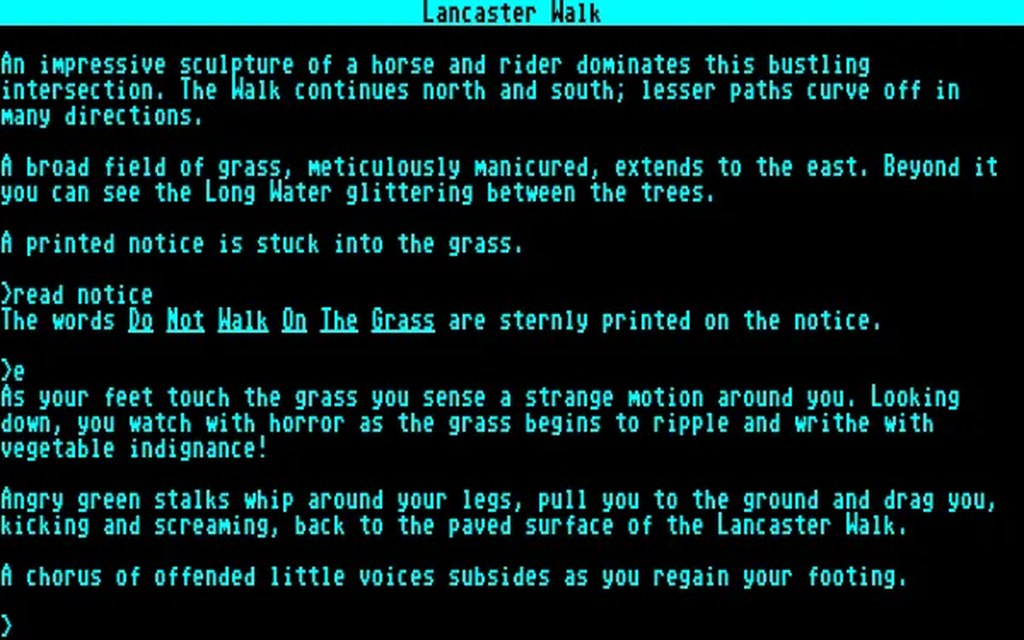
A prose poem you can walk around in
Moriarty built the game the way a novelist builds a book. He conceived the story in 1983, before joining Infocom; management initially judged it too large for the Z-machine of the day, and it waited for the Plus system — for machines like the C128 — to make it possible. He researched the history of nuclear weapons for a year, visited the Trinity site and Los Alamos, and folded British children’s literature through the whole design: J.M. Barrie’s The Little White Bird (the source of Kensington Gardens’ magic), Mary Poppins’ London, Alice’s logic turned elegiac. Quotations surface in the text at charged moments, triggered by your actions, the game pausing its machinery to let a line of literature hang in the air. The effect, even now, is startling: Trinity is a game that trusts silence.
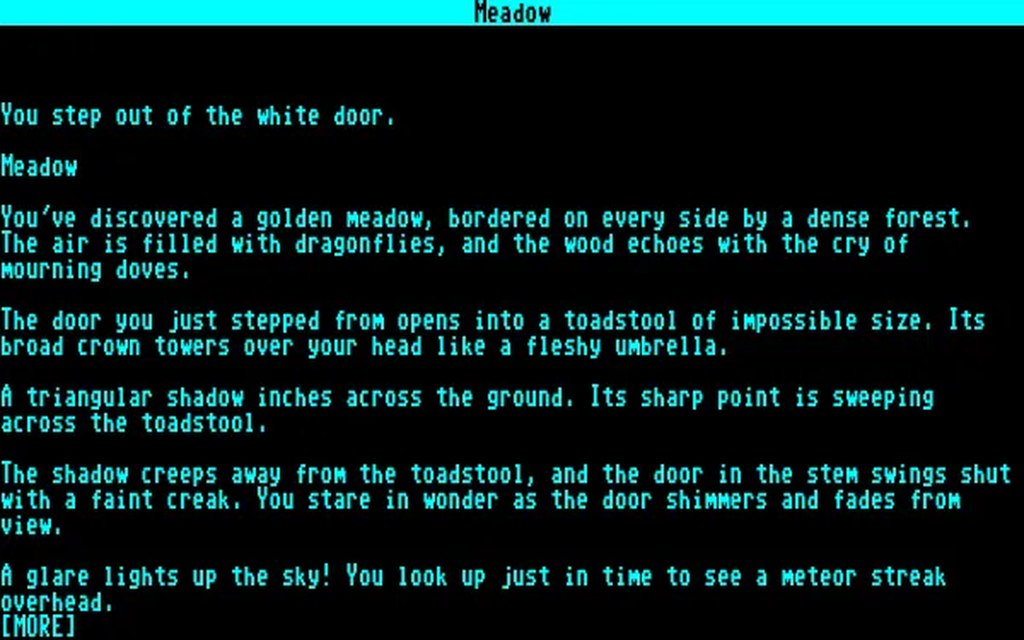
The puzzles — because it is an Infocom game, and a demanding one — are woven into the meditation rather than pasted over it. The bird that steals your ruby, the perambulator, the paper bird, the toadstool that grows in the shadow of a mushroom cloud: solutions feel like metaphors that happen to work. Death is frequent but rarely cheap; the game’s world teaches its own physics of wonder and fallout. Moriarty later said writing it was not a pleasant experience — “it’s not easy to sit down and write that stuff” — and the game carries that weight honestly. Its final movement, at the Trinity site itself, with the countdown running and history at its most fragile, is interactive fiction’s equivalent of a held breath.

The Plus treatment, and the box it came in
Technically, Trinity is a showcase for what the Plus range meant on the C128. The larger memory holds a bigger, denser world without the constant disk-thrash of the 64K Infocom titles; the 80-column VDC display presents Moriarty’s prose at book measure, the quotations and status passages given room to breathe. The C128 screenshots that survive show page after page of considered, unhurried text — this is the Infocom catalogue at its most literary, on the Commodore screen best suited to reading it.
A missile falls on Kensington Gardens in the first five minutes, and everything after is the question of what one person, armed only with knowledge, owes the past.
The physical package was integral, as Infocom intended: “The Illustrated History of the Atom Bomb”, a comic drawn in the style of a 1950s educational pamphlet, which is both a feelie and a key — symbols in its panels correspond to places in the game — alongside a map of the Trinity site and a paper sundial. That a comic about the bomb should be simultaneously charming, factual and quietly horrifying sets the game’s tone before the disk ever spins. Trinity was Infocom’s twentieth game, and the last it released while still solvent; the masterpiece and the ending arrived together.
How to approach it now
Practical guidance for the modern player, because Trinity rewards preparation. Take the opening slowly: Kensington Gardens before the flash is a tutorial in the game’s grammar of small kindnesses and small objects, and several easily missed items — and one easily missed bird — matter hours later. Map the Wabe by hand even though the game’s geography is modest; the act of drawing the doors teaches you how the worlds connect, which is the game’s real subject. Expect to die, and to learn from dying; Moriarty’s deaths are punctuation, not punishment. And read the feelie comic before you play rather than after — it is doing quiet structural work, seeding images the game will call back at the moments of maximum pressure. Players who bounce off Trinity usually bounce off its first hour’s stillness; players who stay describe the same stillness, later, as the bravest thing about it.
The game also sits at a hinge in its author’s life: Moriarty went on to design Loom for Lucasfilm, carrying Trinity’s convictions — that interface should disappear, that story is a system, that games can grieve — into the graphic era. Trinity is where those convictions were forged, on 128K machines, in prose.
Reception, then and since
Contemporary reviewers recognised the scale of what Moriarty had made. Compute! placed Trinity atop its coverage of the season’s adventures, praising its scope and its atmosphere; the hobby press treated it as an event release, one of the big grey Infocom boxes that signified seriousness on a shelf. Its honours accumulated slowly and then permanently: retrospective canons of interactive fiction place it at or near the summit — it has topped community polls of the genre’s best works, and its presence in 1001 Video Games You Must Play Before You Die made official what the IF community had long assumed. The game’s afterlife is active rather than archival: it is taught, analysed and replayed, and Moriarty’s design papers around it are primary sources for the study of narrative games. The C128 edition shares fully in that afterlife — it is no cut-down sibling but one of the original Plus platforms, textually and mechanically identical to the versions the canon celebrates.
The verdict
Every platform has a game that justifies taking it seriously, and for the Commodore 128 — a machine whose native library is usually discussed with an apologetic smile — that game is Trinity. It needed the 128’s memory, it deserves the 128’s screen, and nearly forty years on it has lost none of its power to quiet a room. If you play one text adventure on this machine, play the one about the end of the world, written by a man who went to New Mexico to stand where the world changed. It is as good as this medium got in the 1980s, and the C128 is one of the places it genuinely lives.
Score: 9.0/10 — Interactive fiction’s prose poem about the bomb: beautiful, sorrowful, essential — and a native citizen of the Commodore 128.