At a glance: Turbo · ColecoVision · Coleco/Sega, 1982 · Driving · Bundled with Expansion Module #2, the driving controller · Score: 8.5/10
Most games ask you to buy a cartridge. Turbo asked you to buy a cockpit. Sega’s vertical-scrolling racer was the ColecoVision’s designated driver for Expansion Module #2 — Coleco’s driving controller, a proper steering wheel and accelerator pedal that plugged into the console and turned your lap into the arcade. The game shipped with the module, which makes Turbo inseparable from its hardware: it is simultaneously a launch-window showpiece, a peripheral showcase, and one of the most distinctive racers of the early eighties. It is also, played with the wheel as intended, an absolute riot.
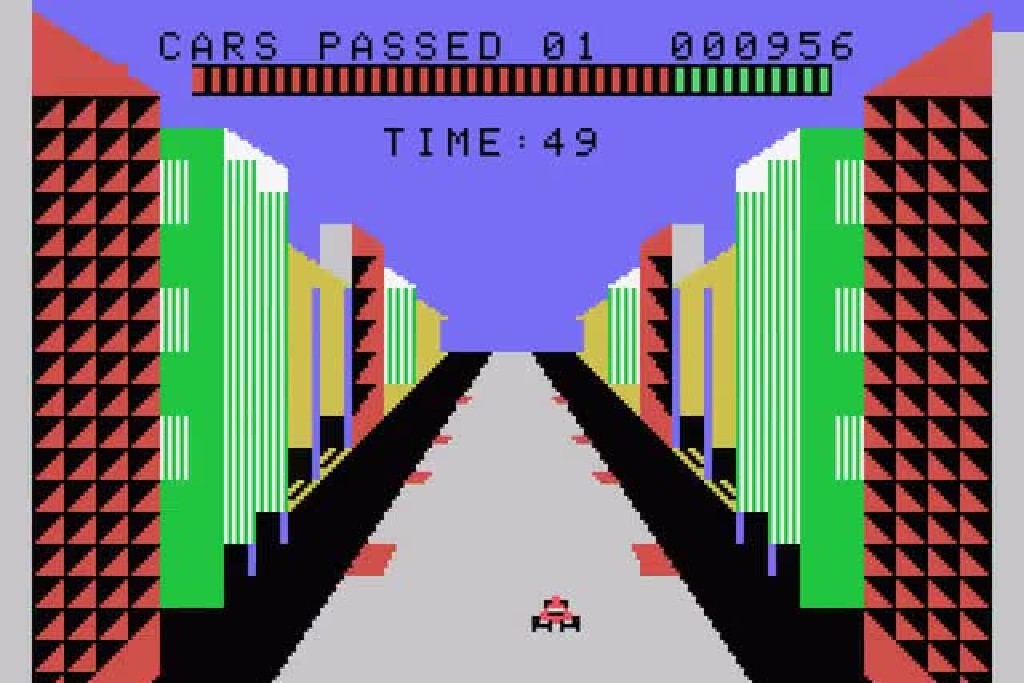
The format is an endurance run through changing country. Your car races along a road that unrolls ahead of you against a field of rivals, and the journey strings together distinct stretches: broad city avenues lined with tower blocks give way to open country roads, tree-lined straights and tighter, twistier sections where the scenery crowds the tarmac. A timer and a quota of cars to pass govern each stretch; finish the section having overtaken the required number and the run continues, crash too often and it ends. An ambulance periodically barges through the field, siren first, and must simply be survived.
The wheel is the difference
Play Turbo on the standard pad and it is a competent, quick eighties racer. Play it on the Expansion Module #2 wheel and it becomes the thing Coleco promised: steering with genuine travel, speed on a foot pedal, and a gear lever arrangement via the second controller for shifting between low and high gear. The wheel’s self-centring pull makes the slalom between rival cars physical in a way no joystick of the era matched, and threading a crowded city section at full speed with the pedal down is the single most arcade-authentic experience the ColecoVision offers. If you collect for this system, Turbo is the cartridge that justifies hunting the hardware.

The game’s structure rewards nerve management. Traffic density climbs, the road narrows, and the changing sections layer new sightlines and corner speeds onto the passing quota. The country stretches are the memorable cruelty: the same corner that was a formality among the tower blocks becomes a negotiation when the road tightens and the rivals bunch. Crashes cost time as much as lives, and the passing quota means a cautious run can fail as surely as a reckless one — you are always being asked to overtake a few more cars than feels wise. That pressure, sustained across a long multi-stage run, is the game’s signature.
Conversion notes
Sega’s arcade Turbo was a graphically ambitious machine, with its scaling scenery and dashboard presentation, and the ColecoVision version necessarily simplifies: the road is flatter, the scenery sparser, the sense of speed conveyed more by traffic and roadside objects than by the coin-op’s spectacle. What survives intact is the game’s geography and rhythm — the sequence of environments, the city-to-country structure, the ambulance, the quota system — and, with the wheel connected, its soul. Engine and siren sounds do their work through the console’s sound chip, and the dashboard readouts keep speed and progress legible.
Two practical notes for modern players. First, the module’s pedal is essentially a switch rather than an analogue control, so speed management is about feathering and timing rather than fine throttle work — period-authentic, and part of the skill. Second, Turbo also plays acceptably on a standard controller, so the cartridge is not hostage to the peripheral; it is simply transformed by it. Complete Module #2 sets — wheel, pedal and game — are among the ColecoVision’s most sought-after boxed items, and condition of the wheel mechanism is what to check first.
The checkered flag
Turbo’s place in the library is unique: it is the game that proved Coleco’s expansion philosophy in the most literal way, by putting a new kind of control in the box. As a racer it has aged into a tough, charming endurance challenge, and as a piece of design it points directly at the driving rigs and wheel peripherals that gaming would chase for decades. This is the ColecoVision at its most ambitious — a console trying to bring the whole arcade cabinet home, wheel and all.

Managing a run: quotas, gears and the ambulance
Long Turbo runs are won on management rather than reflexes. The passing quota reframes every section as an arithmetic problem: you must bank overtakes steadily rather than heroically, because a section spent recovering from crashes is a section whose quota quietly becomes impossible. The gear change — worked from the second controller when the full module setup is in play — is the rhythm of that management: low gear for the crowded, technical stretches where positioning is everything, high gear for the open road where the quota is made up. And then there is the ambulance, the game’s roaming sermon on restraint. It announces itself by siren, barges through the field at its own pace, and cannot be passed with any dignity; the correct play is always to let it go, lose the seconds, and resume the count. Every new Turbo player learns this by experiment exactly once. The game’s other quiet virtue is legibility: speed, time, cars passed and score are always in view, so failure in Turbo is never mysterious — you know which section, which overtake, which moment of greed ended the run, and the next run starts with a plan already forming.
The peripheral that predicted the future
Step back, and Expansion Module #2 is a remarkable artefact: a home console shipping a dedicated steering wheel and pedal set as a first-party expansion in 1982, decades before racing rigs became a gaming industry. Turbo was its proof of concept, and the pairing was sold as a system, not an accessory — the box promised the arcade’s driving cabinet, and by the standards of the day it delivered one. That lineage matters to the ColecoVision’s reputation among hardware collectors, for whom a complete, working Module #2 with its game is one of the system’s signature display pieces. It matters to players for a simpler reason: Turbo with the wheel is not a novelty control scheme. It is the game as designed, and the pad, however competent, is the substitute.
For collectors: buying the full Turbo experience
Because the game and the driving module were sold as one proposition, collecting Turbo properly means collecting the set — wheel unit, pedal and cartridge — and judging it as a set: the wheel’s mechanism should turn smoothly and centre honestly, the pedal should respond without sticking, and the cartridge itself is the common, easily replaced part of the trio. A working module also pays rent beyond this one game, since a small group of ColecoVision titles — Destructor most charmingly — can use the driving controller, giving the big plastic wheel a second life most single-game peripherals never get. None of that changes the essential point with which this review began, but it sharpens it: Turbo is not simply a game to own for this system. Assembled whole, it is a piece of the arcade, parked in front of your television, that Coleco sold in a box in 1982.
The verdict
With the wheel, Turbo is an essential ColecoVision experience and one of the great peripheral games of its era. Without it, it is still a stern, varied and rewarding racer. Either way, it is the cartridge that turns this console into a driving machine.
Score: 8.5/10 — Pedal down: the definitive home racer of 1982, steering wheel included in the legend.