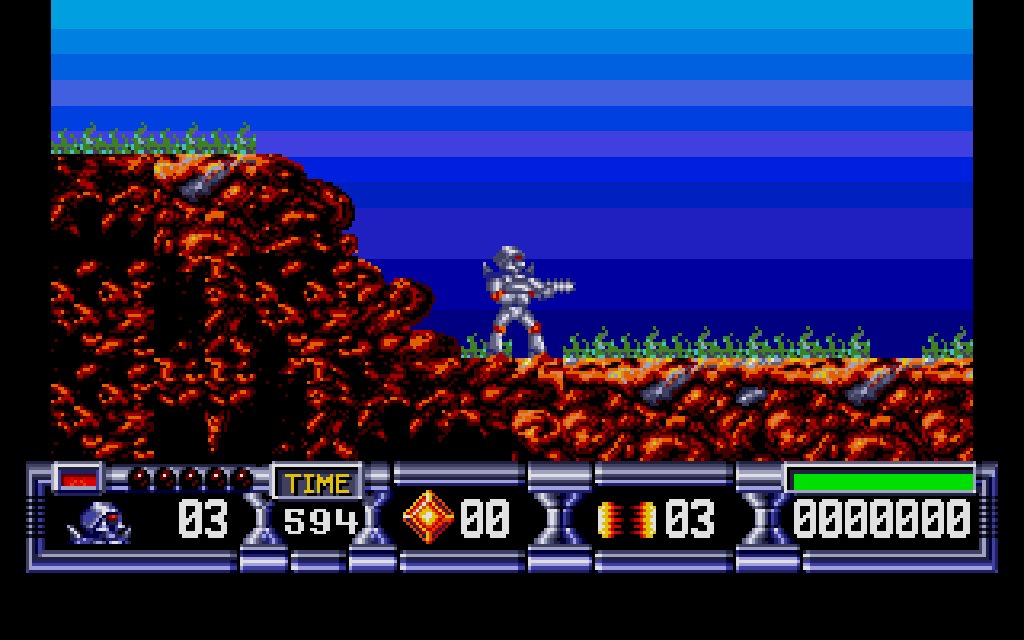
At a glance: Turrican II: The Final Fight · Atari ST · Factor 5 / Rainbow Arts, 1991 · Run-and-gun platformer · Score: 8.5/10
The Morgul is coming, Earth is calling, and one man in a Turrican assault suit answers with the most generous arsenal in 16-bit gaming. Turrican II, Factor 5’s 1991 sequel, is the run-and-gun perfected on home computers: five worlds of sprawling, secret-stuffed levels, a hero who can roll into an invulnerable wheel, spread fire in a 360-degree arc by holding the button and spinning, and Chris Huelsbeck’s score pouring through the speakers like the end credits of the best action film never made. On a dozen formats it was a flagship. On the ST — a machine that shooters of this scale were supposed to struggle with — it is a small technical miracle and a very big game.
The levels are the argument. Where most run-and-guns are corridors, Turrican II builds territories: multi-level complexes of platforms, waterfalls, machinery and sky, packed with hidden blocks, 1UPs, weapon caches and entire secret rooms, rewarding the player who explores upward and backward as eagerly as forward. The wheel form turns navigation into a puzzle language — gaps too low to walk are rolled, hazards that would kill the suit glance off the ball. Two shoot-’em-up stages break the campaign open into pure aerial blasting, and the final world delivers a confrontation the series’ fans still rank among the era’s best. It is a long game, a wide game, and it respects the player’s curiosity with a density of secrets that took the playground months to map.
The ST conversion that refused to shrink
Let the technical record be stated plainly, because it is the ST version’s glory. This style of fast, multi-directional scrolling with large sprites and layered action was widely considered the home ground of the ST’s great rival and its custom hardware. The ST conversion of Turrican II — handled with Factor 5’s own code at its heart — delivers the full game: the huge levels, the weapon system, the wheel, the shoot-’em-up stages, running fast and scrolling smoothly on a stock machine. It stands as one of the most accomplished action conversions in the ST library, proof repeated whenever the old playground argument needs settling with evidence instead of volume. Owners who were told their machine could not do this kind of game had a two-word answer, and the second word was a number.
Turrican II on the ST is not the compromised port the playground expected. It is the whole game, at speed, with its secrets intact — a conversion that argues back.
Then there is the music. Huelsbeck’s Turrican II score — The Final Fight, The Great Bath, the whole soaring, synth-orchestral campaign of it — is one of the most beloved soundtracks in games, and hearing it interpreted on the ST’s YM chip is its own pleasure: leaner than the famous sampled renditions, all melody and momentum, with sound effects battling honourably for the channels. Purists will always crown the other version’s audio, and fairly; but the ST’s rendition is no apology, and in play — wheel spinning, spread shot sweeping, that score driving — the complete experience is intact where it counts: under your thumbs.
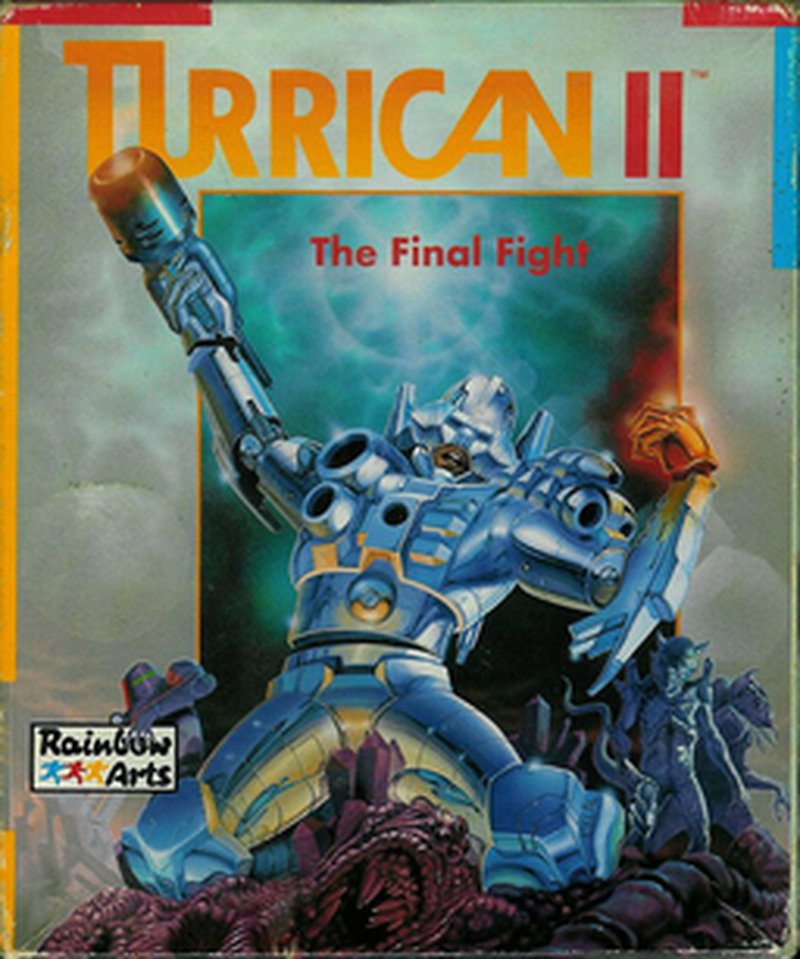
The honest debits
Turrican II’s generosity has a price in difficulty shape. The campaign is long and continues are limited, so a full run is a commitment an evening must plan for; the exploration-first design, for all its riches, can strand a hurried player in a level’s back corners while the clock of their attention runs down; and some of the later worlds lean on instant-death drops that the wheel form’s momentum makes genuinely treacherous. The ST version, for its miracle, drops the parallax layers its rival flaunts, and sprite flicker joins the biggest melees. These are the debits of a game reaching for everything at once. Its reach, mostly, is its grasp.
The series’ standing needs no inflation: Turrican II is routinely named among the finest action games of the 16-bit era on any system, and the ST edition’s quality made it a cross-format citizen rather than a footnote. It closed Rainbow Arts’ and Factor 5’s home-computer era at a peak both companies carried into everything after.
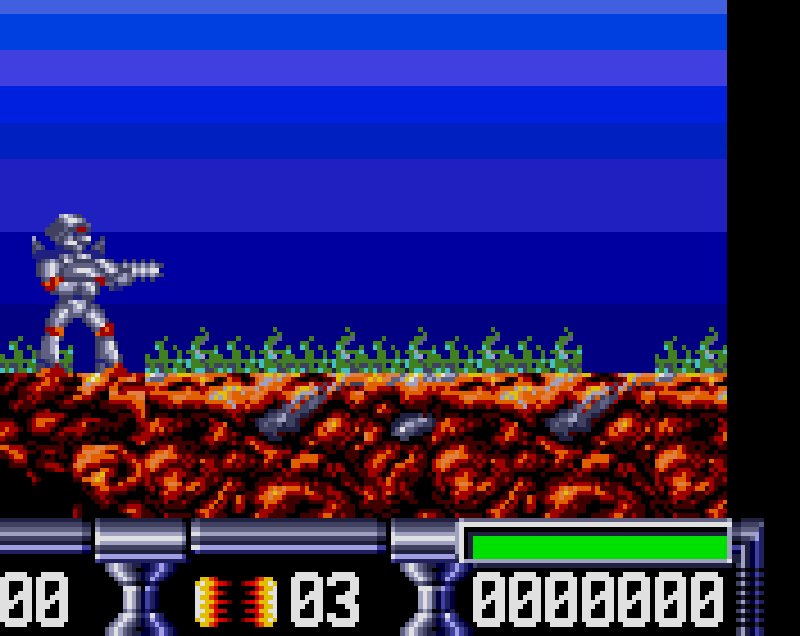
Armed to the teeth, by design
The arsenal deserves its own salute, because Turrican II’s weapons are a philosophy. The spread shot that fans to a full circle as you spin the joystick is not just powerful; it changes your relationship with the level, turning every direction into a negotiation and every ambush into an opportunity. The lightning whip — that crackling, steerable beam — rewards aggression with reach. Power lines carve through everything in a straight, glorious argument. Layer the wheel form beneath it all, invulnerable and momentum-drunk, and the hero becomes less a sprite than a small arsenal with opinions, and the levels — built wide to give the arsenal room — become playgrounds rather than gauntlets. Few action games of any era hand the player this much joyful overkill and then design honestly around it; the enemies mass, the bosses swell, and the balance holds.
The shoot-’em-up interludes complete the generosity. Rather than padding, they function as the campaign’s deep breaths — pure, fast, Huelsbeck-scored blasting that recontextualises the ground game’s exploration as one movement of a larger symphony. It is the structure of a team at the height of its powers showing off in several disciplines at once, and Factor 5 would carry exactly that confidence into their celebrated console work. On the ST, the miracle is that none of it was trimmed to fit the machine. The whole symphony is here, in tune, at tempo. That is why this conversion is the one ST owners cite when the old argument starts — not as a plea, but as an exhibit.
A collector’s footnote that doubles as a playing tip: Turrican II rewards the explorer so systematically that the honest way to review your own progress is by secrets found, not worlds reached. The player who finishes it with a low tally has played a very good shooter; the player who ferrets out the hidden blocks, the stacked 1UPs and the rooms behind the waterfalls has played the masterpiece. Both are in the same box, which is the definition of generosity in an action game. Set aside a long evening, a notebook for the password milestones, and no intention of stopping at the first world. The Final Fight is long, loud and — on the evidence of this conversion — entirely worth the ST it was fought on.
Verdict
Turrican II: The Final Fight is an essential ST action game: vast, secret-rich, superbly armed and converted to the machine with a craftsman’s refusal to cut corners. Its scale, its wheel, its score and its sheer confidence make it the run-and-gun its library is proudest of — and the disc you reach for when someone claims the ST could not do this kind of game. Suit up, hold the fire button, and spin. The Morgul is waiting, and so are a hundred hidden rooms.