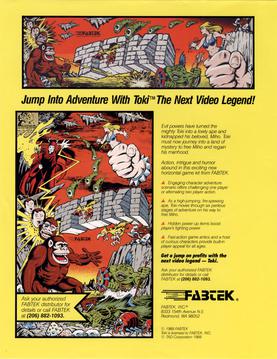
Of all the lost games to come back from the dead, few are as cheerfully unlikely as this one: a spitting ape, a console Atari had already buried, and a finished game nobody knew existed. When we first reported this story in January 2015, it sounded almost too good — the unreleased Atari 7800 port of Toki, TAD Corporation’s beloved arcade platformer, had been discovered on a former Atari employee’s computer and was, supposedly, on its way to a cartridge release. A decade on, the full story is stranger and more bittersweet than the original headline suggested, so here it is properly: how Toki for the 7800 was made, lost, found — and why the ending still isn’t quite the happy one we were promised.
The Ape Who Spat His Way Around the World
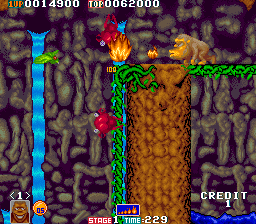
Toki arrived in arcades in 1989, developed by TAD Corporation and known in Japan as JuJu Densetsu. Its hero is a jungle-dwelling man transformed into an ape by the witch doctor Stark — Vookimedlo in western versions — who has turned the whole island’s population into beasts and kidnapped the princess Miho. Toki keeps his wits, gains the improbable ability to spit energy bolts (some ports carried the glorious subtitle “Going Ape Spit”), and sets off through trap-filled stages of caves, lakes, fire caverns and ice palaces, collecting power-ups — fireballs, helmets, flamethrowers — and facing down a menagerie of end-of-level brutes.
It was never a Street Fighter-sized phenomenon, but it was a dependable arcade earner with charm to spare, and the home conversions came thick and fast: NES, Mega Drive, Amiga, Atari ST and Commodore 64 all got versions, and the Atari Lynx port in particular is still remembered as one of that handheld’s finest hours. One machine, though, was conspicuously missing from the list — the Atari 7800, the console Atari had relaunched in 1986 to fight the NES and largely abandoned by the turn of the decade. As far as anyone knew, Toki had simply never been part of its story.
A Ghost in the Paperwork
Except that it had. Internal Atari documents that surfaced among collectors showed a 7800 version of Toki in development remarkably late — so late, in fact, that work continued after January 1st, 1992, the day Atari formally discontinued the 7800, the 2600 and its 8-bit computers. Collector guides drawing on those documents place Toki among a final handful of 7800 titles still active in May 1993, alongside Pit Fighter, Rampart, Road Riot 4WD and Steel Talons, and describe it as very close to finalised when management pulled the plug on 7800 development entirely. The conversion was handled in Britain by Images Ltd. — programmer Jason Lihou is the name attached to it — with input from Maximum Effect, and the paperwork put the project’s total cost at a strikingly modest £9,000.
Paperwork, however, is not a game. For more than twenty years, those documents were the only evidence the 7800 port had ever progressed beyond a line in a spreadsheet. Prototypes of other cancelled 7800 games trickled out over the years, but of Toki there was no code, no cartridge, nothing to play. It had every appearance of being one of retro gaming’s permanent phantoms.
Found on a Hard Drive, January 2015

Then, in late January 2015, Beta Phase Games announced the discovery. The 7800 version had turned up on a computer — bought on eBay — that had belonged to a former Atari employee, and Toki was not alone on it: the same haul included a 7800 Klax and a clutch of Lynx works including Hotdog, Road Riot 4WD, Poker and Relief Pitcher. The Toki build, labelled Beta 2, was essentially the finished game. AtariAge member CPUWIZ posted photographs of it running on real hardware, and the community’s verdict was immediate: this was no mock-up or early demo, but the genuine, near-final conversion the documents had promised.
Beta Phase’s plan, as reported at the time, was exactly what collectors wanted to hear: convert the PAL-format build to run properly on NTSC machines, release Toki on cartridge, and follow it roughly a month later with a public ROM release. Our original stub, published on January 31st, 2015, passed that promise on in good faith. Hold that thought — we will come back to it.
How Good Is the 7800 Version?
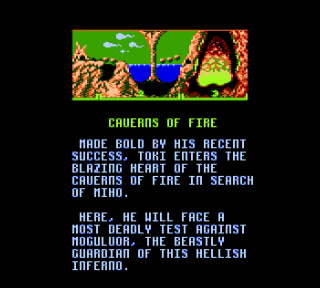
Thanks to AtariProtos’ exhaustive playthrough of the prototype, we know the answer in detail — and it is: remarkably good. The 7800 conversion follows the arcade game’s structure stage by stage, from the Labyrinth of Caves through Lake Neptune’s swimming sections, the lava rides of the Caverns of Fire and the Ice Palace, with its bosses intact — the monkey-hurling Boloragog, the eyeball-dropping Rambacha, the letter-belching Mogulvar and the tusk-throwing mammoth Zorzamoth all present and correct. The power-up set survives too, with one hardware-shaped compromise: the arcade’s three-way split shot becomes a two-way V on the 7800, a sensible trim rather than a glaring loss.
There are cuts, and they are honest ones. The arcade game’s swinging vines never made it in, and — as AtariAge’s report noted at the time of the discovery — the final stage is absent altogether, most likely a victim of cartridge space. The difficulty is pure 1989: one hit kills Toki, and the timer is stingy enough to punish sightseers. But measured against what the 7800 usually received in its lean years, this is a conversion of real care — colourful, faithful and fast — which makes its cancellation in 1993, with the finish line in sight, all the harder to take. Atari was months from launching the Jaguar; a £9,000 ape game for a discontinued console simply had no champion left in the building.
Hindsight: The Release That Never Quite Happened

Here is where we must correct our own headline. In the years after the 2015 announcement, the promised cartridge did not reach sale, and the planned follow-up ROM release never officially happened either. Collector checklists of physical 7800 releases still file Toki under prototypes that never came out, and the build has been deliberately kept out of the community’s freely-distributed ROM collections at the rights holder’s insistence — its absence from those packs is specifically noted by their compilers. Whatever the reasons behind the scenes, the result is a strange limbo: the game exists, it is finished bar its final stage, it has been documented screenshot by screenshot — and the general public still cannot legitimately play it. The discovery was real; the release, to date, was not.
Toki himself, at least, got his comeback by another road: Microids’ hand-drawn remake, with art by original-era illustrator Philippe Dessoly, brought the ape to the Switch in 2018 and to other platforms in 2019, introducing him to a new generation in high definition. It is a lovely thing. But for 7800 devotees, the little lost conversion remains the one that got away — a reminder that in game preservation, finding the treasure and sharing it are two very different battles, and the second one is sometimes never won.