
Most lost games leave a paper trail. There is a magazine preview, a trade-show listing, a line in an old catalogue — something for historians to chase decades later. UWC left nothing at all. When collector and YouTuber Stephan Reese, known online as Archon 1981, posted footage of the game in early March 2019, he was not announcing the recovery of a documented rarity. He was introducing a Nintendo Entertainment System wrestling title that, as far as anyone could tell, had never been publicly announced, advertised, reviewed or even rumoured. A complete, playable NES game had sat in private hands for roughly thirty years, and the wider world learned of its existence only because the man who ended up owning its cartridge decided to plug it in and press record.
What appeared on screen explained both the fascination and the confusion. The title screen read simply UWC, carried a 1989 copyright and bore the name of Japanese firm SETA. Behind those three letters sat a roster of late-1980s wrestling stars — Ric Flair, Sting, the Road Warriors — rendered as chunky 8-bit portraits. Yet almost nobody in 2019 recognised the initials, because the company they stood for had barely existed at all. UWC turned out to be a fossil from one of the strangest fortnights in wrestling business history: the brief moment when the promotion that became World Championship Wrestling was called something else entirely.

The Nintendo Entertainment System, the machine UWC was built for and never reached in shops. Photo: Evan-Amos via Wikimedia Commons.
A Name That Barely Had Time to Exist
To understand the cartridge, you have to start in Charlotte, North Carolina. Through the 1980s, Jim Crockett Promotions was the dominant territory in the National Wrestling Alliance, the loose confederation of regional promotions that governed much of American wrestling, and its television programmes gave the South a weekly diet of Flair, the Road Warriors and a fast-rising, face-painted Sting. The promotion’s finances, however, were struggling, and in 1988 media magnate Ted Turner stepped in. Turner Broadcasting bought Jim Crockett Promotions in the autumn of 1988, taking control of its wrestlers, its television slots and its championship lineage.
Buying a promotion is one thing; naming it is another. Reporting around the discovery — notably Paste magazine’s Garrett Martin, whose wrestling knowledge Polygon and others drew on in March 2019 — established that Turner’s organisation initially planned to operate under a new corporate banner: the Universal Wrestling Corporation. The name was genuinely used, but only fleetingly. Within a very short time the company settled instead on World Championship Wrestling, borrowing the title of its flagship television programme, and WCW went on to run for thirteen years before its assets were sold to the rival WWF in 2001. The Universal Wrestling Corporation, by contrast, survives mostly as a trivia answer.
That fleeting window is precisely what makes the cartridge datable, and so remarkable. A game branded UWC could only sensibly have been commissioned while the Universal Wrestling Corporation name was still the plan — which points to a deal struck around the Turner takeover in late 1988, with development running into 1989, the year on the title screen. By the time the game approached completion, its very title referred to a company that no longer existed under that name. The branding had been pinned, counted out and replaced before the software ever reached a shop shelf.
The Cartridge in the Tester’s Keeping
The physical trail, as Reese described it in his reveal video and as Kotaku, CNET, Polygon and others relayed it that March, is short and unusually human. The game was developed in Japan under SETA’s banner — SETA’s name is the one the title screen carries — and a review cartridge was sent across the Pacific to Nintendo of America, the standard route for a title seeking approval for release in the United States. There, according to Reese’s account, the cartridge was handed to an employee to test for a disarmingly simple reason: he was a wrestling fan.
Then the trail goes quiet, because the game went nowhere. It was never announced, so there was no cancellation story for magazines to report, and the review copy simply stayed with the man who had been given it to evaluate. It remained in that former Nintendo employee’s possession for around three decades — not archived by a publisher, not listed in any database, just kept. Reese, a dedicated NES collector, acquired the cartridge directly from that former employee, in what contemporary reports described as a purchase from the tester himself; Reese has said the copy he obtained is, as far as anyone knows, the very review cartridge that crossed the Pacific, and quite possibly the only one in circulation.

A standard retail NES cartridge. UWC never reached this stage — its only known copy remained a review cartridge held privately for three decades. Photo: Wikimedia Commons.
Reese revealed the find the modern way, with a YouTube video showing the cartridge, the title screen and extended gameplay, and the story spread within days through gaming and wrestling press alike. WWE itself, which had owned the WCW name and library since 2001, covered the discovery on its own website, noting that the review-cartridge format suggested a game that had been close to finished. Frank Cifaldi of the Video Game History Foundation quickly became involved, and within about a week of the reveal the Foundation had played the game through and published a full playthrough — the first time anyone outside that small 1989 circle had seen the game completed.
Eight Faces and Not a Single Name
Curiously, the game never tells you who you are playing. Its character-select screen presents eight illustrated portraits without printed names, which turned the first week of coverage into a parlour game for wrestling historians. Some identifications were instant: nobody could mistake the grinning, robe-ready Ric Flair, and the Road Warriors — Hawk and Animal — brought their unmistakable face paint and spiked presence with them. Sting, still in his colourful surfer-era look rather than the later crow-inspired reinvention, was equally clear, as was Barry Windham in the footage Reese released.
The rest took detective work. Garrett Martin’s analysis, published through Paste and widely cited that week, identified the Midnight Express pairing of Bobby Eaton and Stan Lane, plus Jimmy Garvin — an identification confirmed when Garvin appeared by name in the in-game action shown in the footage. One portrait provoked genuine argument: Polygon’s Owen Good looked at the same selection screen and saw Lex Luger, then one of the promotion’s biggest stars, where Martin saw Lane. The debate resolved in favour of Lane once the Video Game History Foundation’s playthrough circulated in mid-March, confirming the full eight: Road Warrior Hawk, Road Warrior Animal, Sting, Jimmy Garvin, Bobby Eaton, Stan Lane, Ric Flair and Barry Windham.
That line-up is a time capsule in itself. It captures the promotion at the exact hinge point between the Crockett era and the WCW years — the Horsemen pairing of Flair and Windham, the Midnight Express at their peak as a tag team, Garvin, and the ascendant Sting — while omitting figures who left around the takeover, and freezing everyone as they looked before the 1990s reshaped them. The subsequent NES release WCW Wrestling, developed by Nichibutsu and published by FCI in 1990, would field a noticeably different roster. UWC preserves the earlier moment.
What Is Actually on the Cartridge
For a game nobody was meant to see, UWC is strikingly complete. As documented in Reese’s video and the Foundation’s playthrough that March, it offers one-player and two-player options and three match types: singles bouts, tag team matches and an elimination series format. The tag mode locks its eight wrestlers into four fixed teams — the Road Warriors together, Eaton and Lane as the Midnight Express, Flair paired with Windham, and Sting teamed with Garvin — so dream pairings across those lines are off the menu, a very tag-team-era design decision.
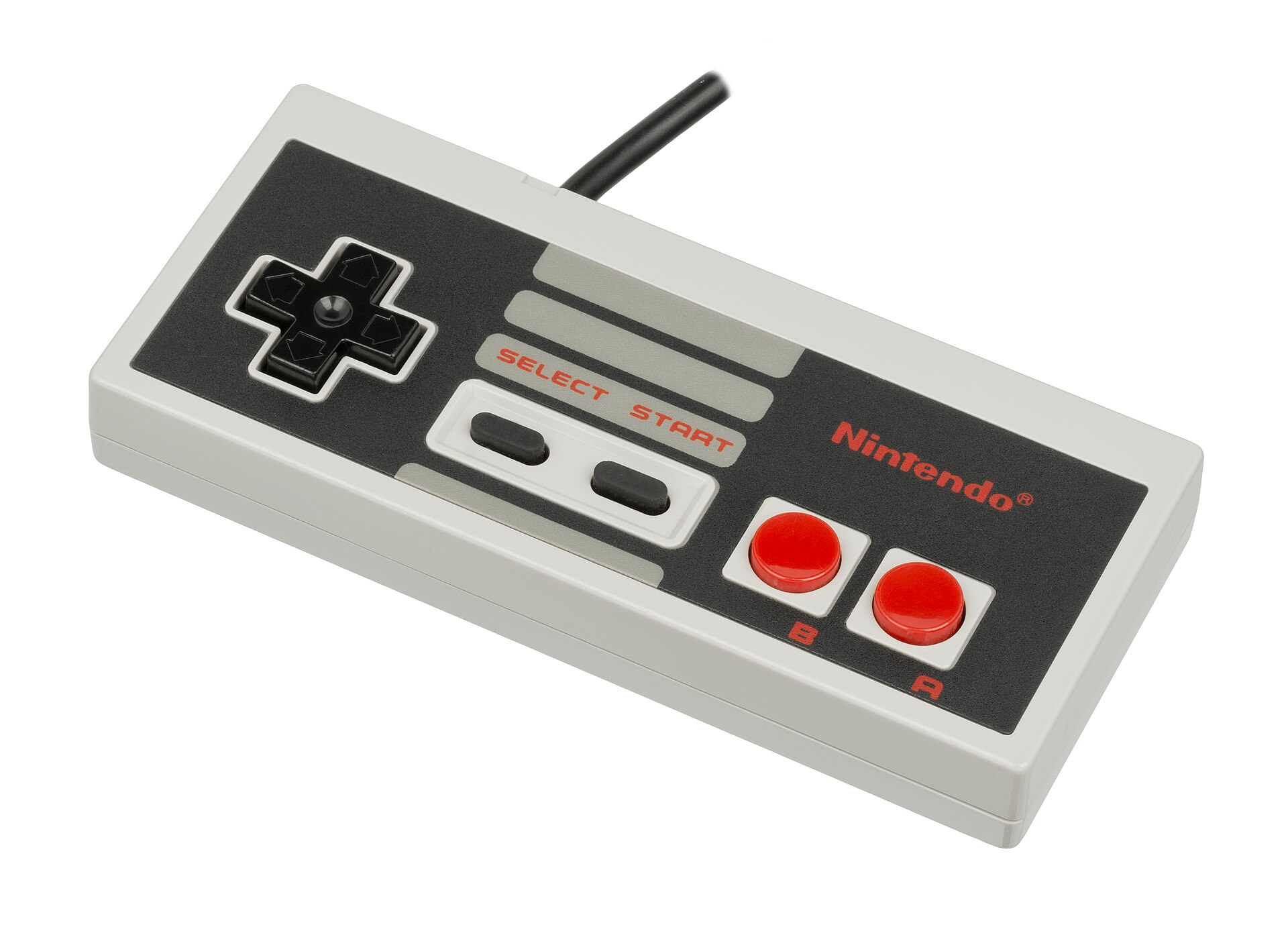
The NES controller — two buttons were all UWC needed for its grapples, strikes and pins. Photo: Evan-Amos via Wikimedia Commons.
Single-player progression, as contemporary coverage of the playthrough described it, is structured around climbing difficulty tiers — Beginner and Professional before a final Master level — on the road to the championship, which means beating the game once is only the start of the assignment. In the ring, observers in March 2019 repeatedly reached for the same comparison: Nintendo’s own Pro Wrestling, the beloved 1987 original, with WWE’s coverage also noting similarities to the later FCI game. The action spills outside the ropes as well, with opponents hurled, clotheslined or suplexed to the floor, and contemporary breakdowns of the footage catalogued a respectable moveset for the hardware — running lariats, vertical suplexes, a bridging belly-to-back suplex out of a headlock, even a standing claw from Hawk. This was no single-screen tech demo; it played like a finished commercial wrestling game of its period, because that is what it had been built to be.
Why the Bell Never Rang
Here the record thins to speculation, and honesty requires saying so. As of March 2019, nobody — not Reese, not the press, not the preservationists — could say definitively why UWC was shelved. Reese himself offered theories rather than answers in his reveal. The most plausible reading, aired repeatedly that month, is a licensing shuffle: whatever arrangement put SETA’s game into development around the 1988 takeover did not survive the transition, and the NES wrestling licence visibly landed elsewhere, producing FCI’s WCW Wrestling instead. A game named after a corporation that had already been renamed faced an obvious commercial problem in any case; rebranding it would have meant new art, new text and a new deal, for a title whose moment had arguably passed.
What is certain is the scale of the near-miss. A near-complete, fully playable game, built around some of the most famous wrestlers on the planet, passed through Nintendo of America’s own testing process and then vanished so thoroughly that its existence was unknown even to specialist historians for thirty years. It was not lost in a fire or a flood. It was simply set aside, in the keeping of a tester who liked wrestling, while the industry moved on.
A Game That Existed Only Once
The discovery matters on two levels. For wrestling fans, UWC is the earliest WCW-related game ever documented — earlier than the title that actually carried the WCW name — and a snapshot of the promotion at its most transitional. For game historians, it is a reminder of how fragile this history is: an entire commercial production survived, apparently, because one employee kept one cartridge. Had that single copy been binned at any point in three decades, there would have been nothing to find — no announcement, no advertisement, no evidence the game had ever existed at all.
Reese closed his reveal with a promise that pointed the story forward: he intended to make the game available for the public to play, so that a title known to almost no one in March 2019 would not spend another thirty years that way.