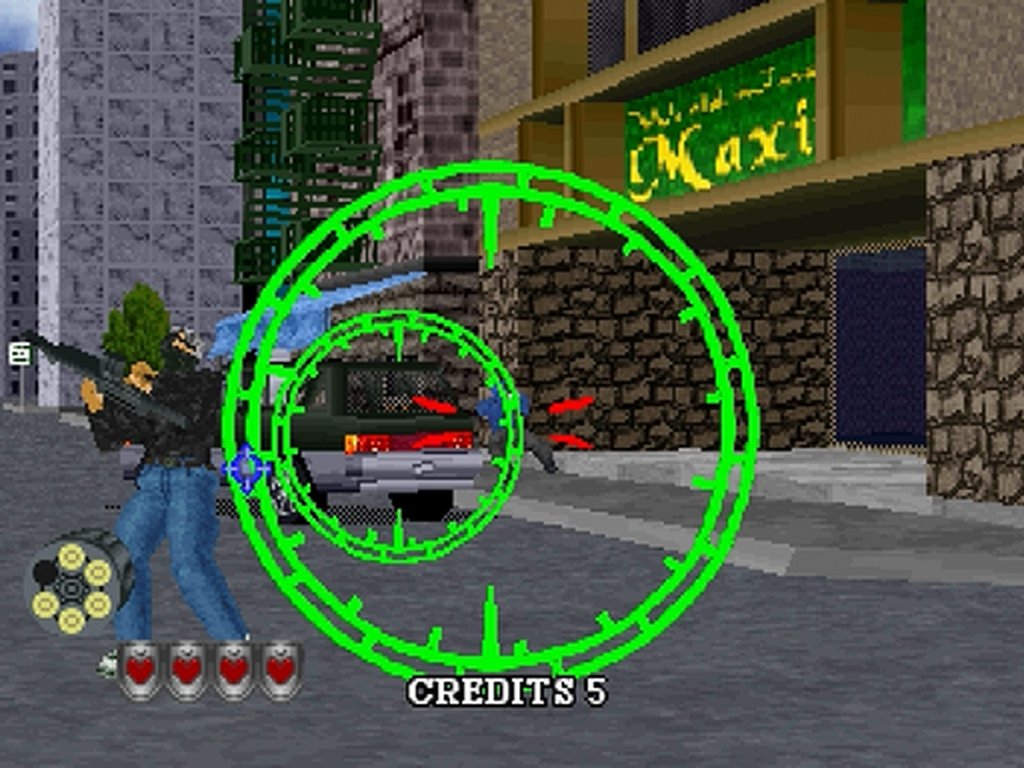
At a glance: Virtua Cop 2 · Sega Saturn · Sega AM2 / Sega, 1996 · Light-gun shooter · Score: 8.5/10
Virtua Cop 2 is built on a single, satisfying verb: point. Yu Suzuki’s AM2 took the light-gun game — a genre as old as the arcade itself — and gave it cinema: criminals who roll, dive and pop from behind hostages; locations that move, from a jewellery heist to a speeding train to a bulldozer chase; and a scoring system built on the Justice Shot, the disarming hit that rewards the steady hand over the fast one. The Saturn conversion brought the Model 2 arcade game home with its pace, its polygonal charm and its soul intact, and with a Virtua Gun in your hand and a CRT in front of you, it remains one of the most purely enjoyable quarter-hours in gaming — repeatable, like all great arcade machines, forever.
The structure is arcade-honest: three cases of escalating mayhem, each a few minutes long, each ending in a boss with a health bar and a grudge. What separates Virtua Cop 2 from the shooting-gallery crowd is direction. The camera is a filmmaker: it swoops down stairwells, pans across a bank robbery in progress, rides a cable car, hangs off the side of a train. Enemies are placed like actors — the innocent bystander who must not be hit is the game’s favourite punctuation, and the penalty for shooting one, a life, teaches trigger discipline faster than any tutorial. Power-ups hide in barrels and crates: machine guns, automatics, a magnum that feels like a promotion. Every thirty seconds the game finds a new way to arrange targets in space, and because the runs are short, every arrangement can be memorised, perfected, and shown off.

The Saturn conversion carries AM2’s usual signature: the essentials protected at all costs. The frame rate holds through the busiest shootouts, the flat-shaded polygonal criminals animate with that Model 2 balletic snap — enemies do not just fall, they perform their falls — and the home version adds the options the arcade never could: difficulty and life settings, a gun calibration that respects your television, and the two-player co-operative mode that turns the whole game into a duet of overlapping fields of fire and friendly arguments about who shot the hostage. Played with the Virtua Gun (the Stunner, in North America), the loop is perfect: aim, fire, reload off-screen with a flick, the way the arcade taught a generation. Played on the pad, it is a lesser but still respectable target-shooter, the cursor honest and the game forgiving enough to allow it.
Justice, scored
The Justice Shot deserves its own analysis, because it is the mechanic that turns a shooting gallery into a sport. Wing a criminal’s gun hand — shoot the weapon, or the arm that holds it — and he surrenders, worth more points and more honour than a body shot, chained into bonuses for consecutive mercies. It reframes every encounter: the fast kill is safe, the disarm is art. Combined with the accuracy grading, the item bonuses and the boss clear bonuses, Virtua Cop 2 becomes a score-attack game with genuine texture, where a perfect run is a choreographed thing. The Saturn’s memory of your best scores, case by case, quietly drives the one-more-go loop that arcade operators once monetised. Add the unlockable extras, the big-head cheats and the Saturn-only training flavour, and the package is generous by 1996’s coin-op conversion standards.
Virtua Cop 2’s genius is the Justice Shot: it pays you more for mercy than for marksmanship, and suddenly every trigger pull is a moral decision taken at speed.
The limitations are the genre’s and the era’s, plainly worn. Three cases make a short game — a skilled run is under half an hour — and the Saturn version cannot add what the arcade never had; replay is the content, as it was designed to be. The polygon models, charming as they are, were plain even in 1996 next to the textured revolution happening elsewhere, and a modern player meeting the game on a flat panel will meet its one true hardware demand: light guns need a CRT, full stop. On original hardware with the right television, that demand is invisible. Without them, you are playing the translation, not the text — the same caveat that applies to the era’s whole light-gun library, and worth stating in a Saturn review because the Saturn’s gun, and this game, were the era’s best pairing.

AM2’s arcade, at home
In the Saturn’s story, Virtua Cop 2 is the reliable professional: not the million-selling phenomenon of Virtua Fighter 2, not the cult miracle of the Panzer games, but a conversion that did its job so well it became the default way to own an AM2 arcade game. It also anchored a little ecosystem — the gun, the sequel-hungry fans, the later Virtua Cop and House of the Dead releases that made the Saturn, improbably, the light-gun console of its generation. Judged as the Saturn version specifically, that is its glory: no content cut that matters, no frame-rate apology to make, and a co-op mode that fills a room with noise the way the arcade original filled it with quarters. Its 8.5 is the score of a superb short game — the ceiling that brevity imposes, not any failure of execution, which is faultless.
There is one more pleasure worth naming: the game’s confidence in its own silliness. The criminals wear sunglasses indoors. The final boss arrives with the series’ trademark absurdity. A bulldozer is a vehicle section. Virtua Cop 2 never winks, which is why it works — the straight face, the sunglassed goons, the hostage who waves. Arcade games were pop music, and this is a perfect three-minute single, pressed onto a Saturn disc without losing a note.
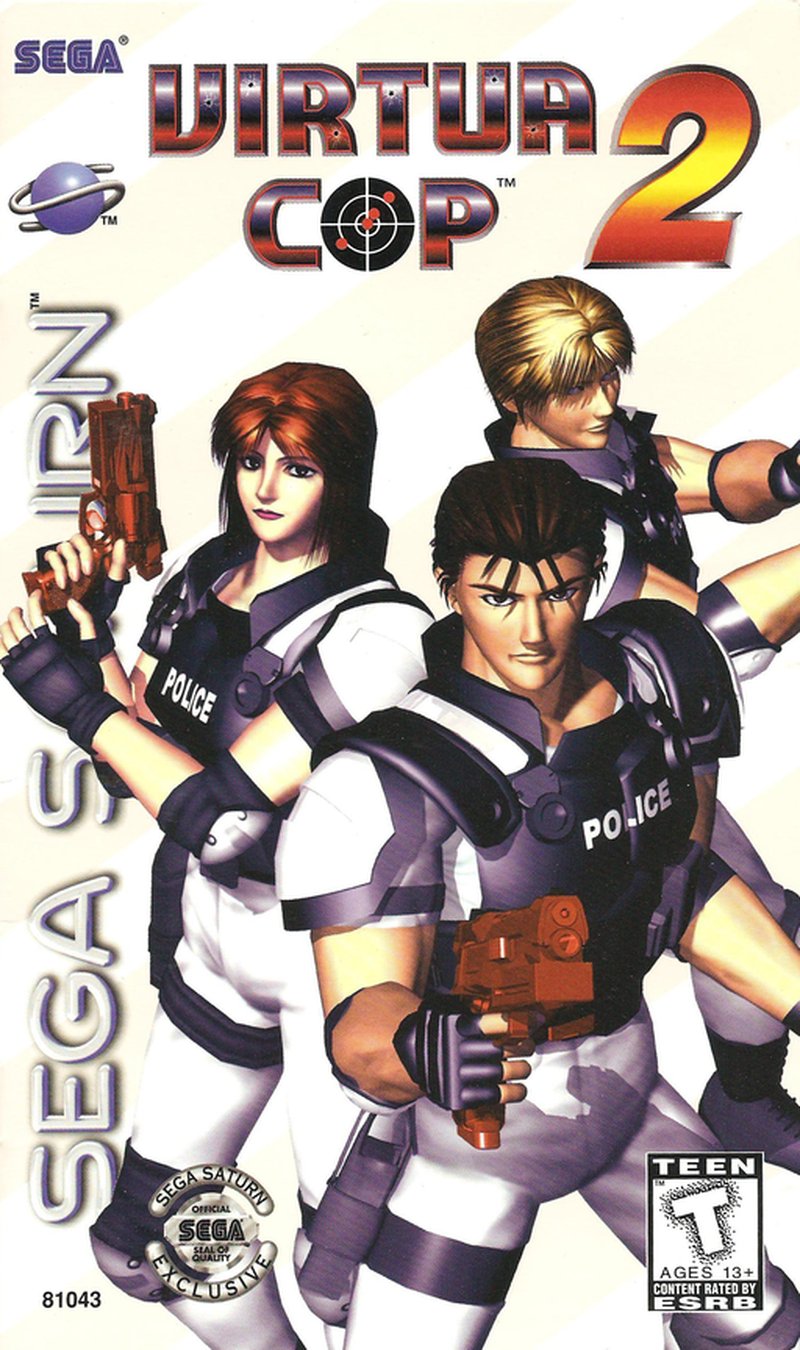
Three cases, directed like films
Take the cases one at a time and the direction lesson sharpens. The first, a jewellery-store robbery that spills into a car chase, is the tutorial that never says so: hostages placed generously, criminals telegraphed, the city bright and readable. The second raises the stakes onto a moving train, where the scenery itself becomes a timing mechanism — tunnels, crossings, enemies framed by the rhythm of the cars — and the shooting must learn to breathe with the setting. The third moves through a construction site toward the finale’s machinery, the series’ set-piece imagination in full flood. Across all three, AM2’s secret is restraint in the right places: the camera never spins for its own sake, enemies enter from readable angles, and the innocent never appear without a half-second of recognition time, which is why a hostage hit feels like your failure rather than the game’s trick. That fairness, at speed, is craftsmanship of a high order, and it is why Virtua Cop 2’s half-hour can be replayed for years without the scenes going stale: they were blocked like choreography, and choreography does not date the way spectacle does.
Verdict
Virtua Cop 2 on Saturn is the light-gun game perfected at home: cinematic cases, the Justice Shot’s merciful scoring, flawless two-player co-op and an AM2 conversion that protects everything that matters. It is short because it is an arcade game, and it is essential for the same reason. Gun in hand, CRT glowing, a friend at your side arguing about a hostage — this is the Saturn doing one of the things it did best, and doing it completely.