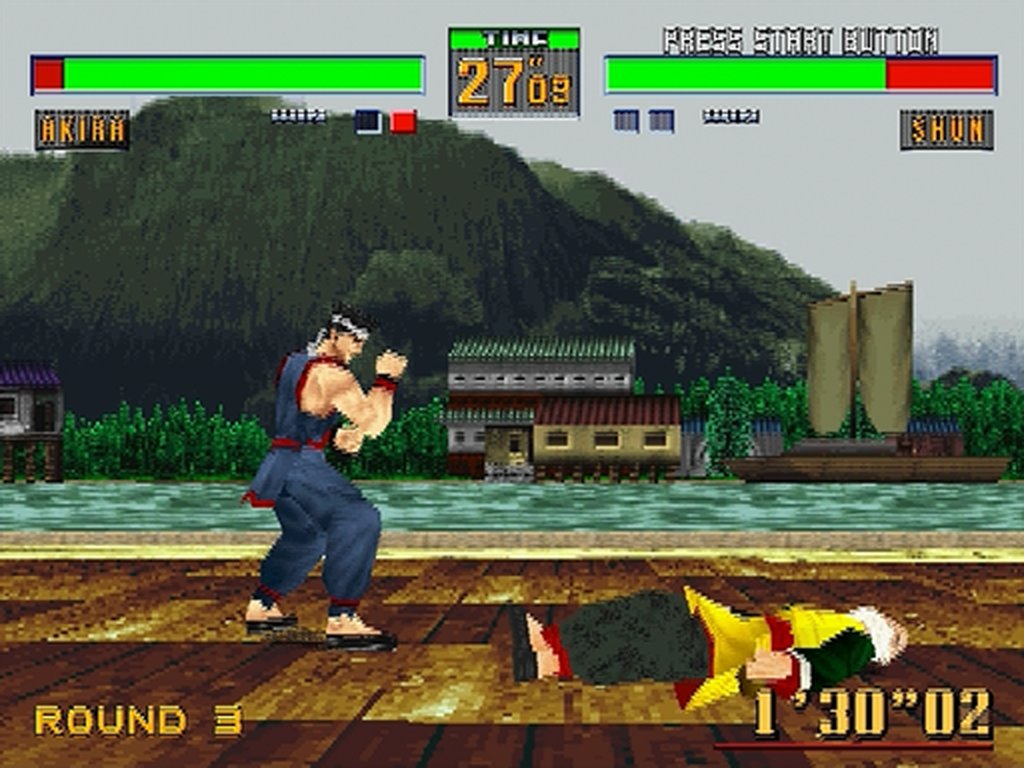
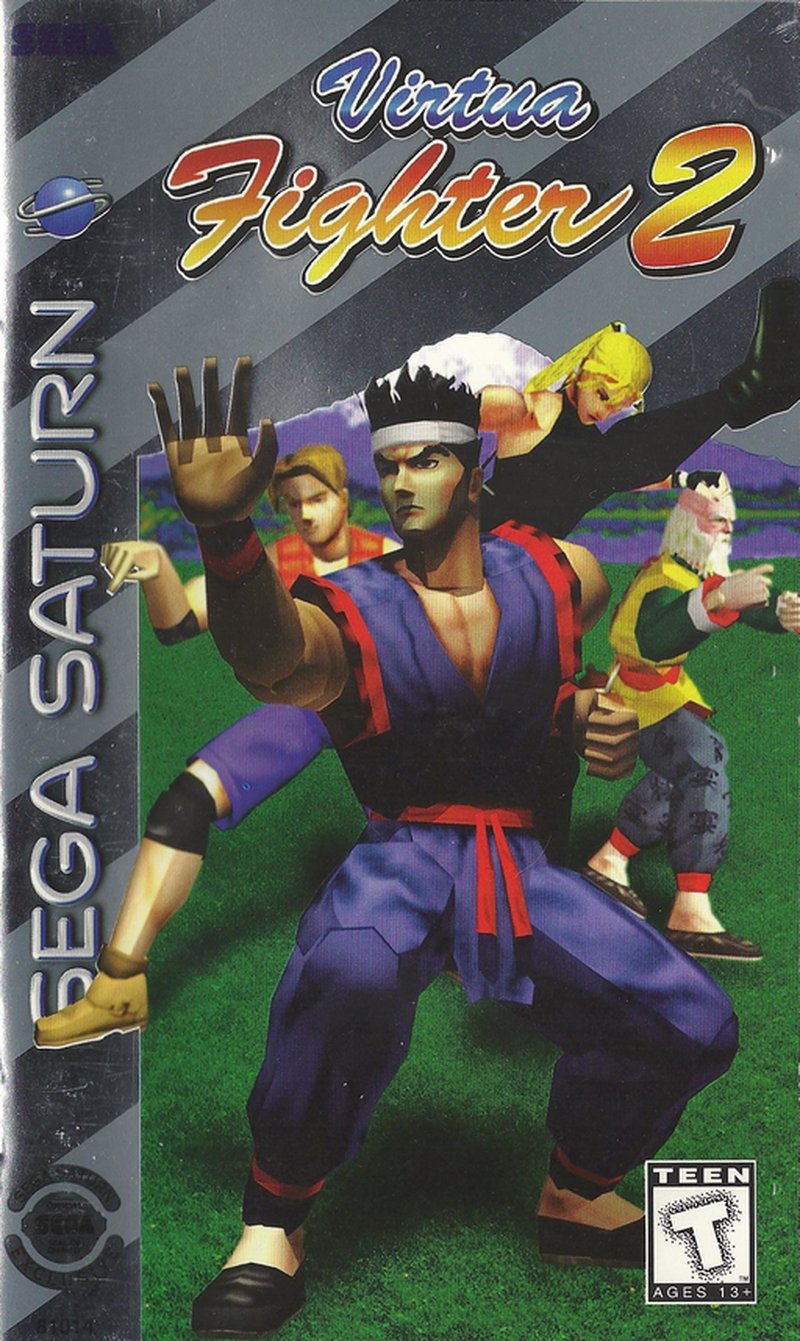
At a glance: Virtua Fighter 2 · Sega Saturn · Sega AM2 / Sega, 1995 · 3D fighting · Score: 8.5/10
Virtua Fighter 2 is the game that sold the Saturn in Japan — more than a million copies, the console’s biggest hit in its home market, the title that for one winter made Sega’s difficult machine look like the future of fighting games. Yu Suzuki’s AM2 built the arcade original on Model 2 hardware that seemed a generation ahead of any home console, then performed the era’s most impressive conversion trick: the Saturn version runs at the arcade’s high resolution, at sixty frames per second, with ten fighters whose flat-shaded grace survived the journey almost untouched. It is not the deepest Virtua Fighter, and time has added rivals inside its own series. It remains the Saturn’s definitive fighting game and the clearest proof that AM2 understood this hardware like its own signature.
The fighting itself is Virtua Fighter’s famous minimalism: three buttons — punch, kick, guard — and a universe inside them. Every one of the ten fighters, from Akira’s explosive palm strikes to Kage’s tumbling ninja throws to Jeffry’s splashing brutality, fights from the same simple grammar of strikes, throws, counters and ring positioning, differentiated by speed, range and a moveset animated with a martial artist’s respect for weight. There are no fireballs, no meters, no comebacks granted by a system. You win by reading a human being: their habits, their panic, their favourite string. The ring-out rule keeps every exchange honest — back a careless opponent to the edge and the fight can end on positioning alone — and the Saturn version’s Team Battle and Watch modes stretch the package beyond the arcade’s coin hunger.

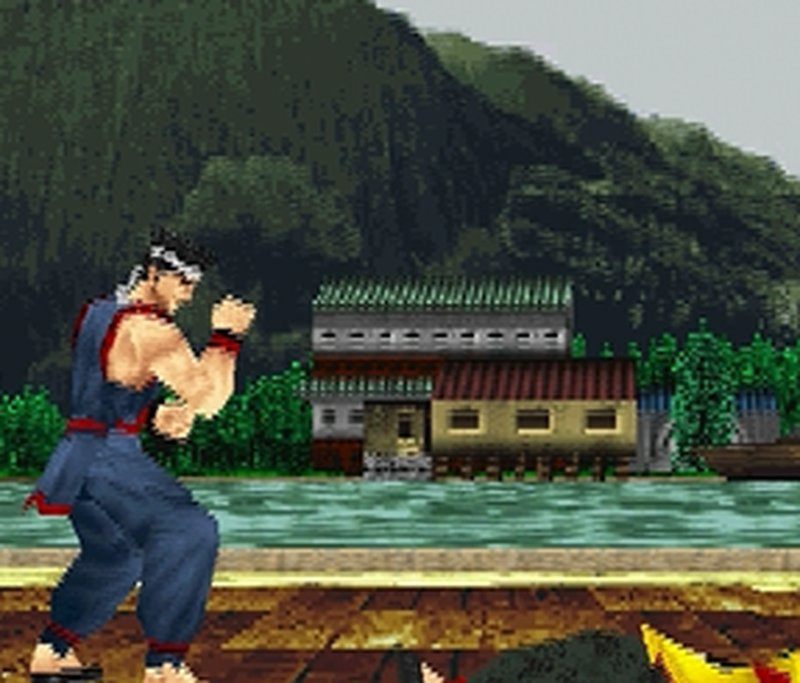
The technical achievement still startles. The Saturn was supposed to be the 2D machine, the one whose polygons came with apologies. AM2 shipped a fighter at 704 by 480 — a resolution console games would not routinely touch for years — running at a locked-feeling sixty frames, with clean, untextured models whose animation does all the showing off. Watch Akira’s shoulder check or Sarah’s flamingo stance and you are watching motion captured from real martial artists and honed by animators who understood that a fighting game is choreography first. The backgrounds are simpler than the arcade’s, some effects are trimmed, and the character models lose a polygon here and there — the honest price list is short, and none of it touches the frame rate, the resolution or the feel, which is to say none of it touches the game.
The million-seller’s burden
Context explains the score’s restraint as much as the game’s quality explains its fame. Virtua Fighter 2 arrived when the Saturn needed a champion and became one so completely that it defined the console’s Japanese identity: the serious machine for serious fighting-game players, in the years when that identity was worth more than any mascot. Its Western life was strong too, bundled and discounted into millions of homes. But judged purely as a game to play today, it sits between stools its own family built: the first Virtua Fighter’s stark purity behind it, Virtua Fighter 3’s terrain and evasion — and the Saturn’s own Fighters Megamix, which borrowed VF2’s engine and added the carnival — ahead and beside it. The single-player offering is a ladder and your own discipline; there is no story mode, no quest, nothing to unlock but mastery. That was the genre’s contract in 1995. It is a thinner contract now.
Three buttons, ten fighters, sixty frames: Virtua Fighter 2 proved a fighting game needs nothing but honesty — and that the Saturn, in AM2’s hands, could deliver it at arcade resolution.
Against human opposition, none of that thinning matters, which is the review’s real verdict forming early. VF2’s balance across its ten styles is the stuff of arcade legend; the mirror of two skilled players reading each other at sixty frames remains as tense as fighting games get, and the Saturn pad — six face buttons, a D-pad built for quarter-circles even in a game that mostly asks for taps — serves it beautifully. The AI ladder, by contrast, shows its era: readable at first, then suddenly psychic in the late stages, with Dural, the metallic final boss, waiting to teach humility. Options are generous for 1995 — round counts, ring sizes, handicap, the works — and the presentation’s restraint, all clean arenas and Takayuki Nakamura’s propulsive score, has aged into elegance.
The Saturn’s fighting foundation
There is a final, historical pleasure in playing it here. This is the disc that justified the Saturn to Japan, the one that made the console’s strange dual-processor 3D look like a plan rather than an accident. Every Saturn fighter that followed — Fighting Vipers, Megamix, the imports that fill collections — stands on the ground VF2 surveyed. Later hardware would give the series textures, terrain and online play. None of that erases what this version is: the biggest fighting game of its moment, converted by its creators onto hardware everyone underestimated, at a fidelity that silenced the room. If the score above seems a half-step shy of the 9s elsewhere in this wave, that is the single-player thinness and the series’ own later growth talking — not the conversion, which is flawless where it counts, and not the fighting, which is forever.
Ten styles, one language
The roster’s balance of styles is worth a final examination, because it is where VF2’s design intelligence concentrates. Akira’s bajiquan is all elbows and explosive short-range power; Pai and Lau bring flowing kung fu at different temperatures; Wolf and Jeffry turn the ring into a wrestling argument about throws and splash damage; Jacky and Sarah practise Jeet Kune Do and savate-flavoured kickwork at speed; Kage tumbles, Lion dances low with mantis strikes, Shun drinks and sways through the game’s most beloved animation set, and Dural waits at the end as everyone’s moves in a chrome body. None of them has a projectile. None of them has a gimmick that breaks the shared grammar. The result is a fighting game that can be taught in an afternoon — three buttons, remember — and studied for a decade, which is the precise definition of the easy-to-learn, hard-to-master cliché that a thousand lesser games have claimed. VF2 earned it first on console, at full speed, in high resolution, and the Saturn version’s practice-friendly options and smooth performance made the home the place where a generation actually did the studying.
Verdict
Virtua Fighter 2 on Saturn is a landmark that still plays like one: sixty frames, arcade resolution, ten perfectly differentiated fighters and the purest three-button fighting ever coded. Bring a second player and it is a 9. Bring only yourself and the ladder, and it is the 8.5 on the tin — a masterpiece of conversion and combat, slightly outgrown by its own descendants, and utterly essential to understanding what the Saturn was for.