
Before the first step, a warning that every veteran will recognise: Wizardry does not love you, does not want to be finished quickly, and will keep the bodies. Wizardry: Proving Grounds of the Mad Overlord, written by Andrew Greenberg and Robert Woodhead while they were students at Cornell, and published by Sir-tech for the Apple II in 1981, is one of the most consequential games ever made for the machine — the first true party-based computer role-playing game, the template for a genre, and an experience so uncompromising that its modern remake ships with the original Apple II interface preserved like a fossil you can visit. Playing the original today is not an act of nostalgia. It is an encounter with the source code of an entire genre, running at floppy-disk speed.
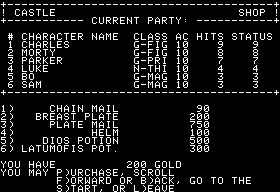
The premise fits on an index card. The Mad Overlord Trebor — Robert, backwards, one of several in-jokes reversed out of the developers’ names — has lost an amulet to the archmage Werdna, Andrew, likewise. Werdna has retired to the bottom of a ten-level maze beneath Trebor’s castle. You will raise a party of up to six adventurers at the training grounds, equip them at Boltac’s Trading Post, fortify yourself at the tavern and the temple of Cant, and go down in the dark to take it back. The castle above ground is a menu. The maze below is the game, drawn in the famous wireframe: white lines on blackness, a small window of first-person corridor floating above your party’s names, hit points and armour classes.
Six Characters, All Mortal
Character creation is the first game. You roll bonus points — usually a pittance, occasionally a fortune — and distribute them among strength, intelligence, piety, vitality, agility and luck, steering each recruit toward fighter, mage, priest or thief, with the elite bishop, samurai, lord and ninja classes waiting for the exceptional or the patient. Races run from human to hobbit, alignments matter and cannot be mixed freely in one party, and everyone begins at first level with the constitution of a wet envelope. Then the maze begins teaching. Combat is turn-based and plotted in advance: each character commits to fight, cast, parry, run or use an item, and the round resolves in a drumroll of text. Friendly fire is not a feature; it is simply what happens when your mage’s fireball meets a room that also contains you.
What makes Wizardry extraordinary, still, is the permanence. The game writes everything to its scenario disk, continuously. A character who dies may be resurrected — if the body can be carried back to the temple, if the fee can be paid, and if the resurrection succeeds, because it can fail, and failure leaves ashes, and raising ashes can fail too, and then that character is gone in the most literal sense the medium had yet produced. A party wiped out deep in the maze stays there, dead, on the disk, until a second party mounts a rescue expedition to recover the corpses and the equipment. Teleport spells can deposit you inside solid rock. Level drains exist. The Apple II’s disk drive grinds through all of it, saving your disasters with the same diligence as your triumphs. Modern games call this permadeath and market it as a feature for the hardcore. In 1981 it was simply how the machine worked, and it generates stories no scripted campaign has ever matched.
Above ground, an economy of beautiful cruelty hums away. The Training Grounds mint your characters from rolled statistics — a bonus roll in the high teens is an event a player remembers for years — and the class ladder (fighter, priest, mage, thief, and the elite bishop, samurai, ninja and lord for the worthy) makes character creation a strategy phase in itself. Boltac’s Trading Post sells the steel, the inn sells back hit points at prices scaled to your dignity — the stables are free and restore nothing but time’s passage — and the temple of Cant takes gold to undo what the maze did, including, at a price, death itself, with a statistical chance the resurrection simply fails and leaves ash. And down on the first level, generations of players found Murphy’s Ghost, the placid spectre in a fixed room who could be fought again and again for experience — the game’s first grinding spot, discovered by the community and passed down like folklore, because in 1981 that is exactly what it was.
The Maze Itself
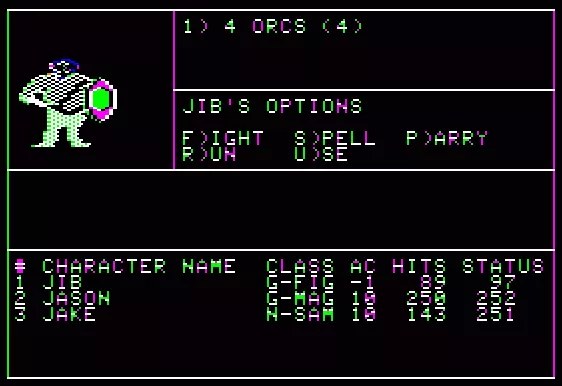
Ten levels sounds modest until you learn their character: darkness zones, anti-magic squares, teleporters, pits, chutes, rotating sections and an elevator, all unmapped by the game and barely signposted by it. Players mapped on graph paper, square by square, casting the DUMAPIC spell to confirm where in the labyrinth they stood, and those hand-drawn maps became treasured artefacts. Level one is a school; level four, with its Murphy’s Ghost — a spectral punching bag that patient parties farmed for experience — is a rite of passage; the lower levels are an examination in everything the game has taught, administered by enemies whose names still tighten veteran stomachs. Werdna’s own chamber, guarded by vampires, is less a boss fight than a final audit.
It is worth pausing on the Apple II-ness of it. Greenberg and Woodhead built the game in Apple Pascal, inspired by the PLATO mainframe dungeon games — notably Oubliette, which has its own piece on this shelf — and the result pushes the machine in directions games were not supposed to go: a persistent world on a floppy, a database of characters, a dungeon in a window. The wireframe looks stark now, but in 1981 colour 3D corridors of any kind on a home computer were close to sorcery, and the clean speed of the drawing still impresses. The sound is minimal — Pascal and an Apple speaker allow little — yet the silence suits a tomb.
The scenario structure deserves mention: Proving Grounds was scenario one of a planned arc, and its Apple II sequels — The Knight of Diamonds and The Legacy of Llylgamyn — imported your surviving party, scars and all, so that a character’s story could run across disks and years like a saga. The utilities that grew around the game, the character editors and resurrectors sold as WizPlus and its kin, testify to the attachment players formed: people paid real money for a second chance for a fictional elf. That attachment is the game’s real invention. The maze is wireframe; the dread is permanent; the party is yours.
Verdict
Wizardry‘s influence is not a matter of opinion: the Japanese industry adopted it wholesale, and through Dragon Quest and Final Fantasy its DNA runs in a sizable fraction of all RPGs since. But the original is not merely historically important — it is still, on its own severe terms, a superbly structured game, provided you accept its terms in writing before entering. Bring graph paper. Bring patience. Bring a second party. The maze is waiting exactly where you left it, and so, if things went badly, are you.
Score: 9.0/10 — At a glance: Developer Andrew Greenberg & Robert Woodhead / Sir-tech · Year 1981 · Genre Party-based dungeon RPG · The genre’s founding document, still lethal.