
At a glance: Xenophobe · Atari Lynx · Atari Corp, 1990 · Action shooter · Score: 7.5/10
Bally Midway’s 1987 arcade Xenophobe was a love letter to Aliens written in split-screen: up to three players, each with their own horizontal window on a space station infested with Xenos, clearing decks of face-hugging, acid-spitting horrors before the station was overrun. It seemed unportable — three playfields do not fit on a handheld. Atari’s 1990 Lynx version is the port that proved the doubters wrong, and then went one better: because every Lynx player has a screen of their own, the linked game supports four exterminators, one more than the arcade ever managed. It is one of the most ingenious conversions in the Lynx library.
Twenty-three stations of infestation
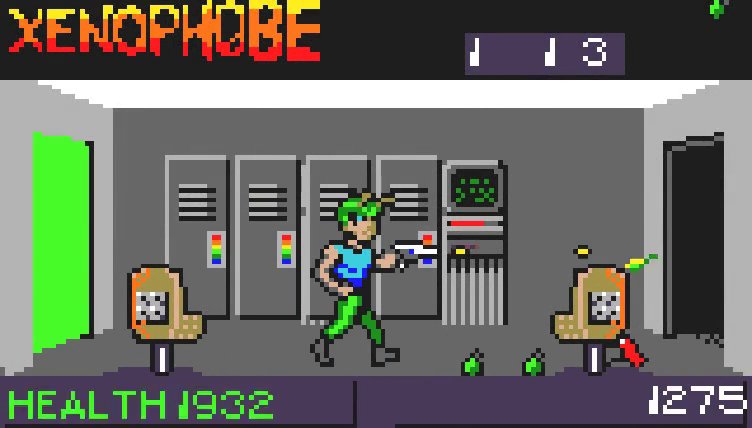
The campaign is a tour of 23 space stations, each a side-scrolling complex of decks, lifts and doors, each crawling with a bestiary that escalates from egg and face-hugger analogues to the spitting Snotterpillar and the station-defending heavies of the late game. You start with a feeble phaser and upgrade through what you find: the Lightning Rifle, the gloriously named Poofer gun, grenades, and a Lynx-exclusive jetpack that changes the geometry of whole decks. Your exit is earned one of two ways — exterminate enough Xenos to clear the station, or survive until it is overrun and get beamed out ahead of its self-destruct, poorer but alive. That second option gives the game its character: Xenophobe lets you lose a station and continue the war, which keeps campaigns moving and pride dented in equal measure.

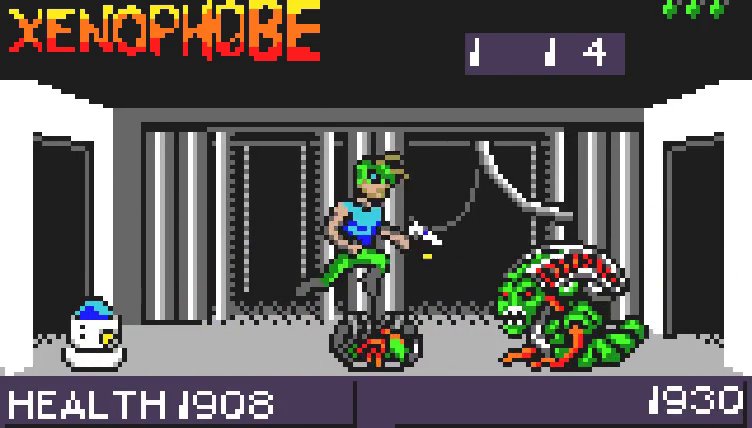
The character system is the port’s cleverest addition. The arcade gave you a hero; the Lynx gives you a roster — nine exterminators of assorted species and silhouettes, who serve as your lives. Lose one, and the next beams in; when the roster is gone, the campaign ends. In multiplayer the pool is shared, which turns hero management into group politics: the careless player is spending everyone’s lives. And the port’s most beloved flourish waits for the player with nothing left — in a linked game, a defeated player can return as a Snotterpillar, spitting at their former teammates. It is griefing as a designed feature, in 1990, and it remains the funniest idea in the Lynx catalogue.
Xenophobe’s Lynx port is a conversion that read its source, understood its soul, and then added a playable alien whose entire job is revenge on your friends. That is not adaptation. That is authorship.
The conversion craft
The pixel work deserves respect. The arcade’s three stacked windows ran at a resolution the Lynx could not dream of, so every sprite and backdrop was redrawn for the small screen rather than shrunk — and it shows in the readability. Xenos are distinct at a glance, weapons read clearly mid-chaos, and the stations’ decks have a grimy, lived-in variety across the 23 stops of the tour. Controls use the Lynx’s full button set to give you crouch, jump, aim and fire without the arcade’s awkwardness. The pace is a touch more forgiving than the coin-op’s quarter-hunger, which on a handheld is not a compromise but a correction.
Weapons, stations and the art of the retreat
The arsenal’s escalation is worth a closer look, because it shapes how stations play. Early decks are pistol work — careful, close, a little desperate. The mid-campaign’s finds, the Lightning Rifle above all, change your relationship with a room: distance becomes a weapon, and clearing from the doorway replaces wading in. The jetpack, this version’s own invention, is the masterstroke — it turns vertical space from scenery into tactics, letting a canny player skip a deck’s worst fight or descend on it from an angle the Xenos weren’t watching. A conversion that adds a mechanic this well judged is not merely competent. It is in conversation with its source.
The stations themselves reward the same tactical eye. Lifts are chokepoints; doors are decisions; the self-destruct countdown, when a station is lost, converts a defeat into one final sprint for the beam-out that can salvage your score and your pride together. Xenophobe understood — a decade before the extraction shooter made a genre of it — that the run for the exit is a game in itself.
The honest infestation report
The arcade’s difficulty followed the game home in its later stations: Xenos that grapple, stun and swarm can chain a player into helplessness for long, controller-gripping seconds, and the roster system means one bad deck can spend three heroes. The stations, for all their variety of layout, share a visual palette that blurs together across a long campaign. Sound is functional rather than atmospheric — the squelches land, the music does not linger. And the solo game, while complete, is plainly the supporting act for the linked one: Xenophobe alone is a good shooter; Xenophobe with friends is the cartridge people tell stories about.
Its place in the fleet
Set beside Slime World and Warbirds, Xenophobe completes the Lynx’s great ComLynx trilogy — three games that treated the cable as a genre rather than a feature. That it does so while also being a first-rate conversion of a difficult arcade original, expanded with a roster system and a traitor mode that were years ahead of fashion, makes it one of the most quietly impressive cartridges Atari ever published for the machine.
Collectors note: it was a popular seller in its day and remains reasonably priced, which undervalues a cartridge of this ingenuity. New players should recruit before they play — one friend, one cable, one shared pool of heroes — because the version of Xenophobe that lives in Lynx legend is the social one, Snotterpillar and all.
It is also, not incidentally, the best Aliens game of its generation that was legally allowed to exist — the atmosphere of the films converted into arcade grammar without a single frame of licensed footage. The Xenos are knock-offs the way a tribute band is a knock-off: in the open, with love, and good enough that the audience stops caring about the distinction.
Thirty-six years on, the stations are still infested, the roster still beams in, and somewhere a Snotterpillar is waiting for a former friend. Games are not usually this generous with their second acts. Clear the decks.
One last consideration for the solo player deciding whether the cartridge earns its slot: twenty-three stations is a lot of war, the weapon curve keeps it changing, and the roster system gives a campaign a narrative shape — who is left standing — that most arcade conversions never attempt. Even alone, Xenophobe is a campaign, not a credit-feeder. With company, it is a legend.
And for the record, the Poofer gun alone justifies the cartridge’s existence: a weapon named like a punchline that plays like a lifeline, in a port that treats its arcade parent with more intelligence than most sequels manage. That is the Lynx conversion standard — set early, in 1990, by a game about bugs in space.
Verdict
A clever, generous, faithful conversion that improves on its arcade parent in the ways that matter — and lets your friends play as the monsters. 7.5/10, rising a full point with every extra Lynx in the room.