
At a glance: The Legend of Zelda: Phantom Hourglass · Nintendo DS · Nintendo, 2007 · Action-adventure · Score: 8.5/10
Phantom Hourglass, released in 2007, had two jobs: follow The Wind Waker, one of the most beloved Zeldas ever made, and justify an experiment no mainline Zelda had attempted — controlling everything with the stylus. Link moves where you point, swings when you slash, rolls when you circle, and throws his boomerang along a path you literally draw. That it works at all is remarkable. That it produced one of the most charming, inventive adventures on the DS is a small miracle of design confidence from Nintendo EAD.
The story picks up directly from The Wind Waker: Tetra’s pirate crew, a ghost ship, a kidnapping, and Link washed ashore in a parallel ocean kingdom under the protection of the Ocean King. His companion this time is Linebeck, a cowardly, greedy, magnificently voiced-by-text-box sea captain whose character arc — from chiselling coward to something braver — is the emotional spine of the game and one of the best-written partnerships in the series. The cel-shaded toon style translates to the DS beautifully, all bright seas and expressive faces.
The stylus as sword, pen and helm
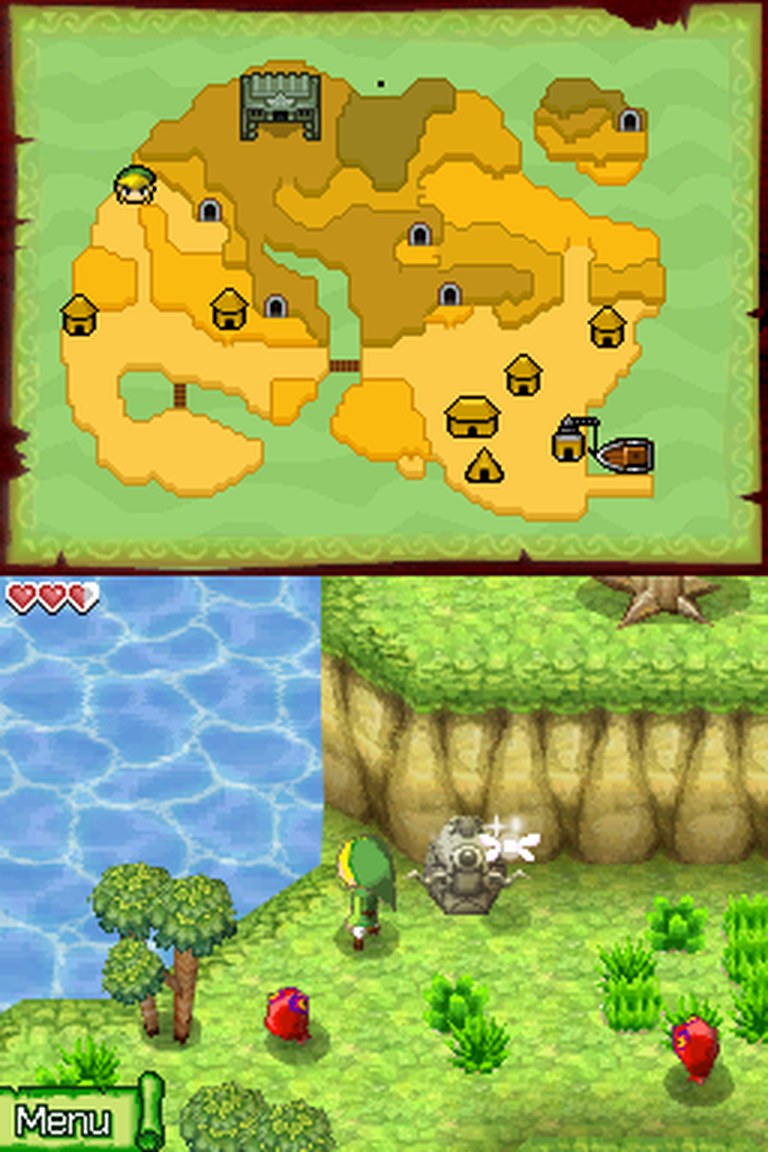
Touch control is not a gimmick bolted onto a normal Zelda; the whole game is re-thought around it. Dungeons are designed for drawn solutions: you annotate your map directly — writing down clues, marking the order of switches, sketching the route a hint described — and the game repeatedly, brilliantly, tests your notes rather than your memory. The boomerang follows your drawn line around corners. The bow, the shovel, the hammer all gain a tactile directness. Combat is the weakest fit — precision swordplay against fast enemies can feel like wrestling the interface — but the sheer novelty of solving a Zelda with a pen never wears off.
Sailing returns, streamlined: you draw your route on the sea chart and the Linebeck steams along it while you man the cannon, salvage treasure with a crane mini-game, and fend off pirates and the occasional boarding ambush from Jolene, Linebeck’s furious ex. Ship customisation — collecting themed part sets that raise the hull’s hearts — gives the seas a collectathon layer. It is Wind Waker’s ocean compressed into something brisker and, for many players, better paced.
The Temple of the Ocean King
The game’s boldest structure is also its most argued-over. The Temple of the Ocean King is a central, timed dungeon you return to between every island chapter, descending further each time with new equipment — inside which the Phantom Hourglass itself shields Link from the temple’s life-draining curse, and hulking Phantoms patrol on routes you must learn, evade or outsmart with drawn plans. It is a stealth-puzzle roguelite spine years before that was fashionable, and replaying early floors is softened by shortcuts and faster routes as your arsenal grows. Some players found the repetition grating; played as intended — racing your own best lines — it is the game’s signature thrill.
No Zelda has ever asked more of a pencil: your map notes, your drawn routes and your boomerang lines are the adventure.
Extras are generous for the era: a two-player Battle Mode over Wi-Fi, with one player steering Link and the other commanding Phantoms, was a genuinely clever asymmetric experiment, and treasure trading gave the salvage economy a social outlet. Technically the game is a showpiece — full 3D on both screens when it counts, seamless stylus sailing, and cut-scenes with a warmth the hardware had no right to deliver.
Small touches, large consequences
It is worth pausing on how completely the stylus philosophy rewired Zelda’s smallest interactions. Rupees are gathered by walking over them, but pots are smashed by tapping; the grappling hook stretches between posts along lines you draw to make tightropes; the shovel digs where you point; even the trading game and the cannon salvage are pen-work. The treasure system — salvage arms hauling chests from drawn map marks, ship parts appraised and traded with other players — gave the ocean economy a tactile, hands-in-the-water quality the GameCube’s menus never achieved. And the game’s signature party trick, closing the DS lid to transfer a stamp between screens, remains the most quoted hardware gag in the series — a puzzle whose solution is the console itself.
The dungeon design rewards the annotation system with unusual trust. Several of the game’s best puzzles are unsolvable by observation alone: an island’s shape must be traced from a whale’s-eye view, a lever order must be transcribed from a tablet in another room, a phantom’s patrol must be clocked and planned like a heist. Because your map is your notebook, success feels authored rather than retrieved. Spirit Gems, collected across the world, upgrade the three fairies who attend you — sword power, shield strength, and a bow that sets arrows alight — adding a light RPG layer that respects the game’s briskness.
Its reception at the time was warm and has stayed warm, with the touch controls — radical then — now reading as the most confident of Nintendo’s many control experiments, precisely because they were total rather than decorative. Spirit Tracks would refine the formula with a train and a playable Zelda. Phantom Hourglass remains the purer, stranger, saltier of the two DS Zeldas, and the one that best understands its own machine.
Modern players should know the game has aged gracefully in one specific way: its session structure. The Ocean King’s temple, the short island arcs, the save-anywhere discipline — Phantom Hourglass was designed for handheld time, in an era before that was a marketing phrase, and it slots into modern fragmented play better than most of its console contemporaries. Its multiplayer battle mode sleeps with the old servers, but everything that made the single-player adventure sing — the pen, the sea, Linebeck’s cowardice and courage — is entirely intact on the cartridge.
Playing it today
The cartridge is plentiful and affordable, and its demands on the player are refreshingly small: a working touch screen, a stylus and a willingness to write on a map like you mean it. Everything except the retired online battle mode survives intact. New players should know the game is a direct sequel to The Wind Waker and wears that lineage proudly, but it recaps what it needs and stands alone comfortably. Of the two DS Zeldas, this is the one to play first — the purer experiment, the saltier air, and the captain you will never forget.
Verdict
Phantom Hourglass is the DS Zelda in its purest form: designed from the first screen for the machine it lives on, funny, inventive and structurally daring. The touch controls will always divide the faithful, and the Ocean King’s temple asks for a patience some won’t give. But its map-annotation puzzles remain unique in the series, Linebeck is an all-time companion, and as a demonstration of what the stylus made possible it has no equal. An essential, singular adventure.