
The ZX81’s famous games are very famous — Monster Maze, Mazogs, Flight Simulation — and they guard the machine’s reputation so jealously that the catalogue behind them goes unread. That is a mistake twice over. First, because the little black wedge attracted hundreds of cassettes in its short reign, from software houses — Quicksilva, Artic, Macronics, Psion, dK’Tronics — who treated 16K as a canvas rather than a cage. Second, because obscurity on the ZX81 is no guide to quality: some of its most inventive games were mail-order curiosities, B-sides and early experiments that the Spectrum’s arrival buried before the magazines could canonise them. These ten are all verified ZX81 releases, all preserved in the archives, and none of them is reviewed elsewhere in this package. Consider this the shelf below the masterpieces — the one the collectors actually argue about.
1. Cosmic Guerilla (Quicksilva)

Quicksilva — the Southampton house that would later help define the Spectrum’s early years — began on the ZX81 with a run of arcade conversions under the QS brand, and Cosmic Guerilla is the line’s most inventive entry: a Space Invaders game whose invaders have a second profession. As the formation descends, aliens break off to steal — making for your reserve craft at the bottom of the screen and hauling them away if you let them land. It converts the Invaders endgame on its head: the danger is not only being shot or landed on, but being robbed of your future lives while you defend the present one. In character blocks, in silence, it remains one of the few Invaders variants on any machine with a genuinely new idea in it — and a reminder that Quicksilva’s imagination was fully formed before the Spectrum gave it colour.
2. QS Scramble (Quicksilva)
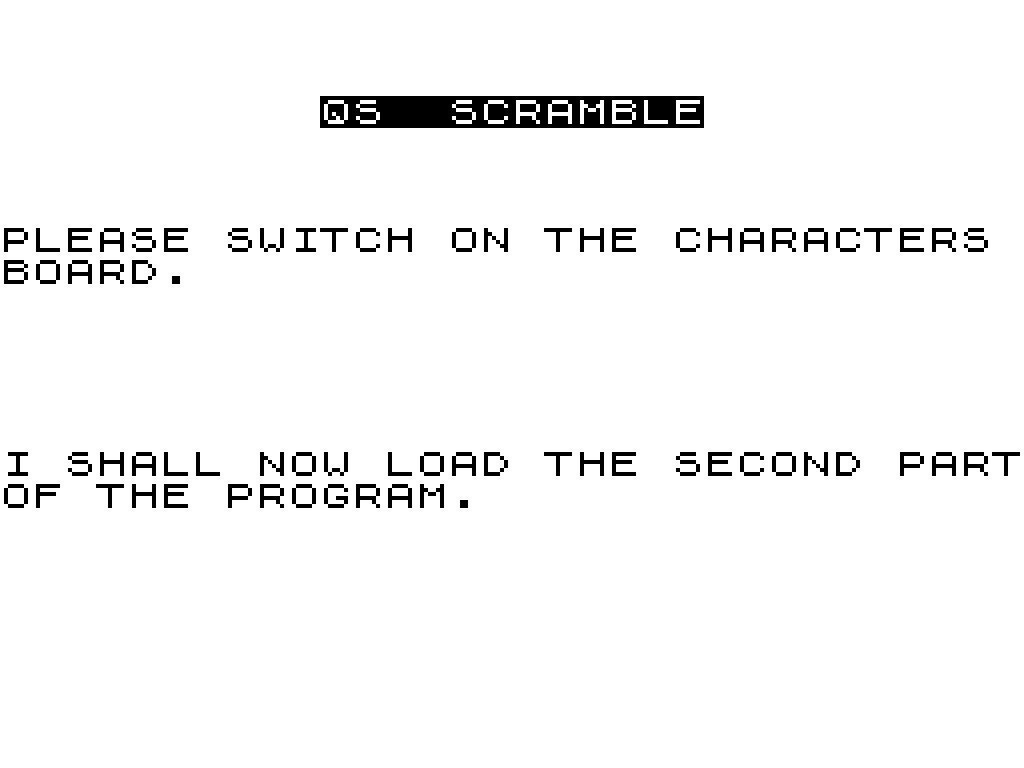
Konami’s Scramble invented the side-scrolling shooter in 1981 — forced scrolling, terrain, fuel, a one-way journey through a cave system — and Quicksilva’s QS Scramble asked the era’s most impertinent question: can a character-mapped, monochrome ZX81 scroll sideways and shoot? The QS line existed to answer questions like that, and Scramble was its sternest test, because the original’s whole identity is motion — the landscape flowing beneath you, the ground rising to meet you. The ZX81 version answers in blocks and nerve: the journey survives, the terrain reads, and the fuel gauge keeps its tyranny. It is not the prettiest Scramble in the world. It is, by a distance, the most improbable — a scrolling shooter on a machine whose screen is a text file.
3. QS Defenda (Quicksilva)

If Scramble tested scrolling, Defenda tested everything else at once. Williams’ Defender is the most demanding of the golden-age shooters — a long wrapping landscape, a radar scanner, humanoids to rescue mid-flight, smart bombs, and controls with a reverse button — and Quicksilva’s ZX81 interpretation attempts the full grammar in 16K: the landscape, the scanner, the abductions happening in miniature at the top of the screen while you fight at the bottom. Inevitably it is a reduction. Equally inevitably, the reduction is fascinating — an X-ray of one of the great arcade designs, showing exactly which parts are load-bearing. The answer Defender’s skeleton gives is the scanner and the rescue: even in blocks, even in silence, saving the falling humanoid is the moment the game lives for.
4. QS Invaders (Quicksilva)

The ZX81 had many Invaders, but Quicksilva’s was the one reviewed like a heavyweight. A contemporary Your Computer notice gives the specification with respect: seven rows of thirteen invaders filling the screen, three shields for your base, a random flying saucer for mystery points, three skill levels, a bonus blaster after five sets of invaders cleared — “just like the real thing.” It needed at least 7K of RAM, cost £5.50, and the reviewer reached the verdict the QS line kept earning: “Excellent value for money!” It even had an upgrade path worthy of the arcade — Quicksilva produced a character and sounds board for use with the game, hardware to give the silent machine a voice. Against Sinclair’s own conservative Space Raiders, QS Invaders was the connoisseur’s choice: bigger, bolder, and unapologetically arcade-sized.
5. Gobbleman (Artic Computing)
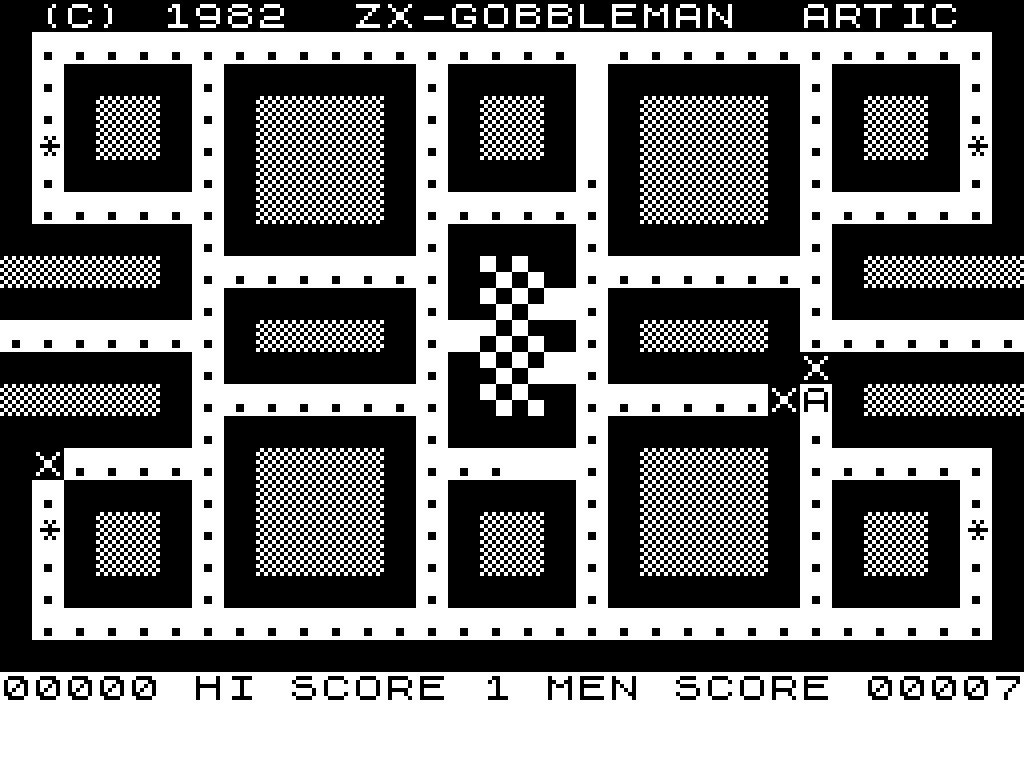
Every machine needed its Pac-Man, and Artic — adventurers and chess programmers by trade — supplied the ZX81’s under the era’s standard legal fig leaf: Gobbleman. The translation is the familiar test of the platform’s strengths. Pac-Man is a grid game of lanes and junctions, and the ZX81’s character display draws maze walls natively; the gobbling hero, the pursuing ghosts and the dot-strewn corridors all survive into blocks with their logic intact. What the machine cannot give is the arcade’s colour-coding of the ghosts or its fruit-bowl charm, and it cannot sing the wocka-wocka. What it gives instead is Artic competence: a complete, playable, properly structured version of the biggest game on Earth, from the house of Planet of Death. The inlay exists in colour and monochrome variants — collectors, take note — and the game remains the ZX81 maze-chase of record.
6. Invasion Force (Artic Computing)
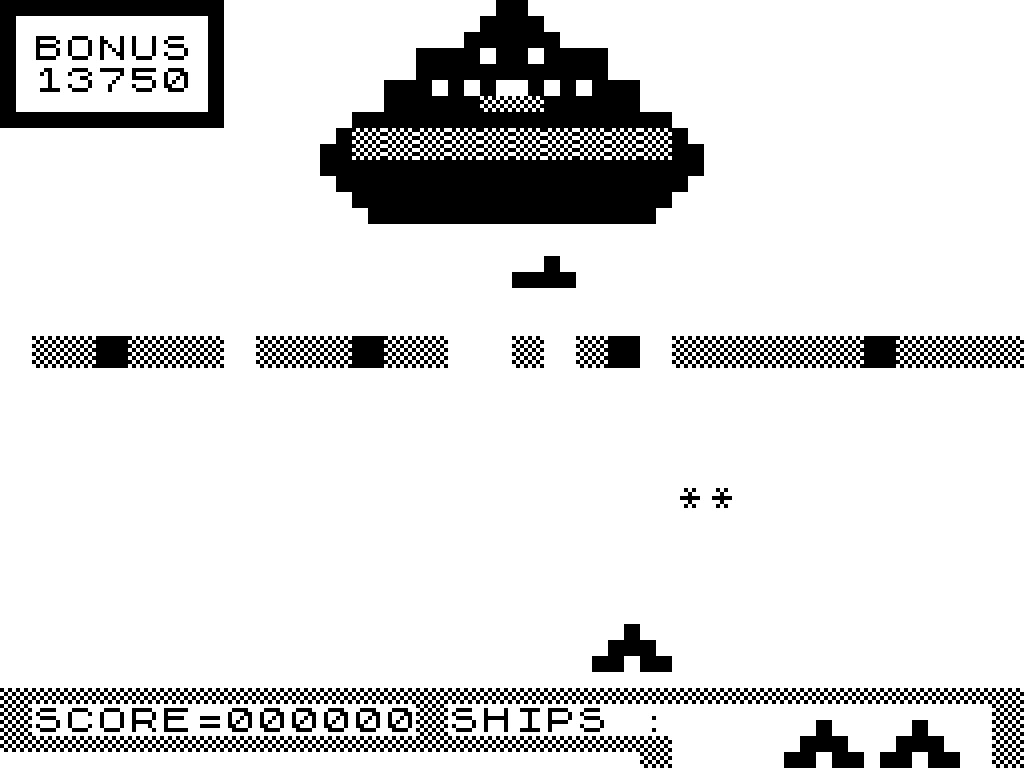
Artic’s other 1982 shooter is remembered, when it is remembered, for its scale: the screenshot tells the story at a glance, with an enormous mothership filling the top of the screen and your lone fighter beneath it, a bonus counter ticking in the corner. Where Galaxians spreads its threat across a formation, Invasion Force concentrates it in a single capital ship — a boss fight, in embryo, on a machine whose other shooters queue their enemies in rows. The David-and-Goliath geometry flatters the ZX81: one huge sprite built from blocks is one of the few things its character graphics do better than early bitmap machines, because size costs nothing when everything is text. MobyGames files it plainly among the ZX81’s 1982 action releases; players who find it discover a shooter with a sense of occasion its better-known shelf-mates lack.
7. Namtir Raiders (Artic Computing)

Start with the name, because the name is a signature: Namtir is Ritman spelled backwards — Jon Ritman, the programmer Artic employed before Ocean made him famous with Match Day, hiding in his own title in the industry’s most charming tradition. Spectrum Computing’s archive quotes the period description: “a space invaders game from Artic Computing with a difference,” and the difference is the point — in 1982, with Invaders variants beyond counting, a difference was the only honest sales pitch left. Namtir Raiders plays the format with Artic’s house polish, invaders above and your bases counted along the bottom, and it survives as a double document: a tidy shooter in its own right, and the earliest shelf evidence of a major British talent, signing his work in a mirror.
8. Sabotage (Macronics)
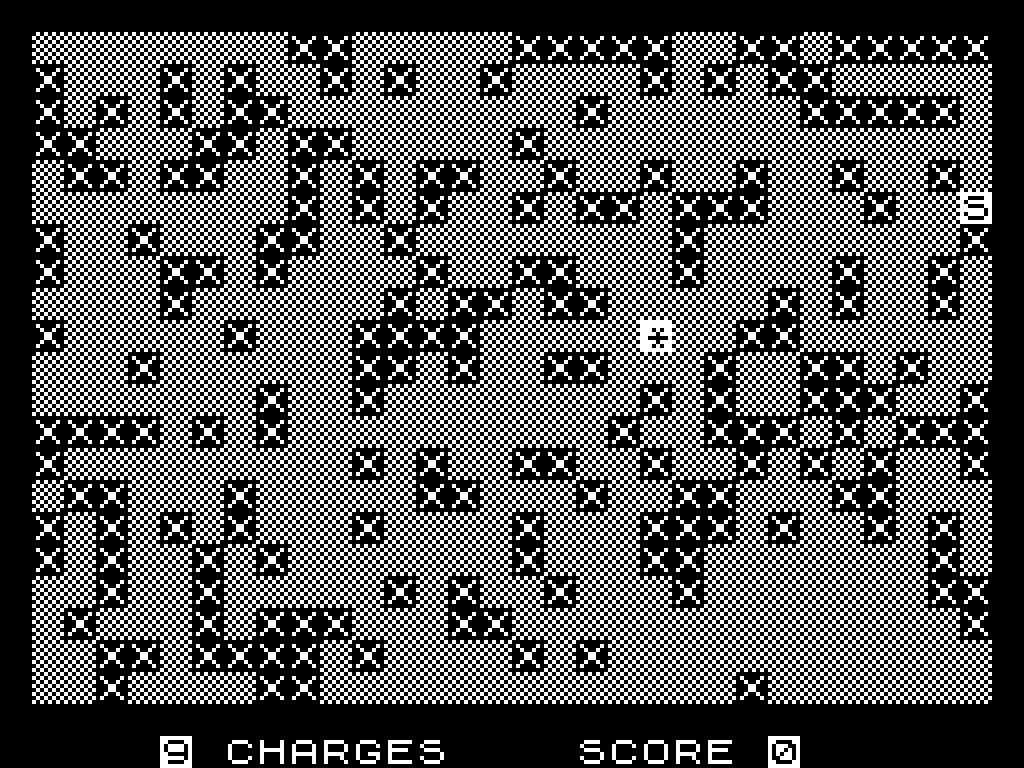
The Centre for Computing History’s catalogue entry for Macronics’ 1982 Sabotage is admirably blunt: “The Guard must protect the ammunition.” Around that single duty, the game builds one of the ZX81’s most distinctive action puzzles. The screen is a field of charges and cover — the screenshot shows the ammunition dump’s terrain as a thicket of obstacles — and your guard is one small figure against an intruder problem, with a score and a count of charges to defend. Macronics, a hardware house moonlighting in software (their ZX81 line was small and odd), produced nothing else quite like it: part guard-duty simulator, part arcade defence, it anticipates the tower-defence idea that a lone defender, a valued stockpile and waves of intent make a complete game. Its Libretro credit names Don Priestley in connection with the program — if the teacher of Mazogs and Dictator touched this too, the ZX81’s small world was smaller, and better connected, than anyone knew.
9. City Patrol (Macronics)

Macronics again, and again the screenshot is the pitch: a city of towers drawn in grey blocks, your patrol craft threading the skyline, with SCORE on one side of the header and — the game’s signature — DAMAGE on the other. City Patrol is a game about flying a city without becoming part of its architecture: the skyscrapers fill the screen in parallax ranks, gaps must be judged and taken, and the damage meter prices every clipped rooftop. It is one of the very few ZX81 games that feels vertical and urban — the machine’s other worlds are space, mazes and dungeons — and its greyscale city, half drawing and half diagram, has a graphic confidence closer to an architectural model than an arcade port. A minor cassette from a hardware house, and one of the most visually distinctive things on the machine.
10. Perilous Swamp (Psion)

Close with the strangest thing Psion ever put in Sinclair’s range. Perilous Swamp, a 16K title from the machine’s first wave, is a rescue adventure played on a map of your own knowledge: the screen shows your position — X marks you — the princess marked with a star, the swamp as blocks of darkness and the edge of the world beyond, while below, the game asks its question in the imperative of the era: “WHICH WAY NOW? N, S, E, W, SE, NW ETC OR ‘MAP’.” It is part adventure, part orienteering — a game about a dangerous landscape crossed by compass points, with the map itself (summoned on request) as the treasure. From the company that made Flight Simulation, it shows Psion’s range at its most experimental: not an arcade conversion, not a simulation, but a small, peculiar quest that treats the ZX81’s map-drawing character screen as a world to be lost in. Every collection needs one game that defies the filing system. The ZX81’s is a swamp, and there is a princess in it.
How this shelf was chosen.
A word on method, because hidden-gems lists are usually where rigour goes to die. Every title here is a verified commercial ZX81 release, present in the Libretro Sinclair — ZX 81 set and the standard catalogues, from houses central to the machine’s story; none is reviewed elsewhere in this package, so the list is a true second shelf rather than a recap; and each earns its place by a distinct claim — an idea (Cosmic Guerilla’s theft, Sabotage’s guard duty), a conversion that should have been impossible (QS Scramble, QS Defenda), a signature hidden in a name (Namtir), or a screen that could belong to no other machine (City Patrol’s greyscale towers, Perilous Swamp’s compass quest). What unites them is the thing the famous games are too famous to show: the ordinary, extraordinary depth of a catalogue produced, in about eighteen months, by an entire country improvising an industry.
Ten cassettes, five houses, one wedge of black plastic. The masterpieces at the front of this package explain why the ZX81 mattered; these explain why it was loved — the depth of the catalogue, the oddity of its corners, and the number of small, sharp ideas that sixteen kilobytes could hold when the whole country was competing to fill them.