At a glance: The 3DO Hardware Family · 3DO · Panasonic / GoldStar / Sanyo, 1993–1996 · Hardware
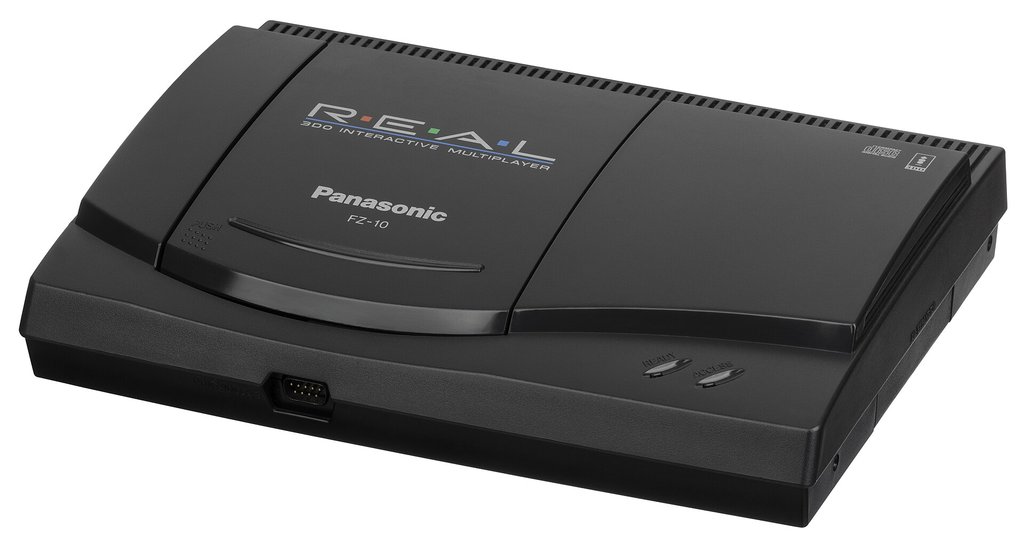
The 3DO is the only major games platform that was never one machine. Because The 3DO Company licensed its standard to manufacturers rather than building hardware itself, the Interactive Multiplayer arrived in the world as a family: the same architecture wearing different badges, at different prices, with different industrial design — a games console run on the home-electronics industry’s rules. Three machines carry the story: Panasonic’s original FZ-1, its cost-reduced successor the FZ-10, and GoldStar’s challenger, with Sanyo’s Japan-only TRY completing the set. Collectors argue about them the way camera people argue about bodies. All of them play the same discs. None of them feels like the others.
The FZ-1: the statement piece
The Panasonic R.E.A.L. FZ-1, launched in North America in October 1993 at $699, was designed to look like the future of home electronics rather than a toy: a wide, low slab of black with a motorised CD tray, gold accents, and the heft of serious hi-fi. It was the machine from the magazine covers, the one with the famous price tag, and its build quality remains the family’s high-water mark — the tray mechanism, the finish, the sense that Panasonic’s best industrial designers had been told to make a luxury object. It also carried the era on its back panel: composite and S-Video, RF via an accessory, a daisy-chain controller port, and an expansion bay for the MPEG video cartridge that would let it play Video CDs.
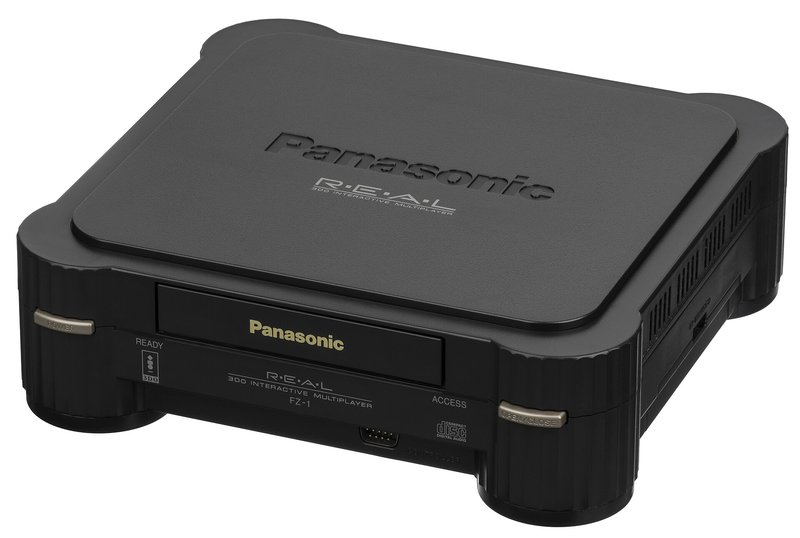
Ownership has taught the FZ-1’s lessons kindly. The motorised tray that wowed in 1993 is now its most common failure point; the laser, in most surviving units, still reads well. But as an object — the console as it was meant to be, the $699 made physical — nothing else in the family carries its presence. It is the 3DO the brochures promised.
The FZ-10: the people’s 3DO
A year later came the correction. The FZ-10 of late 1994 replaced the motorised tray with a top-loading lid, slimmed the case into something closer to a games console, integrated the memory manager into a proper interface — and cut the price to $399, on its way down further. This is the machine that most actual 3DO gaming happened on: cheaper, simpler, and in reliability terms the family’s workhorse, since a manual lid has almost nothing in it to break. Its design language softened the FZ-1’s hi-fi severity into something friendlier, and its controller became the standard pad. If the FZ-1 is the concept car, the FZ-10 is the production model — less romantic, more owned.
One standard, three badges: the 3DO family is what happens when a games console is built like a VCR format — and it worked better than history admits.
GoldStar and Sanyo: the licensees
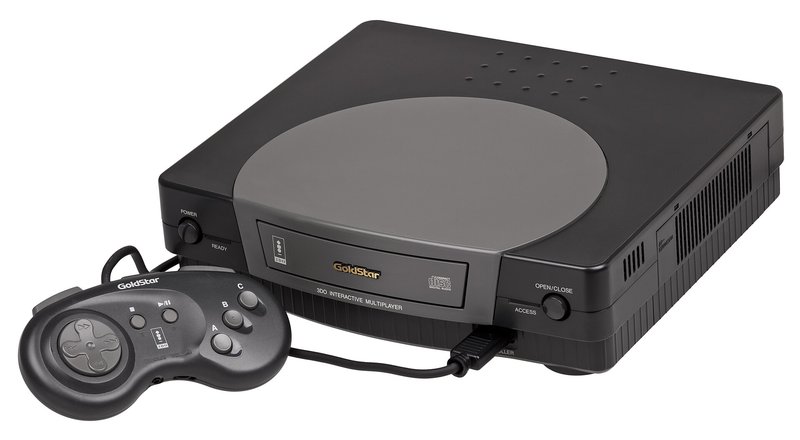
GoldStar — the Korean giant now known worldwide as LG — was the licensing model’s proof of concept. Its GDO-101M of 1994, sold in Korea, North America and Europe, undercut Panasonic’s pricing, sported a distinctive circular-topped design, and bundled a controller many players quietly prefer to Panasonic’s own. GoldStar understood the assignment: the standard was the product, and the badge was a competition. Its machine is the family’s value pick then and now, with the caveat that its lasers have aged less gracefully than Panasonic’s.
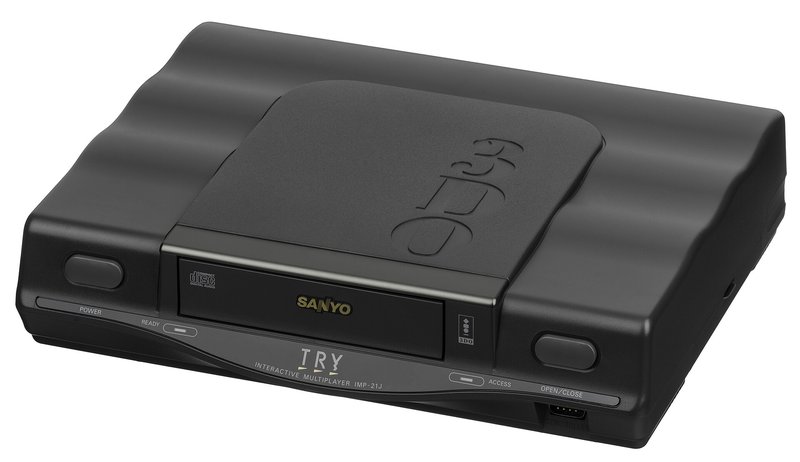
Sanyo’s TRY, Japan-only from 1994, is the connoisseur’s footnote: a handsome, unusually styled machine in limited numbers, mechanically kin to the FZ-10, and the hardest member of the family to find outside Japan. Around these three-and-a-half machines orbit the standard’s further ripples — the Samsung and Daewoo variants in Korea, the AT&T unit that never shipped, arcade and hotel derivatives — evidence that Hawkins’ standard did spread, even as the market’s centre of gravity moved on.
Inside the family resemblance
Open any of them and the standard shows its discipline. Every 3DO, whatever the badge, is built on the same three-chip heart: an ARM processor — a 32-bit RISC design licensed from Britain, years before ARM powered the world’s phones — flanked by two custom chips the engineers nicknamed Madam and Clio, handling graphics, sound and the system’s housekeeping between them. Two megabytes of RAM and a double-speed CD-ROM drive complete a specification that was, in 1993, genuinely imposing — and, crucially, identical under every manufacturer’s plastic. A developer wrote one game; the standard guaranteed it a home on every machine. That guarantee is the unglamorous miracle the licensing model actually delivered, and it is why the 3DO library never fractured the way its rivals’ add-on ecosystems did.
The machines diverge where manufacturers were free to diverge: in the furniture. Panasonic’s FZ-1 spent money on the tray, the finish and the silence of its mechanism; the FZ-10 spent it on nothing, which was its own kind of honesty; GoldStar spent it on the controller and the price sticker; Sanyo, in tiny numbers, spent it on style. Servicing a family member in 2026 is therefore a study in three philosophies — the FZ-1’s tray belts and gears, the FZ-10’s honest lid and laser, the GoldStar’s optics — and the community’s accumulated wisdom treats each accordingly. Choosing between them, as our buying guide argues, is a choice about which kind of thirty-year-old engineering you’d like to maintain. The games, gloriously, do not care.
Which one should you own?
The family’s afterlife has sorted the machines by temperament. The FZ-1 is the collector’s machine and the showpiece, kept serviced and admired. The FZ-10 is the player’s machine — the one with the ODE fitted, the lid worn smooth, the highest mileage in the retro room. The GoldStar is the character actor: bought for its looks and its pad, forgiven its laser, beloved anyway. And the TRY is the rumour at the family reunion, the one most owners will only ever meet in photographs. That a single standard could support four ownership stories is the licensing model’s last laugh: Nintendo and Sega owners of 1994 argued about games. 3DO owners have always argued about furniture — and the furniture, thirty years on, is half the fun.
The family in the wild
The spread did not stop at living rooms. The standard’s licensing carried the architecture into Korean production under local electronics giants, into arcade experiments, and into the hotel pay-per-play systems that introduced the machine to travellers who never saw a games shop. Each offshoot is a reminder that the 3DO was conceived as infrastructure — a format, like VHS, meant to be too widely adopted to fail. The format war it entered had other plans, but the family’s variety remains unique among consoles: no other platform’s history requires a group photograph.
One library, every badge
The family’s quiet triumph is compatibility. Because the standard was a standard — enforced by The 3DO Company’s licensing, built on the same Madam, Clio and ARM heart — a disc bought for an FZ-1 plays on a GoldStar in Seoul and a TRY in Osaka, with none of the regional fragmentation that plagued its rivals’ add-ons and revisions. The differences collectors debate — tray against lid, badge against badge, laser against laser — are differences of furniture, not of platform. In an industry that had always treated the console as a single company’s product, the 3DO family was a glimpse of another arrangement entirely: the platform as a format, the manufacturers as rivals within it. It did not win. But every games-capable device in your house that runs a licensed standard is living in its idea.