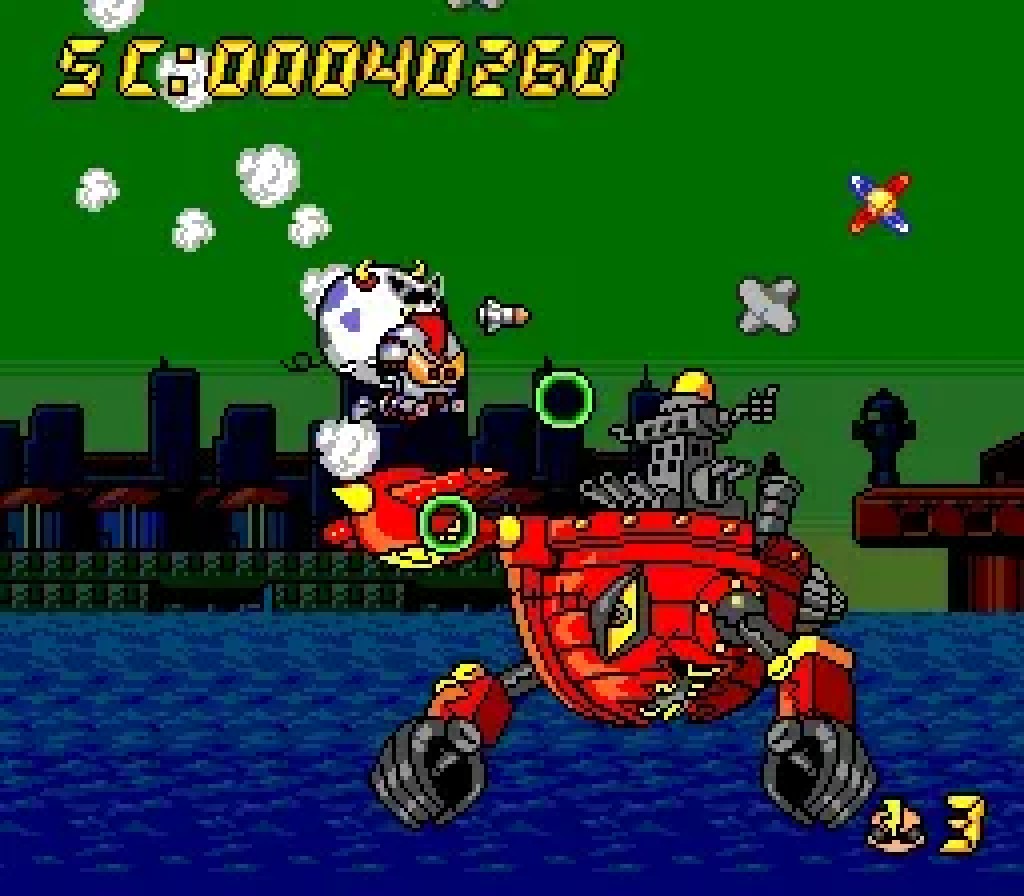
At a glance: Air Zonk · TurboGrafx-16 HuCard · Hudson Soft / Red Company, 1992 · Horizontal cute-’em-up · Score: 8.5/10
Every mascot of the 16-bit era eventually got a reinvention, but none committed like this. In 1992, Hudson Soft and Red Company took Bonk — the TurboGrafx-16’s bald, head-butting caveman — flung him thousands of years into the future, made him a cyborg, gave him power sunglasses, a lightning-bolt mohawk and a Z in his name, and starred him in a horizontal scrolling shooter. Air Zonk, released in Japan as PC Denjin, is a cute-’em-up with the soul of a Saturday-morning cartoon and the craft of a team at the peak of the HuCard era. Zonk even became the TurboDuo’s mascot in North America. One level in, you understand why.
The setup: the evil King Drool has sent his cyber robots to conquer the world, and Zonk and his friends — a gloriously odd roster of allies — are the resistance. Five stages, three difficulty modes with honest names (Sweet gives you five lives, Spicy three, Bitter exactly one), and a friend system that defines the game.
Choose your friend, become a hybrid
Before each stage you pick a companion — or let the game choose — from a bench of ten allies including Moo Moo the cow, Spike Lee the plant, and Bob the skeleton-ish oddity the manual describes with a straight face. Your friend flies alongside you as support, and collecting enough smiley-faced power-ups triggers the main event: Zonk and friend combine into a giant hybrid form with screen-filling attacks and temporary invincibility. It is a transformation mechanic with the timing of a wrestling tag-team finish, and routing your pick-ups so the fusion lands on a boss is the game’s central skill.
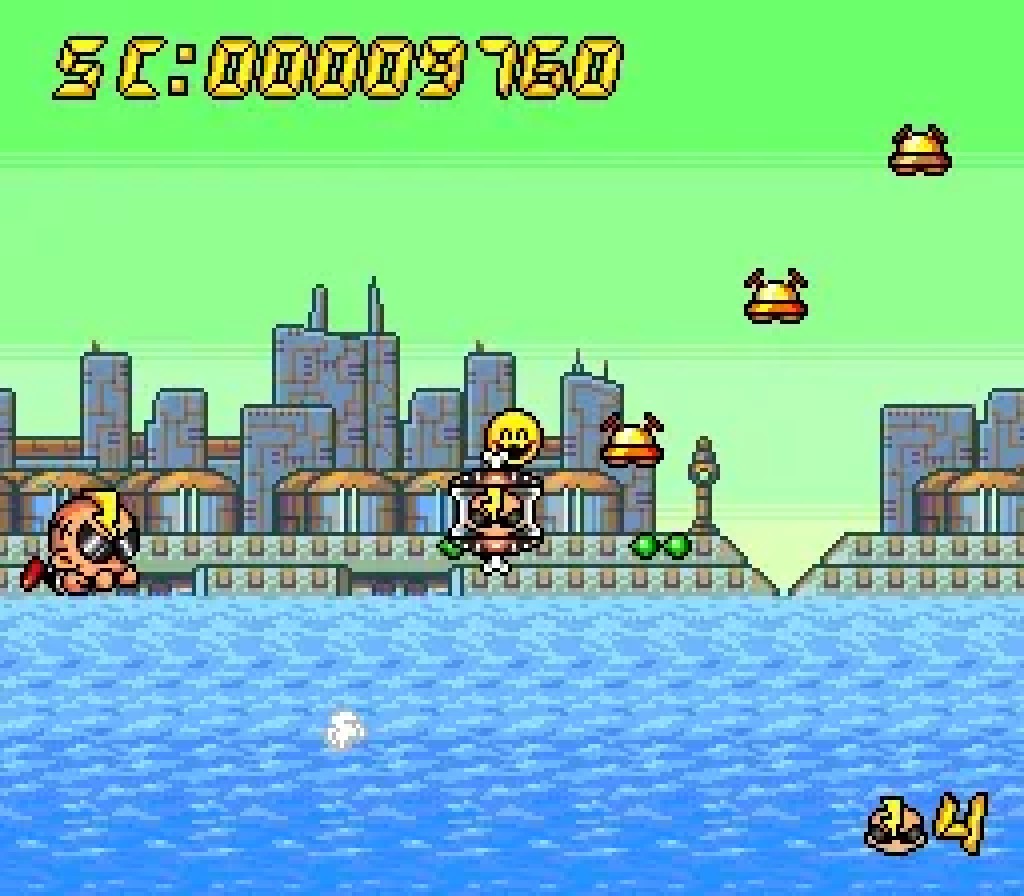
Zonk’s own arsenal is charged-shot based: hold fire to build a blast — including the memorably juvenile dropped bomb the manual calls the Pooped Bomb — and hoover up the meat on the bone that is this series’ eternal power-up. The backfire weapon, firing behind you when enemies sneak up, acknowledges the horizontal shooter’s oldest cheap death and does something about it. Everything is readable, generous and fast.
Colour as a weapon
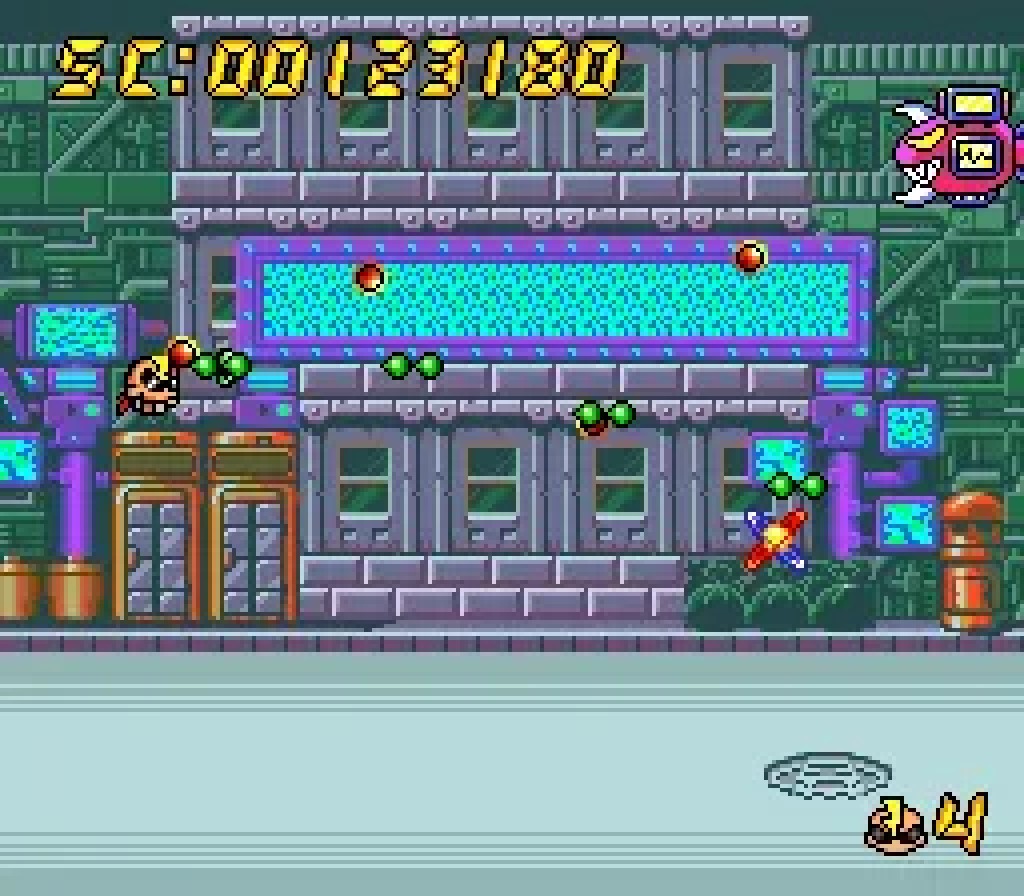
Visually, this is one of the most exuberant games on the system. The TurboGrafx palette is pushed into saturated cartoon territory — a riverside stage, a factory, a sports stadium, a final stage whose walls are tiled with Bonk artwork in a gag that doubles as a victory lap. Parallax scrolling is everywhere, sprites are big and expressive, and the sight gags come steadily: enemies with personalities, backgrounds with jokes, a hero who sticks his tongue out on the advertising because of course he does. The soundtrack matches it, chip music with genuine swagger — and yes, there is a theme song moment, because this is a game that believes in itself completely.
The honest criticism is length and, for shooter veterans, resistance. Five stages is a short afternoon, and on Sweet mode a competent player will cruise. But the three difficulty settings scale lives rather than merely enemy counts, Bitter mode is a genuine one-life test, and the friend-combination system gives replays a different texture depending on which ally you bring to which stage. The CD sequel, Super Air Zonk, is famously the lesser game; this HuCard original is the one with the ideas and the energy.
Why Zonk endures
Air Zonk arrived late in the TurboGrafx-16’s North American life, which kept it from the audience it deserved at the time — a fate it shared with much of the system’s best work. What survives is the purest expression of Hudson’s house style: technically assured, mechanically generous, and funny on purpose. In a library stacked with stern military shooters, Zonk is the one grinning at you.
Friends, in detail
The friend system rewards a proper examination, because it is the game’s strategy layer disguised as a joke book. Each of the ten allies brings a different support pattern — covering fire, orbiting assistance, spread shots — and, more importantly, a different combined form when the fusion triggers, so your choice of partner is really a choice of which emergency super-weapon you are carrying. Some fusions are screen-clearing bruisers built for bosses; others are wide, forgiving patterns that suit the crowded mid-stage. The Auto and Manual selection modes frame the decision honestly: let the game deal you a partner and adapt, or build your run deliberately, stage by stage. Veterans plan fusions the way other shooter players plan bomb stocks — the transformation is invincible, spectacular and finite, and wasting it on empty sky is the game’s purest self-inflicted wound.
The charge-shot economy reinforces the same playful discipline. Zonk’s held-fire blast, the dropped bomb for enemies below, and the backfire for the ones sneaking behind give a horizontal shooter an unusually complete toolkit, and the meat-on-the-bone pick-ups tie the whole game back to Bonk’s table manners. Even the smiley-face score items are doing design work: they are the fusion fuel, so the game constantly tempts you into greedy lines for the one more face that triggers the transformation before the boss door.
Stages as sight gags with teeth
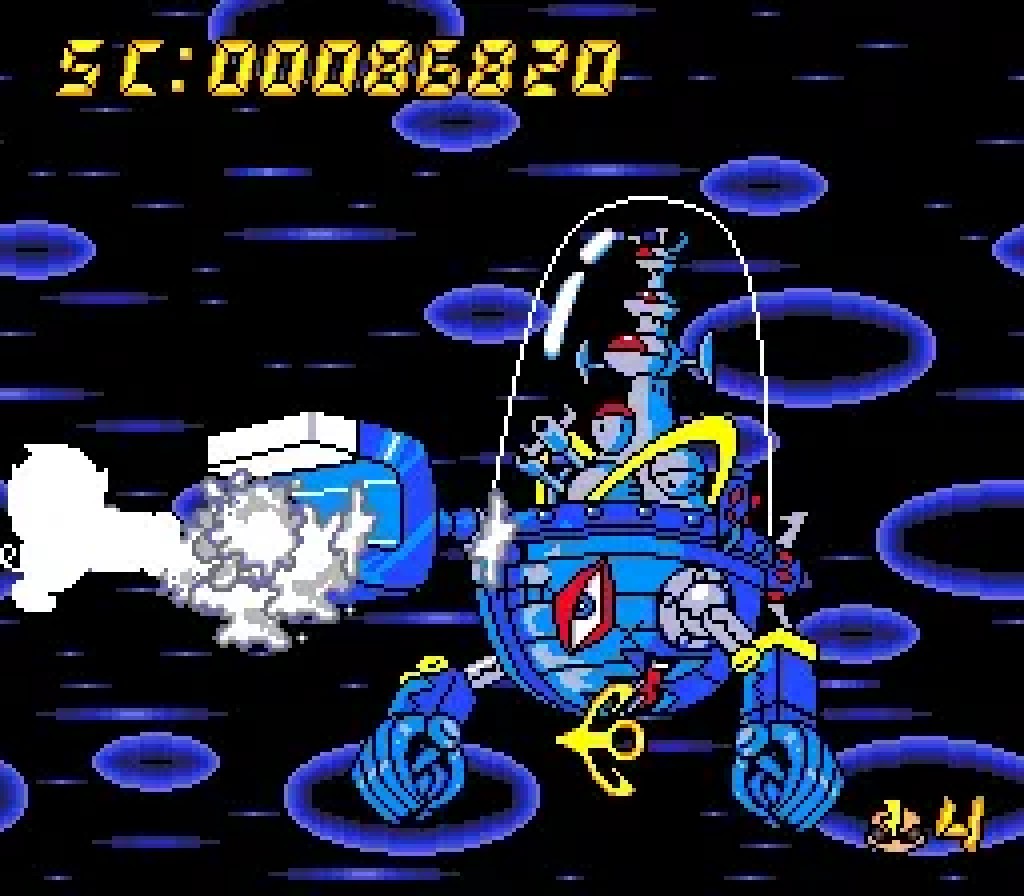
The five stages repay description. The riverside city opener is a parade — colour, parallax, enemies with comic timing. The factory stage industrialises the joke without losing it. The stadium stage is pure Hudson showmanship, a boss culture of sport and spectacle. And the final stage, whose walls are papered with Bonk artwork, is the rare self-reference that also plays well: a gauntlet through the series’ own history before King Drool’s robots make their last stand. Bosses throughout are large, expressive machines piloted by Drool’s menagerie, and their patterns are tuned to the fusion system — every boss is secretly a question about whether you arrived transformed.
What keeps Air Zonk from mere novelty status is that the shooting underneath the comedy is properly built: bullet patterns are readable at the game’s saturated palette, hitboxes are fair, the three difficulty modes change the game’s terms rather than just its numbers, and Bitter mode’s single life turns the cartoon into a genuine exam. Hudson and Red shipped a mascot game with a cult shooter’s spine. That combination — not the sunglasses alone — is why Zonk, of all the era’s mascot reinventions, is the one players still seek out on purpose.
A note on the mascot succession
Zonk’s afterlife is brief but telling. He fronted the TurboDuo’s North American identity, headlined the system’s late advertising, and returned for the CD sequel — a game whose weaker reception only burnished this original’s standing by comparison. When the TurboGrafx-16 Mini arrived decades later, Air Zonk was on the list, shades and all, introducing the character to players who had never seen a HuCard. Few mascot experiments survive their console. Zonk did, because the game underneath the gimmick was built by people who made shooters properly and jokes carefully. The shades were always earned.
Verdict
Short, sweet and almost absurdly charismatic, Air Zonk is the cute-’em-up at its console peak — a shooter whose transformation system, colour and confidence still land. Bring a friend. Mecha-fuse with them. Save the world.
Score: 8.5/10