At a glance: Astrosmash · Intellivision · Mattel Electronics, 1981 · Fixed shooter · Designed by John Sohl · Score: 9.0/10
Some games define a console by showing off what it can do. Astrosmash defined the Intellivision by being the game nearly everybody owned. Designed by John Sohl and released by Mattel Electronics in 1981, this fixed shooter sold more than a million copies, climbed into the system’s all-time best-seller list, and by 1982 had become so essential that Mattel replaced Las Vegas Poker & Blackjack with Astrosmash as the cartridge packed in with the console itself. If you grew up with an Intellivision, there is a very good chance this was the first screen you ever saw — and the case for revisiting it today is that, underneath the familiarity, Astrosmash is a smarter, stranger shooter than its reputation as “Space Invaders meets Asteroids” suggests.
Two games fused into one
Astrosmash has an unusual birth that explains its unusual feel. Sohl originally built a game called Meteor!, a close Asteroids clone, but it didn’t fill the cartridge’s ROM space. Rather than waste the room, he built a second, simpler variation — Avalanche! — into the same cartridge, and then, crucially, programmed a branch at startup that skipped the menu and dropped the player straight into the action. The released game blends both ideas: you command a laser cannon that slides along a planet’s surface at the bottom of the screen, blasting everything that falls out of the sky at you, exactly the hybrid its origins promised. It looks like a Space Invaders formation translated into an Asteroids debris field, and it plays like neither — faster than the first, more grounded than the second.
The falling traffic is a proper taxonomy of threats. Most of it is meteors, in two sizes and a shifting rainbow of colours as the score climbs; big ones split into smaller ones when shot, just as Asteroids taught a generation to expect. Mixed among them are the spinning white bombs — the game’s true villains. Let a meteor slip past and you merely lose the points it would have given you. Let a spinning bomb reach the ground and you lose a cannon. Later come guided missiles that curve toward you and a UFO that crosses the screen laying fire down at your position. The hierarchy is elegant: everything is worth shooting, but only some things must be shot, and learning to triage a crowded sky in a fraction of a second is the whole skill of the game.
A scoring system with a sting

What elevates Astrosmash above its many fixed-shooter contemporaries is that your score is not a one-way ratchet. Points are deducted when targets get past you. Your total can go backwards, slide toward zero, and the game’s difficulty is pegged directly to that total: cross a threshold and the background changes colour — black to blue to purple to turquoise to grey and back to black — and everything falls faster. Fall back below a threshold and the game mercifully slows again. It is a self-balancing difficulty curve in 1981, implemented with nothing more than a score counter, and it creates a rhythm no rival managed: surges of panic as the sky fills and the palette shifts, then brief, earned breathers when you’ve been knocked back down a band. Modern designers would call it dynamic difficulty. Sohl just called it using the whole cartridge.
The controls deserve their own paragraph, because Astrosmash is one of the games that made the Intellivision’s much-mocked disc controller sing. The cannon glides in sixteen directions’ worth of smoothness along the bottom of the screen, and the game offers automatic fire — hold nothing, think only about positioning — which was a genuine novelty at the time. There is also a hyperspace escape that teleports your cannon to a random spot when the sky becomes unsurvivable: a panic button that can save you or drop you somewhere worse, which is exactly what a panic button should be. On the disc, all of this feels fluid in a way that the same game on a joystick, in its later Atari 2600 incarnation as Astroblast, never quite matched.
Presentation: simple, sharp, unmistakably Intellivision

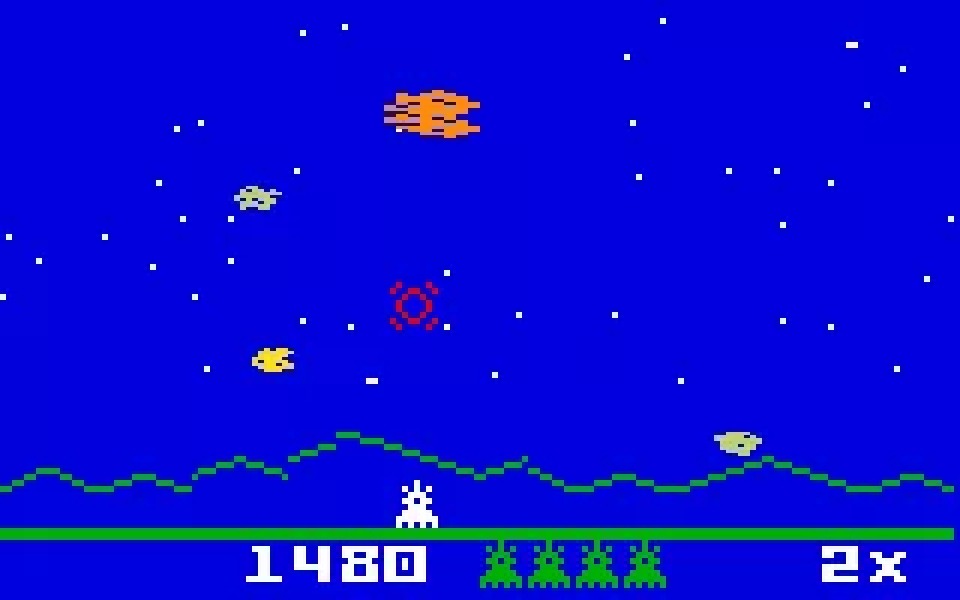
Visually this is early Intellivision at its cleanest: a scrolling green horizon of low hills, a starfield, chunky multi-coloured meteors and that distinctive chunky score readout with its multiplier ticking up as you climb the bands. The palette shifts double as both decoration and information — an experienced player reads the background colour the way a racing driver reads a gear indicator. Sound is sparse but functional, the usual Mattel bleeps given urgency by sheer density of action. Nothing here strains the hardware, and that is the point: every resource went into speed and smoothness, and the game still feels fast today, especially once the grey band arrives and the screen becomes a genuine blizzard.
The pack-in that earned its place
It is worth pausing on what Astrosmash’s success actually meant, because it shaped the Intellivision’s identity. Las Vegas Poker & Blackjack, the original pack-in, was a fine game but a statement about adults and card tables — Mattel’s “thinking person’s console” pitch made literal. Replacing it with Astrosmash in 1982 repositioned the machine around the thing it did best: fast, smooth, score-attack arcade action that felt a generation more fluid than the Atari 2600 norm. The change also tells you something about Sohl’s design that players sometimes miss on a casual credit. Astrosmash is frequently described as derivative — Space Invaders below, Asteroids above — but the deduction scoring and the colour-band difficulty system give it an identity neither parent has. Invaders never punishes you for a leaker with anything but lost ground; Asteroids never throttles its chaos to your performance. Astrosmash does both, continuously, and the result is a difficulty curve that meets every player exactly where they are. A child can survive for minutes at the black and blue bands and feel heroic; a veteran lives in the grey band, where the game is genuinely ferocious, and the score multiplier has climbed to match the risk.
There’s a final, quieter virtue: session shape. A game of Astrosmash has a natural dramatic arc — calm, pressure, crisis, collapse, and that involuntary reach for the reset button — compressed into a few minutes. It is the cartridge you demonstrate the console with, the one you hand to a sceptical visitor who thinks the Intellivision is all sports simulations and strategy. Thirty seconds of the disc under their thumb, cannon skating across the horizon while meteors split overhead, usually finishes the argument.
The verdict
Astrosmash is not the deepest game on the Intellivision, and it was never trying to be. It is the purest: one screen, one cannon, a sky full of falling trouble and a scoring system with the courage to punish you. Its million-plus sales were not an accident of bundling — the bundling happened because of the sales, and the sales happened because this is the fixed shooter of its generation that respects the player’s intelligence. If you are building an Intellivision shelf, this is not merely a game to own. It is the control group against which everything else on the system is measured.
Score: 9.0/10