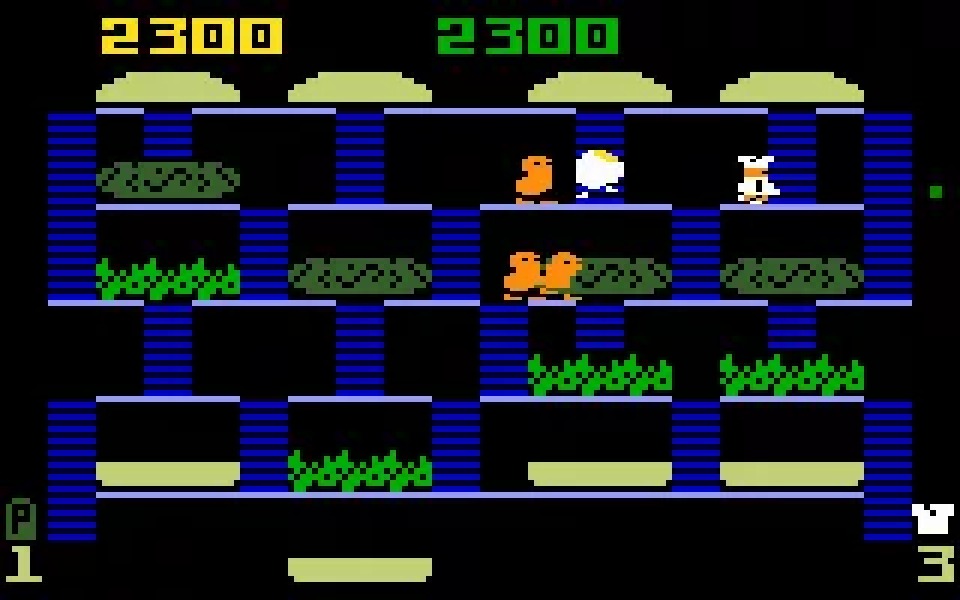
At a glance: BurgerTime · Intellivision · Mattel Electronics / Data East, 1982 · Maze/platform action · Score: 9.0/10
Ask a room of retro collectors to name the best home version of BurgerTime from the original era and the argument usually ends in the same place: the Intellivision cartridge. Data East’s 1982 arcade game — chef Peter Pepper climbing ladders and walking across giant burger ingredients to drop them onto plates, pursued by murderous Mr. Hot Dog, Mr. Pickle and Mr. Egg — was ported everywhere, but Mattel’s Intellivision edition, programmed in-house (with Ray Kaestner among the key hands credited on the project), is the one that kept the arcade’s soul intact. On a system famous for sports and strategy, BurgerTime was the proof that the Intellivision could also do the arcade-conversion game as well as anyone alive.
The burger, faithfully rebuilt

The core loop survives the translation perfectly. Each screen is a scaffolding of platforms and ladders stacked above a row of plates. Walk Peter Pepper across a bun, a patty, a lettuce leaf or a cheese slice and that ingredient drops one level, crushing or carrying down anything beneath it; drop every ingredient to assemble the burgers at the bottom and the screen is cleared. The enemies patrol with real intent, converging on your level, and your only weapon is a limited supply of pepper — a quick shake stuns a pursuer where he stands, ideally on top of an ingredient about to fall, because an enemy riding a falling patty is worth a glorious stack of bonus points. It is a risk-reward engine disguised as a cartoon about lunch, and the Intellivision version keeps every moving part: the pepper, the bonus foods that appear mid-screen (ice cream, coffee, fries in the arcade tradition), the escalating speed, the extra chef at the score threshold.
What surprises newcomers is how complete it feels. The Intellivision’s graphics hardware was built for chunky sprites on card-based backgrounds, and the BurgerTime team turns that into an asset: the scaffolding is drawn in strong blue girders, the ingredients are big, flat, appetising slabs of colour, and Peter Pepper himself is a crisp little chef you can read at a glance. Compare it with the flickery, simplified Atari 2600 port — a game that deserves respect for existing at all — and the Intellivision version looks like the arcade’s younger brother rather than a rough sketch of it.
Built for the disc

The other half of this version’s reputation is control. BurgerTime in the arcade is a four-way joystick game, and the Intellivision disc — a sixteen-direction pad you roll your thumb across — ought to be its nemesis. In practice the game’s movement is grid-locked: Peter Pepper snaps cleanly between platforms and ladders, the disc’s diagonals resolve into the four directions the maze actually uses, and the result is precise, confidence-inspiring movement. The side buttons throw pepper, and the whole scheme is one of the exhibits Intellivision defenders produce when the controller wars start. This is a maze game you play with your instincts rather than your workarounds.
Structurally the cartridge gives you the arcade’s progression of screens with their distinct layouts — the Intellivision edition is generally counted as carrying six stages before looping with increased speed — and two-player alternating play for the household rivalry the box art promised. Difficulty ramps honestly: the early screens teach spacing and pepper discipline; the later ones are genuine traffic-management crises in which every ladder is contested and a dropped ingredient with two riders aboard is the only thing standing between you and the high-score table.
Sound, polish and the Mattel touch
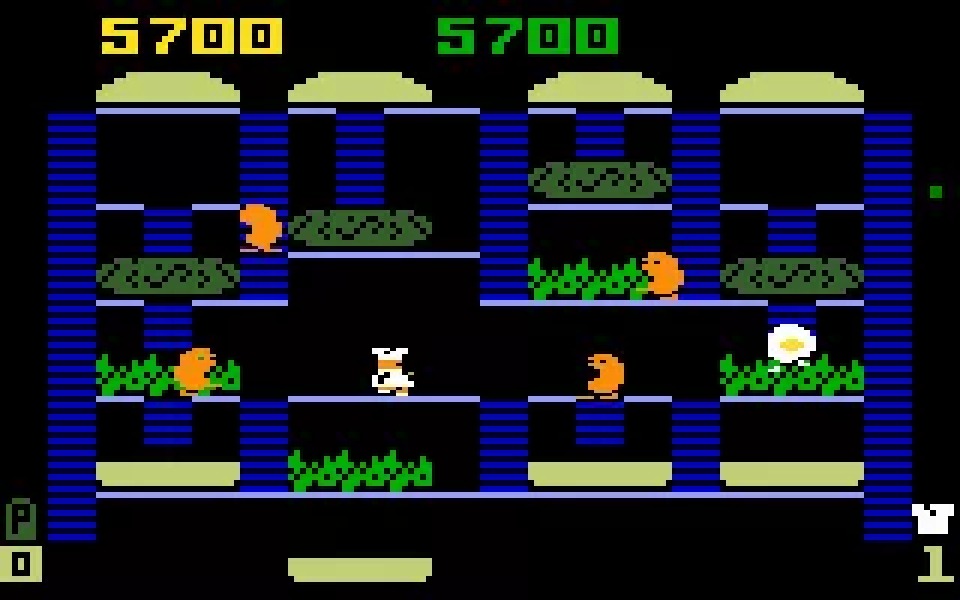
Mattel’s sound work here is modest — jingles for level start and completion, the squelch of a falling ingredient — but the polish is elsewhere: in the animated title screen, the intermission touches, the way the game keeps the two players’ scores displayed like an arcade attract mode. This was Mattel’s house style at its peak, the same care that made its sports games feel a generation ahead of Atari’s. BurgerTime arrived in that 1982–83 window when Mattel Electronics was arguably the best publisher in the business, and the cartridge carries itself accordingly.
How it stacks up against the other versions
Version-shopping is where BurgerTime gets interesting, because the field was crowded. The arcade original remains the reference for animation and sound, but among the home editions of the era the Intellivision cartridge sits at the top of the pile for playability: the ColecoVision version is handsome but moves at a more deliberate pace, the Atari 2600 version is a heroic squeeze that sacrifices too much of the maze, and the various computer ports vary wildly. The Intellivision edition’s advantage is that nothing essential is missing and nothing important was rethought. The ingredient weights feel right — a patty carrying an enemy falls fast and scores fat — the pepper economy is tuned to force decisions rather than hoarding, and the enemy intelligence, simple as it is, produces the pincer movements that make the arcade game tense. Mr. Hot Dog, Mr. Pickle and Mr. Egg enter from the edges with intent, split up to cut off ladders, and converge in a way that constantly asks whether you should spend pepper now or save it for the ambush forming two platforms up.
One more thing this version gets right is length of session. BurgerTime can be a marathon game in skilled hands, and the Intellivision port’s steady difficulty ramp — rather than a sudden wall — rewards the patient, route-planning style of play the design secretly wants. You learn to think in completed burgers: which column to build first, which ingredient is a natural enemy-trap, when to abandon a half-built stack and go rebuild elsewhere. That strategic layer, present in the arcade, survives here intact, and it’s the reason this cartridge anchored so many Intellivision collections rather than decorating them.
A word on the sequel you should also know
BurgerTime’s Intellivision story has a coda worth knowing, because it affects how collectors complete the shelf. In 1987, years after this cartridge, INTV published Diner — an isometric sequel built by ex-Mattel talent that moves Peter Pepper into a scrolling 3D diner. It is superb, it is covered in our hidden-gems list, and it is a different game in a different genre of maze-action; this review’s subject is the 1982/83 original only. The two together make the Intellivision the definitive BurgerTime machine of the classic era: the best contemporary port of the arcade game, and the boldest sequel it ever received, on one console. Few licences of the period can say as much, and none can say it about hardware built in 1979.
The verdict
Every console has one arcade port that becomes the reference version, the one other ports are judged against. For BurgerTime’s generation, this is it. It is faithful where faithfulness matters, clever where the hardware demanded cleverness, and it plays superbly on the controller it was supposedly going to embarrass. Play the Intellivision version once and every other early-80s port becomes a footnote. If your shelf can hold only one arcade conversion for the system, hold this one.
One last practical note: the cartridge is common, because it sold the way essential games sell. Buy the copy with the overlay if you can — not because the game needs it, but because BurgerTime’s box, overlay and manual together are one of the era’s nicest artefacts, and this is a game you will own for a long time.
Score: 9.0/10