
At a glance: Night Stalker · Intellivision · Mattel Electronics, 1982 · Maze shooter · Designed by Steve Montero · Score: 8.5/10
Every early console had its maze game, but only one of them genuinely understood dread. Night Stalker, designed by Steve Montero and released by Mattel in 1982, drops you into a dark blue labyrinth with a bunker in the middle, a gun that is almost never where you are standing, and a menagerie of things that want you dead — bats, spiders, and robots that start dumb and get frighteningly smart. It is often described as the Intellivision’s answer to Berzerk, which is fair as far as it goes, but Berzerk never made you feel hunted the way this game does in its best moments, when the music pulses, the bunker has failed you, and the grey robot is coming.
The gun is somewhere else

The whole design hangs on one decision: you do not carry a weapon. A handgun spawns at a random location in the maze, good for a handful of shots — the supply grows as you score — and when it runs dry you are unarmed until you find the next one. Every excursion out of the bunker is therefore a calculation. Do you have enough shots to justify the trip? Is the maze’s current tenant a spider you can dodge or a robot you cannot? Night Stalker’s maze is a single screen, but the random gun placement turns that screen into a fresh tactical problem every few seconds, and no two games unfold alike. The bunker in the centre protects you completely while you stand in it — but nothing scores inside a bunker, and the game knows exactly how long you’ll dare to hide before greed pulls you out.
The bestiary escalates in a carefully staged ladder. Bats flap through the corridors and spiders scuttle along the floor — nuisances that cost you a life on contact and teach you the maze’s traffic patterns. Then come the robots, and Night Stalker becomes something else. The early robots are slow, stupid, and die in one shot. Score higher and the blue robots arrive, faster and tougher. Higher still, the white robots — quicker, more resistant, and aggressive. And at the top of the ladder waits the grey robot, the game’s quiet claim to legend: it takes multiple hits to kill, it hunts you rather than wandering, and its shots can destroy your bunker cover entirely, the only enemy in the game that can reach into your sanctuary and end the argument. In 1982, an enemy that dismantles your safe space was not a feature. It was a threat the whole genre would spend years catching up to.
Sound design as suspense
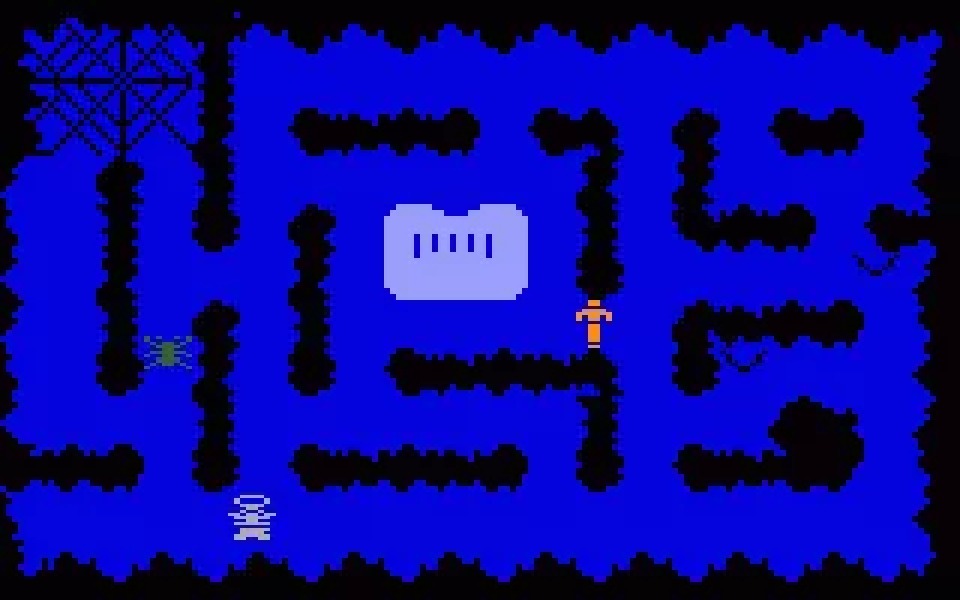
Ask anyone who played Night Stalker in a dark room in 1982 what they remember and they will not describe the graphics first. They will hum the heartbeat. The game runs a low, relentless percussive pulse — a bass throb like something stalking you — under everything, quickening the blood while the maze does its work. On a system whose sound chip was nothing special, Montero’s team understood that atmosphere is a mechanical resource: the pulse makes you impatient, impatience makes you leave the bunker early, and leaving early is how Night Stalker kills you. The sparse effects — the crack of the handgun, the electronic zaps of a dying robot — land harder because the space between them is filled with that drum.
Visually the game is a single deep-blue screen with black corridors, pale webbing in the corner, and tiny, legible sprites. It looks minimal because it is minimal — and the minimalism is the mood. The maze reads instantly, your man reads instantly, and the one flash of colour that matters — a fresh gun glinting somewhere in the dark, or the grey bulk of the top robot entering play — gets your full attention. This is presentation in service of tension, and it has aged far better than prettier games that spent their budget on decoration.
Playing it today
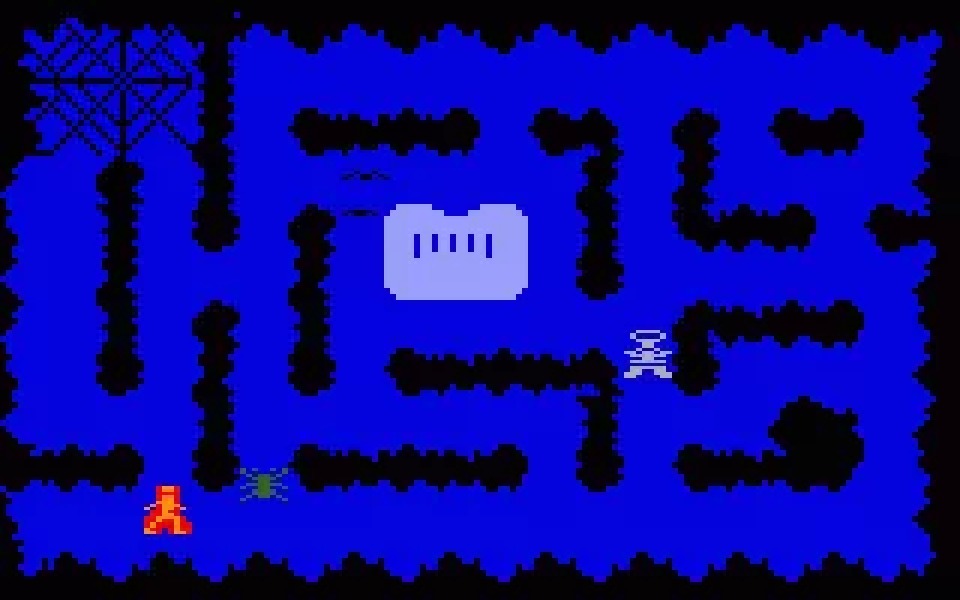
The disc controller divides movement and firing cleanly — disc to run, buttons to shoot in the direction you’re facing — and the scheme holds up because the game is about positioning, not marksmanship. Sessions are short, deaths are instructive, and the score ladder gives you a permanent reason for one more run: beating your best robot tier feels like a genuine achievement. As a two-player alternating contest in a household it was a fixture, and it remains one of the easiest Intellivision games to teach a newcomer, because its rules fit in one sentence and its depth arrives on its own schedule.
A design that taught the genre
Look at Night Stalker’s component parts and you can see how much of the modern survival-action grammar is already here, assembled in 1982 from a single screen and a few sprites. Resource scarcity: your gun is temporary, your ammunition is counted, and resupply requires a dangerous journey. Safe-room psychology: the bunker is total protection with zero reward, and the game’s scoring system is a standing bribe to leave it. Escalating enemy intelligence: the robot ladder, from wandering drones to the bunker-breaking grey hunter, is a difficulty system expressed as a bestiary rather than a speed knob. Even the much later language of horror games — the heartbeat you can’t switch off, the sanctuary that stops being one — is present in embryo. None of this is to claim Night Stalker single-handedly invented those ideas; Berzerk’s Evil Otto and the arcade’s general cruelty were in the air. But Montero’s team bundled them into a home game with an elegance the arcade rarely attempted, because a home game had to sustain tension for an evening rather than extract a quarter in three minutes.
The two-player culture around the game deserves mention too. Night Stalker scores are beautifully comparable — same maze, same ladder, same cruel grey robot — which made it a natural house championship game: pass the controller, beat the run, hand it back. Its starkness is an asset there. A spectator can read a run at a glance, knows exactly how much trouble you’re in, and hears the heartbeat speed the room’s nerves along. Few single-screen games have ever been this good to watch.
One more thing: the remake trail
Night Stalker’s afterlife confirms its standing. It has been a staple of Intellivision compilations and retro collections for decades — the game licensors reach for when a compilation needs the system’s atmosphere in a single cartridge — and its design DNA (the armed/unarmed oscillation, the escalating hunter, the sanctuary that fails) keeps surfacing in indie horror-action games whose designers grew up, as so many did, in a dark room with that heartbeat. If you are choosing where to start with Mattel’s action library, start here and then take Astrosmash for the opposite pole: the same company, the same year-ish window, one game about a heartbeat and one about a blizzard. Between them they map the system’s whole emotional range.
The verdict
Night Stalker is the Intellivision’s purest exercise in tension: a maze, a missing gun, a safe room that stops being safe, and a heartbeat that won’t let you relax. Berzerk may have done the robot maze first, but no contemporary did it with this much atmosphere or this clever an escalation curve. It belongs on any shortlist of the system’s essential games — preferably played loud, in the dark, the way it was designed to hunt you.
Score: 8.5/10