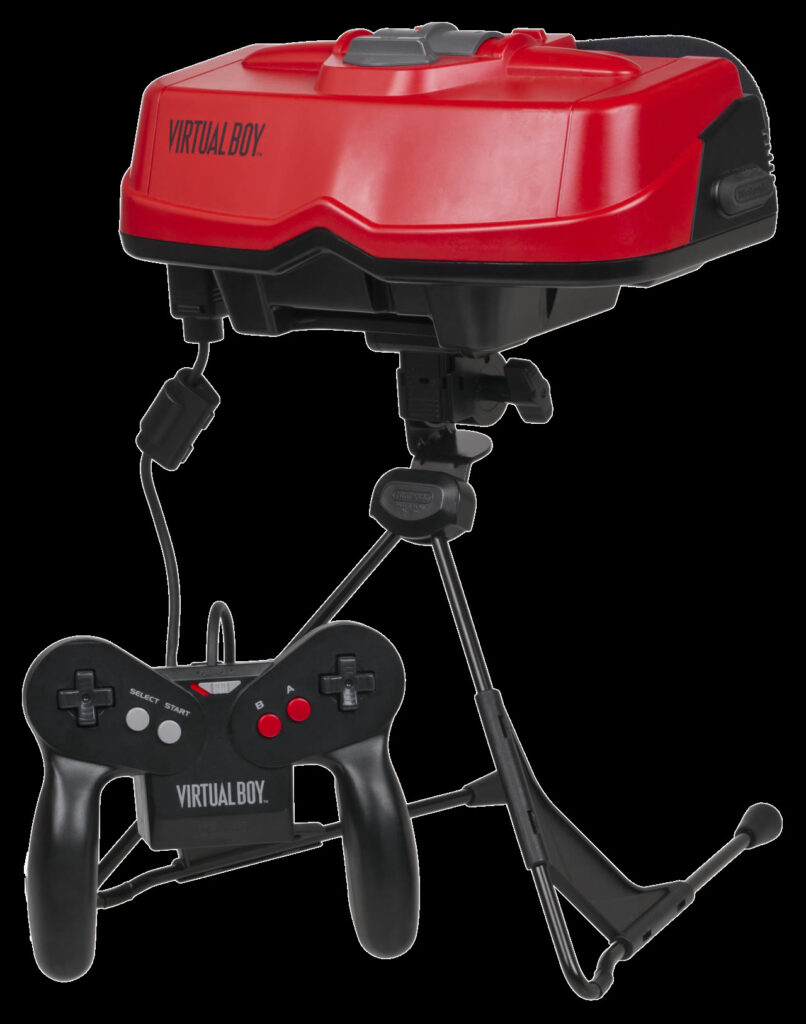
Every great company has one: the product so strange, so doomed, so thoroughly rejected that it becomes legend. Nintendo’s is a red plastic viewport on a spindly stand, a machine that showed you the future in a single colour, hurt your neck showing it, and was cancelled within a year – having sold fewer units than the Game Boy sold in a slow month. The Virtual Boy is Nintendo’s most famous failure, and this is the complete story: of Gunpei Yokoi, the most important designer in Nintendo’s history, betting his reputation on virtual reality in 1995; of the ingenious mirror-and-LED machinery inside the visor; of the 22 games, the firesale, and the resignation that followed. And of the punchline nobody saw coming – that the failure was right about the future, just thirty years early, and that Nintendo itself would one day sell the Virtual Boy back to you.
Yokoi’s Last Big Idea
Gunpei Yokoi invented the modern Nintendo. He designed the Game & Watch, created the D-pad, produced Donkey Kong and Metroid, and built the Game Boy – the machine that made Nintendo the king of handhelds – on a philosophy of “lateral thinking with withered technology”: use cheap, mature parts in surprising ways, and never chase power for its own sake. By the early 1990s he was chasing something that fit the philosophy in an odd, inverted way. A small Massachusetts company, Reflection Technology, had built a display called the Private Eye: a single column of red LEDs swept by an oscillating mirror into a full image. Mature, odd, cheap – and capable of genuine stereoscopic 3D if you built one for each eye. Nintendo licensed it, and Yokoi’s team, under the codename VR32, spent years turning it into a product: the “Virtual Utopia” made plastic. What emerged kept sliding between two identities – too bulky to be a handheld, too solitary to be a console – and Nintendo, already deep in the expensive Nintendo 64 programme, positioned it as a “third pillar” beside the Game Boy and the home consoles. It would be remembered as a third rail.
The Machine: Mirrors, LEDs and Red, Red, Red
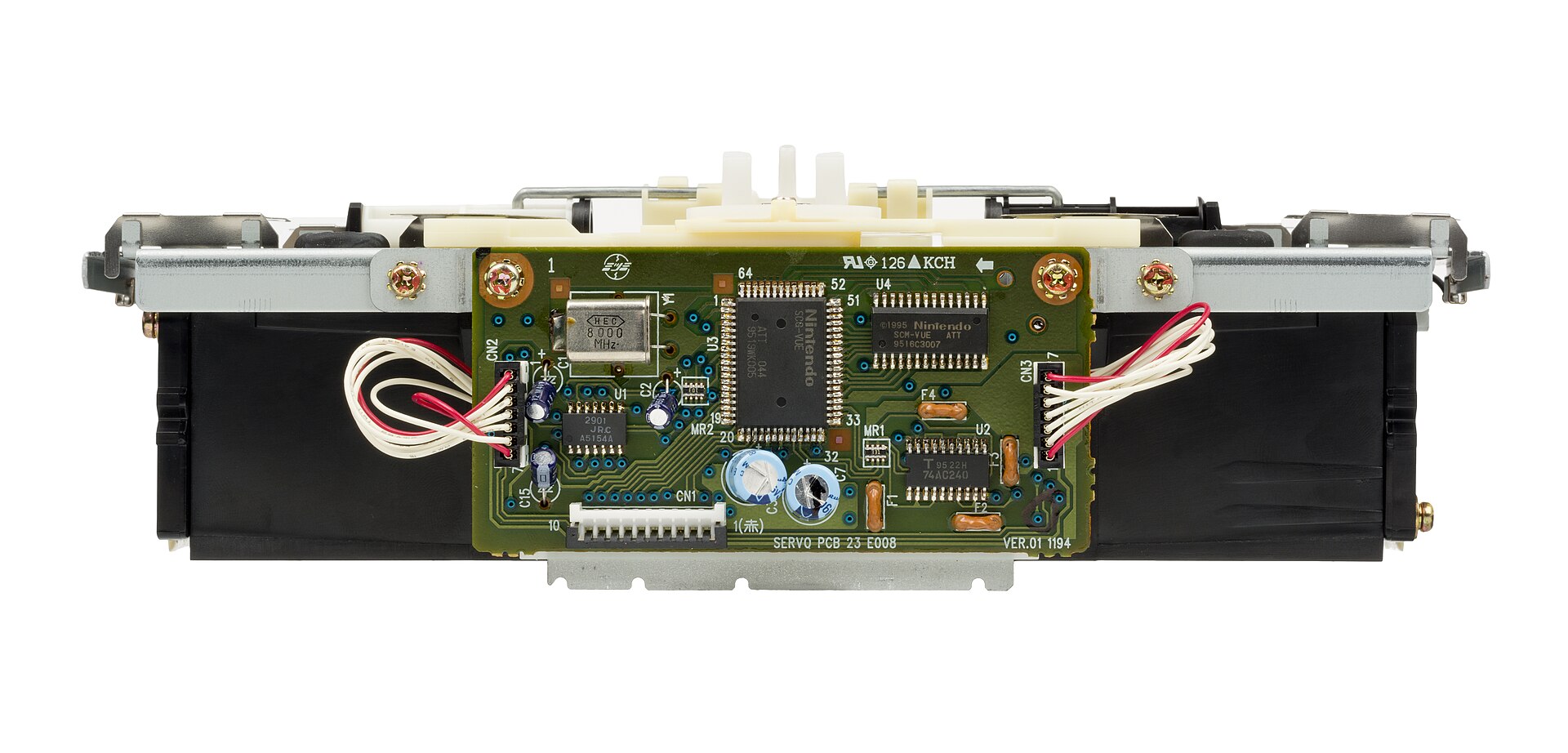
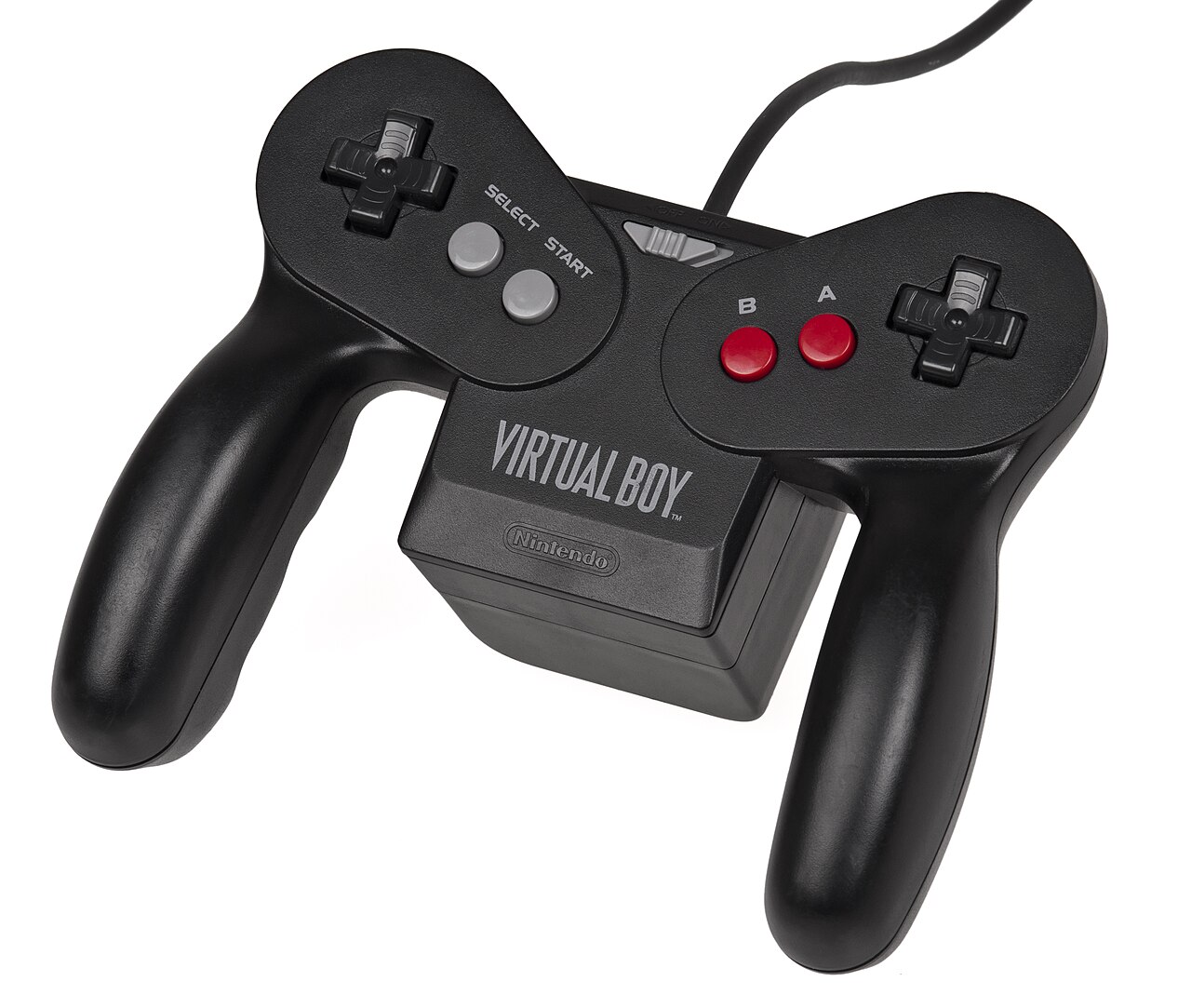
Inside the visor is some of the most ingenious engineering Nintendo ever shipped. Each eye sees a 384×224 image – genuinely high resolution for 1995 – painted one column at a time: a strip of 224 red LEDs blinks patterns while a mirror, vibrating fifty times a second, sweeps the column across your vision. Red because red LEDs were the affordable, power-sipping, high-brightness option; colour displays would have tripled the price and battery drain, and Yokoi’s philosophy held the line. The brain is NEC’s V810, a proper 32-bit RISC chip – the Virtual Boy was, technically, Nintendo’s first 32-bit machine. The controller anticipated the future too: TWO D-pads, one for each thumb, designed for moving and facing in 3D space before analogue sticks existed. And then there were the compromises that wrote the headlines: the machine sat on a table stand, so you played hunched into the visor like a Victorian stereoscope viewer; it ran on six AA batteries in a pack on the controller; it had no head tracking, so the world didn’t turn with you; and Nintendo, terrified of the new technology’s optics, printed warnings everywhere – including an automatic pause every fifteen minutes and a caution against children under seven that the press read as a confession.
The Demo Problem
No product in Nintendo’s history was harder to sell than a picture only one person could see. Television ads for the Virtual Boy could show a visor, a stand, a famous claymation mascot floating in red space – anything except the product. Magazine screenshots were red wireframe ghosts. So the machine’s first impression, for most of America, was a store kiosk: a Virtual Boy bolted to a counter at a fixed height, in fluorescent light, with a queue. You hunched, pressed your face to a rubber gasket a hundred strangers had shared, and played Mario’s Tennis standing up, in public, at whatever height the fixture assumed your spine preferred. It was the least seductive demo in retail history for the most theatrical technology Nintendo had ever made. And the climate was poisoned besides: the early nineties were the era of video-game seizure headlines and Congressional hearings, and a machine that strapped to your face, warned against children, and paused itself every fifteen minutes was catnip to every local-news segment in the country. The Virtual Boy didn’t just have an image problem. It had the image problem the whole industry was trying to outrun, worn as a headset.
Launch: $179.95 and a Rental Scheme
The Virtual Boy launched in Japan on July 21, 1995, and in North America on August 14, at $179.95. Nintendo knew the machine was a hard demo problem – 3D you couldn’t photograph, couldn’t televise, couldn’t even describe – so it struck a deal with Blockbuster: rent the console before you buy it, an admission no launch wants to make. The reviews were a shrug in unison: fascinating technology, uncomfortable posture, games that used the depth politely rather than essentially. Mario’s Tennis, the pack-in, was charming doubles in shallow 3D. Red Alarm flew wireframe sorties. Teleroboxer punched in glorious parallax. But the Game Boy beside it cost half as much, played anywhere, and had Tetris and Mario and Pokemon assembling on the horizon. By the autumn Nintendo had cut the price; by Christmas the machine was a curiosity at $159, then $99, then the stuff of clearance bins. Japan discontinued it in December 1995 – five months after launch. America lasted into 1996. Final tally: roughly 770,000 units and exactly 22 games, the smallest library of any Nintendo platform that reached retail. Third parties took one look at the install base and walked: the catalogue is Nintendo, Hudson, Atlus, T&E Soft and a handful of others, and it ends almost as soon as it begins.
The Autopsy in Numbers
The figures have the clarity of a chalk outline. Nintendo shipped the Virtual Boy expecting the machine to ride the Game Boy’s momentum; instead the first production run became nearly the whole story — around 770,000 units across the system’s life, against Game Boy sales that year measured in the tens of millions. Blockbuster’s rental scheme, intended as a try-before-you-buy bridge, mostly proved that people who tried it at home still didn’t buy it at $179.95, and the discounting ladder that followed — $159, then $99, then clearance pricing that put boxed units in remainder bins before the platform’s second birthday — destroyed any premium story the technology might have kept. Retailers wrote the experiment off as shelf poison for the rest of the decade, which is one reason dedicated VR hardware vanished from games retail for twenty years: the men who bought stock in 1996 remembered the red visor every time a headset was pitched to them afterward. The jokes about headaches became the machine’s entire obituary because jokes are what a market writes when the numbers are too dull to argue with. What the numbers couldn’t say, time did: a complete-in-box Virtual Boy that cost $30 in a 1997 remainder bin is a four-figure collectible now, and its best game trades at prices its maker never achieved at retail. The market was wrong about the machine at launch, then wrong about it in the bin, in opposite directions — which is to say the market, like Nintendo, like all of us, simply had no idea what the red light was for.
The Games: Better Than the Reputation
Here is the secret the clearance bins hid: the Virtual Boy’s library is, pound for pound, one of the strongest tiny catalogues in history, because Nintendo’s own teams worked on it in earnest. Virtual Boy Wario Land is the crown – a full, inventive Wario platformer with foreground-background plane-shifting that remains the best reason the machine exists. Mario Clash rebuilt Mario Bros. in true depth. Jack Bros. brought Atlus’s Shin Megami Tensei demons into dungeon-crawling 3D years before Persona made them famous. Galactic Pinball, Vertical Force, Panic Bomber and Golf all do their genres honestly in red. And the unreleased shelf is legendary: Bound High, finished and cancelled; Zero Racers, complete and shelved – the lost games the community still hunts, alongside oddities like Yan’s World, the game that never quite was. Even the aftermarket scene is inventive: homebrew like Deathchase’s true-3D remake treats the hardware as a medium, not a museum piece.
Twenty-Two Games, Two Countries, One Missing Cable
The library’s geography is part of the story. Nineteen of the 22 games reached Japan; fourteen reached North America; the overlap is imperfect, and each side kept treasures. Japan got Innsmouth no Yakata, a Lovecraft horror adventure of genuine dread; Virtual Lab and V-Tetris; SD Gundam Dimension War, now among the most valuable Nintendo cartridges ever made. America got Nester’s Funky Bowling and 3D Tetris as exclusives of a sort, and both regions watched the pipeline freeze mid-stride: Bound High, a complete and delightful puzzler, cancelled; Zero Racers, a finished F-Zero successor, shelved with the warehouse stock; Dragon Hopper, previewed and vanished. Strangest of all is the multiplayer that never was: the Virtual Boy has a link port, games like Mario’s Tennis carry dormant two-player code, and the link cable needed to use any of it was never released. The community built its own decades later – two Virtual Boys, finally, playing together in red. The platform’s whole biography is in that sentence: everything it promised arrived eventually, delivered by its fans, at their expense, after its maker had walked away.
Playing It: What the Red Actually Feels Like
Strip the legend away and play one, and the Virtual Boy is a stranger, more interesting experience than its reputation. The 3D is real and startlingly clean: no flicker, no ghosting, objects arranged in space with a precision modern retro players consistently underestimate — the parallax in Wario Land and the approach angles in Red Alarm are not tricks of shading but actual depth, resolved by your own eyes. The red, after ten minutes, stops registering as red; the brain files it as “the colour of this world” the way it files monochrome Game Boy green, and the four shades of brightness the display can produce do more work than they should. The honest complaints are ergonomic, not visual: the hunch, the stand’s fixed height, the pressure of the visor, the creeping neck ache that the enforced fifteen-minute breaks genuinely mitigated. The terror-headlines about damaged eyes have not aged into evidence — ophthalmologists who later examined the question found strain and fatigue, not harm, and the famous under-seven warning owed more to lawyers than to data. What you are left with, playing one today, is a sense of arrested possibility: a display technology with no descendants in Nintendo’s line, doing something its contemporaries couldn’t, abandoned not when it stopped working but when it stopped selling — which, for the Virtual Boy, was almost immediately.
The Reckoning
Gunpei Yokoi resigned from Nintendo in August 1996, a year after the American launch. He insisted – and those who knew him backed the account – that the departure was long-planned and that he left to work independently; he founded a small company, Koto, and designed the WonderSwan for Bandai. But the timing wrote its own story in the press, and the story stuck: the Virtual Boy is forever told as the failure that ended the career of Nintendo’s greatest inventor. The truth is sadder and simpler. Yokoi had wanted the machine held until the technology matured – colour, comfort, tracking – and Nintendo, mid-transition and wanting a 1995 product, shipped the prototype of his idea. He died in a traffic accident in October 1997, aged 56, with the WonderSwan unfinished by his hand. The industry he built mourned him as what he was: the man who taught Nintendo that toys could think.
The Afterlife: From Punchline to Collectible
The rehabilitation took decades and happened in stages. First the collectors: complete Virtual Boy sets became the trophy shelf of Nintendo completism, 22 games being exactly achievable. Then the preservationists of Planet Virtual Boy, who documented everything, translated the Japanese exclusives, and finished the unfinished – fan patches and releases of cancelled prototypes turned the library into a living archive. Then the redemption hardware: homebrew emulation on the Nintendo 3DS, of all machines, gave the games true autostereoscopic life – the Virtual Boy finally portable, on its maker’s own later handheld, through the community’s work rather than the company’s. Flashcarts like the HyperFlash32 put the whole library on one card. Prices climbed past the launch tag, then past absurdity. And finally, the maker itself relented: after decades of jokes at the machine’s expense, Nintendo added the Virtual Boy to its Switch Online classics line in 2026 – replica headset and all – selling the red future back to the world as heritage. The punchline became the product, again.
The Canon (All 22, Ranked by Survival)
Virtual Boy Wario Land (1995) – the masterpiece; the library’s reason to exist. Mario’s Tennis (1995) – the genial pack-in. Jack Bros. (1995) – Atlus in the visor. Mario Clash (1995) – depth as a mechanic. Teleroboxer (1995) – parallax pugilism. Galactic Pinball (1995) – four tables, honest physics. Red Alarm (1995) – wireframe Star Fox energy. Vertical Force (1995) – Hudson’s layered shooter. Panic Bomber (1995) – Bomberman does puzzles. Innsmouth no Yakata (1995) – Lovecraftian horror, Japan-only, terrifyingly ahead of its time. Waterworld (1995) – yes, that Waterworld; the infamous one. Twenty-two games: you could collect the entire output of a Nintendo platform in an afternoon, and people now pay five figures’ worth of effort to do it. Japan’s SD Gundam Dimension War alone trades in four figures loose, and a sealed Virtual Boy Wario Land costs more than the console did — the aftermarket having reached, at last, the prices Nintendo once dreamed of.
Wrong About Everything Except the Future
The Virtual Boy failed because 1995 could not build what it described: real VR needed colour, comfort, tracking, and power that wouldn’t arrive at consumer prices for twenty years. Yokoi knew; the machine in the box is his compromise, not his dream. But stand in the present – in the age of standalone VR headsets with twin sticks descended from that double-D-pad controller, of Nintendo itself reselling these very games as premium nostalgia – and the red visor stops looking like a joke. It looks like a message that arrived before its reader was born. Nintendo’s strangest product was a preview. It just charged $179.95, in 1995, for a ticket to 2016 – and the world, correctly at the time and wrongly forever after, declined.