
At a glance — Game: Donkey Kong 64 · Developer: Rare · Publisher: Nintendo · Original release: November 22, 1999 (North America) · Original platforms: Nintendo 64 · Genre: Platform, action-adventure · Director: George Andreas · Music: Grant Kirkhope
The instruction from the top of Rare was one word: more. More collectibles, more characters, more of everything — and Donkey Kong 64, which arrived on November 22, 1999, is what happened when a great studio obeyed it completely. It begins, famously, with a rap: a DJ gorilla, a roll call of five Kongs, and a chorus — “DK! Donkey Kong!” — that a generation of players can still recite against their will. It was the first 3D Donkey Kong, the biggest thing Nintendo had ever put in a yellow cartridge, and the game that forced an Expansion Pak into the box. Twenty-seven years later it is both a monument and a warning label, and the argument about which it is more has never really stopped.
From 2.5D to the Banjo engine
Rare began Donkey Kong 64 in 1997, straight off Donkey Kong Country 3, and for its first 18 months it was not a 3D game at all: the plan was a linear, 2.5D platformer in the Country mould. The Nintendo 64 was new, Rare had no shared engine, and the pivot came from within the building — Banjo-Kazooie (1998) proved the open-ended approach, much of the Banjo team moved across, and the final game was rebuilt on the Banjo engine by a team of 16, with eight more assisting late. The characters had to be remodelled from scratch: the Country games’ pre-rendered NURBS models could not survive as real-time polygons, so Rare built a new tool, Gamegen, and used the old renders as reference. Lead artist Mark Stevenson remembered the pain of it — an animation that looked good side-on could look awful from every other angle, and in 3D, every angle is yours.
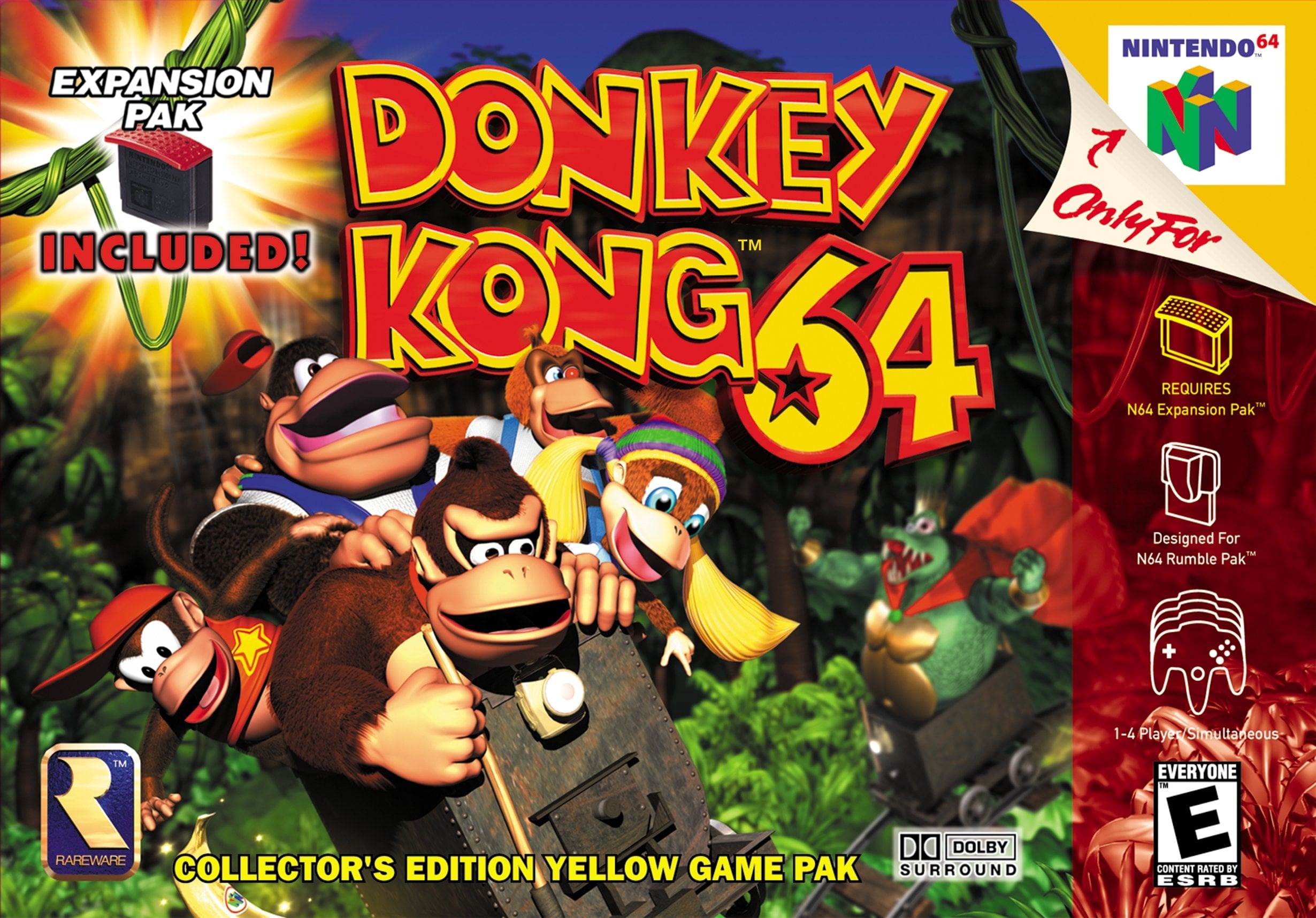
Two decisions defined the production. First, differentiation: Rare co-founder Tim Stamper demanded more collectibles and more characters than Banjo, and director George Andreas kept going back with “here’s some” only to hear “no, more things” — Andreas later conceded he should have reined himself in, particularly the colour-coded banana system. Second, hardware: Donkey Kong 64 was the first game to require the N64 Expansion Pak, bundled in the box. The Pak was marketed as improving frame rate and draw distance; artist Mark Stevenson has called the famous story — that it merely patched an unfixable bug — a myth, saying the decision came early and powered the dynamic lighting system. Nintendo bundled it, it said, to avoid confusing consumers. Either way, the yellow cartridge (a collector’s edition, no less) carried a RAM upgrade as standard equipment.
The design’s fingerprints are everywhere in the details. Donkey Kong creator Shigeru Miyamoto, shown a pre-release build, was appalled to see DK aiming a realistic shotgun used as a placeholder — and quickly sketched the coconut gun that replaced it. And buried in the production was Stop ‘N’ Swop, Rare’s scheme to let players hot-swap the Banjo-Kazooie cartridge into a running N64 — its memory retained data for a few seconds after removal — to unlock bonuses in DK64. Nintendo asked for its removal at approval: later N64 models retained memory for less time, making the trick unreliable and a potential console-damage risk. It remains one of gaming’s great what-ifs, cut from a game that otherwise kept everything.
Two hundred golden bananas
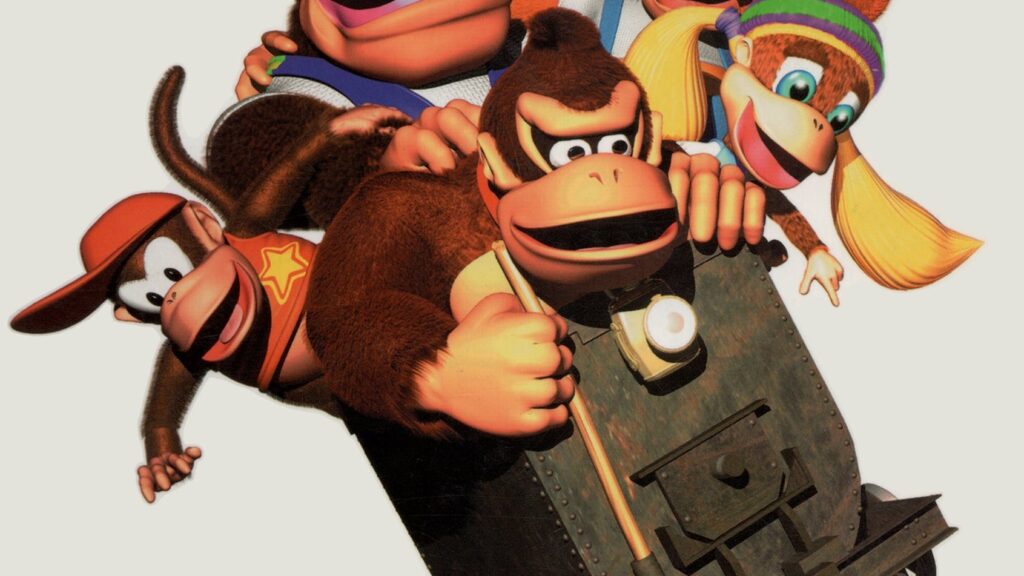
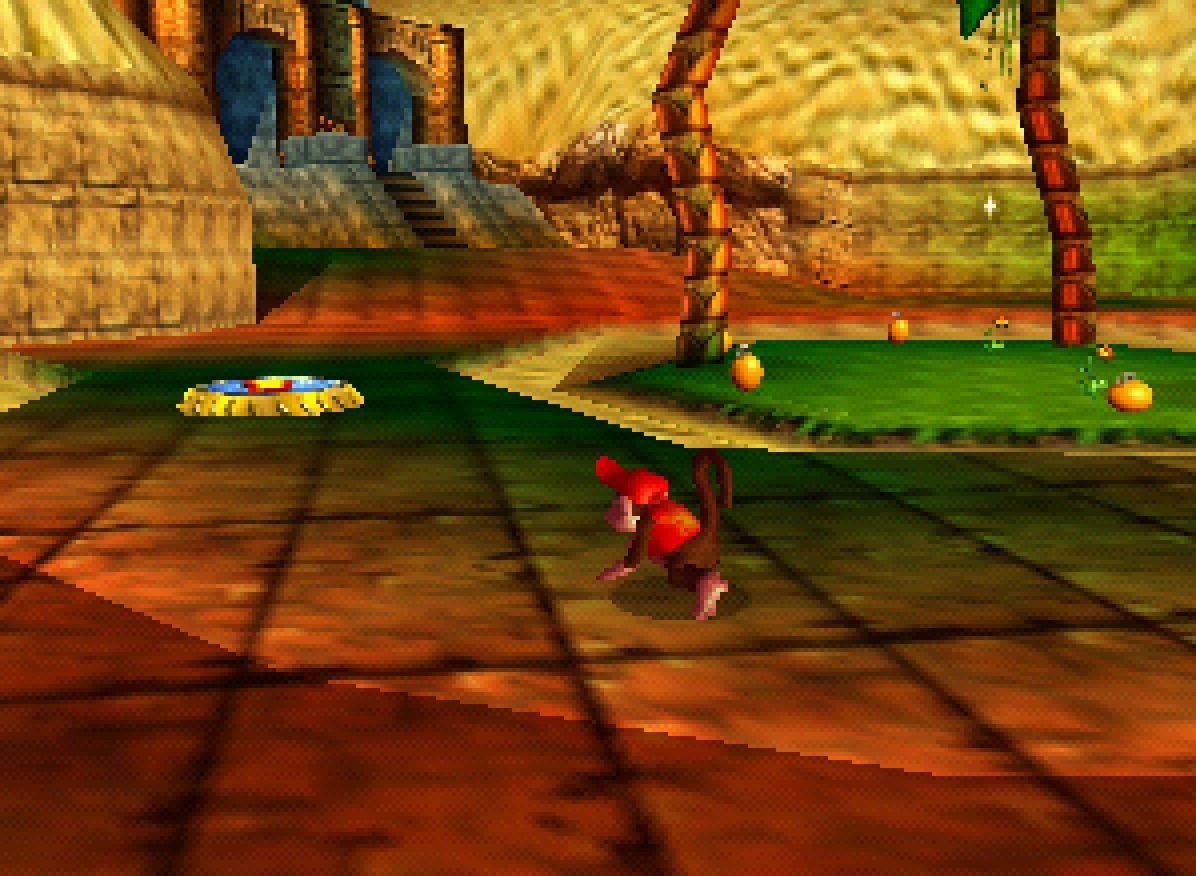
The structure is abundance organised by colour. King K. Rool has kidnapped the Kong family and is charging his Blast-O-Matic to destroy DK Isle. You rescue four playable Kongs — Diddy with his jetpack, Tiny who shrinks, Lanky who floats, Chunky who lifts rocks — and each of the five has five golden-banana objectives in each of eight worlds: 200 golden bananas, plus colour-coded banana bunches that only the matching Kong can collect, banana coins, blueprints, weapons, instruments and Banana Fairies to photograph. Abilities are bought from Cranky and gate the backtracking. Hidden inside the game, required to finish it, sit playable versions of the original Donkey Kong (1981) and Rare’s own Jetpac (1983). A six-minigame multiplayer mode for up to four players rounds it out. Grant Kirkhope’s score leans toward Banjo’s spirit, and over the whole production floats the DK Rap — composed as a joke, received as one, and since canonised as one of the most infamous and beloved songs in games.
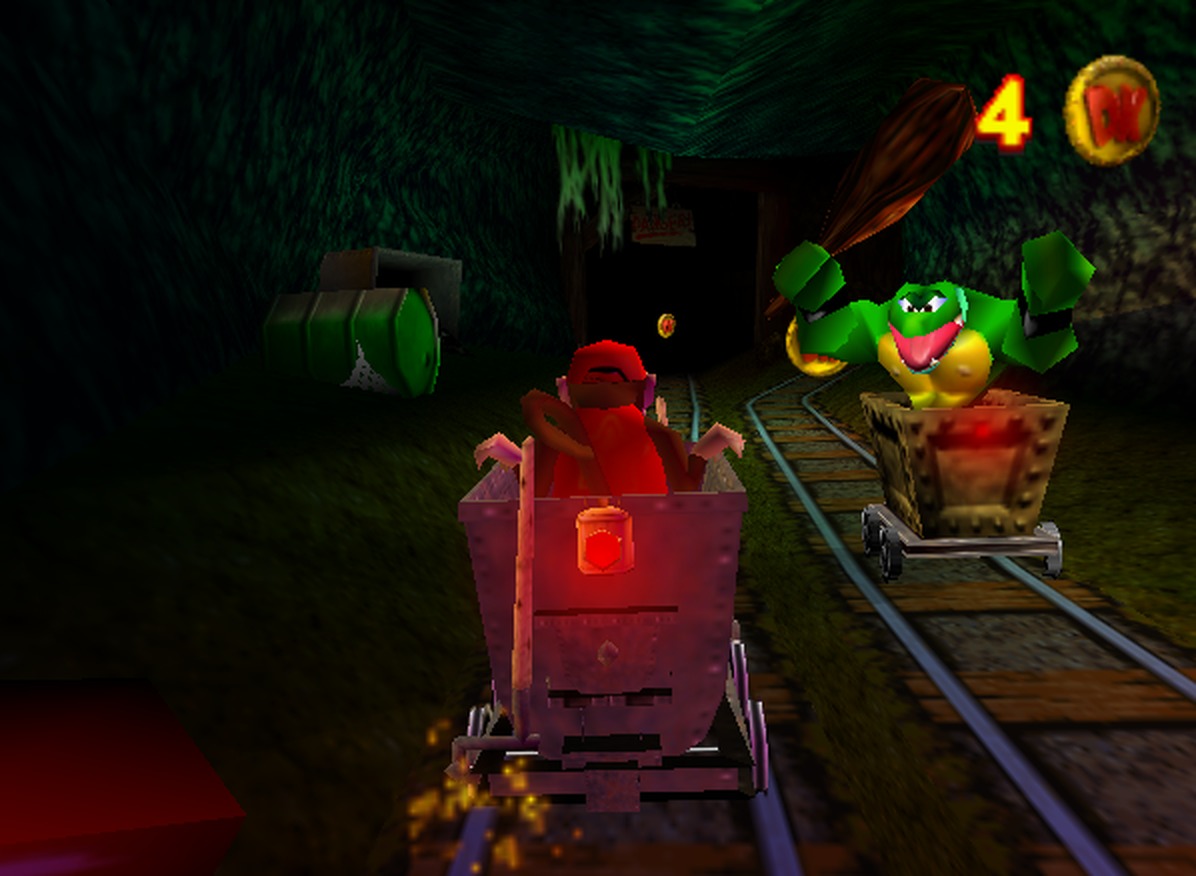
The multiplayer deserves its footnote too: Monkey Smash arenas and Battle Arena king-of-the-hill, with snapshot-hunting in the main game unlocking bonus features — boss and cinematic replays, cheats, and Krusha as a hidden multiplayer character. Even the extras had extras.
Nintendo’s bestseller of Christmas 1999
Nintendo spent $22 million marketing it — advertisements, sweepstakes, a national tour — and the game delivered: it was Nintendo’s bestseller of the 1999 holiday season and sold 5.27 million copies worldwide by 2021. It won the 1999 E3 Game Critics award for Best Platform Game, and reviewers praised its visuals, size and length. The reservations arrived in the same reviews: the camera, and the sheer emphasis on collecting and backtracking, with more than one critic noting how closely it resembled Banjo-Kazooie. Retrospectives hardened that into a verdict — Donkey Kong 64 as the collect-a-thon’s reductio ad absurdum, blamed by some for 3D platforming’s early-2000s decline. It was also an ending: Rare’s final Donkey Kong game before Microsoft’s 2002 acquisition, and the franchise’s only 3D platformer until Donkey Kong Bananza in 2025. Nintendo rereleased it on the Wii U Virtual Console in 2015 and on the Nintendo Classics service in 2026.
And the Rap itself deserves the last word before the verdict. Written by Kirkhope as an affectionate joke — a character-by-character roll call over a hip-hop beat, performed in-house — it was promptly named by some outlets among the worst songs ever put in a video game. Then the internet adopted it. The DK Rap became a meme, a concert singalong and eventually an official piece of the franchise’s furniture, outliving nearly every serious attempt to make Donkey Kong cool in 1999. A game this determined to include everything had, inevitably, also included its own punchline.
Why Donkey Kong 64 at 27 still swings
Because excess, done this completely, becomes a kind of honesty. Donkey Kong 64 is what happens when a great studio is told “more” by its founder, its publisher and its moment all at once — five heroes, eight worlds, two hundred golden bananas and a rap about all of it. The genre spent years apologising for games like this; players, notably, never stopped playing it. At 27, the yellow cartridge stands as the collect-a-thon’s maximal monument: too much of a good thing, remembered — mostly — with love.
— Chip
For more launches from this date, see This Day in Gaming History: November 22.