
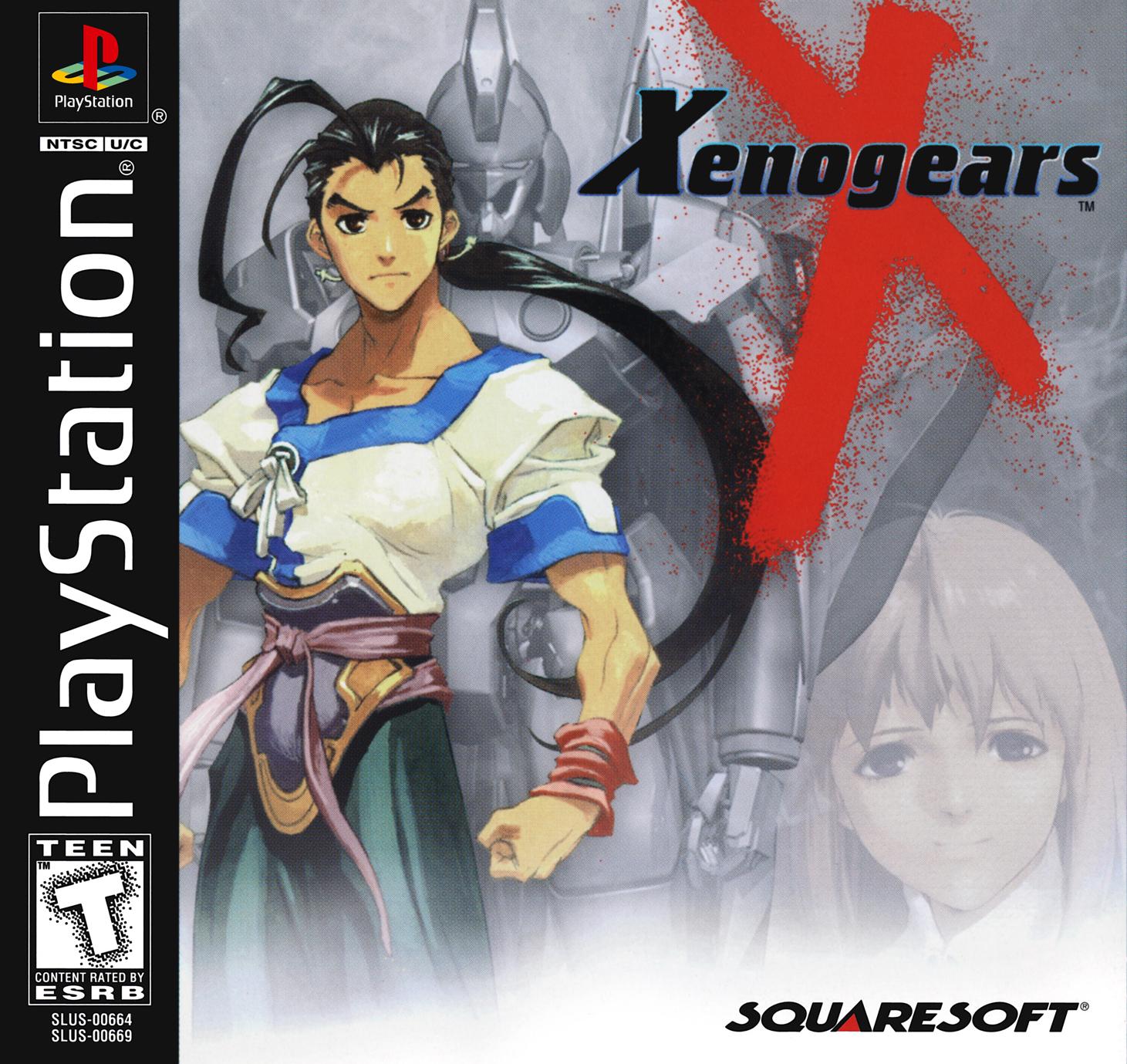
At a glance — Game: Xenogears · Developer: Square Product Development Division 3 · Publisher: Square (Japan); Square Electronic Arts (North America) · Original release: February 11, 1998 (Japan); October 20, 1998 (North America) · Original platforms: PlayStation · Genre: Role-playing game
Every RPG fan my age keeps one game they can only describe with an apology attached. This is mine. I will be halfway through calling Xenogears one of the greatest stories put on a PlayStation disc when I catch myself adding, “Well. Except for Disc 2.” Because Disc 2 is not really a disc at all. It is the outline of one — the second half of a masterpiece, told to you by two tired people sitting in chairs.
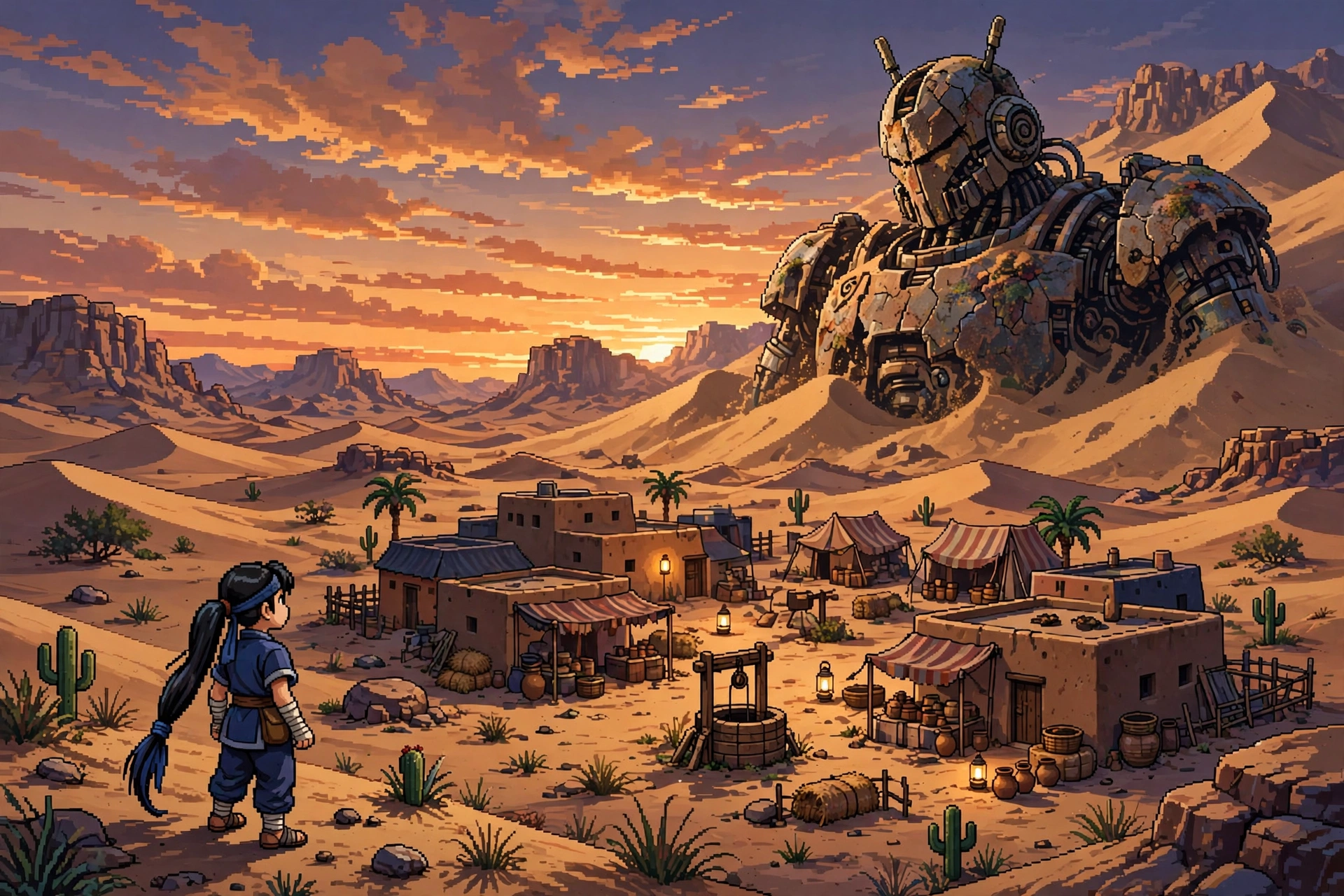
I knew none of that the first time through. I knew the opening: a village called Lahan, a young man named Fei Fong Wong who paints and practices martial arts and cannot remember his past, and a night when giant machines called Gears come crashing down out of a war he wants no part of. Within an hour the game had taken his home away from him, and it took me with it. This is my attempt to explain how a game this unfinished became the one so many of us never stopped thinking about — and why a fan project is now trying to build the ending we never got.
Episode V of six: the ambition behind Xenogears 1998
Start with the nerve of it. Director Tetsuya Takahashi and his wife Kaori Tanaka, who wrote alongside him under the name Soraya Saga, did not pitch a game. They pitched the fifth chapter of a six-part saga spanning thousands of years of fictional history — gods, reincarnation, a crashed starship, and a weapon built by human hands that believes itself divine. Xenogears is Episode V; Episodes I through IV were backstory, and Episode VI never existed outside the planning documents, later published in Japan in the Xenogears Perfect Works book — the blueprints of a cathedral that only ever got one tower.
The idea had reportedly begun life as a possible scenario for Final Fantasy VII before becoming its own project. Nothing in Final Fantasy prepared me for a game that opens with questions about God and spends eighty hours actually trying to answer them. It name-checks Freud and Jung and means it. Most RPGs of the era gave you a crystal and a prophecy. This one gave you a reading list.
That ambition is why Disc 1 soars — and why there was never time or money to land it as drawn.
Disc 1 is the real thing: Fei, Elly, Gears, and Mitsuda
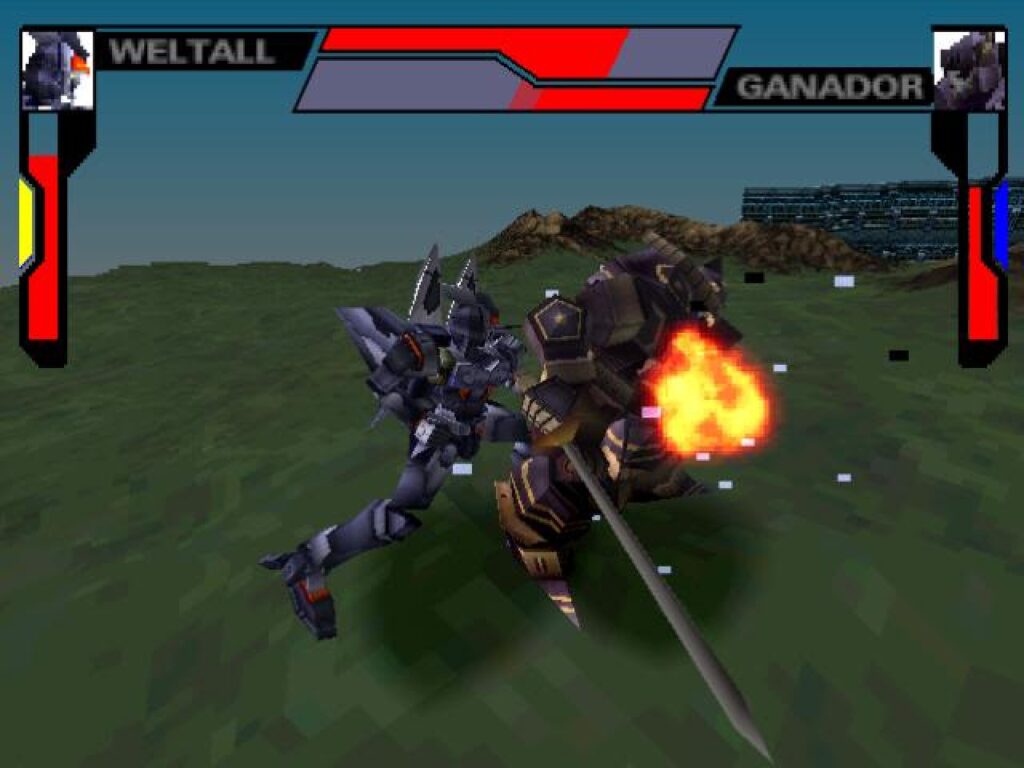
For its first disc — a full, generous RPG by any 1998 standard — Xenogears is superb. Fei is exiled from the ruins of Lahan and falls in with Elly, an officer of Gebler, the military force of the floating nation of Solaris. Their relationship is the spine of the game: two people on opposite sides of a war between the surface kingdoms of Aveh and Kislev, slowly discovering that their connection runs far older and stranger than either can explain. Around them the cast keeps growing — Citan, the village doctor who knows more than he says; Bart, a desert pirate prince with a sand cruiser and a grudge — and every one earns their place.
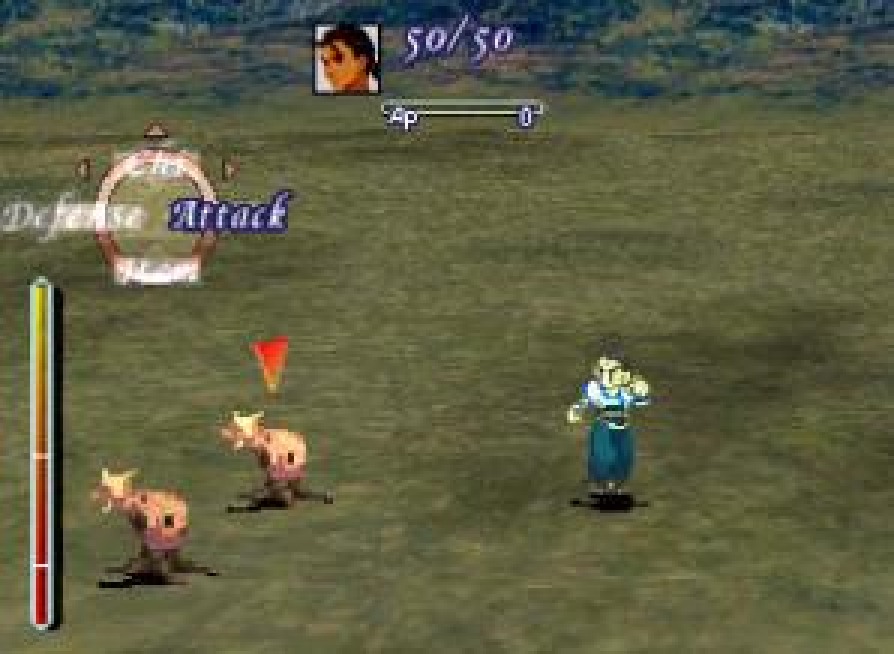
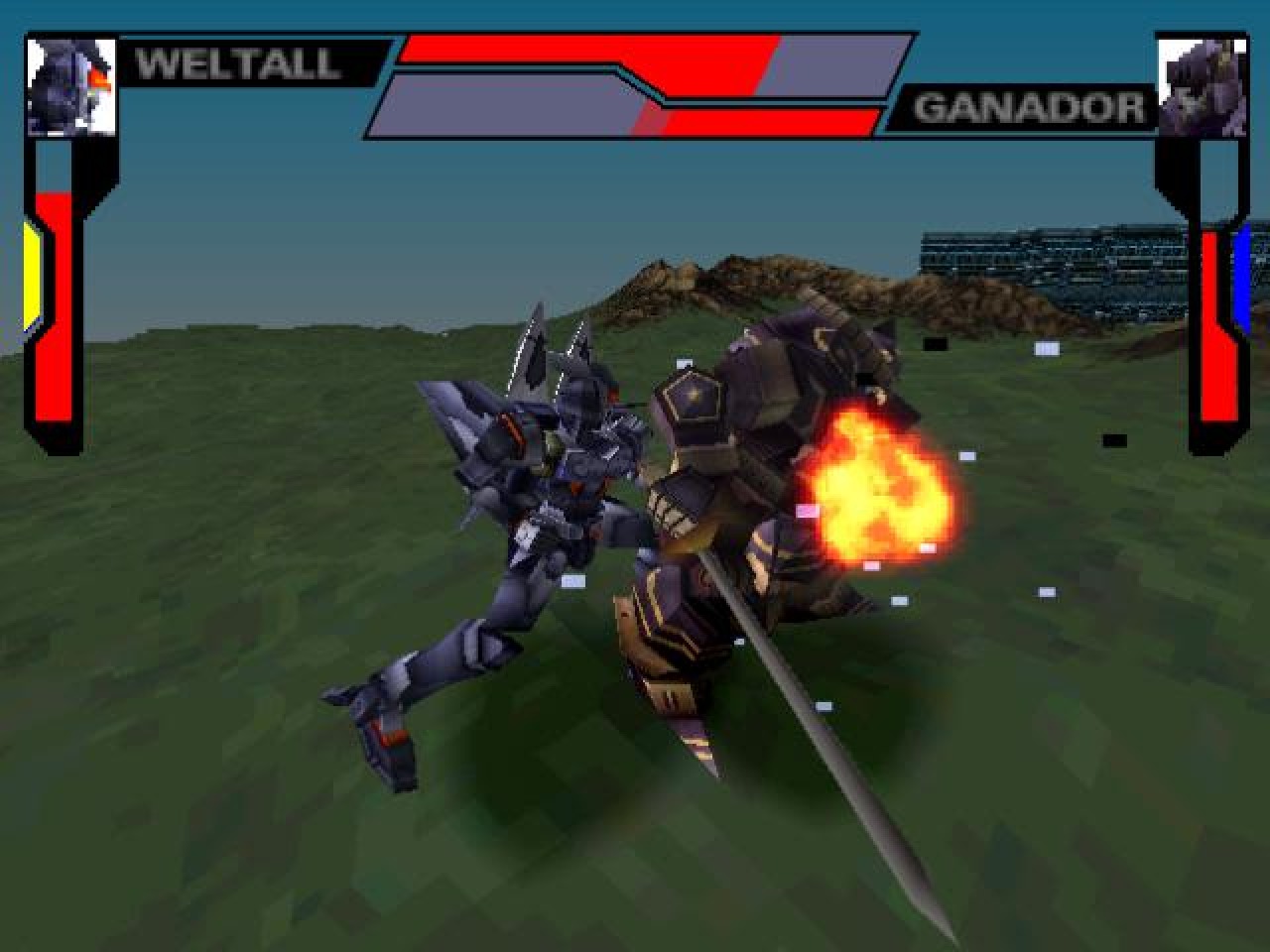
The fighting does real work, too. On foot, your party strings light, medium, and strong attacks against an action-point budget, and repeating certain combinations teaches permanent Deathblow techniques — I still remember the thrill of a new one unlocking mid-battle. Then the game changes scale on you. Climb into a Gear and the same party fights as towering machines, trading combos for fuel management, where every special attack burns the tank down — a second game living inside the first.
And over all of it sits Yasunori Mitsuda’s music. Mitsuda reportedly worked himself to exhaustion on this score, and you can hear a man spending everything he had. Celtic-tinged melodies, choral pieces, quiet village themes that feel like sunlight — and an ending song, “Small Two of Pieces,” performed by Joanne Hogg, when a sung vocal theme over an RPG’s credits still felt like an event. The hand-drawn anime cutscenes, produced with Production I.G, complete the impression.
Then you put in Disc 2, and the chairs come out
Here is what nobody warned me about in 1998. You finish a rich first disc, swap to the second, and the game changes species. Long stretches of Disc 2 are not played at all. Fei or Elly sits in a chair against a dark background — sometimes a still image behind them — and narrates. Text scrolls. Events that Disc 1 would have built into dungeons, towns, and boss fights are summarized for you: journeys happen off-screen, battles are described rather than fought. There is real gameplay in there, and some of the game’s most important story beats. But the ratio has flipped. You are being told the second half of Xenogears more than you are playing it.
The account repeated ever since, including in Takahashi’s own later reflections, is the unglamorous one: time and money ran out. The team was young, the scope was enormous, the schedule could not hold a six-episode story compressed into one game’s back half, and rather than cut the story, they changed how it was delivered. Fair enough — truncating the plot would have been worse. But fairness does not change what it felt like at two in the morning, watching a character in a chair describe the dungeon I was supposed to be exploring.
Why it still works, chairs and all
And yet. I finished it. Everyone I know finished it. A lesser story would have died in that chair. Xenogears survives its second disc because the story being narrated is worth hearing — the revelations about Fei’s past, about Elly, about the true nature of Solaris and the god it serves, land with the weight of everything Disc 1 built. The game had spent fifty hours making me care, and it cashed that in.
It also helps that what gameplay remains on Disc 2 includes some of the strangest and boldest sequences on the PlayStation. The form broke; the nerve never did. Takahashi left Square in 1999 and co-founded Monolith Soft, where Xenosaga would revisit these same ideas as a spiritual successor — proof the man had more story than one production schedule could hold. Xenogears itself came back as a downloadable PSOne Classic, and a new generation discovered the chairs the way we did: with disbelief, then affection. It is a flawed masterpiece. The flaw and the masterpiece are the same fact.
Project Animus wants to build the Disc 2 we never played
Which brings us to this week, and the reason Xenogears is back in the news. A fan-made remaster called Project Animus, from developer Harry “xHannyah,” is attempting the thing Square never did: rebuilding the game and turning Disc 2 into a playable second half. A showcase on November 20, 2026 ran through more than 450 changes — flat 2D props rebuilt in 3D, see-through dialogue boxes, audible footsteps, and 113 new character portraits.
My favourite detail is the smallest one. The desert town of Dazil has been rebuilt, and with it a fix for the original’s slowdown in its town square, which crawled at roughly 13 frames per second and left Fei wading through the game. Anyone who played the original remembers that square — and that fix tells you its maker suffered through the same game you did. The plan, as the developer tells it, is an alpha in December 2026 — tentative, possibly around Christmas if things go right, and rough in the way alphas are. You will need your own copy of the original game; none of its files come with the project.
Will it work? I have no idea, and I have learned to hold fan projects gently. But for twenty-eight years the chairs have been the most famous flaw in one of my favourite games, and somebody loved the same broken masterpiece enough to try to finish it. Stand tall and shake the heavens, Harry. Some of us have been waiting in those chairs a long time.
— Sal
For more launches from this date, see This Day in Gaming History: February 11.