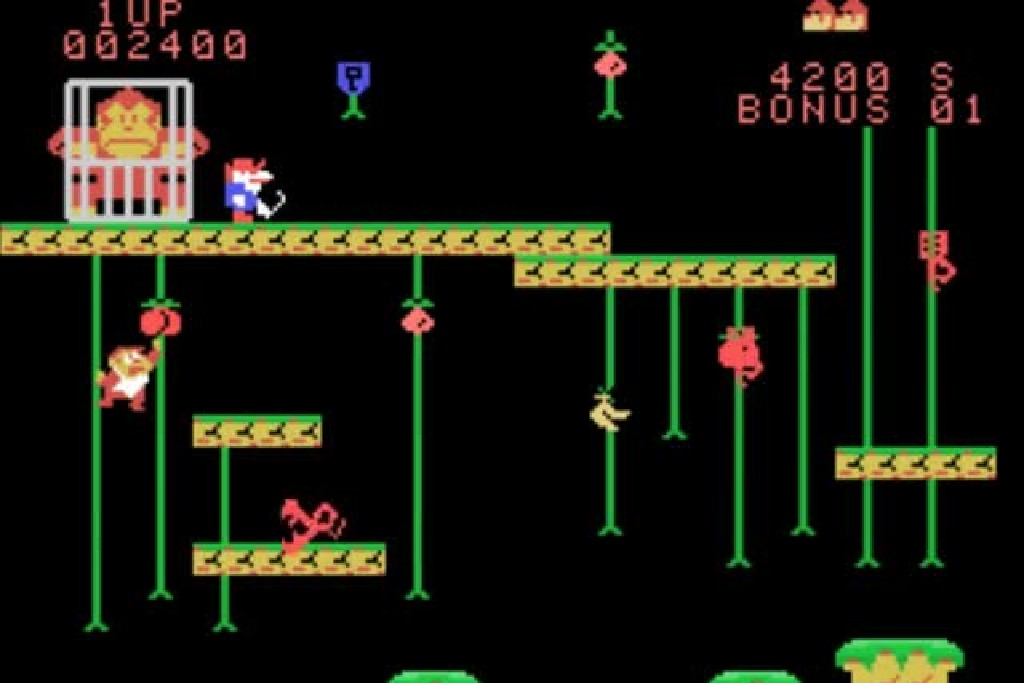
At a glance: Donkey Kong Jr. · ColecoVision · Coleco, 1983 · Arcade platformer · Score: 8.5/10
Sequels rarely invert their own premise as cheerfully as Donkey Kong Jr. Mario — the hero of the first game — is the villain now, having finally caged Donkey Kong, and the rescue falls to the ape’s son: a small, determined junior who must climb vines, chains and platforms to reach the key that frees his father. Nintendo’s 1982 arcade follow-up was a stranger, more intricate game than the original, and its ColecoVision conversion, arriving in the console’s second wave, is the ideal companion piece to the pack-in: same family resemblance, same arcade fidelity, and a moveset all of its own.
Where Donkey Kong was about running and jumping, Donkey Kong Jr. is about climbing. Junior moves hand over hand along vines and chains, and the game’s central skill is managing his two-handed grip: with both hands on separate vines he climbs fast; with one, he slides and shuffles. It is a simple rule that reorganises everything you learned in the first game, and the ColecoVision version preserves it perfectly.
Vines, chains and fruit drops
The conversion keeps the arcade’s stage set: the jungle vines of the opening screen, the springboard-and-platforms trampoline stage, the electrical interior with its sparks travelling the wires, and the chain stage finale, where Junior pushes keys up into their locks while birds dive at him. Each stage is a distinct climbing puzzle. Snapjaws — Mario’s crocodile-toothed traps — patrol the vines, nitpickers dive from above, and sparks hunt along the circuitry, forcing constant decisions about which line to climb and when to drop.

The offensive option is fruit: hanging melons and apples can be knocked loose to fall on enemies below, and lining up a drop while a snapjaw climbs beneath you is the game’s signature small triumph. The ColecoVision pad handles the two-handed climbing better than you might fear — left and right commit Junior’s hands, up and down do the honest work — though quick lateral switches between vines take a session to become instinct. Once they do, the game flows: climb, pause, drop fruit, swing across, climb again.
A harder, deeper climb
Make no mistake, Junior is the tougher game. The first Donkey Kong could be learned as a set of running routes; this one asks for continuous three-dimensional thinking on a two-dimensional screen — you are managing height, grip and enemy lanes simultaneously, and the margin for error on the chain stage is slim. The bonus timer is as impatient as ever. Players bouncing off the difficulty should persevere to the electrical stage, which is the design at its best: sparks telegraph their routes, and success becomes a rhythm of climb, wait, cross, climb.

Presentation is a delight. Junior is an expressive little sprite, Donkey Kong rattles his cage at the top of the screen, and the jungle palette — greens and browns against the black — gives the game a different flavour from its predecessor’s construction-site pinks. The between-stage touches survive, including the payoff of the cage finally giving way. Sound is functional arcade fare: climbing squeaks, fruit-drop thuds and jingles that mark progress. As with the pack-in, the conversion’s confidence is the story: nothing about it feels shrunk.
The pair belongs together
It is worth saying plainly that the two ColecoVision Kong games are a matched set, and the library is unthinkable without both. The first is the purer, more famous score-attack; the second is the more inventive design, and the one that arguably rewards mastery more. Junior never got the pack-in’s ubiquity, so cartridges are a little less common, but it was a mainstream release and remains an easy find for collectors — and an essential one, because this is where the system’s Nintendo connection deepened from a licensing coup into a small library of its own.
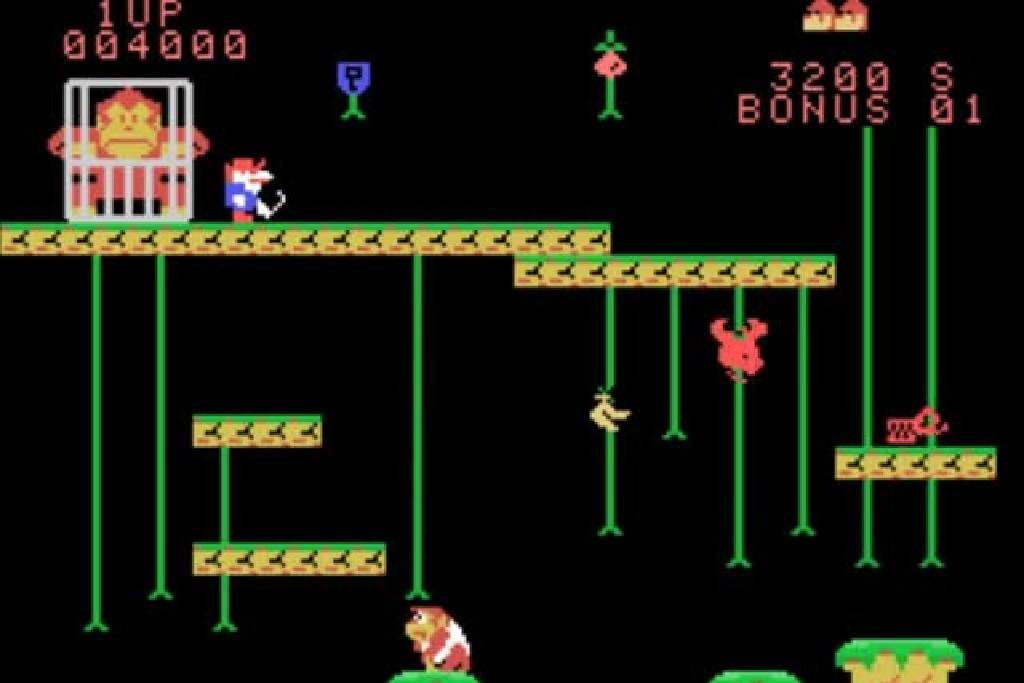
Route craft: hands, fruit and the long way round
Junior’s stages repay proper route study. The central decision on every vine is which hand configuration you need for the next ten seconds: paired vines for speed, single vine for control, and the courage to drop — falling is fast, free, and often the correct answer to a snapjaw arriving on your line. Fruit placement is never decorative: each hanging fruit sits over a traffic lane, and the game’s high scores come from treating drops as scheduled appointments rather than accidents, clearing a lane below before you commit to climbing through it. The trampoline stage teaches the other half of the craft — momentum. Junior’s springboard launches are commitments, and the birds crossing the platforms run on patterns that punish hesitation more than boldness. On the chain stage, work the keys in an order that keeps your escape lane open: pushing a key home while a nitpicker owns the only way down is the classic Junior death, and it is always, on inspection, a planning error rather than bad luck.
Sound, spectacle and the family resemblance
What the conversion gets right at the level of feel deserves its own note. The climbing has a rhythm — hand over hand, punctuated by the little musical phrases for fruit drops and stage completions — that the ColecoVision’s sound chip renders crisply, and the stages are framed as a proper rescue narrative: Mario at the cage, keys in their locks, the moment the cage finally yields. It is also worth registering how unusual the game was in its moment: a sequel that recast the hero as the jailer, starred the villain’s child, and built its entire moveset around climbing rather than running. The ColecoVision library contains both halves of that experiment in faithful form, and playing them back to back — girders, then vines; hammer, then fruit — is the single best short course in early Nintendo design that any 1982 machine can offer.
For collectors and first-time climbers
A practical closing note. Donkey Kong Jr. was a standard retail release rather than a pack-in, so while cartridges are plentiful, genuinely complete copies — box, manual and the cartridge in clean condition — are meaningfully scarcer than its famous predecessor’s, and the box art, with Junior swinging to the rescue, is one of the system’s most displayable. New players should take the game’s own advice and learn on the opening skill settings, where the snapjaw patterns are sparse enough to teach the two-handed climbing grammar; the game then scales honestly, and the jump from competent to fluent happens suddenly, somewhere in your third or fourth session, when the vines stop feeling like an obstacle course and start feeling like a road system. That moment is the whole game in miniature, and it has been converting sceptics since 1983.
A last word on difficulty settings, because they are part of this cartridge’s generosity: the selectable skill levels restructure the enemy patterns rather than merely accelerating them, so a player who graduates through them is learning the game four times at four depths — the same education the arcade’s repeating loops provided, formalised for the home. It is a small design kindness that modern re-releases, with their single default difficulty, rarely think to copy.
The verdict
Donkey Kong Jr. on ColecoVision is a faithful, full-strength conversion of the more interesting Kong arcade game: a climbing puzzler in platformer’s clothing, tougher than the original and every bit as replayable. If the pack-in is the console’s foundation, this is the first storey — and the view is great.
Score: 8.5/10 — A vine-swinging sequel that keeps the arcade faith and raises the challenge.