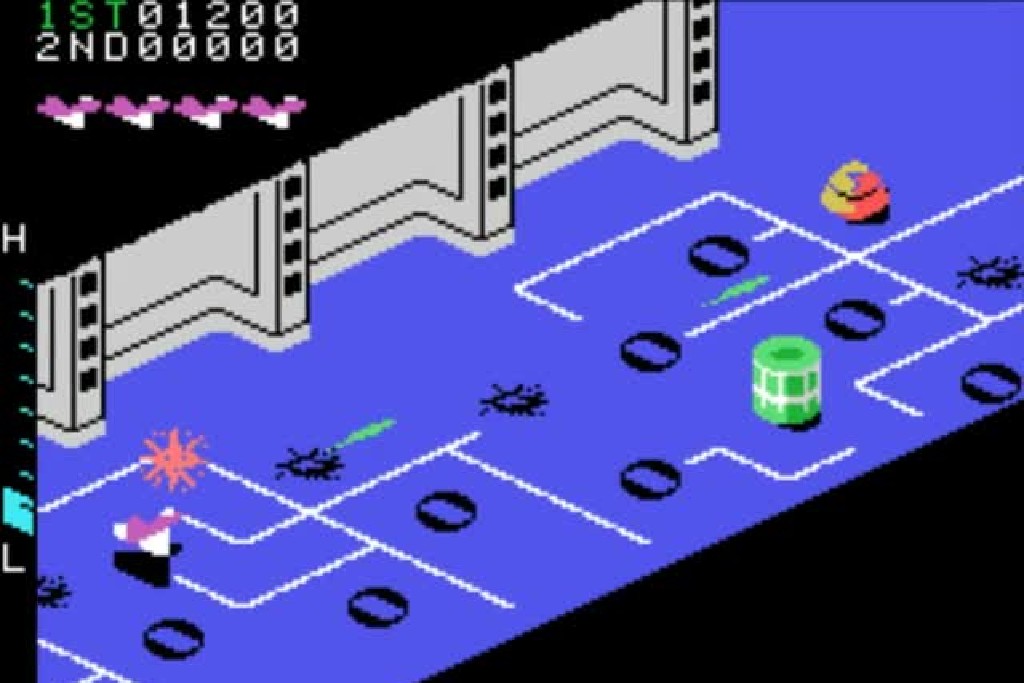
At a glance: Zaxxon · ColecoVision · Coleco/Sega, 1982 · Isometric shooter · Score: 9.0/10
If Donkey Kong was the ColecoVision’s argument, Zaxxon was its demonstration. Sega’s 1982 arcade game had stunned players with its isometric, diagonally scrolling fortress — a genuine three-dimensional battlefield you flew over, under and through, judging your altitude against walls and force fields. No home machine was supposed to be able to do this. The ColecoVision did it, at launch, in a conversion so convincing that it became the second pillar of the system’s early reputation. Decades later, it remains one of the most technically impressive cartridges of its generation.
You pilot a lone fighter on a raid through the fortress of the robot Zaxxon. The run alternates between two theatres: the fortress itself, a walled gauntlet of gun turrets, missile silos, radar towers, fuel tanks and energy barriers scrolling towards you at a diagonal; and open space, where enemy fighters come head-on and a radar contact counts down the distance to the duel with Zaxxon himself. Between the two sits the game’s defining instrument: the altimeter.
Flying by the gauge
Zaxxon’s genius is that the isometric view withholds the one piece of information you need most — your exact height — and gives you tools to recover it. Your ship casts a shadow on the ground below. An altitude gauge runs down the side of the screen. Gaps in fortress walls are marked with how they must be flown: some demand you be low, scraping the floor; others require climbing to clear the wall top; force fields must be threaded at their openings. Every crash in Zaxxon is a judgement error you can diagnose, and every clean pass feels like airmanship. The ColecoVision version keeps all of it: shadow, gauge, wall markings, the lot.
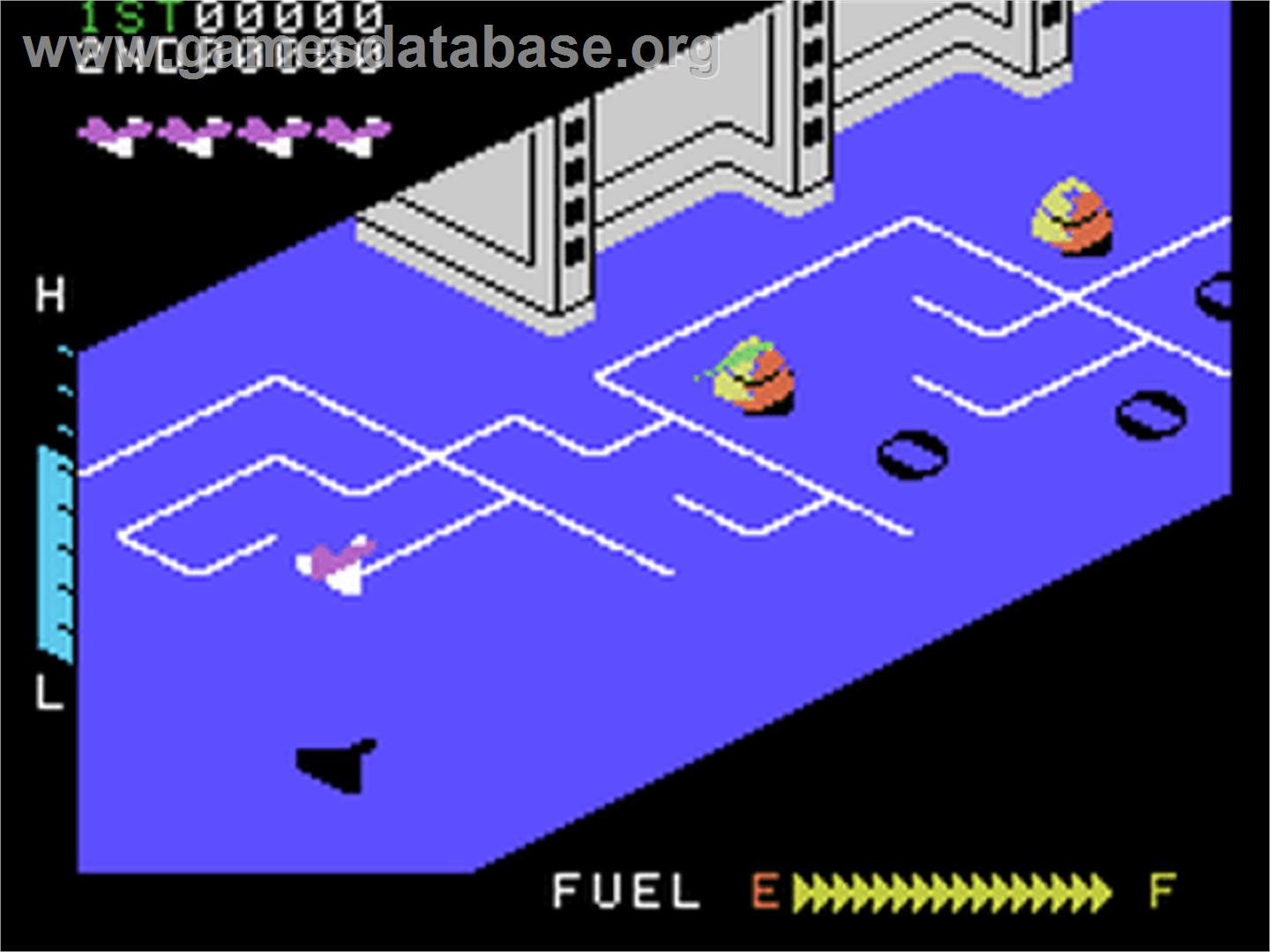
Fuel is the second pressure. Your tank drains constantly, and the only way to refill it is to shoot the fortress’s fuel tanks as you pass — a lovely risk loop, because diving on a tank means leaving your safe altitude and spending time in the turrets’ favourite lines of fire. Enemy planes in the space sections must be met at matched altitude to destroy, which turns head-on passes into games of chicken resolved by the gauge. It is a shooter built from instruments, and it plays like nothing else of its year.
The conversion, judged fairly
No home Zaxxon of the era is the arcade game pixel for pixel, and honesty requires noting the ColecoVision version’s trims: the fortress is a little less dense, the colours are simplified, and the scrolling, while smooth by 1982 home standards, does not have the coin-op’s silky abundance of sprites. But the hierarchy of the era is not close. Rival home versions cut the viewpoint, cut the space duels or cut the fortress down to a suggestion. This one delivers the complete structure — fortress, space, robot — with the isometric view intact and readable, and in 1982 that was a sensation. The big robot finale, in which you must put shots into Zaxxon’s missile launcher as it tracks you, loses none of its menace.

The ColecoVision pad is, for once, a decent match for the game: the stick handles the eight-way positioning well, and altitude changes are deliberate rather than twitchy. The fire button will get a workout — turret suppression is a real tactic — but the game is more about placement than bullet volume. Sound deserves a mention: the engine hum, the rising warning tones and the explosion effects were showroom material in 1982, and the console’s sound chip gives the fortress a properly mechanical atmosphere.
Why it still flies
Zaxxon’s afterlife is mostly as a technical landmark, but the game underneath is genuinely good: short runs, escalating fortresses, a scoring system that rewards destroyed installations, and that unmatched feeling of threading a wall gap at exactly the marked height while your fuel light argues otherwise. It also completes the ColecoVision launch story. Nintendo’s platformer showed the machine could do characters; Sega’s shooter showed it could do spectacle. A new console needs both claims, and in 1982 nobody else at home could make either.
Reading the fortress like a pilot
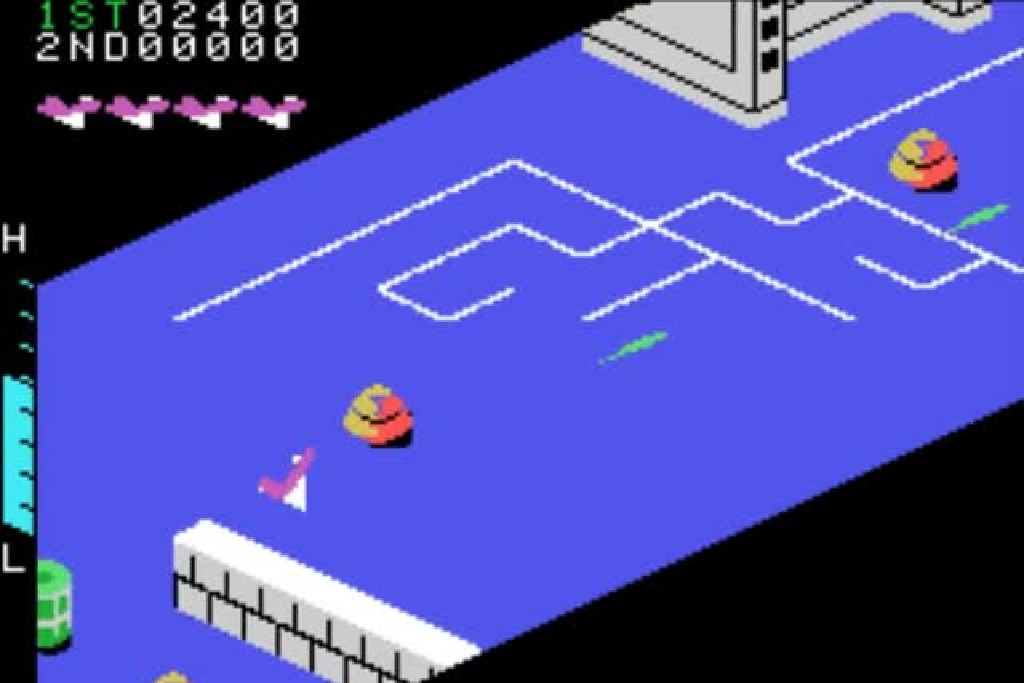
Because so much of Zaxxon is information management, its skills are learnable in a satisfying order. First, the shadow: it never lies, and new players should fly whole runs watching nothing else, learning how altitude reads against the fortress floor. Second, the wall markings: the gaps announce their required heights, and the discipline is to be at the marked altitude early, not to dive or climb at the wall itself. Third, the fuel economy: tanks are both petrol station and bait, and the correct doctrine is to shoot them on your natural line rather than detouring into turret arcs for them — a crashed fighter burns no fuel at all, which is the game’s driest joke. The space sections invert the lesson: there, altitude matching against oncoming fighters is the whole game, and the countdown to the robot duel rewards the pilot who arrives with fuel and composure to spare. None of this ages. The interface is forty years old and the airmanship is permanent.
The showroom effect
Zaxxon’s other job in 1982 was retail theatre. It was the cartridge shops used to end arguments: the isometric fortress scrolling on a shop television communicated, in five seconds, that this new console operated in a different league from the machines families already owned. Sega’s own home versions on rival hardware could not make the same claim, which made the ColecoVision edition a small coup in the licensing war — the definitive home Zaxxon lived on a competitor’s machine. For the modern collector it remains one of the system’s most common cartridges, precisely because it sold so well at launch, and one of the first three any new owner should slot in: Donkey Kong for the promise, Lady Bug for the depth, and Zaxxon for the spectacle.
For collectors and first-time pilots
Zaxxon is among the most available ColecoVision cartridges — a consequence of being a launch-window bestseller — which makes it the ideal first purchase for testing a new console: its scrolling, sound and sprite load will expose a sick machine within seconds, and a healthy one will look magnificent doing it. Seek a copy with its manual if you can; the period documentation explains the altitude markings with a clarity modern tutorials could learn from. First-time pilots should fly their early runs at deliberately conservative heights, treating survival to the robot as the only objective until the fortress reads like language rather than weather. The duel with Zaxxon itself is winnable by discipline — hold your nerve, aim for the launcher, and let the robot’s own timing defeat it. Forty years on, there is still no home shooter of its era that feels quite like this: part flight simulator, part examination, entirely itself.
The verdict
Zaxxon on ColecoVision is the isometric shooter done justice on 1982 hardware: complete in structure, honest in its compromises, and still tense to fly. Alongside the pack-in Donkey Kong, it is the essential launch-window cartridge — the one that proved the arcade-at-home slogan was engineering, not advertising.
Score: 9.0/10 — An isometric landmark, converted with ambition and nerve.