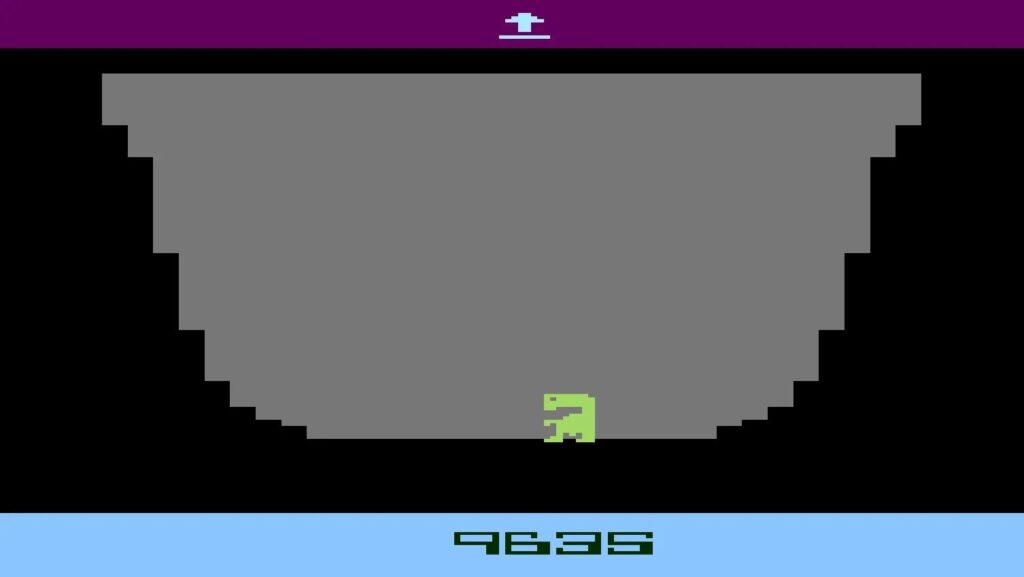
Every industry gets the legend it deserves, and the video game industry’s legend is this: in 1983, a game so bad was made from the film E.T. the Extra-Terrestrial that Atari buried truckloads of it in the New Mexico desert, and the shame of it crashed the entire business. The legend is tidy, cinematic and mostly wrong in its proportions — but like most durable legends, it is built around real events that are stranger than the myth. There really was an E.T. cartridge made in about five weeks. There really was a landfill in Alamogordo. In 2014, people really did dig it up on camera. And the crash of 1983 really did happen — for reasons that had almost nothing to do with one alien, and almost everything to do with an entire industry losing its head at once.


Five weeks
Start with the deal. Steven Spielberg’s film was the biggest hit in the world in 1982, and Warner Communications, Atari’s parent company, paid a very large sum — widely reported at the time in the tens of millions of dollars — for the game rights, as part of a strategy of tying Atari to Hollywood properties. The problem was the calendar: the rights negotiation consumed the summer, and for a cartridge to be manufactured in the millions and reach shops for Christmas, Howard Scott Warshaw — fresh off the hit Raiders of the Lost Ark adaptation and the triumph of Yar’s Revenge — was given roughly five weeks to design and program the game from nothing. A normal 2600 title took months. Warshaw took the assignment knowing exactly what it was, delivered on schedule, and has spent four decades being admirably philosophical about being the man attached to it.
The game he made is an adventure: E.T. must find the three pieces of a telephone to call his ship, scattered in pits across a map of screens, while scientists and agents pursue him, and his energy — also his life — drains with every action. Judged coldly today, it is flawed in specific, explicable ways rather than being the worst game ever made, another part of the myth that does not survive contact. The pit mechanic is its real wound: falling in is constant, levitating out is slow and finicky, and the collision that decides whether you have escaped the pit’s lip is unforgiving enough to drop you straight back in. In five weeks, with those systems, that is what an unpolished edge looks like. Many far worse 2600 games were made at leisure.
Overproduction, not just disappointment
Where E.T. genuinely damaged Atari was arithmetic. Confident in the film, the company manufactured the cartridge in enormous quantity — contemporary and later accounts agree the run was in the millions, and the durable industry story, repeated by executives of the era, is that Atari expected nearly every 2600 owner to buy it. The game sold respectably by any normal standard — it was, in unit terms, a hit — and still left Atari holding vast unsold inventory, because respectable had never been the plan. Returned and unsold cartridges flowed back from retailers into warehouses alongside the surplus of many other titles, notably the home version of Pac-Man, which had been manufactured in even more notorious overabundance relative to the installed base and had disappointed in quality. The symbol fused the two in the public mind: overproduced, under-polished, everywhere.
What actually crashed
The crash of 1983 — North American console revenues fell off a cliff across 1983 and 1984, retailers abandoned the category, and company after company folded — had causes stacked like cordwood, and honest history has to name more than one.
First, the flood. Activision’s success had proven third-party publishing, and by 1982–83 dozens of companies were shipping 2600 games of wildly uneven quality, with no gatekeeper. Retailers could not tell good from bad, ordered everything, and got burned on most of it; consumer trust in a new cartridge became a coin flip. Second, overproduction as an industry habit, of which E.T. was the emblem, not the exception: hit-driven manufacturing assumed permanent growth. Third, competition from home computers — Commodore’s price war made the Commodore 64 a machine that played games and did homework, sold at prices consoles could not answer, and parents’ money followed it. Fourth, a saturated, confused hardware market, with too many incompatible consoles and leftover stock being dumped at fire-sale prices, teaching customers that games were worth a few dollars, not thirty. Fifth, Atari’s own corporate chaos within Warner, whose earnings warnings in late 1982 — when the company’s growth visibly stalled — are as good a start date for the collapse of confidence as any single cartridge.
E.T.‘s role in that stack is real but specific: it was the most expensive single bet, the clearest symbol of hubris, and a large, concrete inventory problem. It did not, alone, cause a continent-wide market to fail; no single product could have. The myth prefers a villain game because a villain game is a better story than a supply chain.

Alamogordo
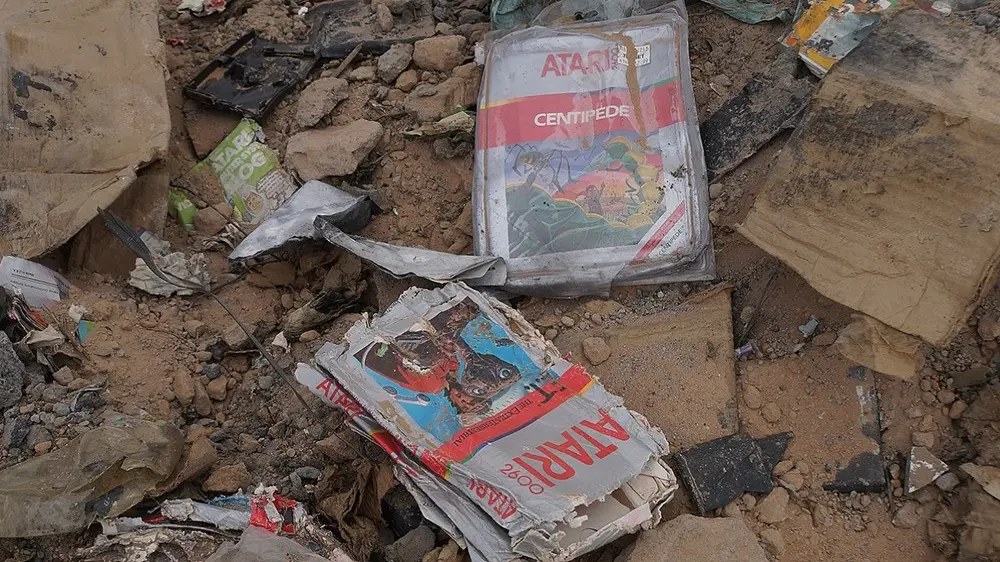
And the burial? In September 1983, the Alamogordo Daily News reported that Atari had dumped truckloads of unsold merchandise from its El Paso warehouse at the city’s landfill, where the loads were compacted, buried and, in the local telling, covered over — standard practice for destroying write-off inventory, and reported at the time as a curiosity rather than a conspiracy. Articles in larger newspapers followed, the story entered folklore, and for thirty years it was retold as either gospel or urban legend, depending on the teller. Former Atari staff gave conflicting accounts over the years, which kept the argument alive nicely.
The excavation of April 2014 — undertaken for a documentary, with the city’s cooperation, former mayor and local witnesses in attendance, and Warshaw himself present — settled the factual question in an afternoon. Diggers unearthed real Atari cartridges and hardware from the site, E.T. among them but far from alone: the recovered material included many titles, exactly as you would expect from a warehouse clear-out rather than a ceremony for one game. The recovered cartridges numbered in the hundreds that first day and the total material was substantial — the careful way to say it is that the dig proved the burial happened and proved its contents were a general inventory dump, while the popular figure of millions of E.T. cartridges under the desert is not what the dig found and should not be repeated as fact. Some excavated cartridges were later sold by the city through auction, with proceeds to the city and a local museum, and one went to the Smithsonian — an ending no publicist could have invented.
Why the myth won
The industry that rose from the crash preferred the myth, because the myth was useful. Nintendo, rebuilding the North American market from 1985, built its empire on the anti-1983: strict licensing, quality seals, controlled quantities, no flood. “Remember E.T.” was the cautionary tale that justified every control. And the story gave the crash a face — one designer, one alien, one desert — instead of a balance sheet.
Warshaw, to his lasting credit, has treated the whole saga with humour and perspective, pointing out that he also made one of the system’s best-selling original games and its Raiders hit in the same short career. The fairest verdict is the dig’s verdict: something real happened in Alamogordo, it was about an industry that made too much of everything and believed its own boom, and the little alien in the pit was carrying more blame than any one game can bear. The desert, when finally asked, said so.