
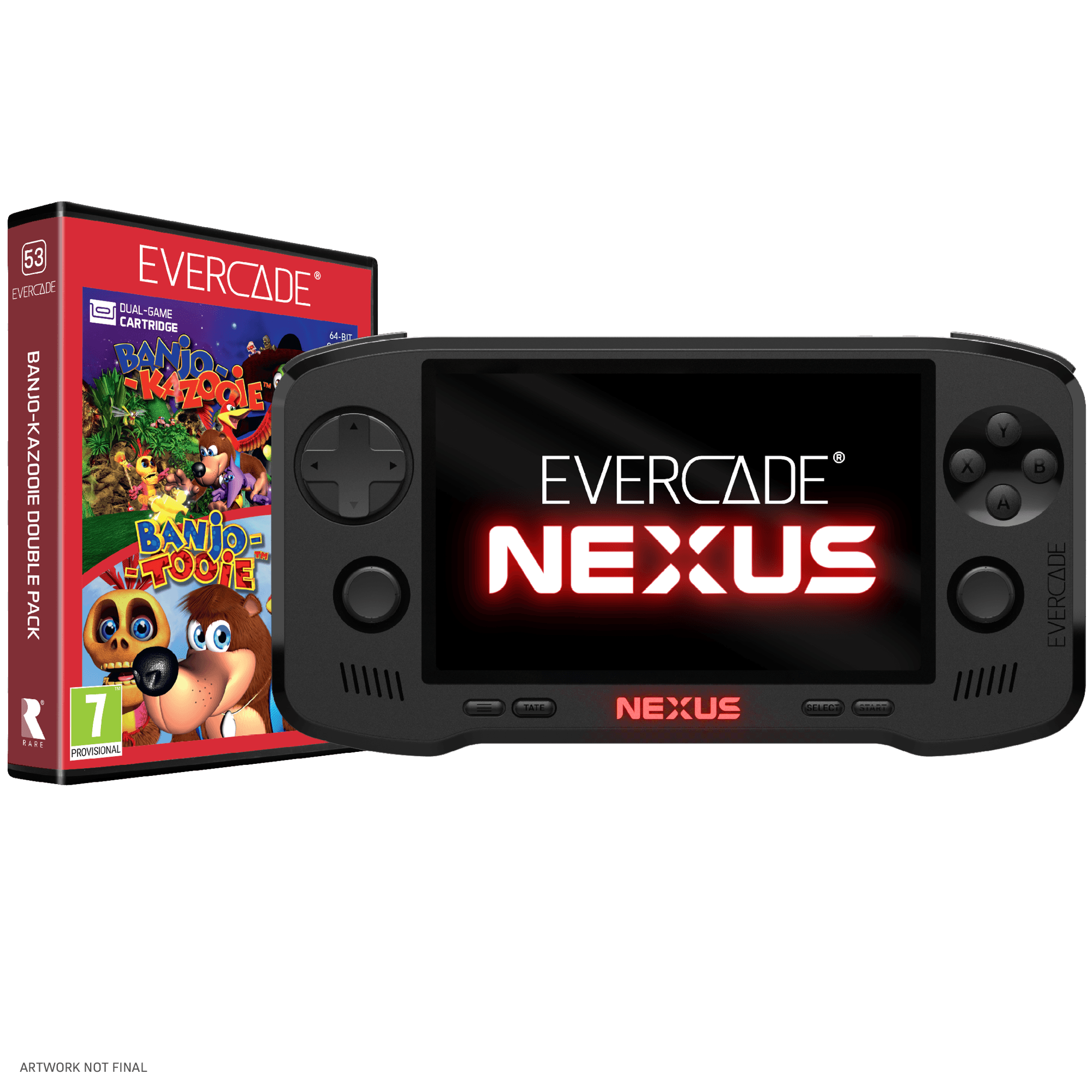
On October 30, Blaze Entertainment launched the most advanced handheld it has ever made — bigger screen, two analogue sticks, Wi-Fi 6 — and put a plastic cartridge in the box. Not a download code. Not a voucher. A cartridge: Rare’s Banjo-Kazooie Double Pack, numbered 53 in its line, in a red clamshell case with the game’s name printed down the spine.
Six years after the first Evercade shipped, that cartridge is still the whole idea. Evercade is the retro platform that looked at ROM files, flash carts and storefronts — the entire modern machinery of playing old games — and bet that people would rather own a box. This is how that bet has aged.
Evercade cartridges in a download world
Blaze Entertainment was formed in 2018 and announced the Evercade in April 2019, when the retro market had a settled shape: mini consoles with fixed game lists, download stores, and a thriving grey market in everything else. The Evercade, released on May 22, 2020 — mid-lockdown, after two delays — ignored all of it. The handheld cost $80; the games came on cartridges at about $20 each, ten collections and 122 games at launch, licensed from the companies that owned them: Atari first, then Interplay, Data East, Bandai Namco and a queue that now runs through Capcom, SNK, Codemasters, Team17, Rare and dozens more.
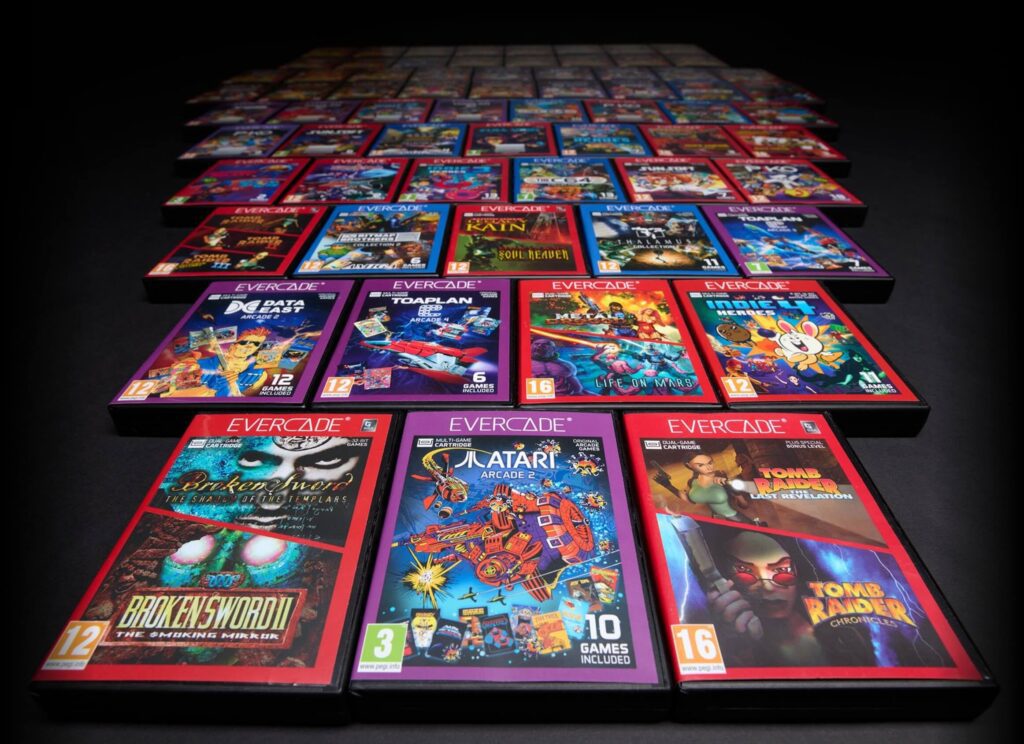
The details were the manifesto. Every cartridge is a curated collection — usually five to twenty games — in a clamshell case with a paper manual. The boxes are numbered, and color-coded: red for console games, purple for arcade, blue for home computer. Blaze has never hidden what that is for. The numbered spines were designed, openly, to make you want the full set — a collection you build, not a library you scroll. In 2020 that read as nostalgia marketing. It turned out to be a distribution strategy.
The decade the storefronts started closing
Consider what happened to the other way of buying old games while Evercade was finding its feet. In March 2023, Nintendo ended new purchases on the 3DS and Wii U eShops, closing the doors on two entire digital libraries. That July, the Video Game History Foundation and the Software Preservation Network published the first serious count of the problem: of classic games released in the US before 2010, only about 13 percent could still be bought legally. The other 87 percent they called “critically endangered” — not lost, exactly, but out of print in an industry that had stopped printing.
A cartridge doesn’t solve preservation. But a cartridge can’t be delisted, either. Evercade’s licensing is done once, up front, with the rights holders — the emulation itself is licensed too, built with the original developers where they’re available — and the result sits in warehouses, shop shelves and secondhand listings, indifferent to servers. If a print run ends, the secondhand shelf takes over, which is more than a shuttered storefront offers. Blaze didn’t eliminate the middleman between old games and oblivion. It just picked the middleman with the longest track record: plastic.
One slot, six years of hardware
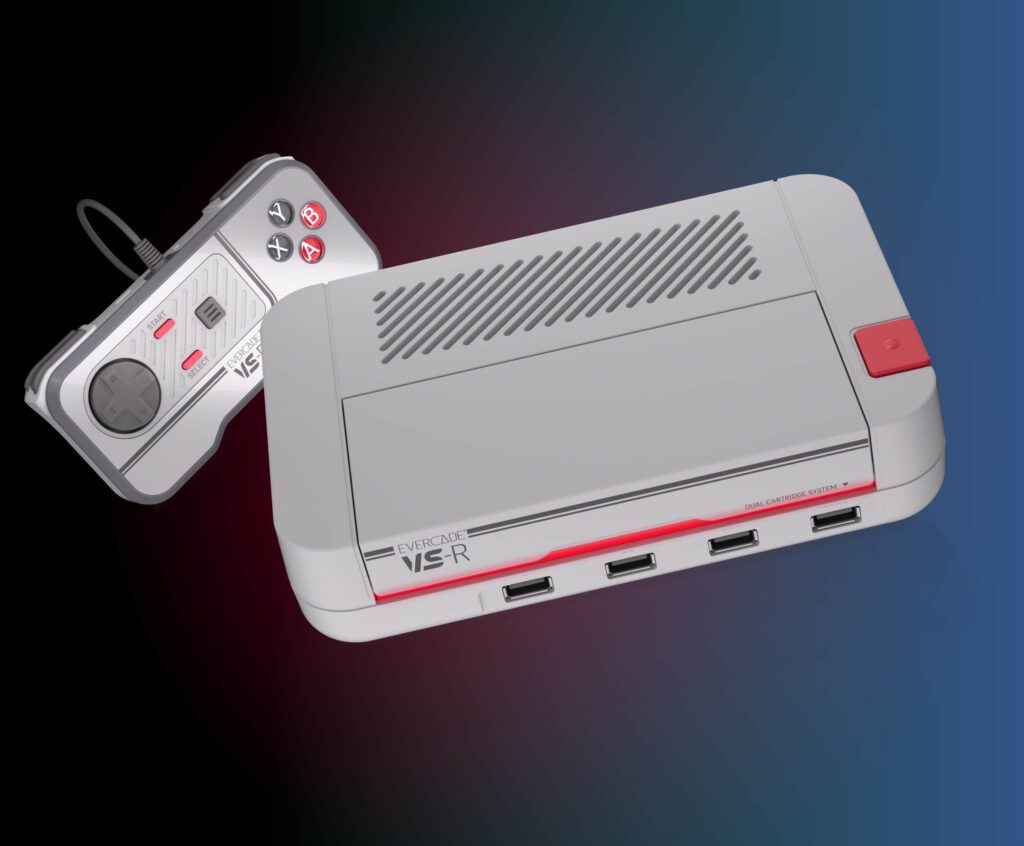
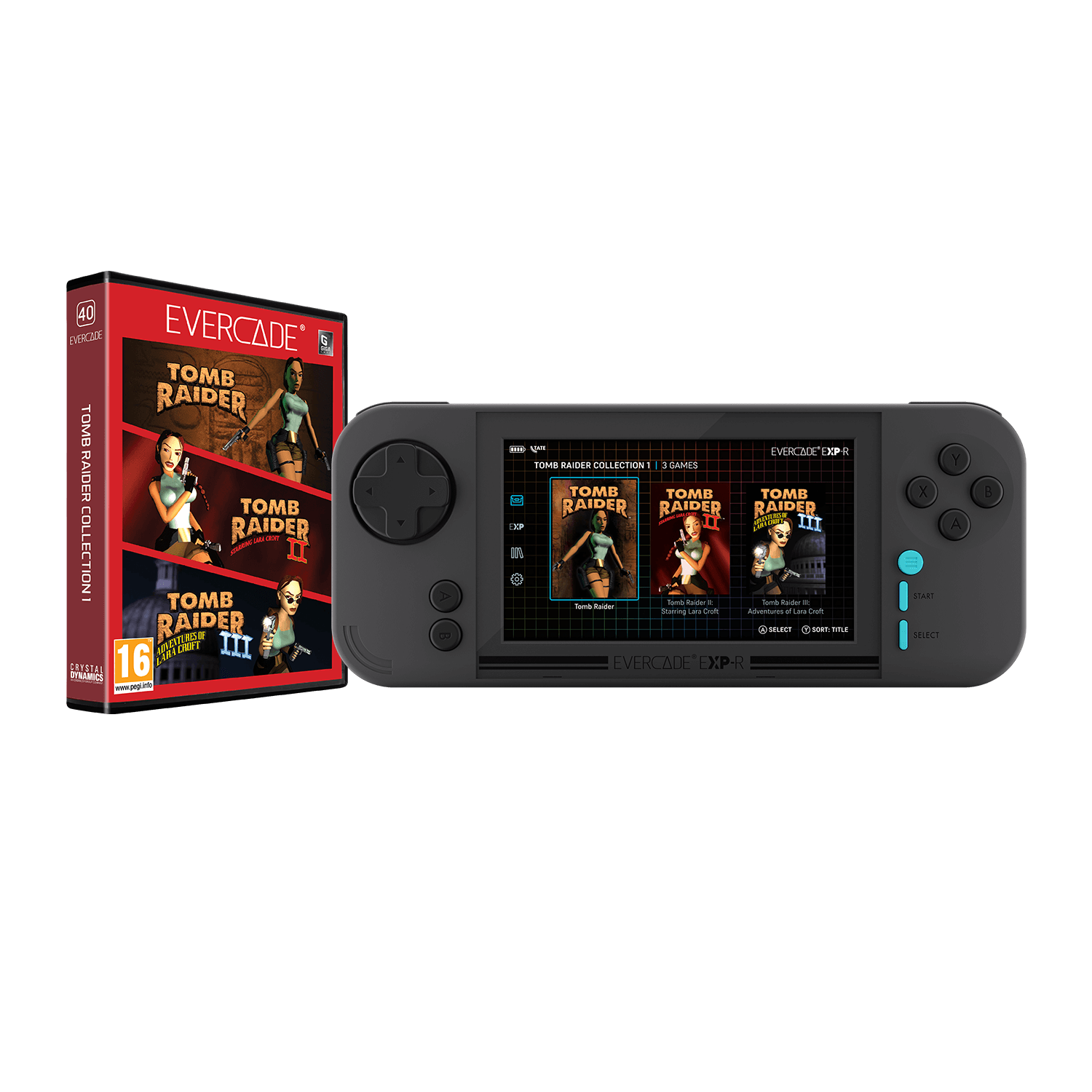
The hardware kept changing; the slot never did. The Evercade VS took the same cartridges to the television in December 2021, with two slots and room for four players. The EXP followed at the end of 2022 with a better screen and a TATE mode for vertical arcade games. In late 2023 the Super Pocket line — under Blaze’s casual HyperMegaTech! brand — shrank the idea to pocket money: built-in games plus the same cartridge slot. The -R refreshes of 2024 (VS-R, EXP-R, $99.99 each) cut prices; the Alpha bartop put the slot in a tabletop arcade cabinet that November; Giga Carts added storage for bigger, newer games.
Through all of it, the promise held: a cartridge bought for the 2020 handheld works in the 2026 one, the odd firmware update aside. The catalog compounded quietly — past 600 games and 70 collections by mid-2026, past 700 games and 80 collections by the autumn. And it widened in kind, not just count: Full Void, in November 2023, was a brand-new game on a single cartridge, running natively rather than through emulation; an SNK deal brought Neo Geo games into the fold from 2025. The slot became a format, and formats are what collecting runs on.
The Nexus: cartridges grow up
Which brings us back to the box from October 30. The Nexus ($199.99, the priciest Evercade yet) is built for the eras that killed the cartridge the first time: a 5.89-inch screen, dual analogue sticks — a first for the line — and a catalogue reaching into 32- and 64-bit games. Its party trick is EverSync: two Nexus consoles share a single cartridge wirelessly, no internet required. Blaze’s own pitch for the pack-in Banjo-Kazooie cartridge is three short sentences long: “No downloads, no codes — you own the games.”
Honesty requires the footnotes. The Nexus has no TV output at all; the living room still belongs to the VS-R. There was a day-one patch, because it is still 2026. The limited 64 and DOOM editions sold out around launch, and the standard model’s $199.99 buys an open handheld with far more raw power. None of that dents the point: the 64-bit generation — the one that moved games to discs, then downloads, then delisting notices — now ships on a numbered cartridge, and the cartridge is the selling point, printed on the box.
What the bet can’t fix
My rule is that every love letter gets a paragraph of cold water, so here it is. The menu is the menu: Evercade’s library is whatever licensing can reach, and the deepest catalogs in retro — Nintendo’s, Sega’s, Konami’s — were noted as missing at launch and remain largely out of frame. If your one favorite game never gets licensed, no shelf completes itself. Prices have crept, too: collections that launched around $20 now arrive at $29.99. And under the romance, these are still emulated games in a plastic shell — an open handheld plays vastly more, for less, if you’re willing to build the library yourself.
The preservation claim needs the same honesty. A licensed cartridge keeps games in legal circulation — which is precisely what that 87 percent figure measures — but it preserves what rights holders agree to license, in the cuts they approve. It is curation with a cash register. The thing is, for six years the cash register has kept ringing, and the alternative distribution systems have kept closing.
The shelf is the argument
That’s the part of the Evercade story that outlasts any single console. Blaze didn’t just sell old games in a new box; it sold the idea that a retro library should be a physical thing you can see filling up — numbered, color-coded, slightly smug about it. The collectors got a shelf. The licensors got a revenue stream from catalogs the download era had left for dead. The games got to stay in print.
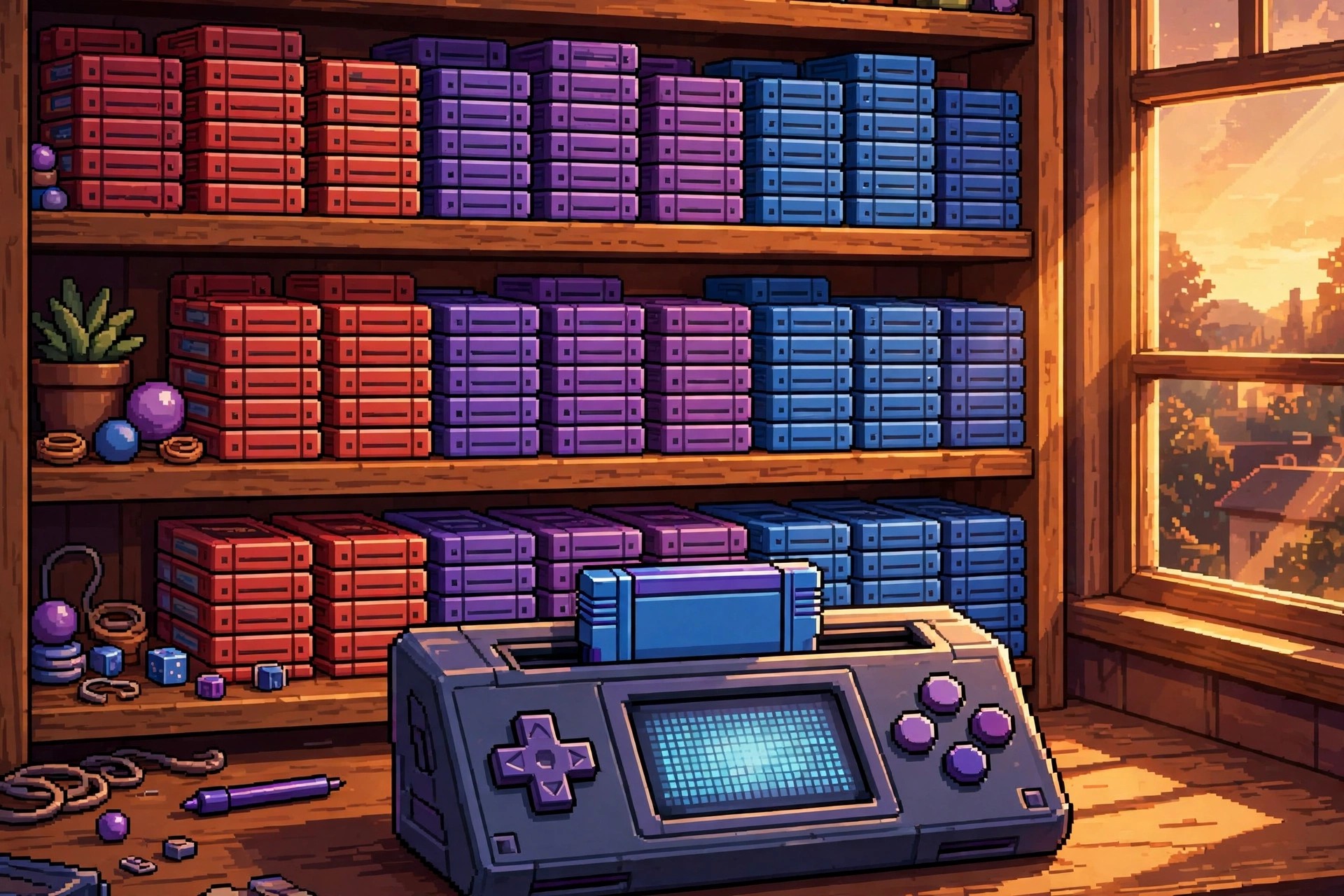
In 2020, the cartridge looked like retro cosplay. In 2026, with storefronts closing behind us and 87 percent of the classics out of print, it looks more like a position: that who gets to keep old games shouldn’t be decided by which servers are still switched on. The Nexus will be replaced in a few years, like every handheld. The cartridge in its box is built to fit whatever comes next. That’s not nostalgia. That’s the bet — and so far, it’s paying out.