
AMIGA · STRATEGY · FROM THE VAULT
Developer: Master Designer Software (Cinemaware) · Publisher: Cinemaware, distributed by Mindscape · Released: November 1986 · Platform: Amiga · Genre: Strategy–action
Forty years ago this month, a two-person California company fronted by a movie-mad software agent released a game unlike anything a home computer had ever shown: a Robin Hood epic that opened like a film, credited its makers like a film, and sold the Amiga like nothing else could. This is the story of the Amiga original of Defender of the Crown.
An Agent Walks Into Hollywood
Every revolution in games has a salesman somewhere near the start of it. Cinemaware’s was Robert “Bob” Jacob: a serial entrepreneur and lifelong film buff who sold his Chicago business in 1982 and moved to Los Angeles with his wife Phyllis, then built a modest career as a software agent, brokering deals between small developers and publishers like Epyx, Activision and Mindscape. Then he saw a prototype Amiga at work in a developer’s office, and the agent decided he wanted to drive the revolution instead of riding shotgun.
His reasoning, recounted by historian Jimmy Maher, was demographic before it was artistic. The Amiga was an expensive, grown-up machine; the people who would buy one were adults with money and not much spare time, people who had outgrown parsers and patience alike. What they would respond to was the movies — the shared visual language of Hollywood’s golden age, served up in sittings as undemanding as television. Jacob’s formula, as he later put it, was games that should “feel like a film, but play like a game.”
So in 1985 Bob and Phyllis Jacob founded the company formally launched the following January as Master Designer Software, built around a product line with a name of its own: Cinemaware. The third founder in spirit was Kellyn Beeck — a friend, Epyx’s software acquisitions manager, and, in Maher’s phrase, a frustrated game designer — who would write the design briefs. Finished games would pass to Mindscape for distribution. The welcome letter printed in Defender of the Crown’s own manual, signed by Robert and Phyllis Jacob as Executive Producers, is the whole manifesto in two sentences: “We are pleased to present this title as part of our new line of interactive movies which we call CINEMAWARE… Cinemaware derives its inspiration from the movies, not other computer games.” Four launch titles were contracted for delivery by October 15, 1986, each an interactive version of a Hollywood genre: a gangster picture (The King of Chicago), an Arabian Nights adventure (Sinbad and the Throne of the Falcon), a Cold War space opera (S.D.I.) — and, first and most cherished, a swashbuckler in the line of Ivanhoe and the Errol Flynn Robin Hood. That one was Defender of the Crown.
England, 1149
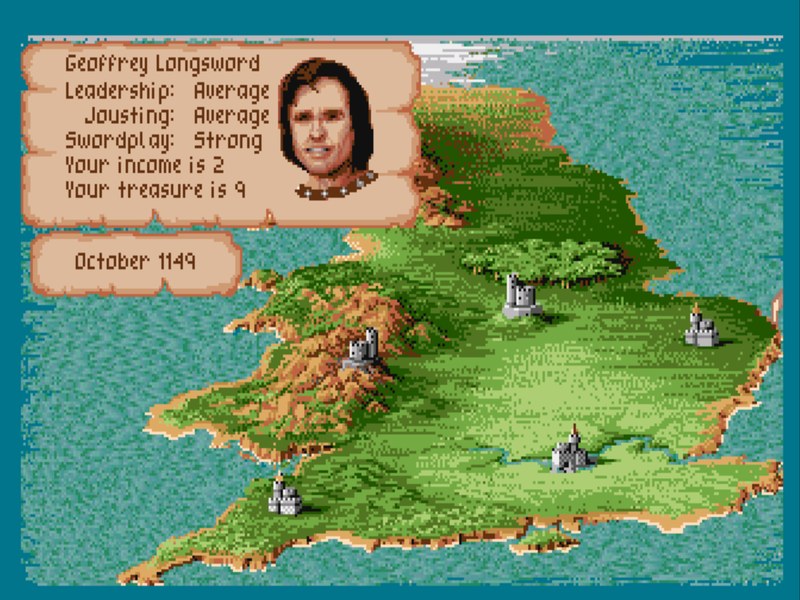
The king is dead, the throne is empty, and England is a map waiting to be repainted. Defender of the Crown is set in 1149 — the date ticks by in the corner of its campaign map — and casts you as one of four Saxon lords: Wilfred of Ivanhoe, Cedric of Rotherwood, Geoffrey Longsword or Wolfric the Wild. Each is rated for leadership, jousting and swordplay (Geoffrey’s card reads Leadership: Average, Jousting: Average, Swordplay: Strong), and the manual steers first-timers to Wilfred and masochists to Wolfric. Against you stand three Norman lords, plus your fellow Saxons, who are allies in the cause right up until the map gets crowded.
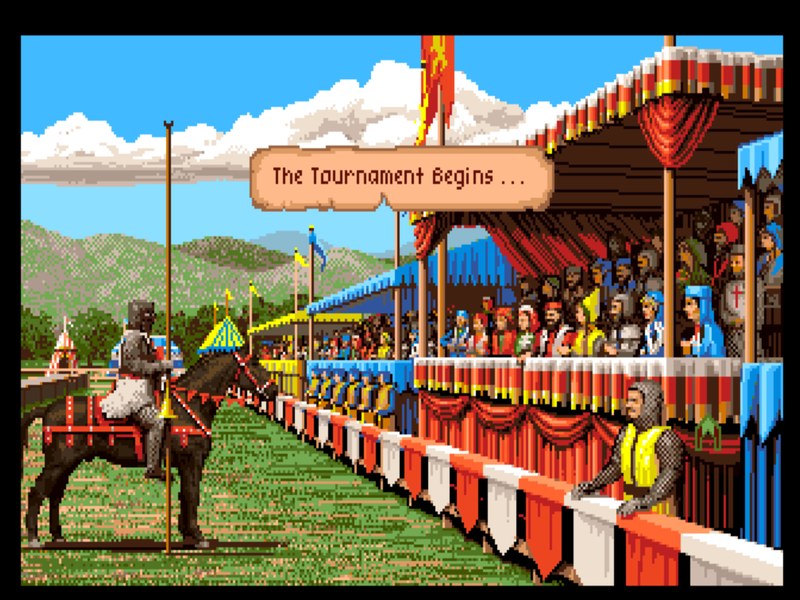
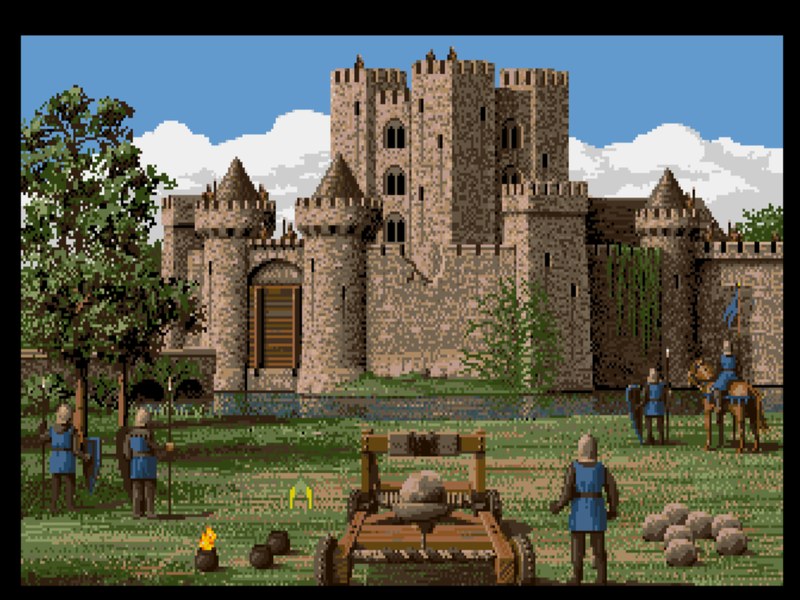
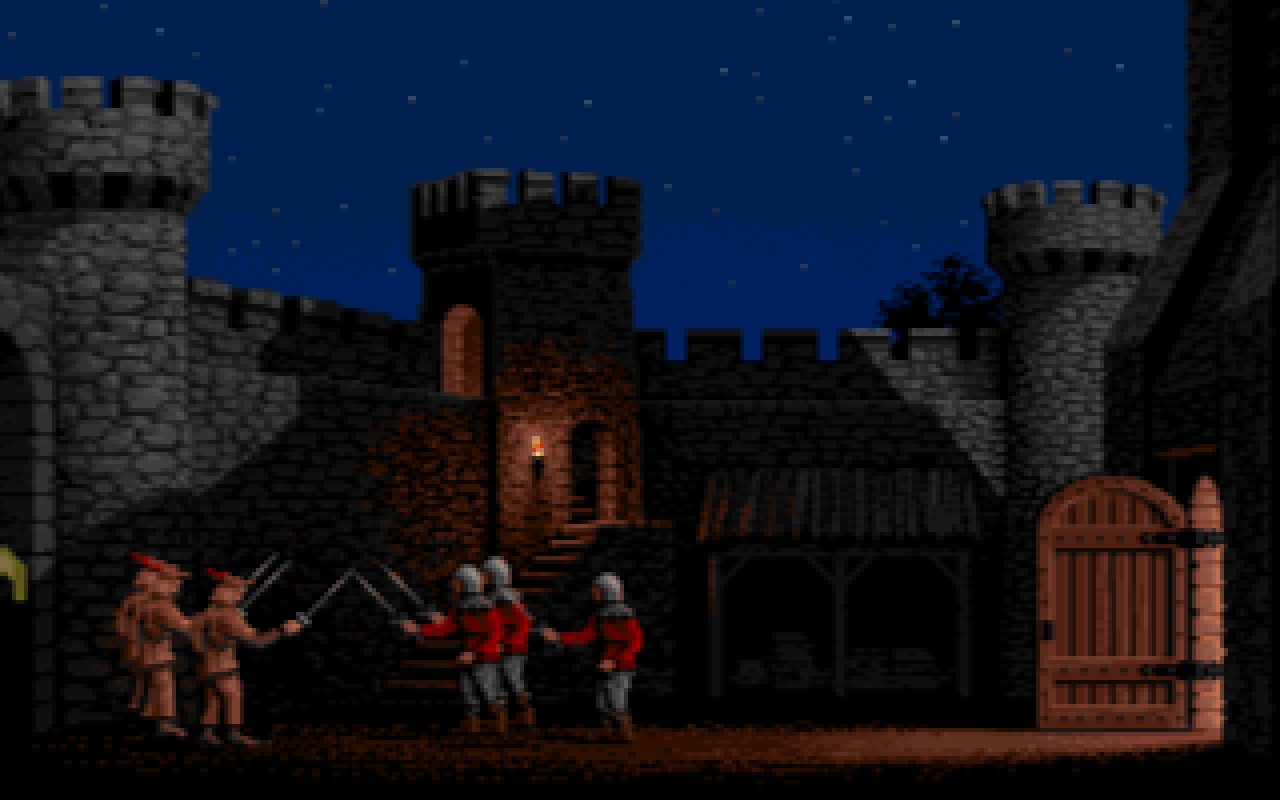
Underneath the pageantry it is, as Maher neatly puts it, Risk played in Merry Olde England: hold territory, collect its income, build your army, and take the castles one by one. But the strategy map is only the frame. Woven through it is a programme of little films you get to step inside. You can hold a tournament — five gold to stage, and chivalry obliges you to attend everyone else’s for free — and ride in the joust for fame, which lifts your leadership, or for land, which takes a rival’s territory without a siege. You can go raiding at night, sword in hand, to loot a Norman castle’s treasury. You can lay siege with a catapult and bring the walls down stone by stone. And when a Norman lord carries off a Saxon damsel, you can fight your way in to rescue her, after which — this is a Cinemaware game, and romance is a military resource — gratitude turns to love.
Best of all is the ally waiting in the greenwood. Robin of Locksley — Robin Hood — introduces the game, and the manual records that he “pledged his aid three times in your quest to restore the kingdom to Saxon rule”: detour to Sherwood Forest before a campaign and his men join your ranks. A full conquest takes well under an hour and there is no saving your game, because a movie does not pause for intermission. It was designed, from its first principles, as an experience to be lived rather than a system to be mastered — and that began with how it looked.
Art Direction, Capital A
If Defender of the Crown has a single author above the title, it is neither its designer nor its programmer but its artist. James D. Sachs was a former US Air Force C-141 pilot who had taught himself programming and pixel art on a Commodore 64: his first game, the self-published Saucer Attack (1984), mixed spectacular graphics with modest gameplay, and his unfinished Time Crystal demo became the stuff of BBS legend. His early Amiga pictures — painted on pre-release hardware after Commodore granted him developer status — were among the first widely shared images of what the machine could do, and when Jacob signed him for Defender he gave him a job title imported straight from Hollywood and new to games: Art Director.
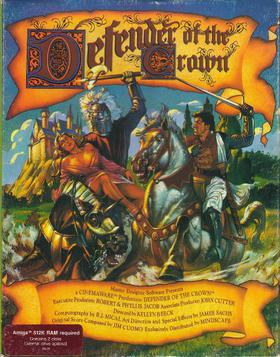
The manual’s credit roll reads like the end of a film because it was meant to: “Written and Directed by Kellyn Beeck. Computography and Mical Game System by Robert J. Mical. Art Direction and Special Effects by James Sachs. Original Music Composed by Jim Cuomo. Executive Producers Robert & Phyllis Jacob.” Sachs directed a small art team — six further artists are credited beside him, an army by 1986 standards — and his brush passed over every scene, harmonising styles into a single lush, painterly England of heralds, harbours and candlelit halls. In later interviews Sachs recalled that his first Defender background took him a full week in the Amiga’s primitive paint tools. The effort is on the screen to this day: no home computer game in 1986 looked remotely like this, because no home computer game had ever been art-directed like a feature film. Even the box was staged like one — its cover painting, by Ezra Tucker, was worked up from a photo shoot for which art director Randy McDonald rented costumes from Hollywood’s Western Costume and posed models “as closely as possible to the way we wanted them to be illustrated.”
The Three-Month Rescue
It very nearly didn’t happen. Defender and S.D.I. had been contracted to Sculptured Software of Salt Lake City, a capable porting house that found the new 68000 machines more than it had bargained for. By June 1986 Sachs and his artists had delivered a pile of mouth-watering art, but when Jacob flew out to check progress he found, in his own later words, that “those guys were like nowhere. Literally nowhere.” With the Mindscape deadline of October 15 looming, Jacob hired his first real employee — John Cutter, a Gamestar designer freshly laid off after Activision’s acquisition — whose first task was to take Defender away from Sculptured entirely.
The rescue fell to a man who knew the Amiga from the inside: R.J. Mical, co-creator of its Intuition interface and author of GraphiCraft. Maher recounts that Jacob offered him $26,000 to take Sachs’s art, Jacob and Beeck’s design and Jim Cuomo’s score and turn them into a finished game within three months. Mical — “I’m your man” — did it, at brutal personal cost: he later insisted he had not been told the true scale of the job, and by Maher’s account he was so unhappy with the rushed result that he had his own name struck from the game’s credit roll (the manual still bills him, gloriously, for “Computography”). Sachs, too, was left with what he called a “bitter taste”: weeks of finished art, including five man-weeks of jousting graphics alone, were cut for time and space. Neither man ever worked for Cinemaware again.
You can see the cuts if you know where to look. In the siege scene a pot of Greek fire sits ready by the catapult — decorative in the Amiga version, where flaming fireballs were finished too late to ship; the feature was restored in later ports, along with extra castles and deeper strategy that the deadline had squeezed out. Defender of the Crown went out the door a slightly unfinished film. It did not matter in the slightest.
A Sensation in a Hundred Thousand Homes
The buzz began before release. An early build shown at the Los Angeles Commodore Show in September 1986 drew a huge, rapt crowd, and when the game reached shops that November — through Mindscape, right on schedule — Amiga owners treated it, in Maher’s words, as a prophecy fulfilled. It sold 20,000 copies before the end of 1986, in a market where the entire Amiga user base probably numbered not much more than 100,000: an attach rate most modern launches would envy. It would go on to sell some 250,000 copies, and Video Games & Computer Entertainment counted almost three-quarters of a million owners worldwide by 1989, across all its versions.
The press reached for superlatives and caveats in the same breath. Computer Gaming World praised its graphics and animation and called it “a showcase program to demonstrate the power of the Amiga to your friends,” later giving it a special award for artistic achievement. Info magazine awarded four stars out of five, saying its “graphics have set new standards for computer games” — while hoping future Cinemaware games would improve on the “adequate” gameplay, which it called “the weak link.” Compute! agreed it demonstrated the Amiga beautifully and found the strategy oversimplified. Mical, watching his artist at work, was blunter than any reviewer: “Jim Sachs, what a god he is,” he marvelled, in a recollection preserved in Brian Bagnall’s On the Edge. And the argument that would follow the game for forty years started immediately: designer Chris Crawford dismissed the whole Cinemaware approach as pretty pictures over weak gameplay, Amazing Computing declared Defender the “most anti-woman game of the year” for its swooning damsels, and players, indifferent to all of it, kept right on uniting England.
Every Screen in the Land
Success like that gets ported. Through 1987 Defender of the Crown marched onto MS-DOS, the Atari ST, the Macintosh and the Commodore 64, with the NES, Amstrad CPC and Apple IIGS among the many that followed. The ports are one of the story’s nicer ironies: freed from the three-month deadline, they quietly finished the design — working Greek fire, more varied castles, minigames tuned until they made sense — and some aficionados still name the Atari ST version the best-playing Defender of all. The Apple IIGS conversion, which we reviewed separately on this site, proved Apple’s quiet machine could stage the spectacle nearly intact. But it is the Amiga original — the rushed, slightly broken, impossibly beautiful one — that history kept.
Commodore itself commissioned a return in 1991, when Sachs provided new internal graphics and interface work for a CDTV edition he himself described as “sort of a Director’s cut,” and Defender of the Crown II followed in 1993 for the CDTV and CD32. By then Cinemaware was gone — bankrupt in 1991, a victim of the very production values it had pioneered — but the crown refused to stay buried.
Playing It in 2026
The name was revived in 2000, and the revivals have never really stopped: the 3D remake Robin Hood: Defender of the Crown (2003), Defender of the Crown: Heroes Live Forever (2007), and a digitally remastered edition of the Amiga original that keeps Sachs’s art exactly as it was — the version sold on GOG today and included in the Cinemaware Anthology on Steam. Sales across all its incarnations had passed a million by 2001, and in this, its fortieth year, the wheel has come full circle in the most literal way imaginable: Retro Games’ new full-size Amiga, THE A1200, arrives with Defender of the Crown and its sequel pre-installed, while a fresh reimagining, Defender of the Crown: The Legend Returns, has been announced for modern machines.
So load it up this month, forty years on. Choose your lord — Wilfred if you’re new, Wolfric if you’re brave, Geoffrey if you fancy your swordplay — detour through Sherwood to collect Robin’s men, and take England back one painted province at a time. The strategy is simple, the jousting is a lottery, and none of it matters: for the length of one sitting you are not playing a game about a movie. You are inside the movie, exactly where Bob Jacob promised to put you in November 1986.