
At a glance — Developer: Bethesda Game Studios · Publisher: Bethesda Softworks · Released: November 10, 2015 · Platforms: PC, PlayStation 4, Xbox One (native PS5 and Xbox Series X/S versions followed in 2024) · Genre: Action role-playing · Director: Todd Howard
Eleven years ago this week, I did something I had never done for a video game before and have rarely done since: I took the day off work for it. Not a long weekend, not a vacation built around it — one plain Tuesday, November 10, 2015, circled on the calendar months ahead, with the fridge stocked and the phone face-down. Fallout 4 was coming out, and everybody I knew who played games was doing some version of the same thing. Bethesda shipped roughly 12 million copies into that launch, more than $750 million worth in the first 24 hours, and for once the numbers felt less like marketing and more like a census. That winter, the Commonwealth was simply where a lot of us lived.
I have replayed it since — a second run a few years later, a third after the big update in 2024 — and each time I go back expecting the spell to have thinned out. Each time, somewhere around the moment I crest the hill above Sanctuary and the ruined rooftops spread out below, it takes hold again. Fallout 4 is not the most elegant game Bethesda ever made, and we will get to the arguments, because the arguments are part of its furniture now. But as a place — a cold, kind, junk-strewn place that asks you to stay awhile and fix what you can — I am not sure the series has ever built a better one.
Fallout 4 Begins With the Last Normal Morning in America
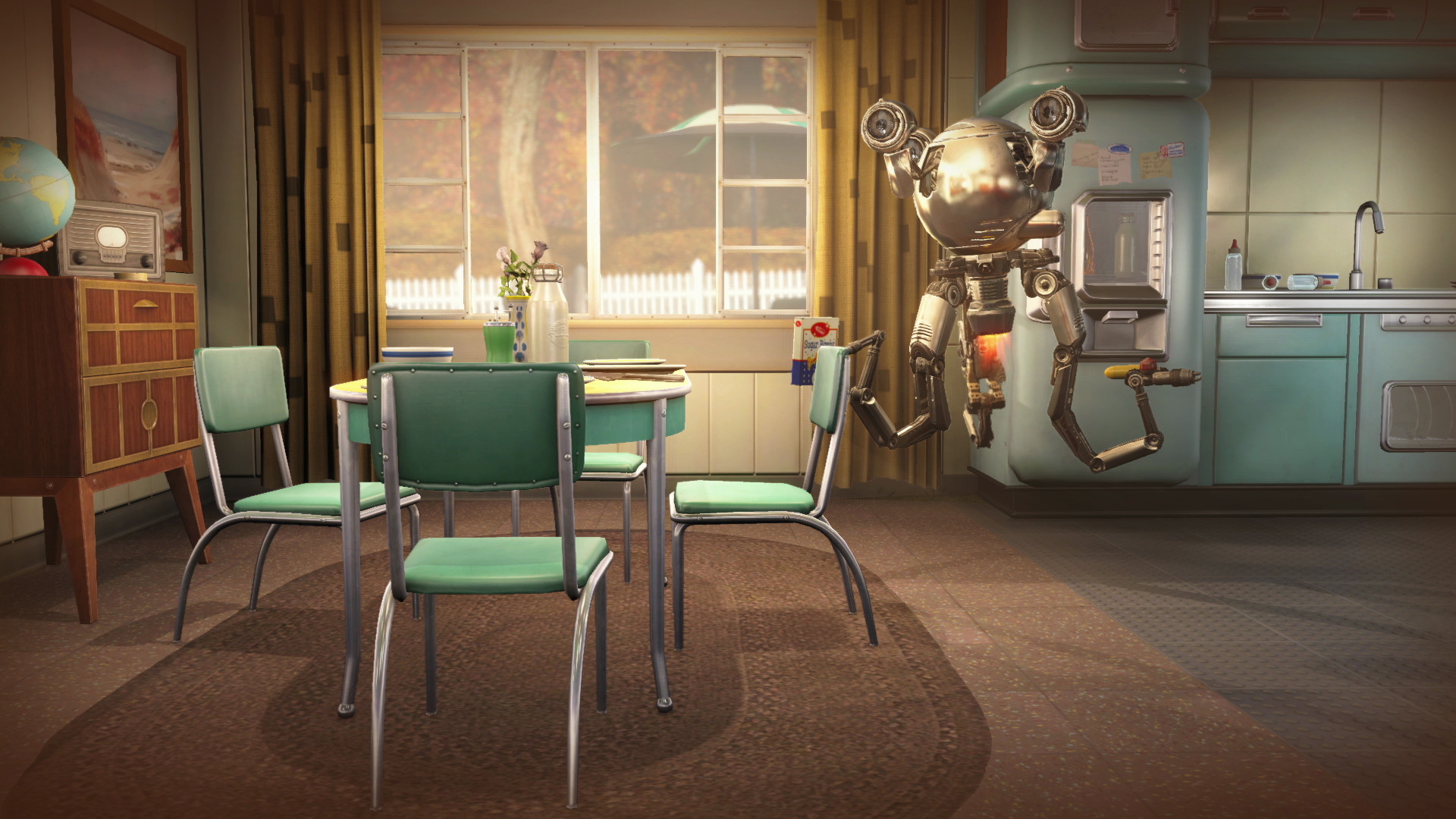
Most post-apocalyptic games start after the end. Fallout 4 has the nerve to start before it, in a sunlit kitchen in Sanctuary Hills on October 23, 2077, with coffee brewing, a robot butler named Codsworth fussing over breakfast, and a Vault-Tec salesman at the door being just pushy enough to save your life. You sculpt your character in a bathroom mirror, trading the controller back and forth between husband and wife — Nate or Nora, a veteran and a lawyer, with a baby, Shaun, asleep down the hall. It is the most quietly daring opening Bethesda ever wrote, because it makes you live in the world that is about to be taken away, at kitchen-table length, for just long enough to love it.
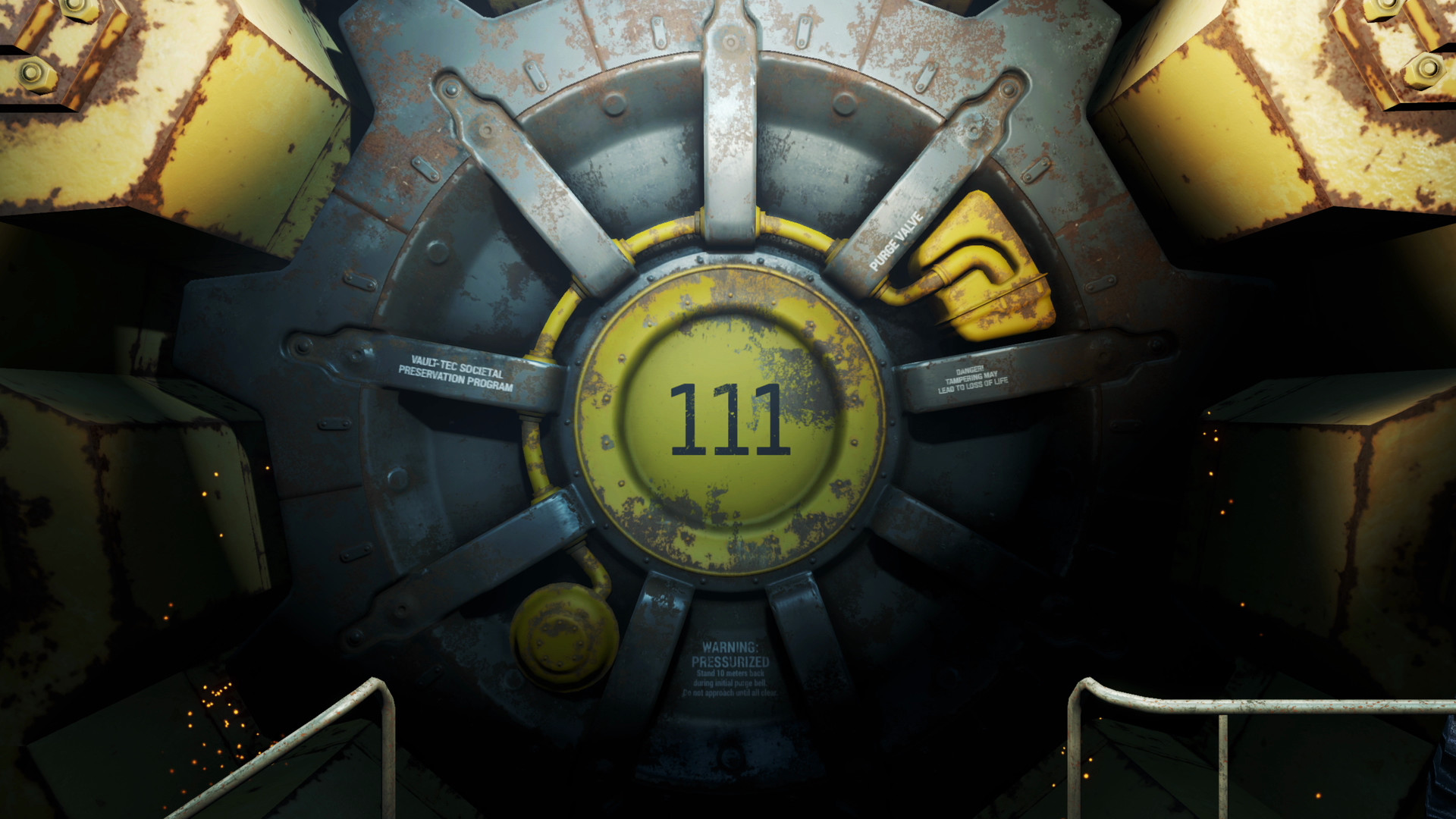
Then the news anchor’s voice changes, the sirens start, and you are running up that hill with your neighbors while the sky goes white. The game puts you in Vault 111, tricks you into a cryogenic pod dressed up as a decontamination shower, and makes you watch — through frosted glass, helpless — as strangers murder your spouse and carry your son away. You wake properly 210 years later, in 2287, the sole survivor of a vault full of the dead, and the elevator ride up into the light remains, for my money, the single best first hour in the studio’s history. Every game since has chased that reveal. The door groans, the platform rises, and Boston’s bones are waiting.
The Commonwealth Swallowed My Winter Whole
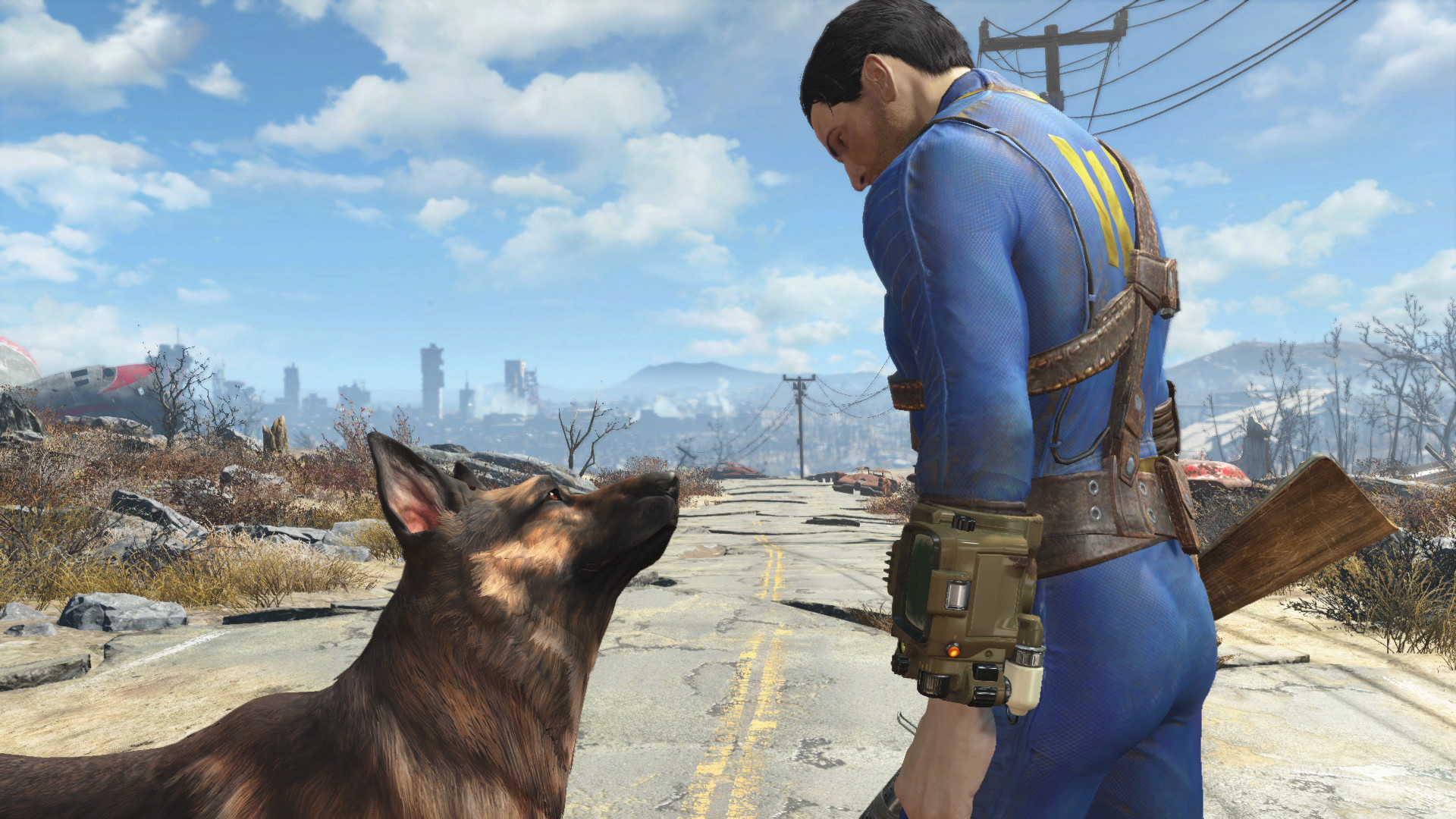
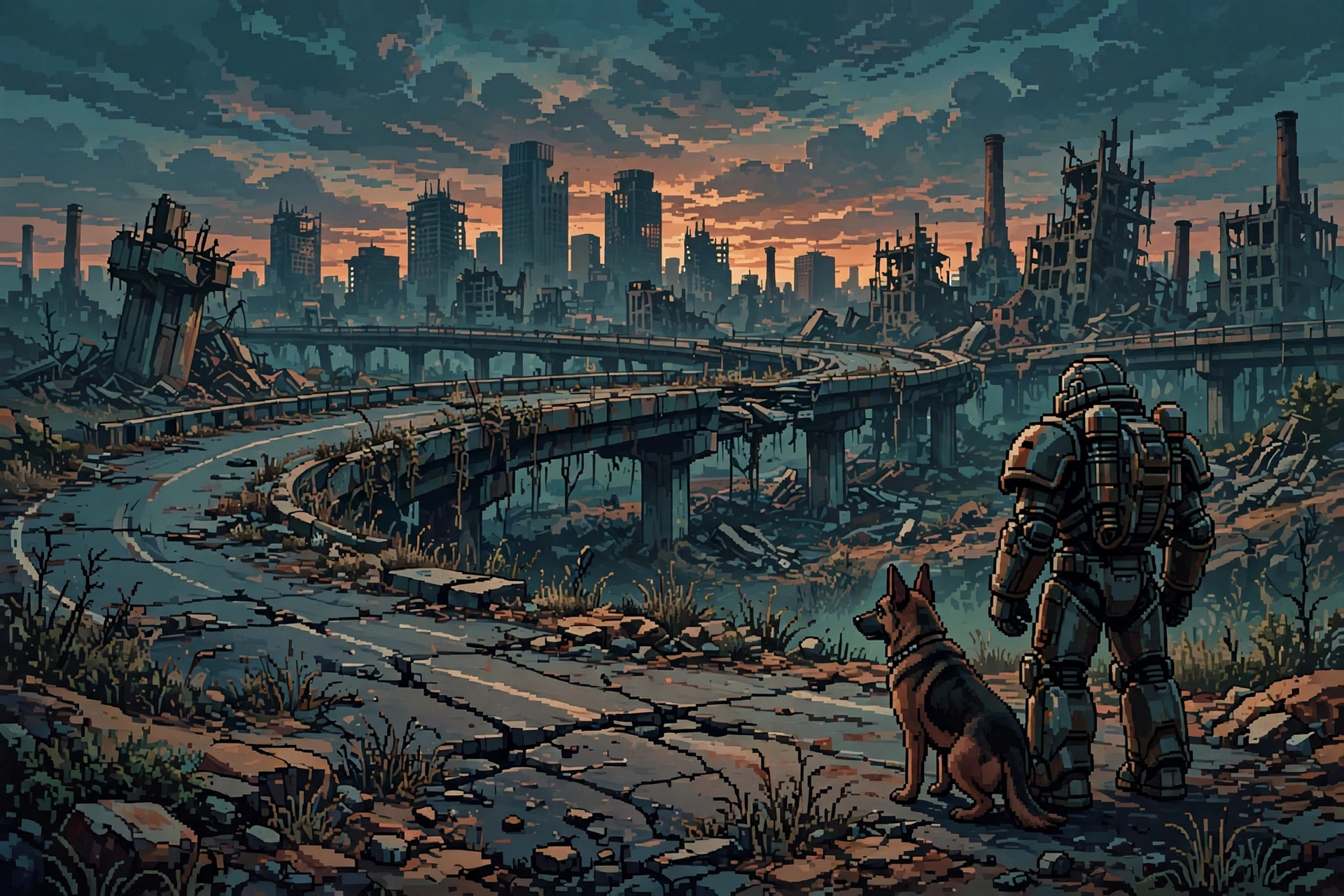
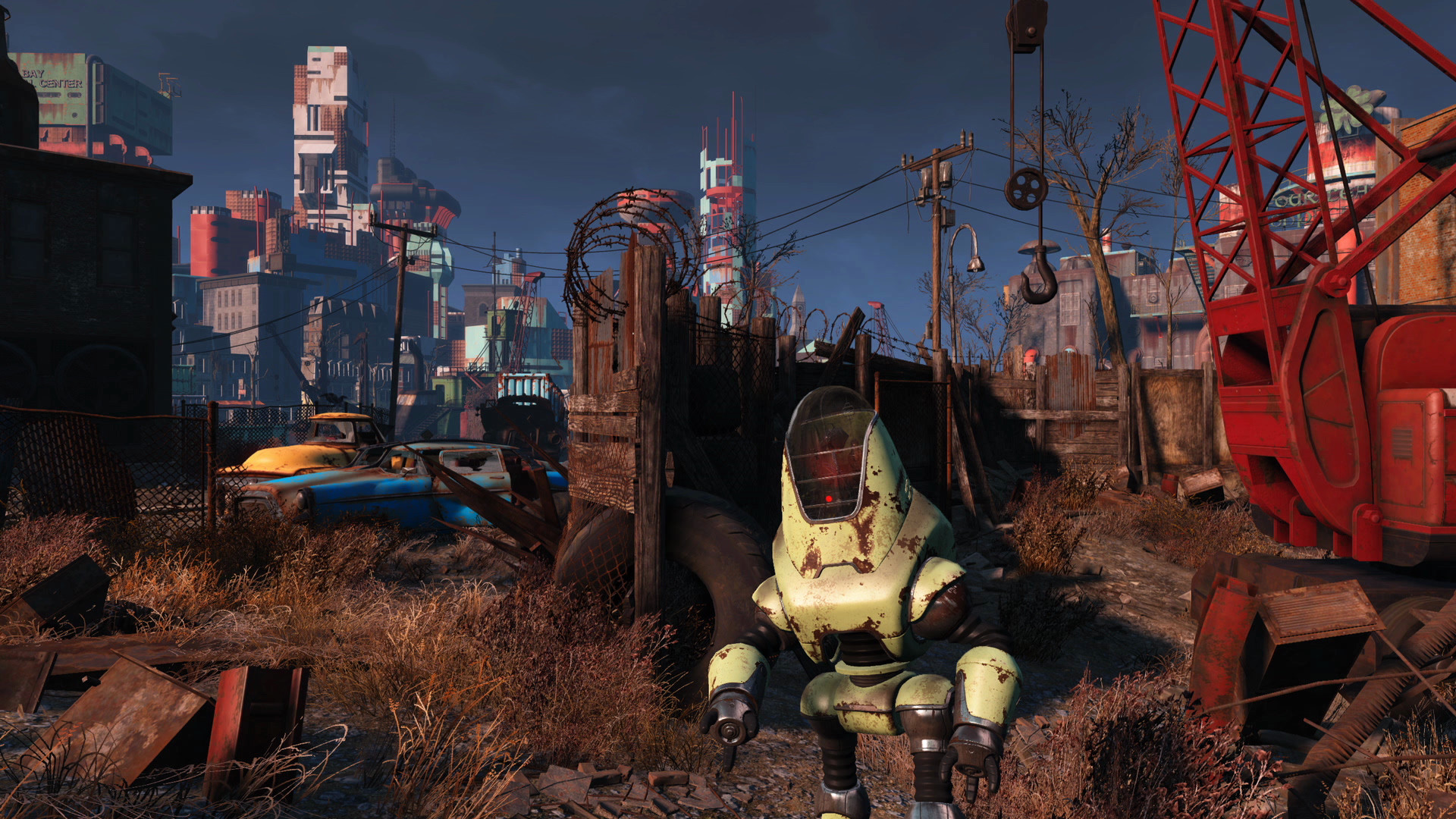
What I remember most about that first run is not the main quest. It is the wandering. Fallout 4’s Commonwealth — Boston and the Massachusetts countryside around it, compressed into a map you can cross on foot in an afternoon of real time — is dense in a way Fallout 3’s Capital Wasteland deliberately was not. That game was about emptiness. This one is about accumulation: every ruined diner, flooded quarry, and collapsed overpass has something in it, and most of that something is junk you suddenly, desperately need. By the time you reach Concord you have a dog — Dogmeat, a German shepherd who falls in beside you and never once judges your decisions, the finest companion the series ever gave us — and a suit of power armor you have climbed into to fight a Deathclaw on a rooftop, in the first hour, like the game is handing you its whole thesis at once: the old world is gone, here is its heaviest relic, try to do some good with it.
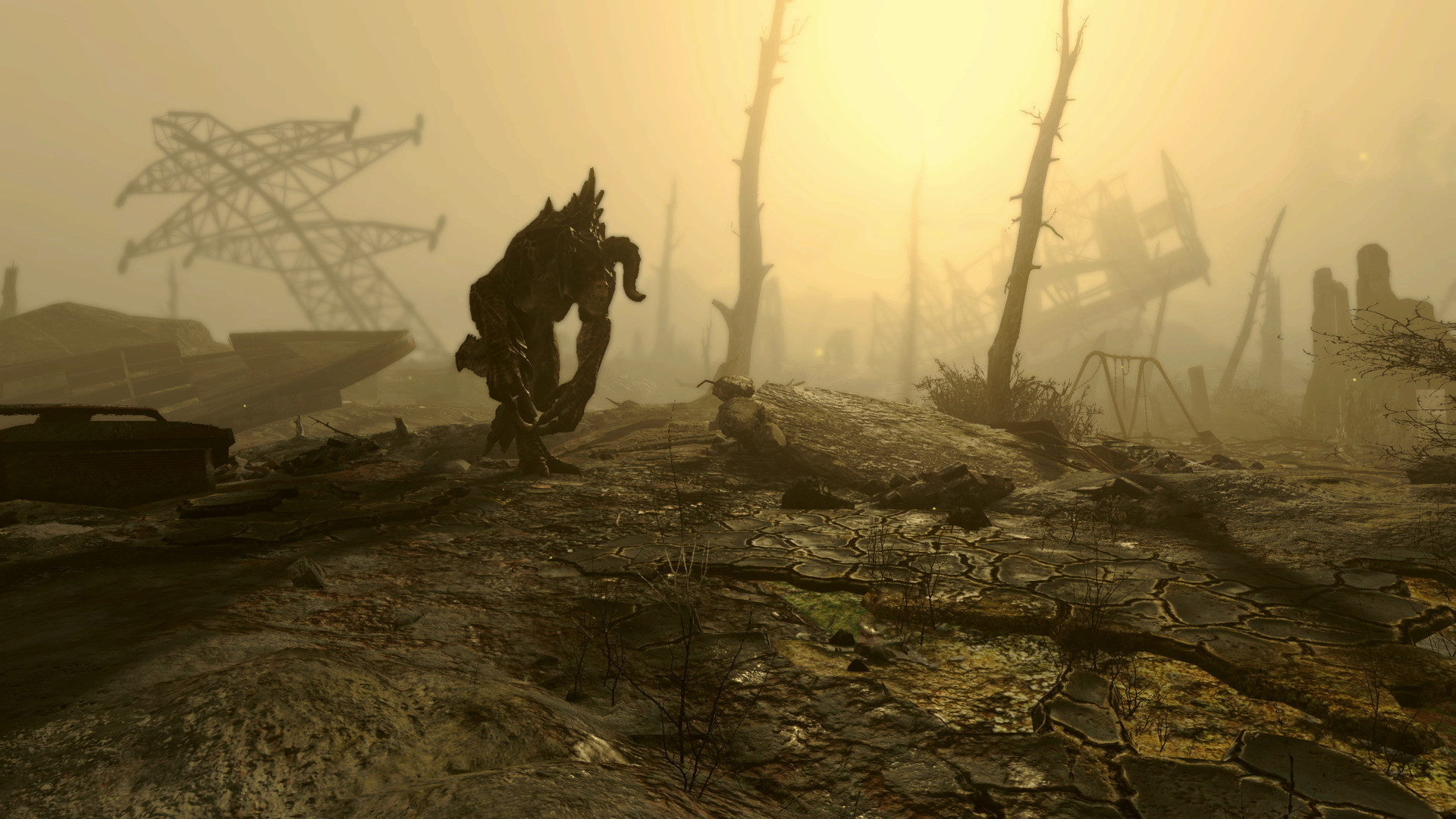
I lost whole evenings to the map’s edges. The Glowing Sea, down in the irradiated southwest corner where the bombs fell hardest, is still one of the great hostile places in games — a yellow murk of radstorms and things with claws, where your Geiger counter chatters like castanets and the churches stick out of the poisoned ground like ships sinking. I went there under-leveled, in the dark, because a quest marker pointed that way and I was too stubborn to turn around. That is the Commonwealth’s trick: it always makes the bad idea feel like your idea.
Fallout 3 gave us a wasteland to survive. Fallout 4 gave us one to move into — and then handed us a hammer.
A Ballpark, a Synth Detective, and the Great Green Wall
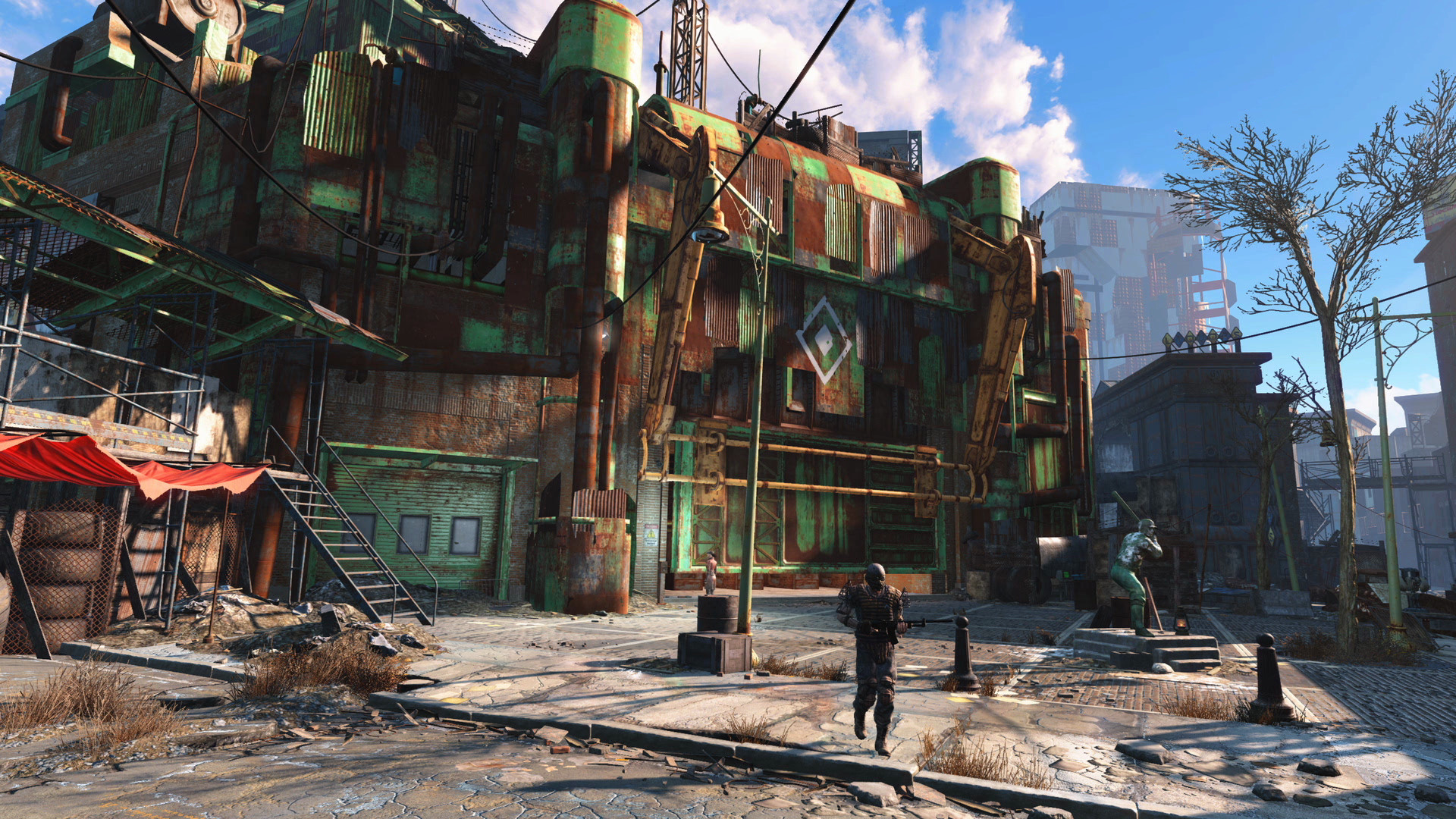
Every Bethesda world has a capital, and Fallout 4’s is a stroke of genius: Diamond City, a shantytown metropolis built inside Fenway Park, its people living under the Green Monster — here literally a great green wall that keeps the wasteland out. There is a mayor, a school, a noodle stall run by a robot, and a paranoid hum under everything, because the Commonwealth’s defining fear is the Institute, the shadowy organization beneath the ruins of the old Commonwealth Institute of Technology that kidnaps people in the night and replaces them with synths — artificial humans indistinguishable from the real thing. It is a witch-trial paranoia poured over a baseball stadium, and it gives the whole map an anxious heartbeat the earlier games never had.
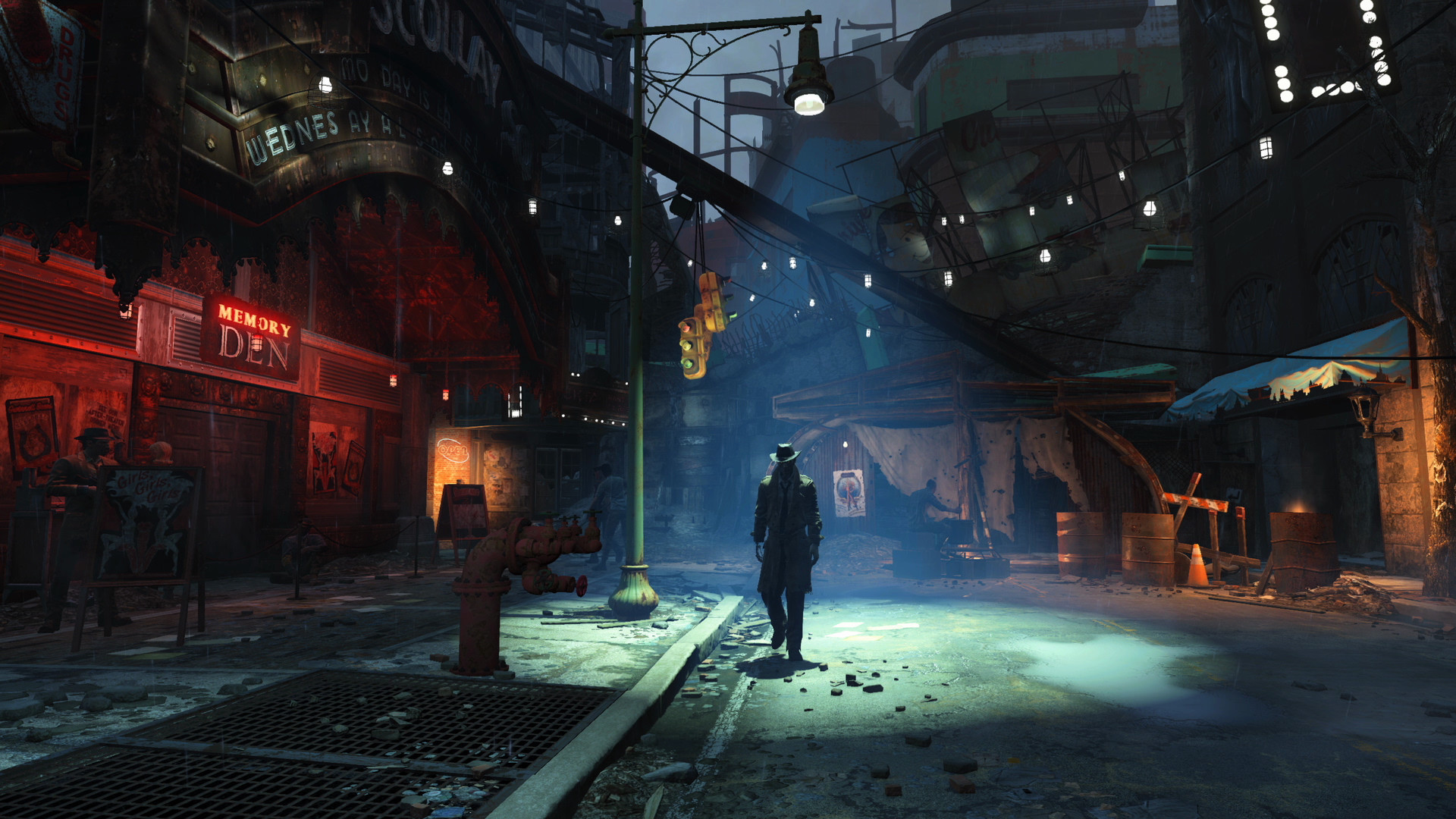
It also gives us Nick Valentine, a prototype synth who escaped the Institute and set up shop as a hard-boiled detective in a city that hates what he is — a character so good, so warmly written and acted, that eleven years later he still wins “best companion” arguments against the entire rest of the cast. The factions circling him — the Minutemen rebuilding settlement by settlement, the Railroad running synths to freedom, the Brotherhood of Steel parking an airship over the airport, the Institute in its clean white underground — force the series’ thorniest question: what counts as a person? Fallout 4 does not always answer it gracefully, but it asks it in a place that feels lived in, down the neon alleys of Goodneighbor, where the Memory Den sells you your own past by the hour.
Fallout 4 Turned Power Armor Into a Vehicle and Junk Into Treasure
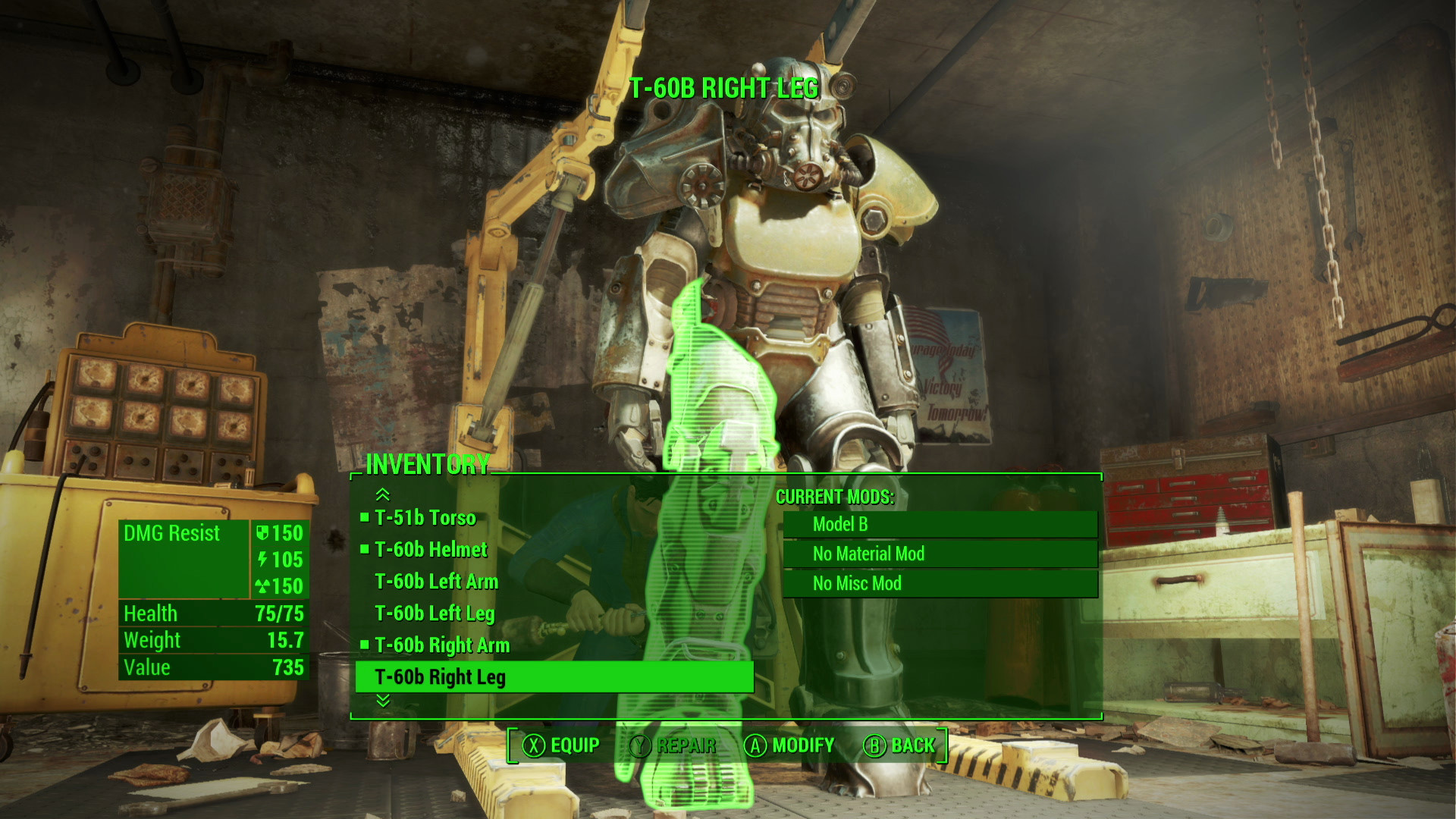
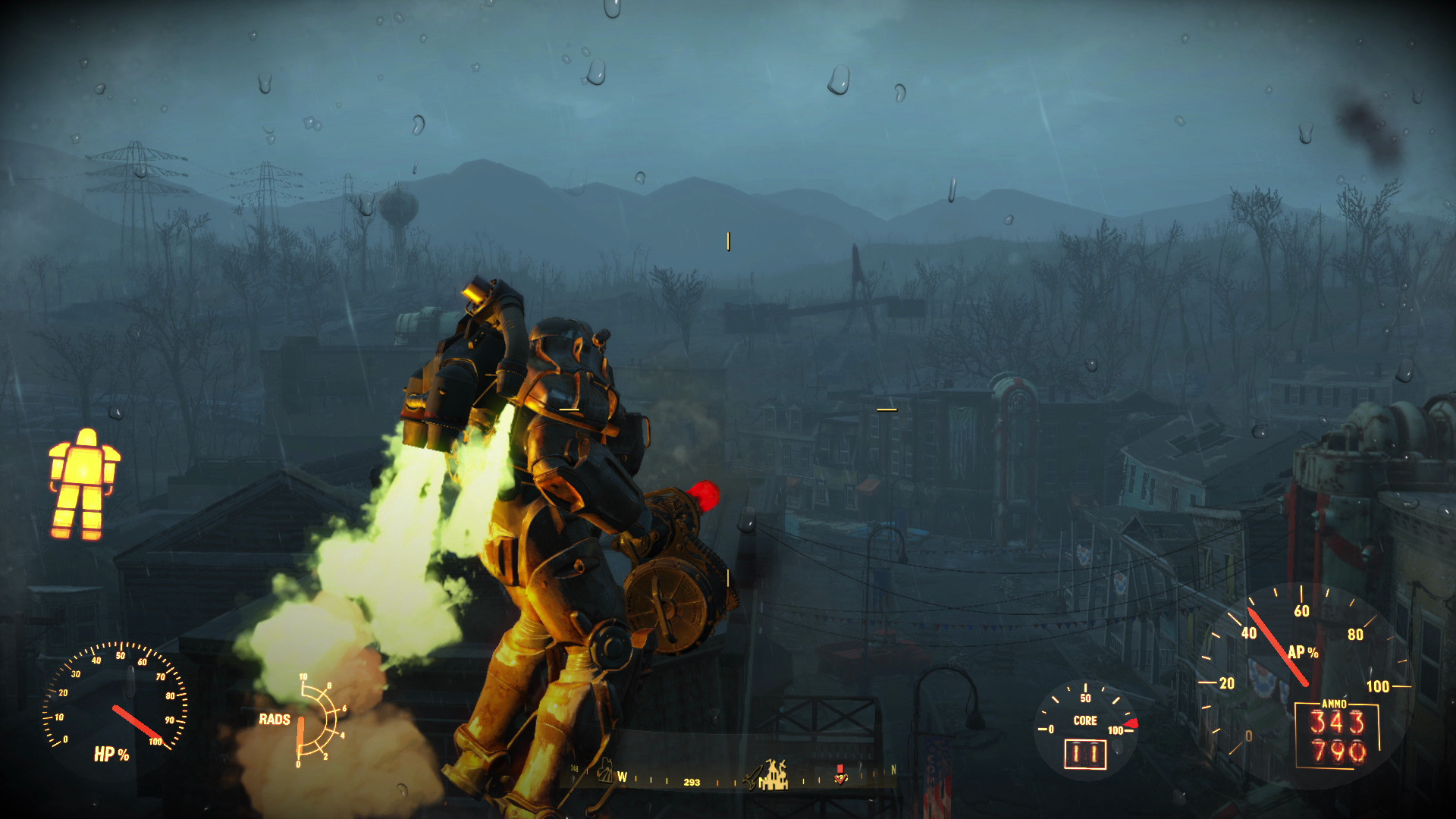
The boldest mechanical swing in Fallout 4 is the one people now take for granted: power armor stopped being an outfit and became a machine. Director Todd Howard’s team redesigned it as something you climb into like a vehicle — a frame with swappable plated limbs, a dashboard HUD, headlamp, jetpack if you are feeling flush — that drinks fusion cores and clanks with real weight. Finding a rusted T-45 in a crashed vertibird’s shadow, feeding it a fresh core, and hearing that hydraulic sigh as the back seals shut is a top-five sensory moment in the whole series. My garage at Sanctuary eventually held six suits in a row, painted and plated and utterly unnecessary, and I regret nothing.
Underneath the armor sits the crafting web that swallowed my winter as surely as the map did: more than 50 base guns open to over 700 modifications, armor in layered pieces, and a settlement system — brand new to the series — that let you scrap a ruined suburb down to its foundations and rebuild it with walls, turrets, generators, water pumps, and rows of tato plants. Every coffee cup and desk fan in the Commonwealth became screws and circuitry. Friends of mine built fortresses with lightboxes and artillery; one spent a month walling Sanctuary with a precision that belonged in an architecture journal. The game handed a shooter-RPG audience a workbench and said the end of the world was a home-improvement project, and millions of us clocked in.
The Arguments Were Part of the Furniture
Eleven years of hindsight should be honest: the arguments about Fallout 4 started on day one and some of them were fair. It was the first game in the series with a fully voiced protagonist, and while the performances are good, the voice narrows the character you can imagine yourself to be. The dialogue wheel’s four paraphrased options — you have seen the memes — too often hid the line you actually got. Critics praised the world’s depth, the freedom, the crafting, the sheer amount of game, and Inon Zur’s lovely, melancholy score, while marking down the simplified role-playing and the usual Bethesda launch-day technical wobbles. It still took top honors at the D.I.C.E. Awards and the BAFTAs, because for most players the trade was worth it: a little less conversation, a lot more Commonwealth.
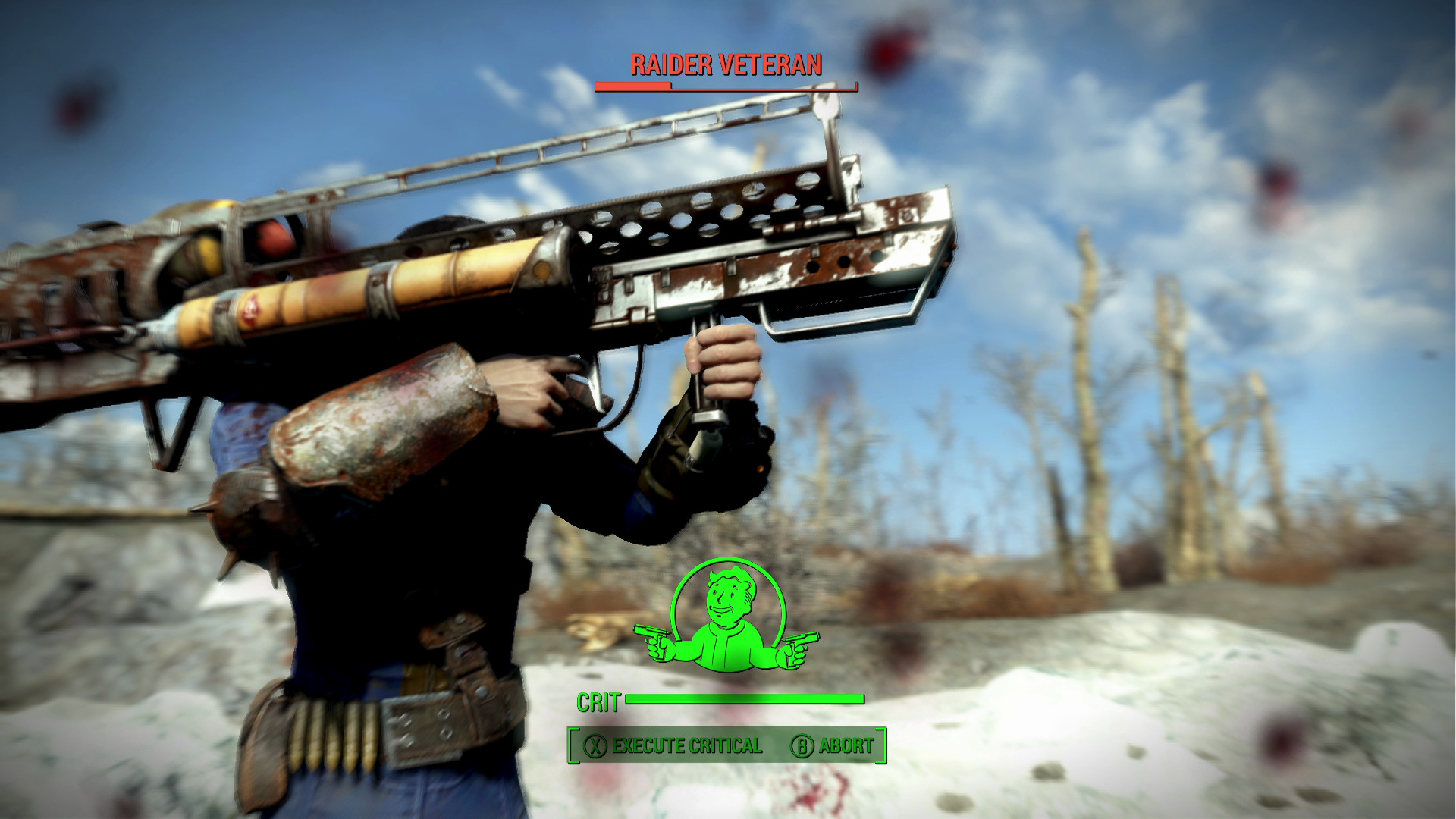
What surprises me, replaying now, is how well the moment-to-moment game has aged. The shooting — worked on with help from id Software, and it shows — has a crunch the series had never managed before, and V.A.T.S., slowed rather than stopped, now builds to a critical-hit meter you spend like a poker chip, which keeps even a scrum with raiders cinematic. The game is funnier than its reputation, too: 111,000 lines of dialogue hide a lot of dry New England wit, much of it delivered by Codsworth, who spent 210 years trimming the hedges of a dead suburb and can pronounce your character’s name, whatever you chose, with undimmed pride.
Eleven Years On, the Commonwealth Keeps Getting Repopulated
The game kept growing after my winter with it. Six add-ons arrived: Automatron, which let you build your own robot companions from scrap; the enormous Far Harbor, a fog-drowned island mystery that many of us still rank as the best writing in the game; and Nuka-World, a raider-run theme park where Fallout 4 finally let you be the villain of somebody else’s settlement. A Game of the Year Edition bundled it all, mods came natively to consoles for the first time in the series, and the settlements people built grew into a folk-art movement of their own.
Then, in April 2024, the Commonwealth got its second launch. The free next-gen update brought native PlayStation 5 and Xbox Series X/S versions with performance and quality modes running up to 60 frames per second, landing just as the Fallout television series turned the whole franchise into a phenomenon again — player counts on Steam surged past 100,000 concurrent in the weeks after the show premiered, numbers the game had not seen since 2015. Last November, Bethesda marked the tenth anniversary with an Anniversary Edition gathering the game, all six add-ons, and a mountain of Creation Club content into one box. Eleven years in, the wasteland has a population problem of the best kind: it keeps refilling.
Other games from 2015 feel like history. Fallout 4 feels like a place you used to live — and the door, incredibly, is still open.
So here is my anniversary ritual, and my recommendation: sometime this week, fire it up — the copy you own is almost certainly better patched and faster-loading than the one from 2015 — step out of Vault 111 into that pale morning light, whistle for the dog, and walk to Diamond City the long way. Do not fast-travel. Stop for every ruined thing. The winter Fallout 4 swallowed for me a decade ago was not lost time; it was a season spent somewhere that felt, against all logic, like home. Eleven years on, the Commonwealth has gone a little grey around the temples, same as the rest of us. It has never looked better.