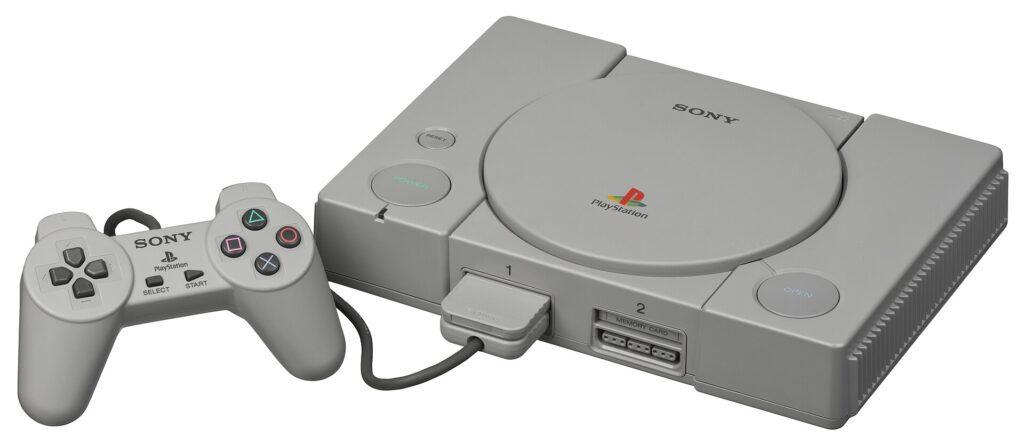
On the morning of 1 June 1991, in a ballroom at the Consumer Electronics Show in Chicago, Sony proudly unveiled the Play Station — a console built with Nintendo, carrying Nintendo’s blessing, years in the making. The next morning, in the same show, Nintendo announced a partnership with Philips. Sony’s executives learned of the betrayal the way the press did: by watching it happen. It is the most consequential humiliation in the history of video games, because of what it produced. The company Nintendo embarrassed that weekend went away, rebuilt the machine as its own, aimed it at Nintendo’s heart — and sold 102 million of them. The PlayStation was not just a console. It was a grudge with a disc drive.
The Sound Chip That Started a War
The trouble began, improbably, with a father watching his child play. Ken Kutaragi, a Sony engineer, had bought his daughter a Famicom and found himself more interested in its sound than its games — specifically in how much better it could be. Without telling his employer, he approached Nintendo and offered them a Sony-designed audio chip. Nintendo accepted, and Kutaragi’s SPC700 became the musical heart of the Super Famicom. When Sony’s president, Norio Ohga, found out his engineer had been freelancing for a partner, he didn’t fire him. He asked what else Kutaragi had in mind. The answer was: everything. A machine that combined Nintendo’s cartridge slot with Sony’s CD technology, announced to the world as the Play Station — two words, a partnership, a future.
Nintendo’s president, Hiroshi Yamauchi, saw the same future and read it differently. The agreement gave Sony control of the CD format’s licensing — the toll booth on what Nintendo believed was the industry’s next road. Yamauchi’s response was the Philips announcement, a public corrective delivered with surgical cruelty. Inside Sony, the project should have died that day; a humiliated junior partner was expected to bow out. Ohga refused. His instruction to Kutaragi, in essence, was to finish the machine and make Nintendo regret it. Sony Computer Entertainment was founded in November 1993, with Kutaragi in charge of the engineering and a brief that had nothing to do with partnership anymore.
Designed to Be Built, Priced to Be Bought
What Kutaragi’s team built was a study in contrasting philosophies. Where Nintendo’s upcoming machine bet on expensive cartridges and bespoke silicon, the PlayStation was designed around two liberating ideas: real-time 3D, and the compact disc. The hardware — a MIPS R3000 processor at 33.87 MHz with a geometry engine that could push hundreds of thousands of polygons a second — was specified to do one thing well rather than everything awkwardly. But the disc was the true revolution. A CD cost a fraction of a cartridge to manufacture, could be pressed in days instead of months, held 650 megabytes instead of a handful, and freed developers from Nintendo’s manufacturing queue and licensing grip. Sony courted developers like a suitor rather than a landlord: cheap development kits, good libraries, fast turnaround, and royalties that didn’t punish experimentation. Namco signed early — Ridge Racer in the arcade was the machine’s proof of concept — and Sony bought British studio Psygnosis outright, securing talent and a pipeline of Western games in a single cheque.
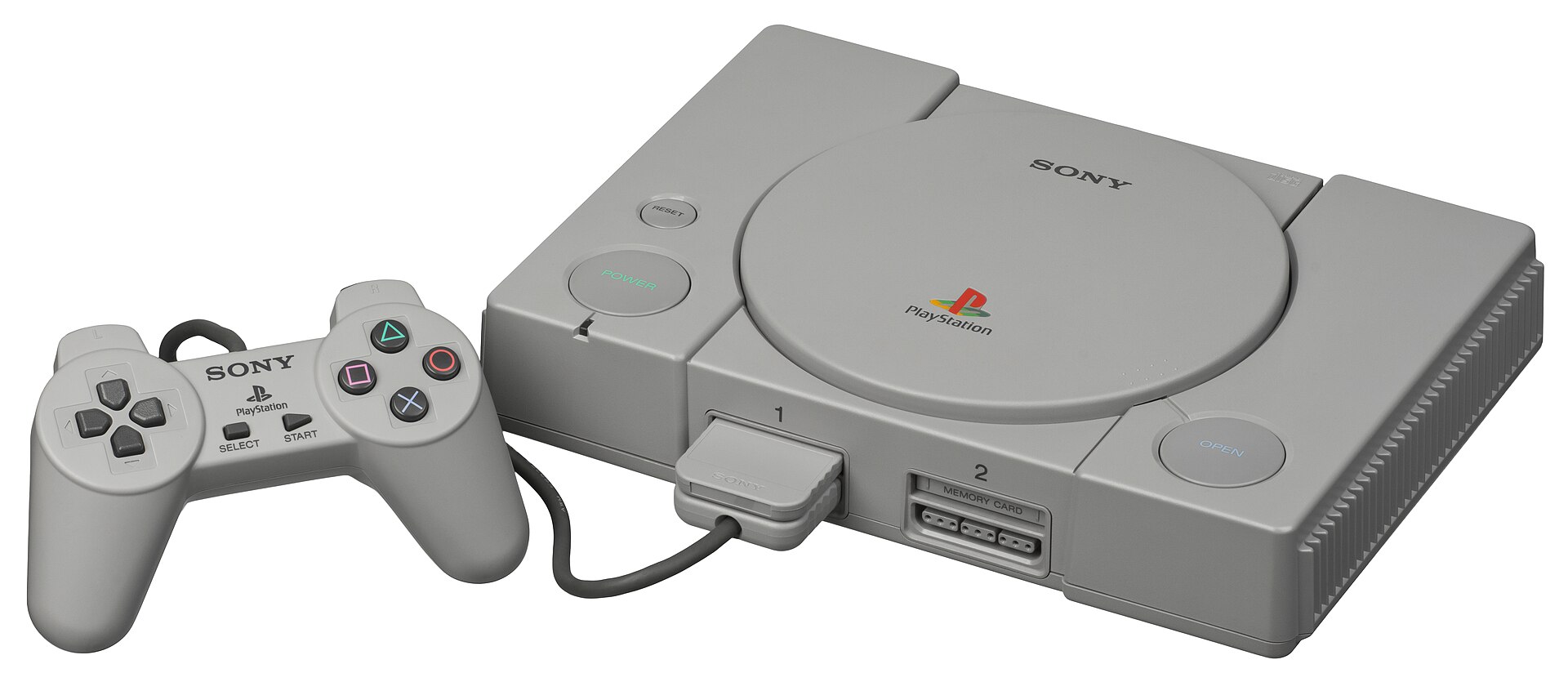
Japan got the machine first, on 3 December 1994, at ¥39,800, with Ridge Racer as its calling card — an arcade conversion that fit, improbably and famously, onto a single disc you could swap out after loading and replace with your own music CDs. It sold 100,000 units on day one and kept selling. The Western launch became theatre. At the first E3 in May 1995, Sega surprise-launched the Saturn in America at $399; Sony’s Steve Race walked to a podium, said “two hundred and ninety-nine dollars,” and walked off to applause that hasn’t really stopped since. The PlayStation launched in North America on 9 September 1995 at $299 and in Europe weeks later. The console war of the 1990s was effectively decided by arithmetic: Sony’s machine was cheaper to buy, cheaper to make games for, and — decisively — the games were coming in a flood no cartridge could match.
Two Rivals, Two Lessons
The generation’s scoreboard tells the story in three numbers. Sega’s Saturn, a powerful 2D machine caught off guard by the 3D turn, sabotaged itself in America with a surprise early launch that angered retailers and developers alike, and finished with 9.26 million units worldwide. Nintendo’s N64, delayed to 1996, held the line on cartridges — loading instantly, costing more, holding less — and watched its most important third-party partners walk to the disc. It sold 32.93 million, a respectable number that was also a collapse from the Super Nintendo’s dominance, and the defections it suffered (Square above all) reshaped the industry permanently. Sony’s 102.49 million was not just a win. It was a transfer of power: from Kyoto’s cartridge discipline to a consumer-electronics giant that treated games as one entertainment among many — and developers as customers to be won. Every platform holder since has operated in the world that transfer created.
The CD Changed What Games Could Be
The disc’s consequences went far beyond price. Storage that cost almost nothing meant developers could fill games with recorded music, voice acting, and full-motion video — crude by today’s standards, revelatory then. It meant a JRPG could sprawl across three discs. It meant games could be sold at budget prices and still profit, so the library exploded in every direction at once: the sublime, the experimental, and the cheerfully strange all shared shelf space because the economics forgave risk. The PlayStation library passed 4,000 titles worldwide — a number neither rival approached — and the little grey box became the default place a strange idea went to find an audience. We’ve spent years on this site digging through exactly that depth, from fan-translated cult RPGs finally reaching English to the modern hardware keeping the original discs spinning.
Sony also understood, earlier than anyone, that a console could be a culture rather than a toy. The marketing aimed squarely at the twenty-somethings the industry had always ignored: Wipeout — Psygnosis’s anti-gravity racer, all Designers Republic graphics and Chemical Brothers pulse — was placed in nightclubs. Advertising got weird, confident, and adult. The PlayStation didn’t ask permission to grow up with its audience; it simply did, and in doing so it permanently expanded what a games machine was allowed to be.
The Demo Disc and the Bedroom Coder
The disc had a second, quieter career: it made discovery cheap. The Official PlayStation Magazine shipped with a demo CD every month, and for a generation of players those silver samplers — an hour of this, a level of that — were how taste formed. Games were tried before they were bought, oddities found audiences a shop shelf would never have given them, and more than a few classics began their lives as a demo a kid played forty times. Sony leaned into the culture further than any rival dared with the Net Yaroze (1997): a matte-black PlayStation sold to hobbyists as a genuine development kit, its games shared and celebrated on those same magazine discs. The line from the Yaroze’s bedroom coders to today’s indie ecosystem is not a straight one, but it is a real one — the first time a console maker handed its audience the tools and said: show us.
The cheap disc cut the other way too. Modchips and copied CDs were the PlayStation era’s shadow economy, devastating in some markets, shrugged at in others, and impossible to separate from the machine’s spread: in more than a few countries, the grey box became ubiquitous partly because its games could be had for the price of a blank disc. Sony fought it with region coding and copy protection and never fully won. The honest history includes the paradox: the same economics that liberated developers also liberated pirates, and the PlayStation conquered some territories on both tides at once.
The Controller Grew Up Too
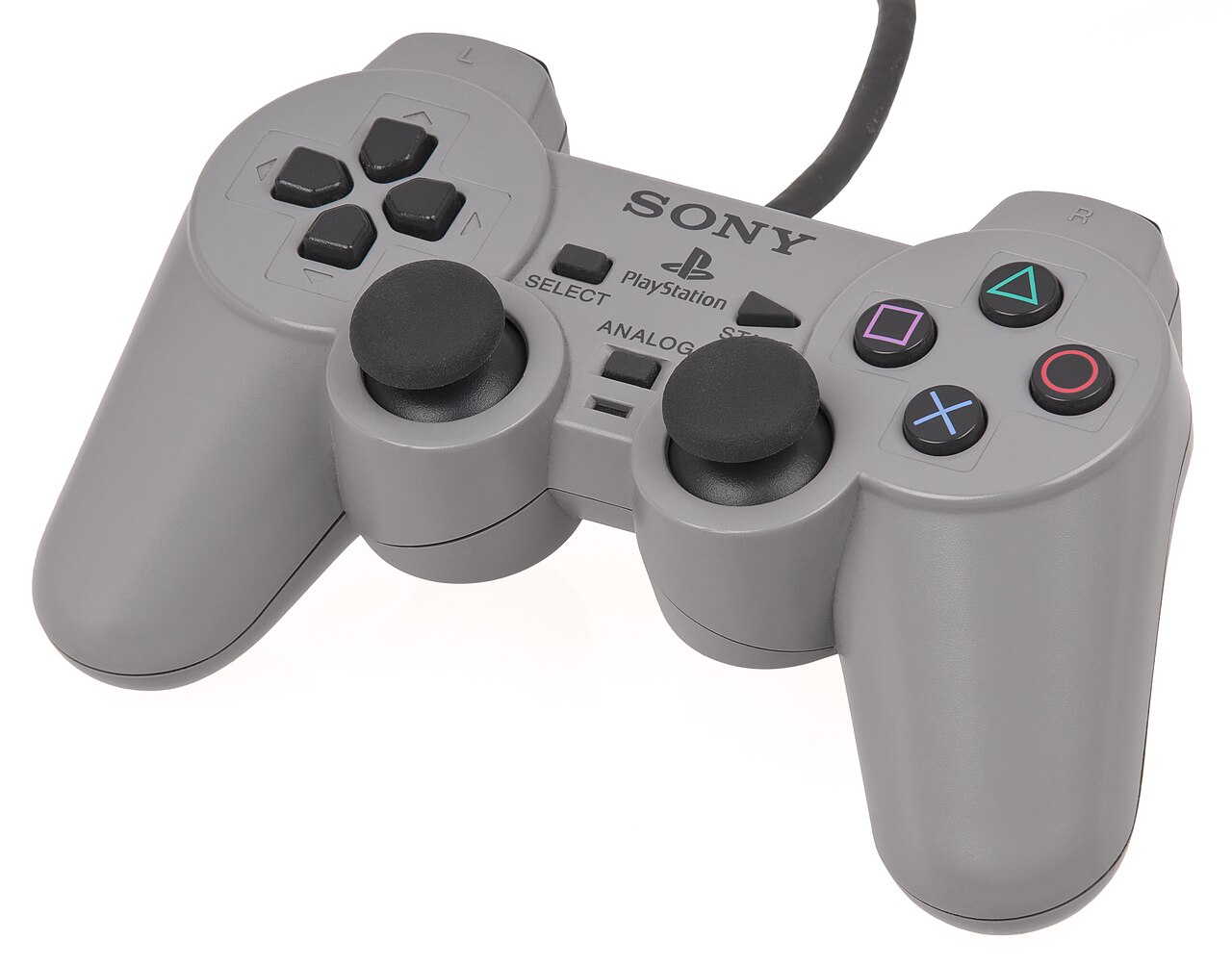
The original PlayStation controller was a quiet landmark: two prongs for your palms, four shoulder buttons, and symbols — triangle, circle, cross, square — that designer Teiyu Goto conceived as meanings rather than letters (a viewpoint, a head, yes and no, a document). Then, in 1997, Sony answered the Nintendo 64’s analogue stick with the DualShock: two sticks, and two rumble motors whose uneven weights made every explosion and engine note a thing you felt in your hands. Games were redesigned around it within a year — Ape Escape (1999) simply refused to work without it — and the layout became the industry’s default grammar. Every mainstream controller since is a descendant of the DualShock’s decisions.
Fifteen Blocks: The Memory Card Economy
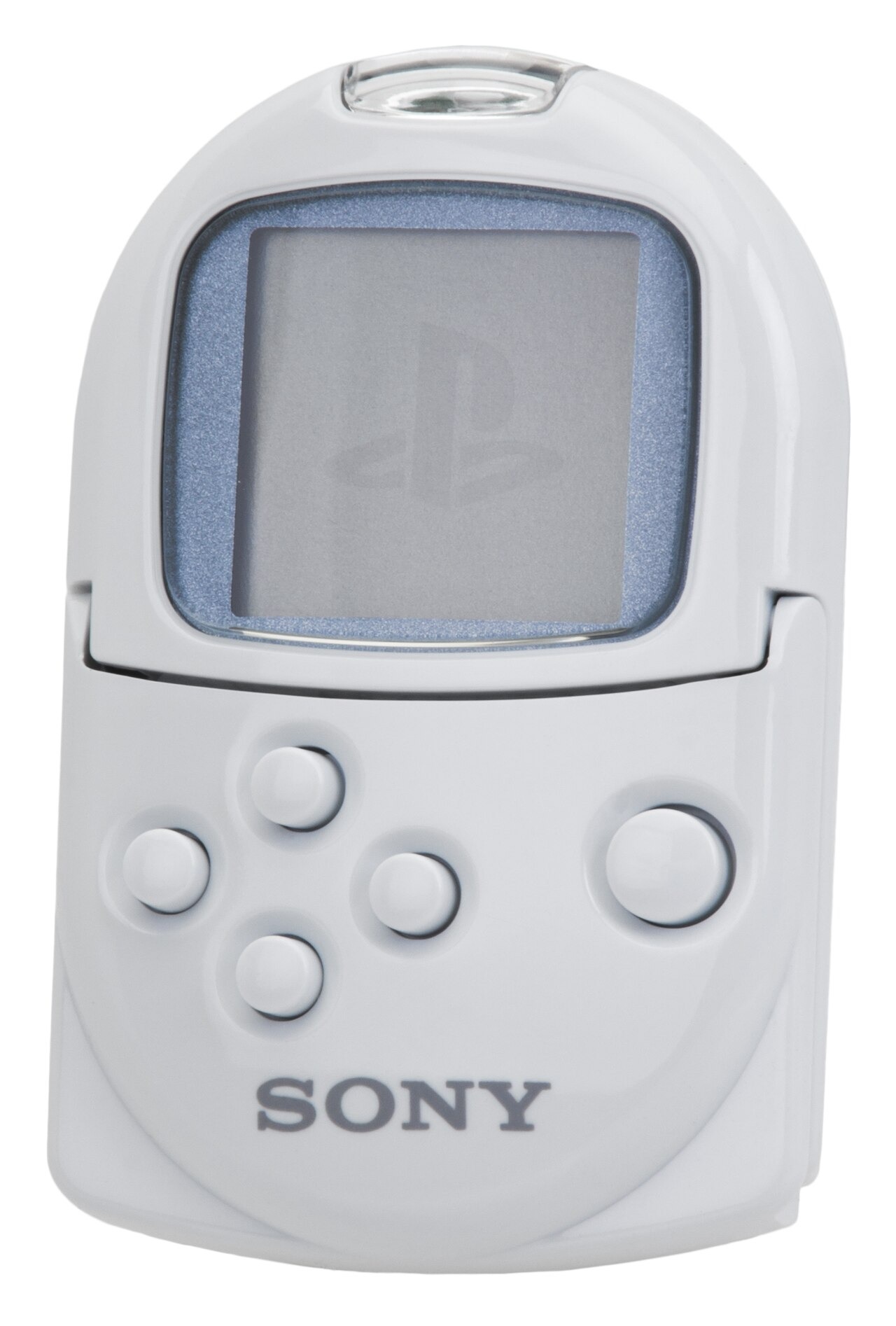
No artefact of the era is more evocative than the memory card: one megabyte of storage, divided into fifteen blocks, slotted above the controller ports. Fifteen blocks was an economy unto itself. A racing game’s ghost data might take one block; a season of football, four; an epic RPG save, one precious slot you would guard like a passport. Renting a game meant renting without your progress. Borrowing a friend’s card meant seeing their entire gaming life laid out in icons — and the PlayStation’s memory-card manager, with its little animated sprites for every save, turned that bookkeeping into a screen players remember as warmly as most games. Japan got the deluxe version of the idea in the PocketStation (1999), a memory card with its own screen and buttons that played mini-games and raised a generation of train-ride diversions. The card taught a mass audience a new idea — that your progress was a portable, personal object — and the cloud saves of today are its invisible grandchildren. Back then, your history as a player lived in a grey slab of plastic in your pocket, fifteen blocks at a time.
The Canon: Defections and Landmarks
Every generation has a moment the ground moves, and for the PlayStation it arrived on 31 January 1997, in Japan: Final Fantasy VII. Squaresoft had made its name on Nintendo’s machines, but cartridge economics — the cost, the capacity, the control — pushed it to Sony’s disc, and the defection was the single loudest signal that the industry’s centre of gravity had shifted. FFVII’s pre-rendered cities and sweeping melodrama made the CD-ROM feel like cinema, sold more than ten million copies, and turned the Japanese RPG into a global mainstream genre overnight. Its successors doubled down: Final Fantasy IX’s storybook return to roots remains a site favourite, and Final Fantasy Tactics built a legacy so durable that its remake became a saga of its own — lost source code and all, a story we’ve followed in detail.
Around that tentpole grew a canon of unusual breadth. Resident Evil (1996) codified survival horror in a mansion of fixed cameras and scarce ink ribbons; its sequels made the PlayStation horror’s home. Tomb Raider (1996) gave the decade an icon in Lara Croft — and made exploration itself the adventure. Metal Gear Solid (1998) was Hideo Kojima’s cinematic manifesto, a stealth game that used the hardware like a stage: memory-card readings, controller-port tricks, codec calls that broke the fourth wall without breaking a sweat. Gran Turismo (1997) did something drier and just as radical — treated the racing game as a library of real cars and real physics, and became the system’s best-seller. Crash Bandicoot fought the mascot war Sony supposedly wasn’t having. Tekken 3, Castlevania: Symphony of the Night, Silent Hill, Tony Hawk’s Pro Skater, Xenogears, Suikoden II, Vagrant Story — the list refuses to shorten, because the library’s depth was the strategy. On a cartridge system, half of these games would never have been greenlit. On cheap discs, nearly anything could.
The Hundred-Million Club of One
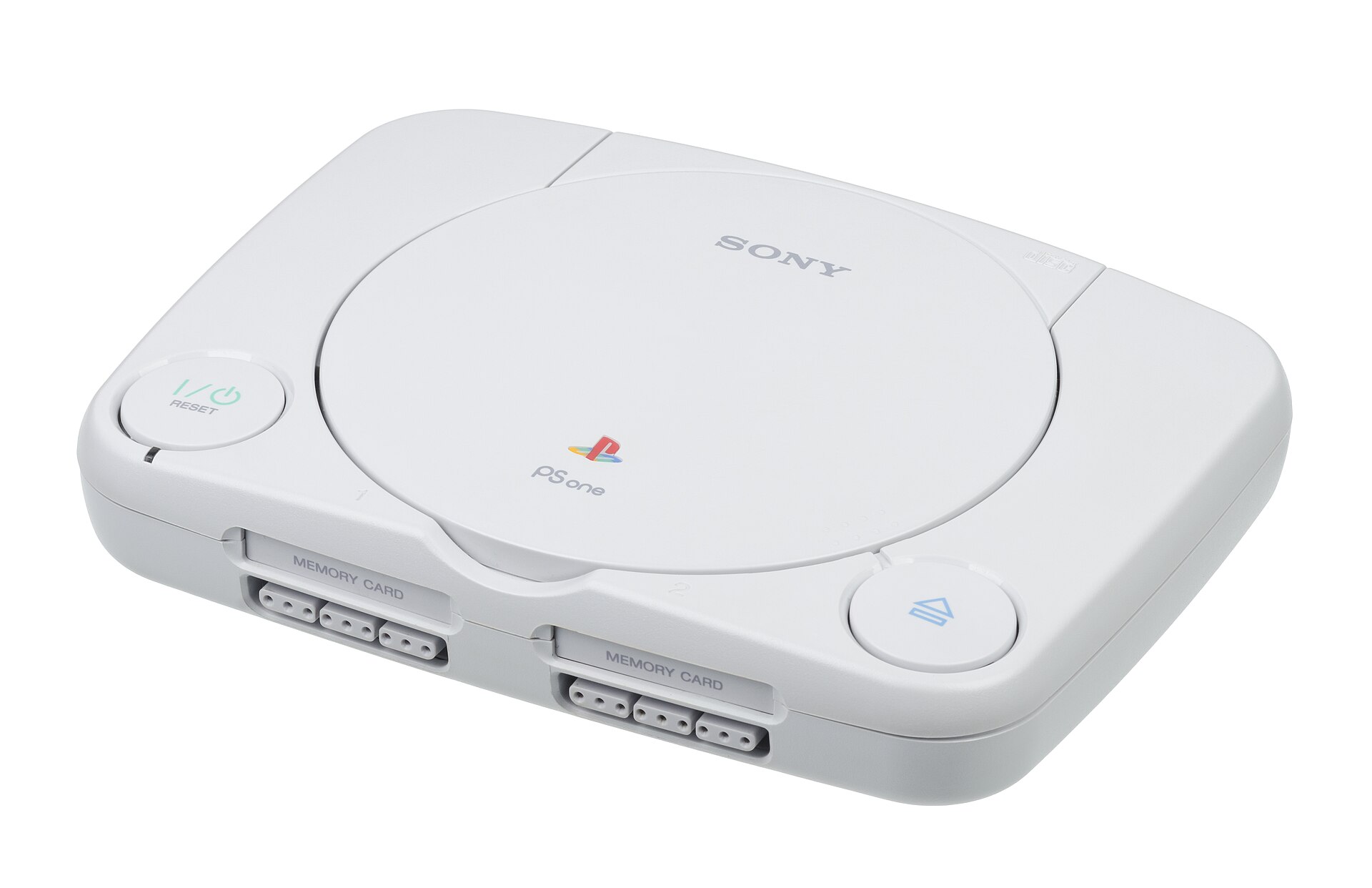
The numbers finished the argument. The PlayStation passed 100 million units in the early 2000s — the first console in history to reach nine figures — and closed at 102.49 million. In 2000, midway through its life and the year of its successor’s launch, Sony shrank it into the PS One, a rounded white pebble of a machine that kept selling to new markets and smaller budgets; in some regions the PS One famously outsold every newer console on the shelf. Production of the original line didn’t fully stop until March 2006 — an eleven-and-a-half-year run, overlapping two of its own successors. The PlayStation 2 arrived in 2000 playing the entire PS1 library, a Kutaragi-era promise kept: the audience’s games were theirs to keep. That backwards-compatibility line runs directly from Yokoi’s rival philosophy — and runs, not coincidentally, through the Game Boy Color story too. The industry learned it from watching both machines refuse to orphan their players.
Grey, Black and Platinum: The Objects Themselves
Part of the PlayStation’s afterlife is purely physical. The original grey shell (the SCPH-1000 through the 9000 series) is the icon, but the line kept mutating: the audiophile-mythologised early models, whose RCA outputs launched a thousand hi-fi forum threads; the Net Yaroze’s matte black, the only official PlayStation that ever looked like it meant business; the translucent and coloured limited editions that turned a mass-market box into a collectable. The Platinum range did for the library what the PS One did for the hardware — the big games, reissued cheap in silver sleeves, until a respectable shelf of classics cost less than one launch title had. And the format had one last domestic trick: the original console played audio CDs as a first-class function, which made it the CD player in a great many teenage bedrooms — a games machine that earned its place in the hi-fi stack years before “media centre” was a phrase. The boot sequence belongs in this section too: that swelling, reverb-drenched chord, composed to sound like a cathedral powering up, may be the most widely recognised piece of sound design Sony ever shipped. Players who haven’t owned the hardware in twenty years can hum it on request.
It is fitting that the machine’s modern life is so hands-on. The library’s size — more than 4,000 titles — means the collecting never really finishes, and the hardware’s quirks (ageing lasers, the famous upside-down console trick for ailing drives) made tinkerers of its owners long before retro maintenance was a hobby with a name. Preservation projects, ODE replacements for tired lasers — like the ArcStation we covered — and a steady trade in memory cards keep the grey box a working machine rather than a shelf ornament. The PlayStation was designed to be manufactured cheaply and sold to everyone; three decades on, that same plainness is why it survives: there are simply so many of them, and so much software, that the ecosystem sustains itself.
What the Grey Box Left Behind
The PlayStation’s legacy is easiest to see in what became normal. Discs, then downloads: physical media as cheap distribution rather than controlled scarcity. Third-party developers as partners to be courted rather than licensees to be managed. Marketing that treated games as culture for adults as well as toys for children. The analogue-stick, rumble-by-default controller. A launch price announced like a punchline. Sony entered the industry because Nintendo humiliated it, and within one generation it was the industry’s centre of gravity — a position built not on a single hit but on thousands of games, most of them strange, many of them cheap, all of them possible because a disc cost pennies.
The library is why this hub exists. The PS1 shelf on this site runs from preservation features to fan translations finally landing in English after twenty-six years — the Milano’s Odd Job Collection story is the PS1 era in miniature: a game the 1990s market couldn’t price, kept alive by fans until the industry caught up. That is the most PlayStation ending imaginable. The machine that won by letting everybody make everything is still, thirty years on, being added to — one recovered game at a time.