
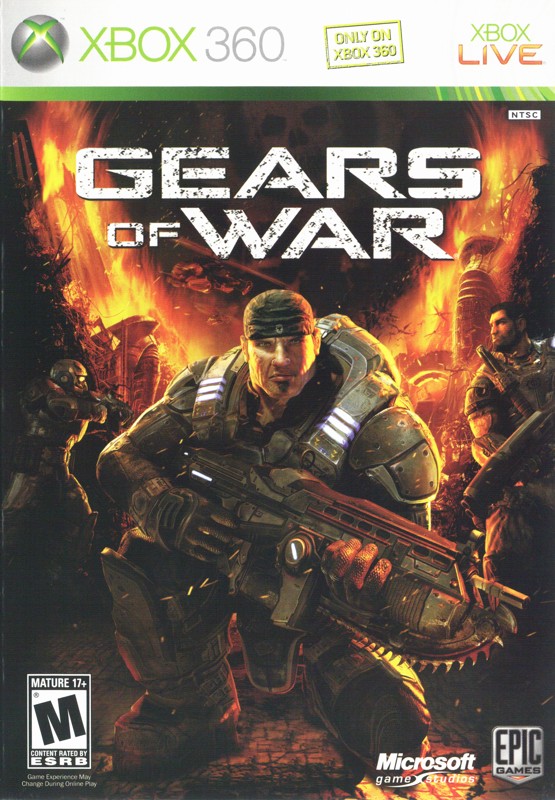
Gears of War · Developer: Epic Games · Publisher: Microsoft Game Studios · Released: November 7, 2006 (Xbox 360) · Genre: Third-person cover shooter
I remember exactly where I was on Emergence Day, and I don’t mean the fictional one. I mean Tuesday, November 7, 2006, standing in a game store on my lunch break, watching a demo loop on a television far better than the one I owned. A soldier the size of a refrigerator door slammed his back into a chunk of broken concrete, and the camera shook like the person holding it was scared. Then he swung around the corner of that concrete and the whole screen seemed to exhale. I’d played shooters my entire life. I had never seen one move like that — heavy, desperate, physical. Twenty years later, I can still feel that first slam into cover in my shoulders.
That is the thing about Gears of War that the anniversary pieces will get right and also somehow miss. Yes, it sold millions — more than three million copies in its first ten weeks, the fastest-selling game of 2006. Yes, it became the flagship that finally made the young Xbox 360 feel like a machine with a future. But the reason we’re still talking about it on its twentieth birthday is simpler and stranger: it changed how every shooter after it felt in your hands. It taught a generation of games to stop running and start hiding.
The night the Xbox 360 grew up
Context matters here. The Xbox 360 had been out for a year when Gears of War arrived, and for all its promise, the machine was still living in the original Xbox’s shadow — which is to say, in Halo‘s shadow. Microsoft needed a second pillar, something that looked like the future rather than a shinier past. Epic Games, a studio better known for the Unreal series and for licensing its engines to everyone else, needed it too. Lead designer Cliff Bleszinski and his team had been building toward this game out of an earlier project, and what they shipped was less a product than an argument: this is what the new hardware is for.
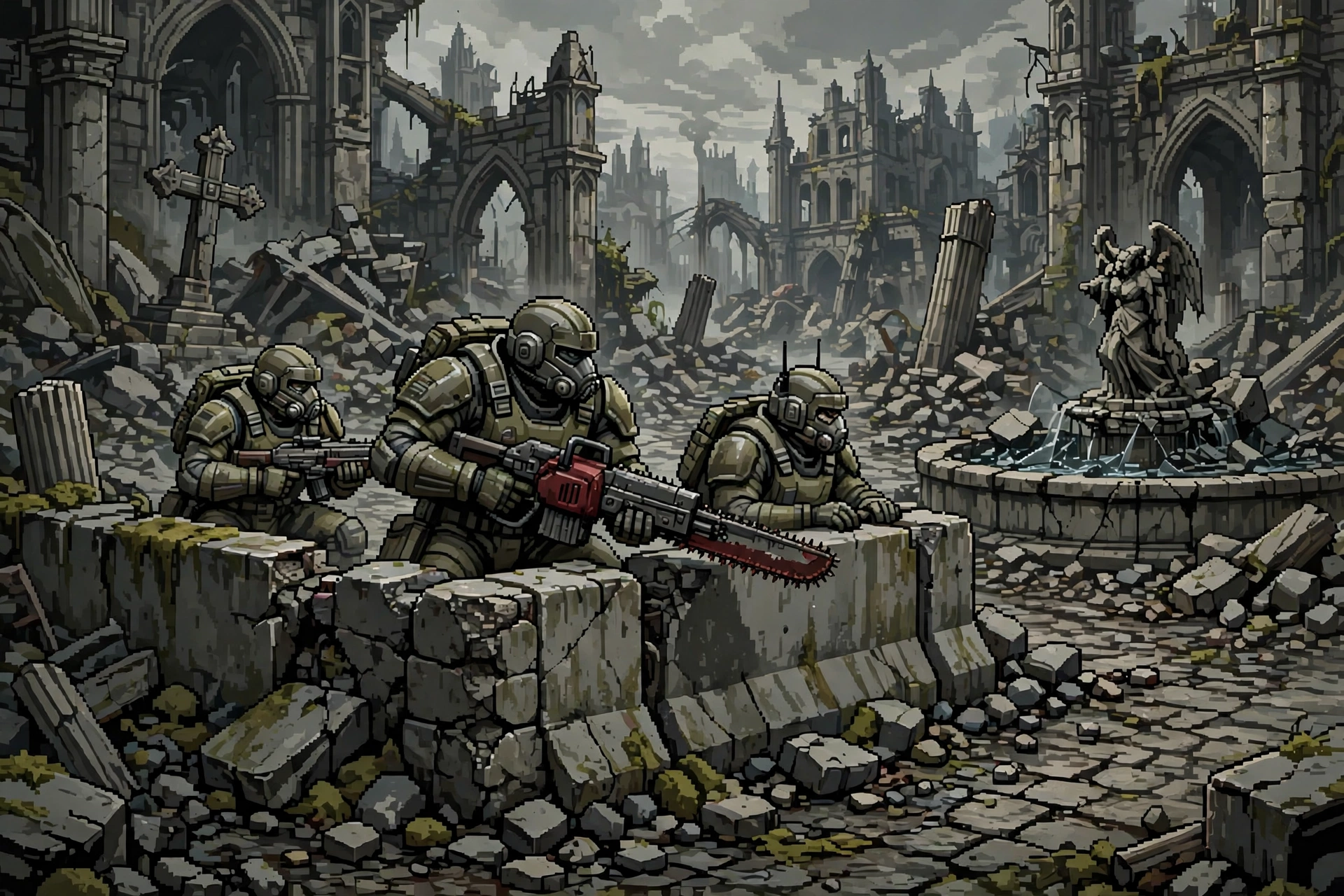
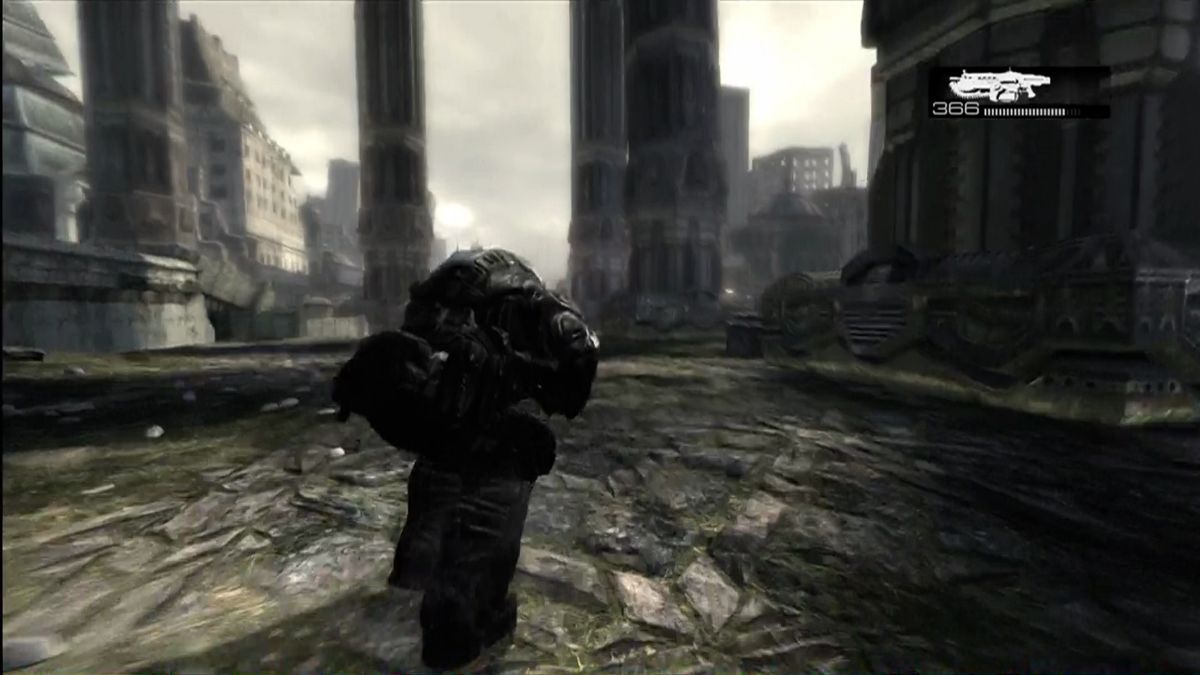
The argument was Unreal Engine 3, and Gears of War was its showroom. Every surface in the game looks carved rather than drawn — cracked marble, rusted iron, stone that has been rained on for a century. The planet Sera is a beautiful place photographed mid-collapse: neoclassical cities, all columns and fountains and grand staircases, being eaten alive from below by the Locust Horde. Epic called the art direction “destroyed beauty,” and twenty years on it remains the game’s most imitated idea and its least duplicated. Plenty of games copied the grey-brown palette. Almost none copied the architecture underneath it, the sense that this world was worth mourning before it was worth defending.
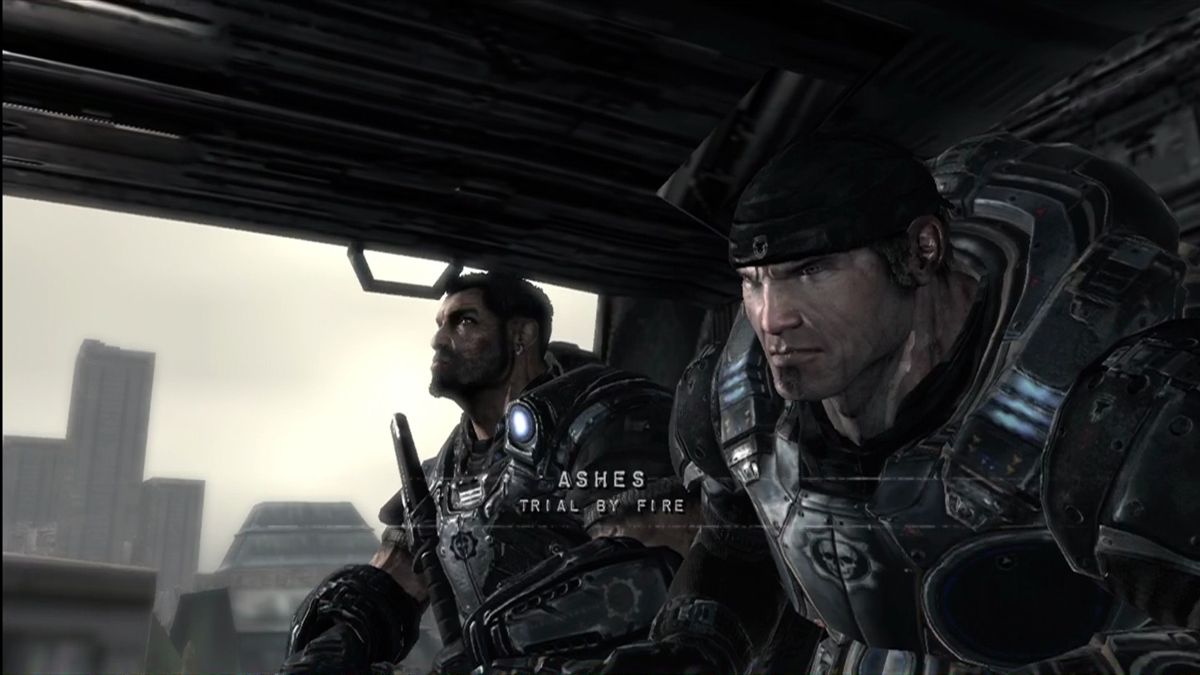
And then there is Marcus Fenix himself, sprung from a prison cell in the game’s opening minutes for reasons the game is in no hurry to explain, handed a rifle and pointed at the end of the world. Marcus is not a quip machine. He’s a tired man doing a job he already failed at once, and the whole campaign — five acts, a train ride I’ll get to — carries that weariness in its bones. Delta Squad banters, sure, and Augustus “Cole Train” Cole brings the noise, but the emotional center is Marcus and Dom, two friends carrying a war and, in Dom’s case, a missing wife. In 2006, shooters did not usually bother. This one bothered just enough.
Gears of War taught shooters to stop and pop
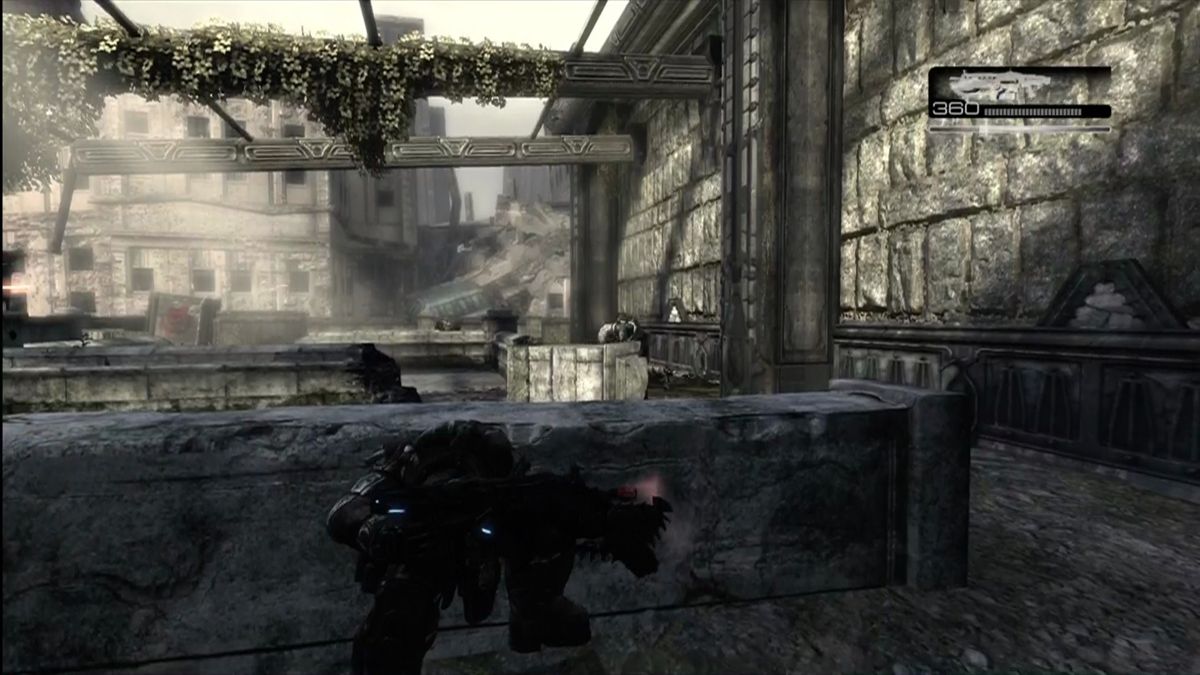
Here is the revolution, and it fits in one button. The A button in Gears of War is a philosophy. Tap it near a wall and Marcus snaps into cover with a thud you can feel through the controller. Hold it and he hauls himself into the famous roadie run — head down, camera dropped to ankle height and wobbling like war footage. Roll it, vault it, slide along it: cover isn’t scenery in this game, it’s the grammar. Bleszinski has never hidden the influences — the over-the-shoulder intimacy of Resident Evil 4, the cover system of Kill Switch, even a dash of Bionic Commando — but nobody had ever fused them into something this complete, this tactile.
“Stop and pop” was the phrase people used at the time, and it undersells it. A Gears firefight is a conversation between pieces of concrete. You are pinned, you are reading the rhythm of enemy fire the way you’d read a pitcher’s windup, and the space between your wall and theirs is the most dangerous real estate in gaming. Lean out too long and the Crimson Omen — that gear-shaped wound that blooms red at the center of your screen — fills up and you’re on your knees, crawling, waiting for a squadmate’s hand. The enemies do it too. The Locust pop up, fire, duck, relocate. Twenty years of shooters have refined this dance, but I go back to the original and I’m always a little startled at how right it already was, first try.
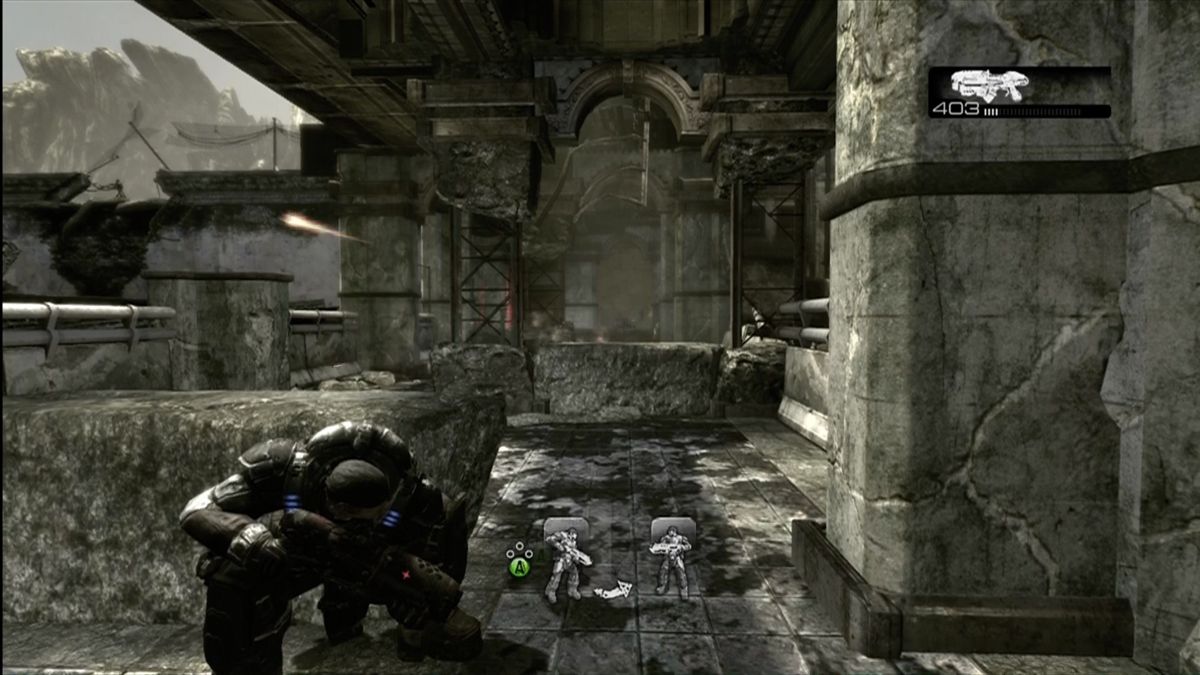
Wrapped around that grammar are a dozen small decisions that became industry defaults so quickly we forget anyone had to invent them. Co-op through the entire campaign, with the second player as Dom — not a sidekick mode, the actual campaign, drop-in and split-screen. A health system communicated by an icon instead of a bar. And the active reload: that little sliding meter that turned the dead air of reloading into a risk you took on purpose. Nail the timing and your fresh magazine hits harder; botch it and your gun jams at the worst possible moment. I have played hundreds of shooters since 2006 and I still, reflexively, watch for that meter’s sweet spot in games that don’t have one. That’s not nostalgia. That’s a mechanic tattooed on the medium.
A chainsaw on a rifle, and other acts of faith
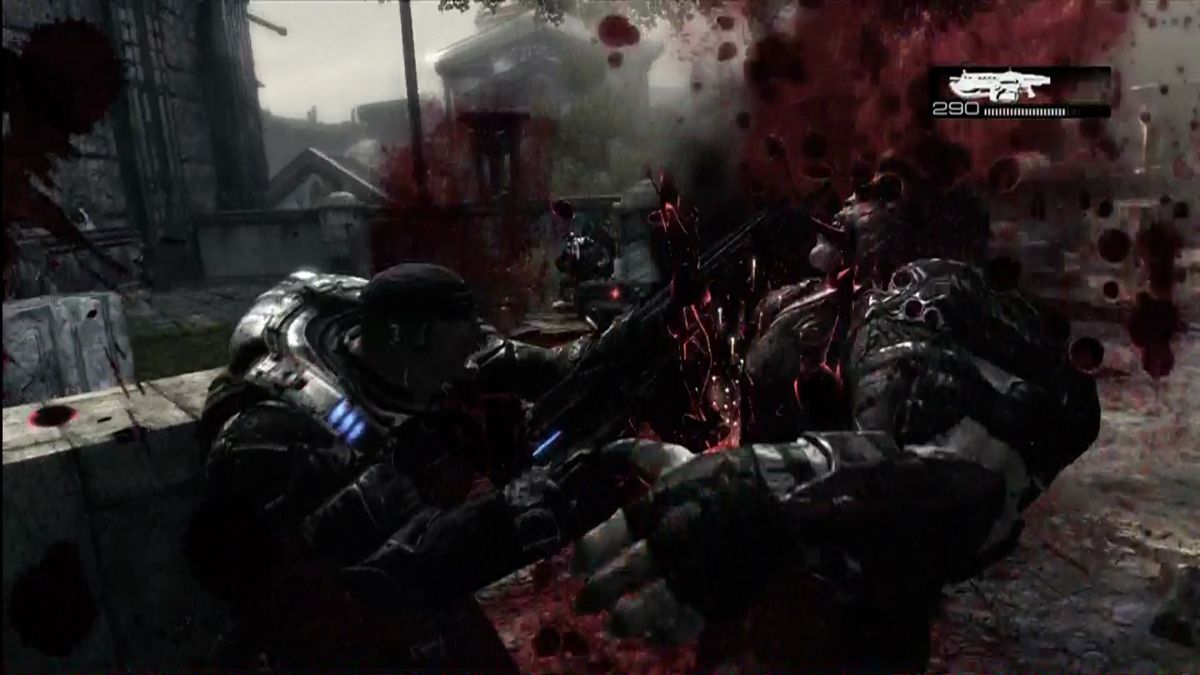
We have to talk about the Lancer, because the Lancer is the whole game in one object. An assault rifle with a chainsaw bayonet sounds like something a fourteen-year-old sketches in a notebook margin — and I say that with love, because I was that fourteen-year-old, just with different hardware. In practice the chainsaw is a design argument: in a game about holding ground at range, it rewards the one reckless dash, the moment you break cover and close the distance. Revving it takes a beat. That beat is an eternity. And when it connects, the game does not flinch. Gears of War was a genuinely violent game in 2006 and it remains one now, but the violence has a function: it’s the exclamation point at the end of cover’s long, careful sentence.
The rest of the arsenal earns its keep the same way. The Torque Bow, whose explosive bolts stick and tick and make enemies scatter from cover they’ve held all fight. The Hammer of Dawn, a satellite laser you can only call down under open sky, which turns the weather into a level-design rule. And a finale — no spoilers that twenty years hasn’t already worn smooth, but it involves a train, a bomb, and General RAAM, still one of the great brick-wall boss fights — that sends the whole thing out at full sprint. The campaign is short, maybe eight hours, and I have come to see that as discipline rather than deficiency. It ends before the grammar gets old.
What hasn’t aged, honestly
Anniversary pieces lie by omission, so here is the other side of the ledger. The story, as opposed to the storytelling, is thin to the point of transparency: you will finish this game knowing almost nothing about why Marcus was in that cell, and the sequels had to spend real effort retroactively building the man. The Locust, for all their wonderful design — hulking Drones, shrieking Wretches, the blind, sniffing Berserker who still stars in my personal hall of fame — are not tacticians; sit in good cover and their habit of popping up in rhythm can turn late fights into a shooting gallery. The palette that looked like courage in 2006 launched a decade of shooters shot through dishwater, and going back, the sequels’ broader color is a quiet rebuke. And the vehicle section. There is always a vehicle section. It’s short. Forgive it.
None of that dents the core. What surprises me most, replaying the original — not the 2015 Ultimate Edition, not 2025’s Gears of War: Reloaded, fine as both are — is how confident the 2006 game still feels at 30 frames a second, under all that grey. The remasters smooth it, brighten it, hand it to new audiences (Reloaded even carried the series onto PlayStation 5, a sentence that would have gotten you laughed out of a forum in 2006). Good. Let everyone play it. But the original’s weight is in the original: the slam, the shake, the half-second of terror between walls.
The verdict, twenty years on
Some classics are museums. You visit them with respect, you admire the craft behind glass, and you leave grateful and faintly relieved it’s over. Gears of War is not a museum. It is a load-bearing wall. Take it out of the timeline and the third-person shooter as we know it — the cover, the co-op campaign, the reload as a skill, the squad banter over the sound of distant artillery — collapses into some other shape we never got to see. Every time a modern hero’s back magnetizes to a waist-high wall, a small royalty of the imagination gets paid to a game about four very large men in a very broken city, holding a line that was always going to break.
Gears of War didn’t just define the Xbox 360 — it taught an entire genre to take cover, and twenty years later the genre has never stood back up. A landmark, and still a joy to play.
So happy birthday, Emergence Day. I’ll be spending it the way I spent the first one: back against the concrete, listening for the Locust, watching that little meter slide — and hitting the button at exactly the right moment. Some skills you never lose. Some games you never really finish. This is both.