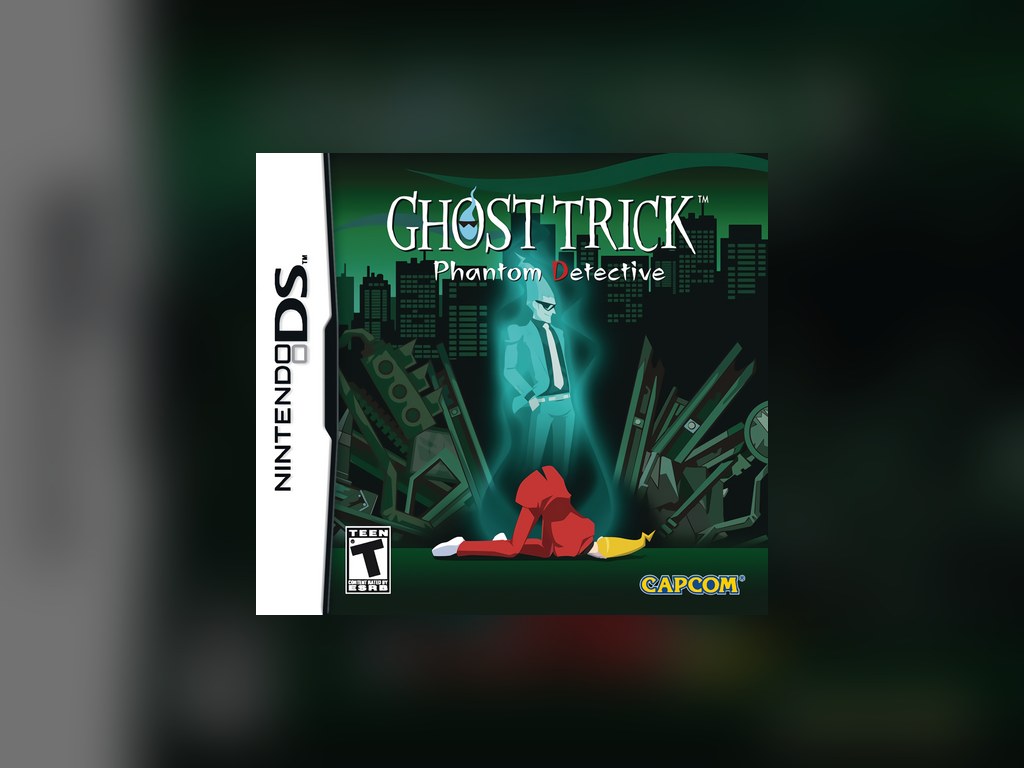
At a glance: Ghost Trick: Phantom Detective · Nintendo DS · Capcom, 2011 · Adventure / puzzle · Score: 9.5/10
Ghost Trick: Phantom Detective, released in Japan in 2010 and the West in 2011, opens with its hero already dead — shot in a junkyard, his soul loose from his body, his memory gone. A talking desk lamp explains the rules: ghosts may possess and manipulate objects, the dead have until dawn before they vanish forever, and one other soul tonight — a red-haired detective named Lynne — is marked to die. Shu Takumi, creator of Ace Attorney, built from those rules the finest single story in the Nintendo DS library: a supernatural mystery of interlocking timelines, impossible rescues and revelations that recontextualise everything, wrapped in animation so fluid it looks like the future. It is, by a distance, the best game most DS owners never played.
You are Sissel, and your amnesia is the plot’s engine: who killed you, why does your body not look like you remember, and what is the meteorite-tempered conspiracy connecting a ten-year-old kidnapping, a submarine, a park shooting and a very good dog? The structure is a single night in eighteen chapters, each a small stage — a junkyard, a prison, a chicken kitchen, a luxury liner — where someone is about to die and Sissel, shifting between the land of the living and the ghost world, must rewind four minutes before their death and rewrite it. Every chapter advances both a rescue and the mystery, and the two threads braid tighter until the final hours become almost unbearably propulsive.

Rube Goldberg, the grim reaper
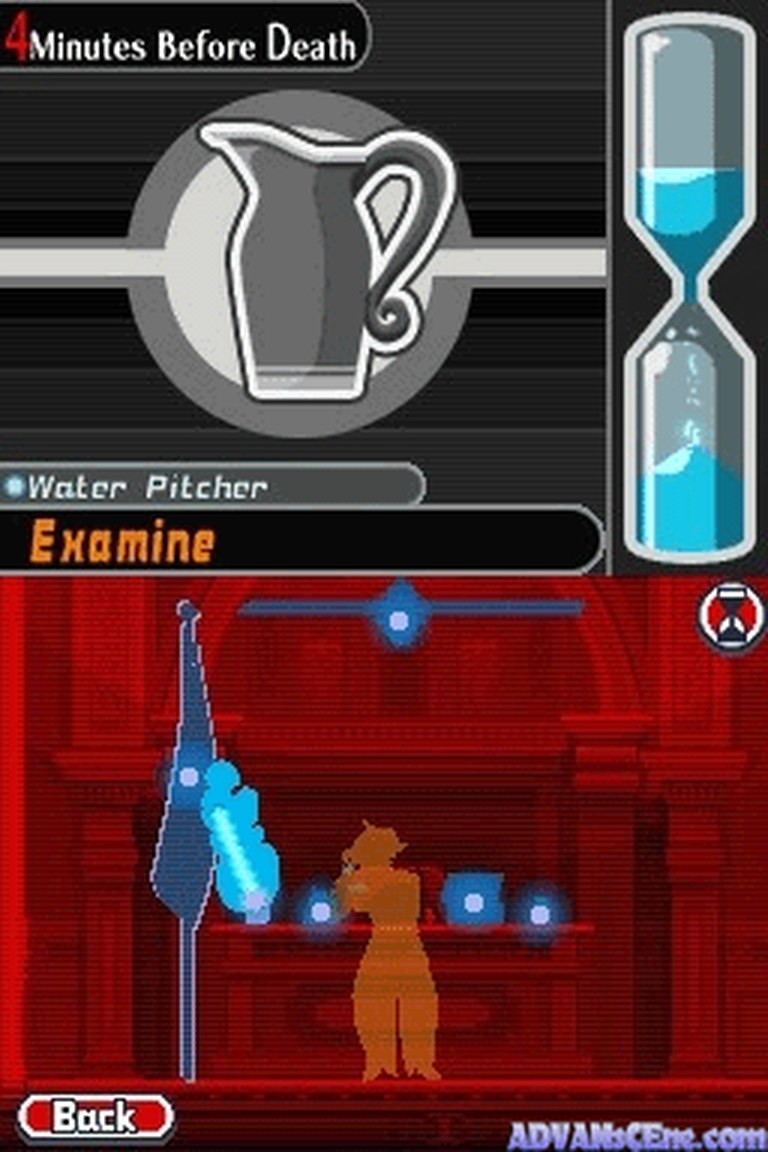
The gameplay is a haunted Rube Goldberg machine. In the ghost world, time stops and Sissel’s soul hops between objects’ cores within reach; back in the living world, each object has a trick — an umbrella opens, a fan spins, a tyre rolls, a telephone rings — and by chaining possessions and triggers, you build causal chain reactions: knock the umbrella to spill the water to short the light to startle the guard to drop the gun one second too late. Deaths in this game are baroque slapstick tragedies — a sniper’s bullet, a falling chicken, a runaway wrecking ball — and undoing them is pure puzzle joy, each solution a little machine of cause and effect that you authored.
The design is merciful in exactly the right places: checkpoints are generous, the four-minutes-before-death rewinds are unlimited, and a hint-flavoured internal monologue (Sissel thinks in jokes even when the player is stuck) nudges without solving. Later chapters layer in a second ghost with different powers — Missile, the bravest Pomeranian in fiction, whose ability to swap same-shaped objects turns the geometry of every puzzle inside out. The difficulty stays honest throughout: hard enough to make each rescue feel earned, never hard enough to stall the story that is the game’s true engine.
Animation as acting
Nothing on the DS moves like Ghost Trick. Its characters — animated in high-resolution rotoscope-smooth motion — don’t walk, they perform: a detective dances with his headphones, an inspector strikes poses mid-sentence, a hitman folds himself into furniture. Every sprite is a silent-film performance, and the writing matches it beat for beat: this is the funniest game in the library and, by its final chapters, one of the most moving, with a closing revelation that re-frames the entire night — and re-frames Sissel himself — in a way that has reduced a generation of players to tears over a desk lamp and a dog.
Ghost Trick’s puzzles are Rube Goldberg machines built to un-murder people — and its story is the best the DS ever told.
There are no meaningful criticisms to file. It is linear, as it must be; it is over in twelve hours, as it should be; its late arrival — 2011, as the 3DS launched — doomed it commercially, which is a tragedy of timing rather than quality. Everything in it, from the phone-tapping travel system to the way the ghost world’s blue stillness contrasts the living world’s warmth, is in perfect service of one night, one mystery, one dog.
The night, examined
The plotting withstands forensic re-examination, which for a mystery is the ultimate compliment. Every apparently decorative detail of the first hours — a red coat, a desk lamp’s manners, a dog’s enthusiasm, the specific wording of a phone call — is load-bearing by the finale, and the game’s celebrated final revelation does not merely surprise: it retroactively explains the mechanics themselves, why Sissel’s powers work as they do, why the night has the shape it has. Takumi has said the story was plotted as a single interlocking mechanism, and it shows in the way chapters hand their objects and characters forward like relay batons — the junkyard’s umbrella matters on the liner; the prison’s guard matters in the park.
It also bears repeating how funny the game is en route to breaking your heart. The dialogue — a masterclass in comic timing delivered through portrait expressions and those extraordinary animations — gives even its villains charm and its minor characters catchphrases, so that the late-night convergence of the whole cast feels like a company curtain call you desperately do not want to end. That Ghost Trick sold poorly on release is now part of its legend: the definitive ‘best game you haven’t played’ of the DS generation, passed between friends like a secret. Consider this review the secret, passed on.
Availability, finally, is kinder than it was: the game’s reputation has carried it to modern re-releases, but the DS original — dual-screen ghost world and all — remains the version its devotees describe with the most affection, and the cartridge has become a cornerstone of serious DS collections for exactly the reasons this review has enumerated. Whichever edition you choose, observe the one rule its fans all enforce: play it unspoiled. The night is short, the lamp is waiting, and dawn comes for everyone. Make it count.

Playing it today
A final, practical mercy: Ghost Trick is a perfect handheld game in structure as well as spirit. Its chapters are fifteen-minute clockwork toys, its save discipline is kind, and its story — the thing you are here for — never once wastes a scene. Play it in the dark, in a handful of sittings, and resist every wiki. The dead have only one night, and Sissel’s is the best night the DS ever hosted. When the dawn comes, you will understand why its players press this cartridge on strangers like a sacred trust. Consider yourself pressed.
Verdict
Ghost Trick is a masterpiece — the word is used carefully here — and the single strongest argument that the DS library still holds undiscovered treasure. Takumi’s plotting, the animation team’s craft and a puzzle system like no other combine into something that feels less like a game you finish than a night you lived. If you own a DS and have not played it, this is your next cartridge. Objection overruled; there is no appeal.