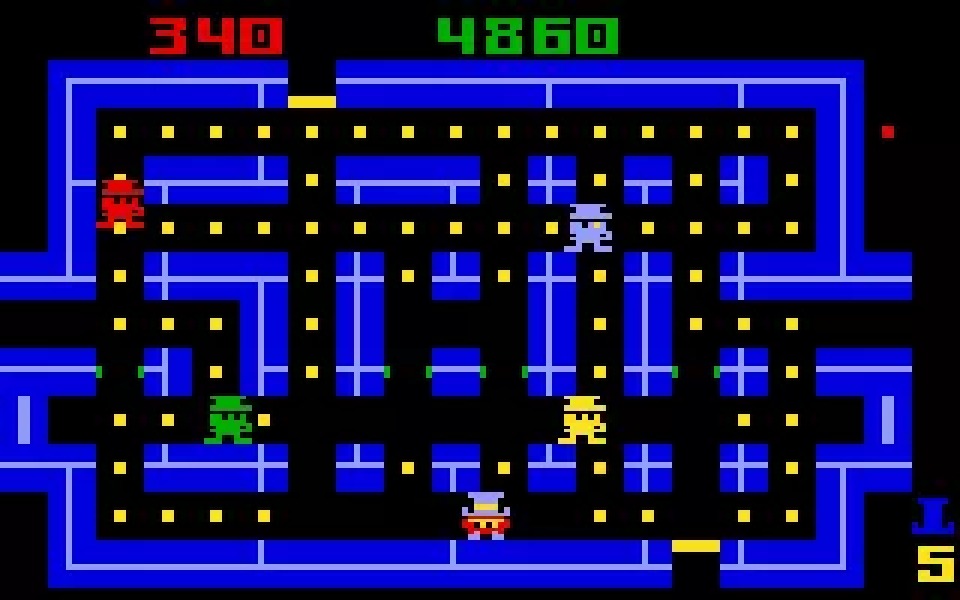
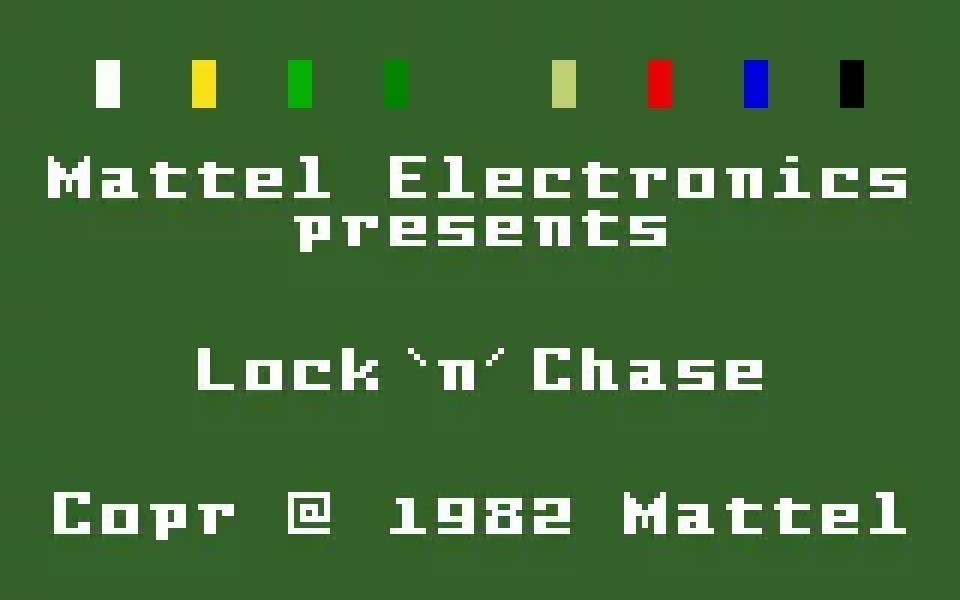
At a glance: Lock ‘n’ Chase · Intellivision · Mattel Electronics / Data East, 1982 · Maze chase · Score: 8.0/10
In 1982 every publisher on earth wanted a Pac-Man, and most of them settled for a photocopy. Mattel, licensing Data East’s arcade game Lock ‘n’ Chase, did something smarter: it published the one maze-chaser with a genuinely different idea at its centre. You are not a hungry circle. You are a robber — a cheerful little thief in a bank vault full of gold coins — and the four policemen hunting you are not ghosts but cops, in a maze whose doors you can slam and lock behind you as you run. That single mechanic, the lockable door, turns Pac-Man’s rhythm inside out: this is a chase game where you don’t just flee the maze, you edit it, second by second, to survive.
The door is the game
The vault is a single-screen maze of corridors studded with coins. Clear the coins to finish the level, grab the bonus treasures that appear in the centre for extra points, and avoid the four cops — colour-coded, increasingly quick, and smarter than they first appear. Scattered through the maze are doors, and as you pass through one it closes behind you; cops reaching a closed door must stop and open it, losing precious seconds. You can have only so many doors shut at once — the game’s delicate balancing rule — so locking becomes a resource to spend at the exact moment a pursuit needs breaking. Every Intellivision player who grew up with this cartridge has a story about the perfect lock: the cop a pixel behind, the door slamming, the breath out. It remains one of the most satisfying single mechanics in any maze game of the period, and it gives Lock ‘n’ Chase a tactical layer Pac-Man never had — you are not merely reading the maze, you are rewriting it against four opponents who are reading you.
The scoring reinforces the heist fantasy. Coins tick up steadily, but the real money is in the centre treasures and in finishing levels with style, and the escalating speed of the police across levels is honestly tuned: early vaults teach routing, later ones demand door discipline and nerves. The cops’ behaviour is the right kind of simple — relentless pursuit with enough variation at junctions to punish autopilot — so deaths feel earned by the hunter or deserved by the hunted, rarely cheap.
A first-rate conversion
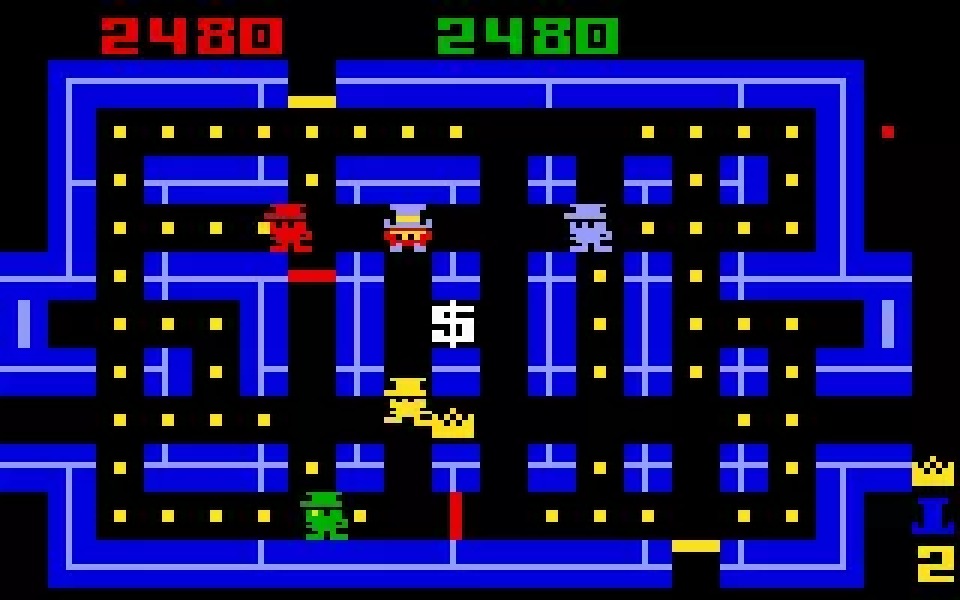
Data East’s arcade original was a modest hit rather than a phenomenon, which makes the quality of Mattel’s conversion the more impressive: somebody cared. The Intellivision version, programmed by Julie Hoshizaki, keeps the arcade’s layout, speed and structure essentially intact, and renders them in the system’s crispest maze-game style: deep blue corridors, bright coins, chunky character sprites with real charm — the robber’s grin, the cops’ helmets. The vault reads instantly at speed, which is the only graphical test a maze game must pass, and it passes without flicker or muddle. Sound is a lean accompaniment of sirens, pickups and the clunk of doors — that clunk again, the most important sound in the game, perfectly weighted.
Control is the eternal Intellivision question, and here the disc acquits itself well. Maze games live or die on cornering, and Lock ‘n’ Chase’s grid movement resolves the disc’s sixteen directions into clean four-way travel with none of the slop that plagued lesser conversions. The robber turns when you intend, stops when you intend, and in a game where a mistimed junction is a arrest, that precision is the difference between a good port and a frustrating one. This is one of the good ones — routinely named among the system’s best arcade conversions, and the maze game Intellivision owners reached for when Pac-Man itself (which arrived on the system later, through Atarisoft) felt a little too familiar.
The long game

What keeps Lock ‘n’ Chase in rotation is the purity of its loop and the stories the doors generate. Levels are short, failure is fast, and improvement is visible: you can feel your routing get cleaner and your locks get later and braver across a single evening. Two-player alternating play turns it into a natural household league game, because scores compare cleanly and every run is a small heist film with a different ending. The cartridge also has that underrated virtue, portability of rules: hand it to a total newcomer and they understand everything except the doors in five seconds — and the doors in thirty. Teaching depth that arrives in layers is the signature of the best arcade design of the period, and this conversion preserved all of it.
Set against its famous rival, Lock ‘n’ Chase is the thinking player’s maze game: less about pattern memorisation than about improvisation under pursuit. Pac-Man is the greater cultural monument, but minute for minute, this little bank job gives it a real run for its money — which is, appropriately, exactly what the robber is doing.
The arcade original, and what Mattel changed
Lock ‘n’ Chase began life as a Data East arcade cabinet — the company behind BurgerTime, and Mattel’s licensing relationship with Data East quietly gave the Intellivision two of its finest arcade conversions. The arcade Lock ‘n’ Chase was a connoisseur’s game rather than a headline act: it never had Pac-Man’s queues, which meant the home version arrived without the burden of impossible expectations and could simply be excellent. Mattel’s conversion is faithful in the ways that matter — maze, door logic, enemy behaviour, the heist’s whole rhythm — and the differences are the honest ones of hardware: the Intellivision’s palette makes the vault moodier than the arcade’s, its sprites chunkier, its sound leaner. Nothing in the translation reverses a design decision. That restraint is rarer than it sounds in 1982, when home conversions routinely redesigned games around hardware limitations and called the result close enough.
The cartridge also sits at an interesting crossroads in Mattel’s story. By 1982 the Blue Sky Rangers — the in-house programmers whose sports and strategy games had defined the console — were being joined by licensed arcade work of this calibre, and Lock ‘n’ Chase is evidence the company’s standards travelled: whatever the source, a Mattel cartridge was expected to control precisely, read clearly and respect the player’s intelligence. This one does all three while a cartoon robber outruns four policemen. Versatility was the house style.
The verdict
Lock ‘n’ Chase is a top-tier maze game hiding in a famous game’s shadow: a faithful Data East conversion built around one brilliant mechanic, tuned honestly and controlled precisely. It doesn’t dethrone Pac-Man as an icon, but as a game to actually play on the Intellivision — to learn, master and pass back and forth across a sofa — it earns its place on any essential shelf. Slam the door. Take the money. Run.
If there is a single cartridge to hand a Pac-Man devotee who has never touched an Intellivision, it is this one: the rules are cousins, the pleasures are different, and the conversion usually takes about ninety seconds — roughly one vault, one chase, and one perfectly timed door.
Score: 8.0/10