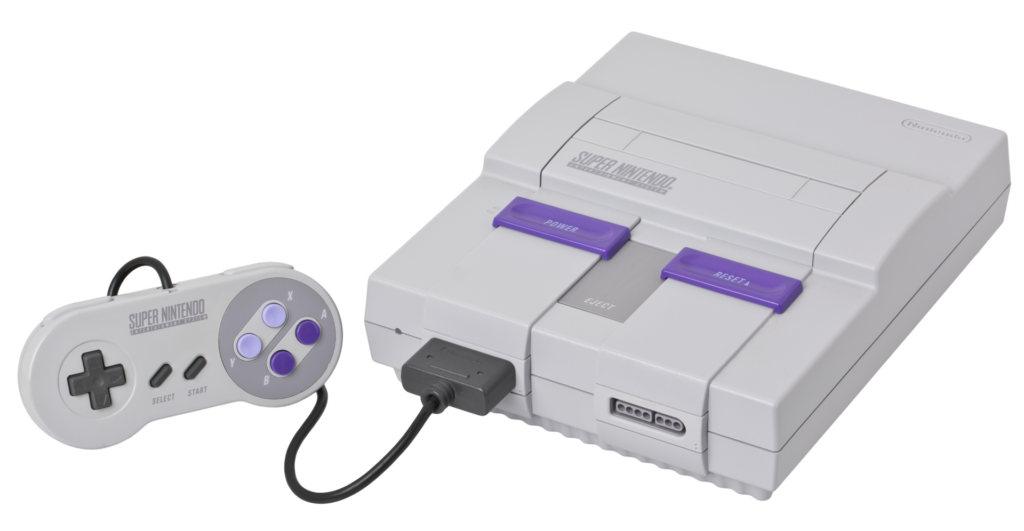
The Super Nintendo arrived late, underpowered on paper, and fighting a war it was losing – and it won anyway, on the strength of the greatest software library of the 16-bit age. It is the console of Mode 7 and the Super FX chip, of the RPG golden age, of Donkey Kong Country’s impossible graphics and a sound chip built by the man who would use the knowledge to destroy Nintendo’s empire from inside Sony. The SNES story contains the whole decade in miniature: the war with the Genesis, the betrayal that created the PlayStation, the censorship battles, and a library so deep that the industry is still remaking it. This is the complete story of the purple-grey masterpiece.
The Champion’s Dilemma: 1990-1991
Nintendo launched the Super Famicom in Japan in November 1990 into pandemonium – initial shipments sold out in hours, and the launch trio (Super Mario World, F-Zero, Pilotwings) announced the machine’s signature tricks immediately: Mode 7’s rotating, scaling ground planes turned racing and flight into theater. The American SNES followed in August 1991 at $199, redesigned into the angular purple-accented slab the U.S. remembers (Lance Barr again, the grooves on top famously explained as a place to set your drink). But the champion’s dilemma was real: the NES still printed money, third parties had to be migrated without mutiny, and Sega’s Genesis, two years into its loud insurgency, owned the American teenager. Worse, the spec sheet betrayed the faithful: the SNES’s Ricoh CPU ran at a leisurely 3.58 MHz – slower on paper than the Genesis’s 68000 – and early games showed it, shuddering with slowdown when the screen filled. What the sheet didn’t show was the rest of the design: 128K of RAM, 32,768 colours, transparency and Mode 7, enhancement chips that could live inside cartridges, and a sound system that would humiliate everything else in the decade. Even the famous slowdown became, in the shooters that suffered it worst, an accidental feature – Gradius III’s bullet-hell stutters played like bullet-time a decade early, and a generation’s reflexes were trained at the machine’s breathing pace rather than its paper speed.
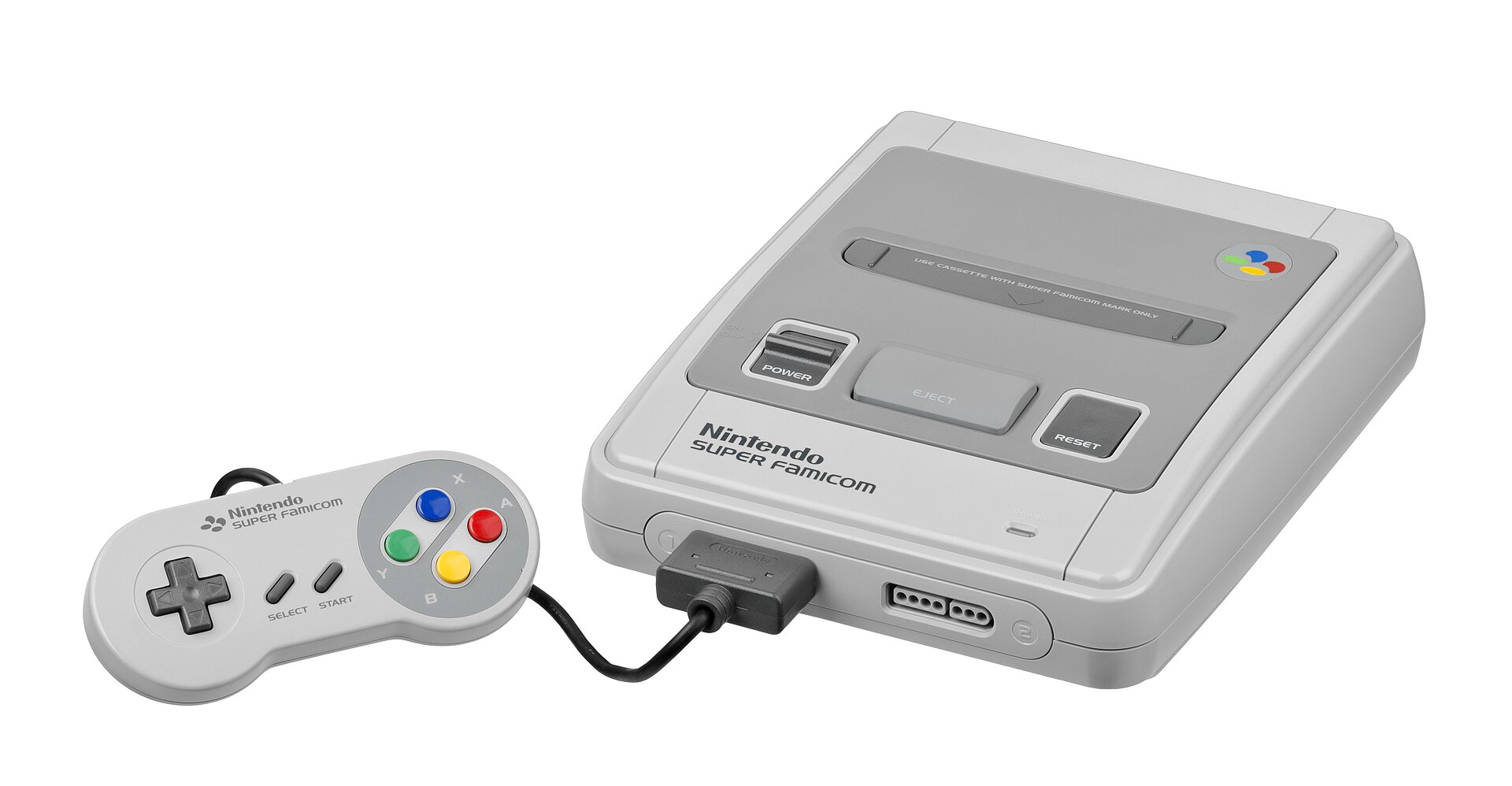
Launch Nights: Trucks at Midnight
The Super Famicom’s Japanese launch on November 21, 1990, remains the template for console mania. Nintendo shipped an initial 300,000 units against orders several times that; the machines sold out in hours, queues became news footage, and Nintendo – in the era’s most repeated legend, and one the company has never quite denied – arranged deliveries in the dead of night amid fears that organized crime would hijack the trucks. The American launch the following August was quieter by design and by competition, but the software did the shouting: Super Mario World, at 9/10s across the press, was the pack-in argument that the champion’s crown had simply changed shape, and F-Zero and Pilotwings demonstrated Mode 7 so fluently that Sega’s speed advantage suddenly looked like a one-trick repertoire. The honest problem was the installed-base trap: NES owners had to be convinced to upgrade while the old machine still dominated their shelves, and Nintendo’s own dual-support years (Zelda and Mario games still arriving on the 8-bit box) made the SNES feel, for its first eighteen months, like a premium tier rather than a succession. The war’s historians date the turn to 1992-93: Street Fighter II’s homecoming, Mario Kart’s invention of the kart racer, and a price war that dragged both 16-bit machines under $100 in turn. By the time Donkey Kong Country landed, the champion’s dilemma had inverted – the SNES had become the safe holiday default again, the thing grandparents could buy without a briefing. Empires fall. This one redecorated.
The Sound of Betrayal: Kutaragi’s Chip
The SNES’s audio was designed by Sony’s Ken Kutaragi, who had watched his young daughter play a Famicom, found its sound wanting, and cold-pitched Nintendo a proper audio processor. The SPC700-based design gave the SNES eight channels of sampled sound – orchestral swells, real reverb, the moody soundscapes of a hundred classics – and gave Kutaragi a front-row education in the games business. The sequel is the industry’s founding treachery, and this site has followed its archaeology for years: Nintendo announced a CD-ROM partnership with Sony at CES in June 1991 – the “Play Station” – and, humiliated by the contract’s terms, announced a rival Philips deal the very next day. Sony’s revenge took four years to ship and was called the PlayStation. The prototypes of the road not taken still surface: read our account of the SNES PlayStation prototype found in an attic, the machine that would have changed everything and instead explains everything. The SNES won its war against Sega while incubating, inside its own sound hardware, the rival that would end Nintendo’s dominance of home consoles for a decade. History has a sense of humor and it is dark. It also has a long memory: the chip in the SNES taught Sony what games were worth, and Sony has been collecting the tuition, with interest, from the entire industry ever since.
The Cartridge That Upgrades Itself
The SNES’s most radical idea was that the console was unfinished on purpose. Nintendo designed the cartridge slot as an expansion bus, and for a decade developers shipped hardware inside their games. The DSP-1 math chip flew Pilotwings and split Mario Kart’s screen. The Super FX – a RISC processor running inside the cartridge, born from Argonaut’s work with Jez San – rendered Star Fox’s polygons in 1993 and, in its FX2 form, painted Yoshi’s Island’s storybook squash-and-stretch. The SA1, essentially a second, faster CPU on the cart, powered Super Mario RPG and Kirby Super Star. Capcom’s Cx4 choreographed Mega Man X2 and X3’s wireframes; the S-DD1 and SPC7110 squeezed graphics past the bus’s limits for Star Ocean and Tales of Phantasia, games that arrive on the SNES like dispatches from a bigger machine. No rival platform did this – the Genesis answered with the SVP chip in exactly one game and a mushroom of add-on hardware instead. The enhancement-chip strategy made every SNES release a potential hardware launch, and it is why the library’s technical range, from Mode 7 racers to pseudo-N64 storybooks, is so absurdly wide. It also made the platform an emulator-maker’s nightmare for thirty years: to emulate the SNES is to emulate a dozen machines that lived inside its cartridges.
The War Years: Speed, Blood and Silicon Graphics
The 16-bit war’s middle years were an arms race fought with cartridges. Sega had speed and attitude; Nintendo answered with depth, colour, and – increasingly – custom silicon. The Super FX chip (1993) put real 3D polygons inside Star Fox. Capcom’s CPS heritage made Street Fighter II (1992) the home event of the decade, and its sequels annualized the duel. The censorship war peaked and broke here: Mortal Kombat’s bloodless SNES debut (1993) cost Nintendo dearly against the Genesis version, and by Mortal Kombat II (1994) Nintendo quietly let the blood flow – the ratings era had made principle negotiable. And in November 1994, with the 32-bit future already on shelves, Nintendo landed the war’s most famous counterpunch: Donkey Kong Country, built by Britain’s Rare on Silicon Graphics workstations, its pre-rendered sprites looking like a generation the SNES had no business rendering. It sold six million copies in a season, dragged the console war to a decision on points, and proved the old machine’s last trick was its biggest. By the totals that history keeps, the SNES won the generation worldwide, 49 million to the Genesis family’s roughly 30-35 – a champion’s win, earned late, in a war that taught the industry everything about marketing it still uses.
Play It Loud: The Marketing War
Nintendo’s counterattack, when it finally came, was tonal surrender as strategy. The company that had sold wholesomeness for a decade launched the “Play It Loud” campaign in 1994 – loud graphics, louder attitude, Butthead-era irreverence – and aimed its biggest games straight at the teenage trench Sega had dug. Donkey Kong Country’s launch was staged as an archaeological hoax in reverse: a VHS tape mailed to press and Power subscribers purporting to show the game’s impossible making. EarthBound arrived wrapped in a scratch-and-sniff campaign so committed to gross-out marketing that its failure became a legend of its own – the game too weird for its own advertising. Nintendo Power turned from house organ into general staff, its maps and counselors coordinating a nation’s playgrounds. The metrics of the war’s peak are hard to fix precisely – both sides lied professionally – but the shape is not in dispute: Sega won whole school years in America; Nintendo won the holidays that mattered (DKC’s 1994 season above all), the Japanese market outright, and the generation on the final ledger. What neither side understood was that the war itself was the last of its kind – a two-company argument for the living room, staged just before a third company with a CD drive and no legacy arrived to repossess the building.
The RPG Golden Age
Ask the SNES’s owners what the machine was for, and the answer is a shelf of boxes with Square and Enix on the spine. For one console generation, the Japanese RPG achieved its classical form here: Final Fantasy IV, V and VI (1991-94) escalating from melodrama to opera; Chrono Trigger (1995), the dream-team collaboration that remains the genre’s consensus masterpiece; Secret of Mana’s real-time ring menus; Dragon Quest V and VI in Japan, selling in convulsions; EarthBound, Nintendo’s deadpan American oddity, a failure at retail that became a scripture; Super Mario RPG (1996), the Square-Nintendo summit that closed the era in partnership. The SNES’s slow CPU and sampled orchestra turned out to be the genre’s perfect instruments: these were games of patience, text and music, and the machine gave them a cathedral to play in. The afterlife keeps adding stained glass – the enhancement scene now grafts CD-quality soundtracks onto the cartridges via the MSU-1 expansion the hardware never officially had. No other console’s library owns a genre’s golden age so completely.
The Long Tail: Satellaview to 2003
The SNES refused to leave on schedule. Its most beloved accessory arrived mid-life: the Super Game Boy (1994), a cartridge that turned the console into a Game Boy player with colour palettes, borders and a few secrets in the games built for it – a $60 bridge that sold millions and quietly made the SNES the first console to swallow its maker’s handheld whole, a trick the industry has repeated ever since. In Japan, Nintendo’s Satellaview (1995) beamed broadcast games and magazines into homes by satellite – streaming’s first rehearsal, with timed events and voice-acted broadcasts that are now lost-media archaeology. The SF Memory flash-cart kiosks rewrote games in convenience stores. The SNS-101 redesign (1997) miniaturized the machine for its budget years. American production ran to 1999; Japanese production, astonishingly, continued until 2003 – a thirteen-year manufacturing life, longer than the NES’s in its home market. The library closed at some 1,750 official releases worldwide, and its last years punched absurdly above their commercial weight: Kirby’s Dream Land 3’s pastel storybook, Kirby Super Star’s anthology generosity, and a Japanese tail of RPGs and oddities the West has spent thirty years translating. The SNES didn’t fade. It was succeeded, ceremonially, over nearly a decade.
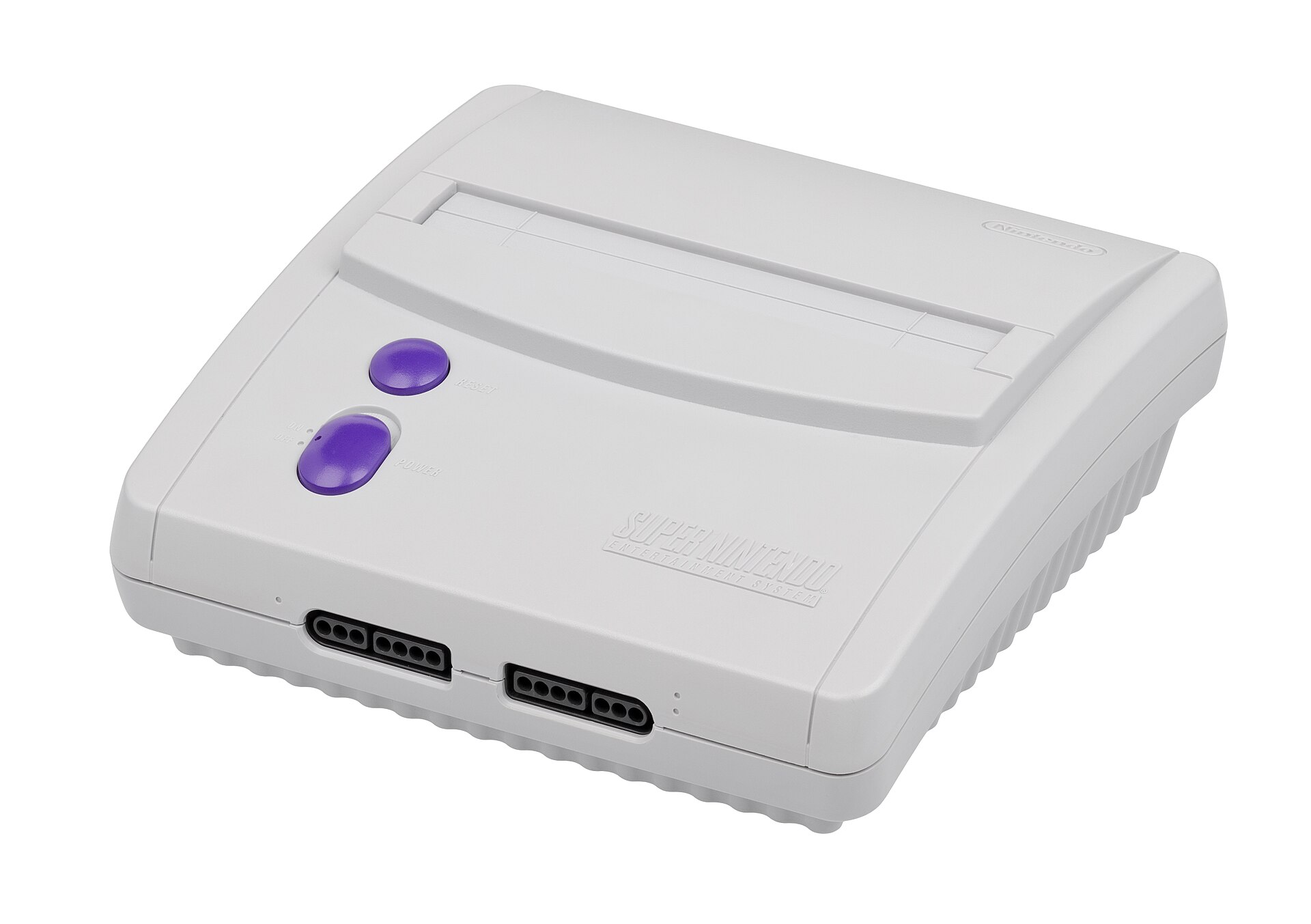
The Afterlife: The Canon Machine
The SNES became the default answer to a question the culture kept asking: what should a perfect games library look like? Nintendo’s SNES Classic Edition (2017) repeated the NES Classic’s retail riot at $80, this time including Star Fox 2 – a finished, cancelled 1995 game released officially after 22 years, the archive’s most famous ghost given a ship date. The FPGA and emulation scenes treat the machine as a cathedral to be measured to the millimetre (the 1CHIP revision’s video output is a collector’s fetish; the enhancement chips have been reverse-engineered into silicon). The fan-translation movement completed the library the nineties withheld. And the hidden corners keep giving: our own shelf runs from a dozen hidden gems that deserved better to the prototype underground of SNES-CD machines and lost fighters. The SNES’s modern reputation – greatest console, full stop, in a thousand listicles – is not nostalgia arithmetic. It is the correct conclusion from the library’s depth chart.
The Canon
Chrono Trigger (1995) – the RPG as perfect machine; time travel without a wasted hour. The Legend of Zelda: A Link to the Past (1991) – the adventure template, doubled across two worlds. Super Metroid (1994) – atmosphere’s masterclass; the genre-name’s second half. Final Fantasy VI (1994) – opera, ensemble, apocalypse: the 16-bit novel. Super Mario World (1990) – the launch game as world atlas. Donkey Kong Country (1994) – the graphical coup that decided a war. EarthBound (1994) – failure, then scripture. Secret of Mana (1993) – the action-RPG in full colour. Super Mario Kart (1992) – a genre founded at 100cc. Star Fox (1993) – the cartridge that grew its own 3D chip. Super Mario RPG (1996) – the summit meeting, and a farewell. F-Zero (1990) – Mode 7’s opening argument, still the purest racer. Super Castlevania IV (1991) – the whip in eight directions; atmosphere as technology. Super Mario World 2: Yoshi’s Island (1995) – the FX2 crayon masterpiece. Mega Man X (1993) – the 16-bit reinvention, wall-jump and all. Street Fighter II Turbo (1993) – the arcade at home, perfected. Kirby Super Star (1996) – eight games, one cartridge, endless generosity. Terranigma (1995) – the RPG Europe and Japan kept from America, and the fan-translation era’s holy grail. ActRaiser (1990) – god game by weekday, action epic by night; the launch window’s strangest masterpiece. Super Punch-Out!! (1994) – the sweet science, cartooned to perfection. A library this deep turns a canon into an argument, and the argument is the tribute: most consoles are lucky to have twelve essentials. The SNES has twelve per genre.
The Champion’s Ledger
The SNES won the 16-bit war the way incumbents are supposed to and rarely do: late, on depth. It beat the Genesis on the world’s totals while losing the American playground argument for whole school years; it hosted the RPG’s golden age and the mascot platformer’s perfection in the same library; it gave Sony the education and the grievance to end Nintendo’s reign, which is the kind of historical irony no marketing department would dare write. Its purple-grey shell contains the decade entire. Every console since has been measured against its library, and most measurements end the same way: the champion set the standard at 3.58 megahertz, with an orchestra inside. The standard held for three decades of challengers – through the CD revolution it accidentally sired, the streaming era it never saw, the remake economy that now runs on its catalogue – and it holds tonight, wherever a cartridge-shaped shadow falls across a modern release calendar.