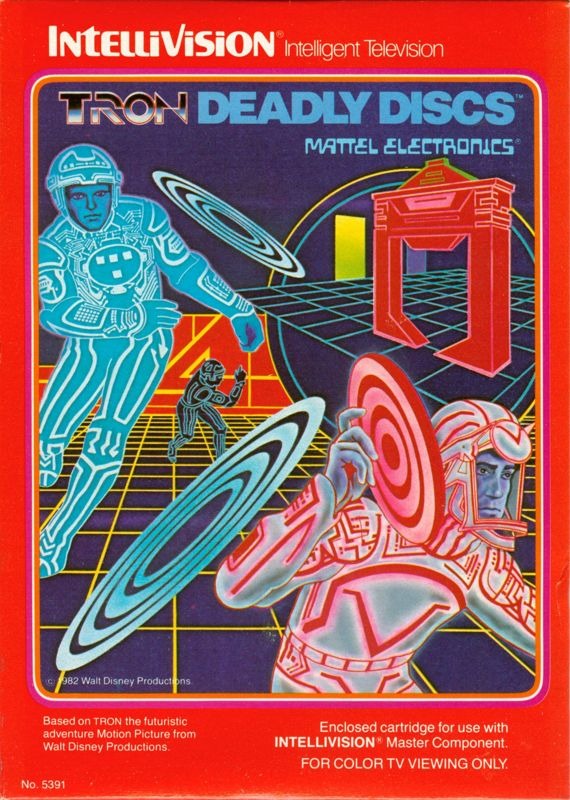
At a glance: Tron Deadly Discs · Intellivision · Mattel Electronics / Disney, 1982 · Arena action · Score: 8.5/10
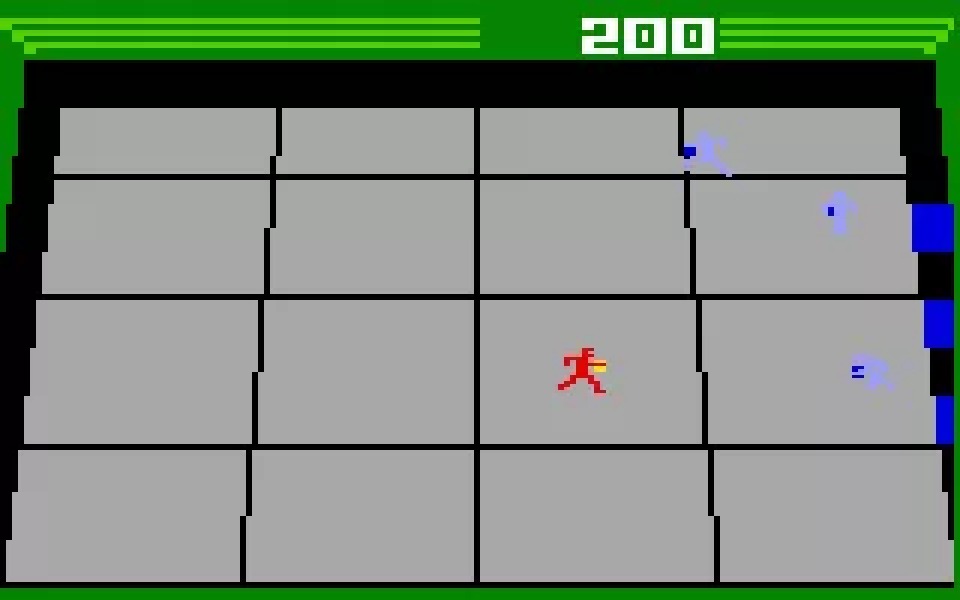
Movie tie-ins were supposed to be embarrassing. In 1982 Mattel released three Intellivision games built on Disney’s Tron, and the best of them — Tron Deadly Discs — didn’t just escape the tie-in curse, it became one of the finest arena action games of its generation, on any system. You are Tron, alone on the game grid, a red warrior in a grey arena, and from the blue doorways around the walls come the enemy programs: first three, then more, faster, meaner, armed with discs that kill. Your disc kills too, and blocks. That is the entire game, and it is enough for a masterpiece of escalation.
One arena, perfect information, no mercy
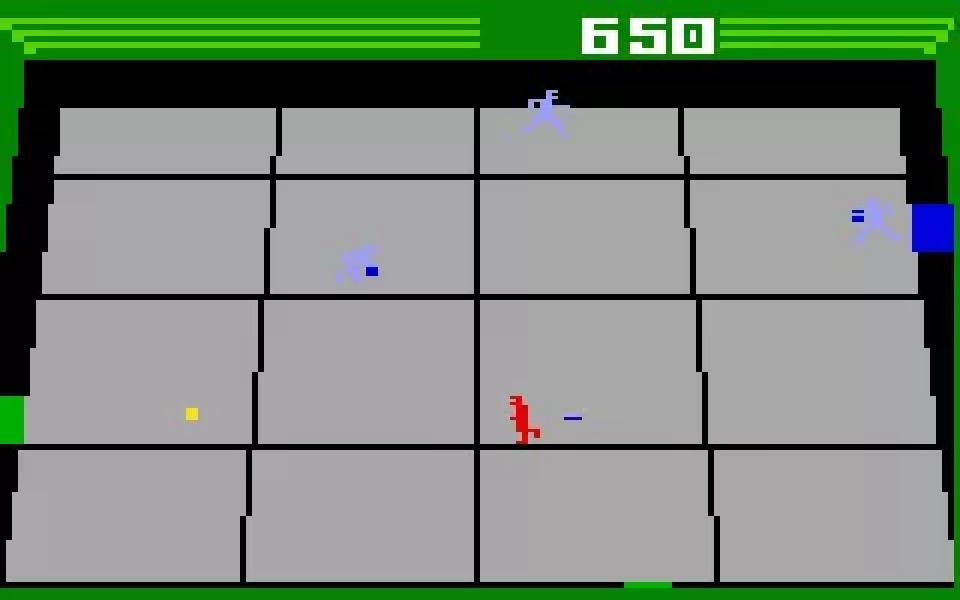
Deadly Discs takes its set-piece straight from the film’s disc arena and strips it to the essentials. Tron stands in an open rectangular field divided subtly into a grid. Enemies enter through doors on the arena’s edges and advance on you, throwing discs; a hit costs you, and enough hits at higher levels derezzes you. Your disc flies where you aim it — the keypad selects throwing direction, a genuinely inspired use of the Intellivision controller — returns to your hand like a boomerang, and doubles as a shield: intercept an incoming disc with your own and you block it, with a satisfying crackle of deflected energy. Kill all the warriors in a wave and the next arrives nastier, until the Recognizer — the film’s great clawed aircraft — looms over the arena to repair the enemy doors you’ve been sealing shut by hitting them, a mechanic that turns the walls themselves into a resource to manage.
The tactical texture here is remarkable for 1982. Because your disc is both weapon and shield, and because it’s absent from your hand while it flies, every throw is a small wager: attack now and be defenceless for a beat, or hold and let the enemy close in. Enemies can be stunned, then finished; their discs can be blocked, dodged by a step, or allowed to shatter a door’s control and seal an entrance. Waves deliberately mix slow starters with veterans who throw faster and aim better. It is, in modern terms, a wave-based arena survival game with a parry — built eight years before that vocabulary existed, on a console whose controller had a telephone keypad on it.
The keypad earns its keep
No control scheme on the Intellivision is more praised, and none deserves it more. The disc moves Tron in sixteen directions with analogue smoothness; the keypad throws discs toward the corresponding direction — press the key at upper-left and the disc flies upper-left. It takes one wave to learn and about three to stop thinking about entirely, at which point you’re playing the purest twin-input action game of its era: movement and aim fully independent, years before twin-stick shooters made that the standard. The overlay that shipped in the box labelled the keys as a compass rose; veterans didn’t need it, but it remains one of the best arguments ever made for why that odd controller existed.
Presentation is stark by design. The arena is flat grey, the warriors are stick-figure programs in the film’s circuit colours — red Tron against blue enemies — and the sound is a lean kit of throws, hits and the Recognizer’s ominous arrival. Nothing distracts from the geometry of the fight, and the geometry is where the game lives: angles, rebounds, the half-second flight of a disc. The Intellivision’s rivals got Tron games too, and some were good, but Deadly Discs is the one people who owned all the versions kept returning to.
Endurance, and the long game
What keeps Deadly Discs on the shelf decades later is its stamina as a score game. Survival is a skill with a visible ladder: learn to seal doors and you change the wave’s shape; learn to block reliably and the hardest throws become scoring opportunities; learn the Recognizer’s timing and you can keep the arena’s pressure at a level you choose. High scores are marathons. The cartridge also allows the kind of two-player alternating rivalry that defined living-room gaming in 1982, and its difficulty ceiling is high enough that few players of the era ever truly mastered it. It is worth noting, for version shoppers, that this review covers the Intellivision original: Mattel’s own ports to other systems followed, but the keypad aiming is native here, and it shows.
Why it outlived the film’s first life
Context matters here. Tron in 1982 was not yet the revered cult object it became; it was a Disney experiment that did respectable business and left Mattel holding a licence it needed to justify quickly. The three Intellivision Tron games were developed in parallel by different hands — Deadly Discs is generally credited to Steve Sohl, brother of Astrosmash designer John Sohl, which makes the family’s grip on the console’s early catalogue something remarkable — and the division of material was smart: Solar Sailer took the film’s journey, Maze-A-Tron its infiltration plot, and Deadly Discs took the one sequence every viewer remembered, the disc duel. Where most licence games of the period spread themselves thin across a film’s plot, Deadly Discs picked a single scene and polished it until it could stand alone as a sport.
And a sport is honestly what it became. The game’s scoring rewards exactly the skills its mechanics teach — door management, blocking, patient positioning — and its waves scale in a way that keeps expert players in genuine danger. It is also, not incidentally, one of the very few early-80s home games that feels fair at its hardest: deaths come from your positioning and your gambles, not from sprite flicker, slowdown or a controller that couldn’t express what you meant. On a system whose library is rightly praised for brains, Deadly Discs is the reminder that Mattel’s teams could do reflexes just as well when the design was clean enough.
Practical notes for players and collectors
A few things worth knowing before you buy or boot. The cartridge is common and inexpensive, a benefit of its popularity in the system’s peak years. The printed overlay is helpful for your first sessions — the throwing compass made physical — but genuinely optional once the keypad geometry is in your fingers, which takes about one evening. Two cautions from long use: the game rewards a controller in good health, since the disc is doing constant fine work, so test your handset’s disc before blaming your aim; and Deadly Discs is a marathon scorer, so set your high-score expectations accordingly — the famous runs are measured in endurance as much as in reflexes. Finally, complete the set consciously: Maze-A-Tron (our hidden-gems list) and Solar Sailer make a fascinating trilogy with this at its centre, three designers’ answers to the same film, and Deadly Discs is the one history crowned.
The verdict
Tron Deadly Discs is the rare licensed game that outlived its licence. The film became a cult classic; the game simply became a classic, full stop — a perfectly tuned arena survival duel with the best control scheme of its year. Of Mattel’s Tron trio (Solar Sailer and Maze-A-Tron have their own charms, and the latter appears in our hidden-gems list), this is the essential one, and one of the half-dozen Intellivision cartridges nobody should be without.
Score: 8.5/10