
At a glance: Radiant Historia · Nintendo DS · Atlus, 2011 · Role-playing game · Score: 9.0/10
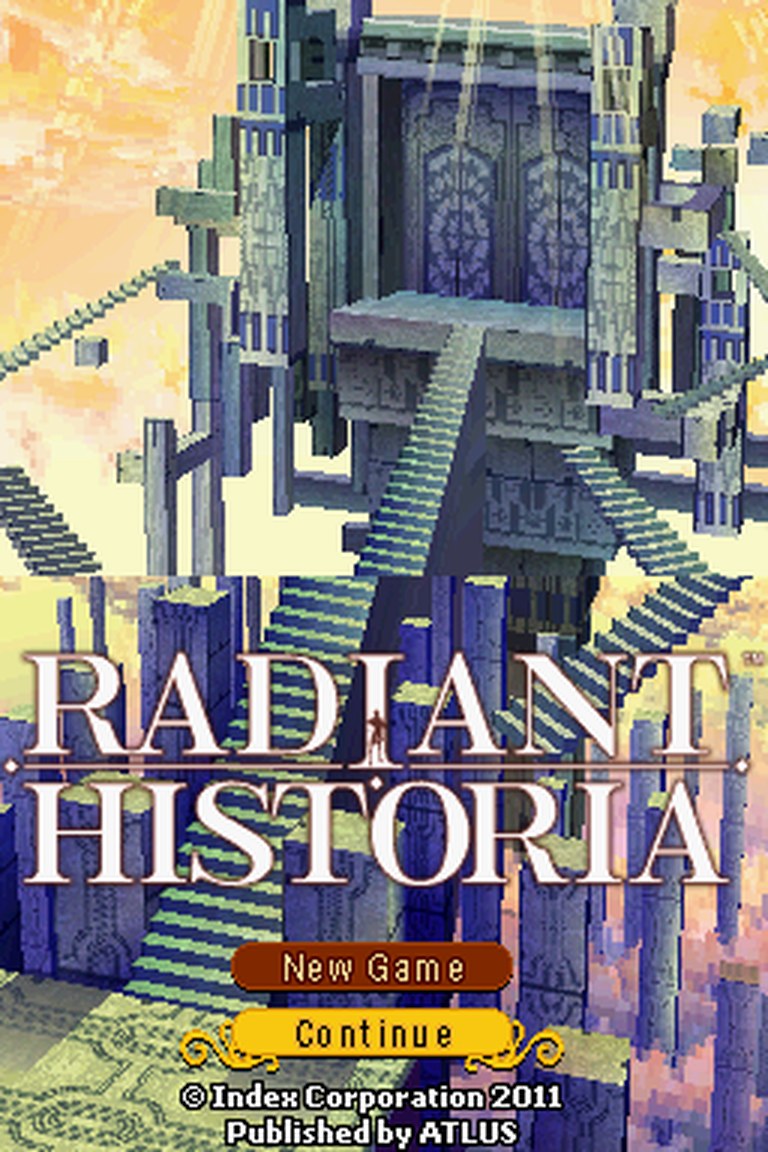
Radiant Historia arrived from Atlus in 2011 — late enough in the DS’s life to be overlooked, good enough to be argued over ever since. It is a time-travel RPG in the lineage of Chrono Trigger, but where that classic sprawls across eras, Radiant Historia compresses: one war, one continent, two branching timelines, and a hero who must live both, carrying knowledge and items between them until the branches converge on survival. Developed by staff with Shin Megami Tensei and Etrian Odyssey pedigree, scored by Yoko Shimomura, it is the thinking player’s DS RPG — intricate, melancholic and superbly constructed.
Stocke, a special-intelligence agent of Alistel, receives the White Chronicle from two eerie children at the moment of his death — and wakes hours earlier, able to step sideways into a parallel history at save-point nodes. In one timeline he stays an agent; in the other he joins the army’s front line. Neither path alone averts the catastrophe consuming the world — a desertification called the Sand Plague, which the game’s cosmology frames as time itself grinding to a halt. The writing is remarkable: a war story about logistics, prophecy and manufactured history, where the same characters recur across timelines in different fates, and fixing one branch’s disaster often requires knowledge bought with another branch’s tragedy.
A battle grid with a memory
Combat is a small masterpiece of systems design. Enemies occupy a 3×3 grid; Stocke’s party specialises in moving them — pushing, pulling and launching foes around the grid to stack them into a single square, where one attack hits the whole pile. Turn order, displayed and manipulable, can be stolen and re-sequenced: swap your turns, delay an enemy’s, and build fifteen-hit combos that multiply damage and rewards. It converts every random battle into a spatial puzzle with an optimisation problem at its heart, and it stays fresh for forty hours because positioning, not stats, is the primary weapon.
The timeline structure is equally disciplined. A chart of nodes maps both histories; dead ends — and there are dozens, each written as a bleak little epilogue — simply return you to the node to try another choice, so experimentation is the game rather than a failure state. Side quests exploit the braid elegantly: an item found in one history heals a stranger in the other, a skill learned from a doomed swordsman saves him in the branch where he lives. This is time travel as editing, and no RPG of the era does it with more rigour or less waste.

Shimomura’s war
The presentation is painterly and restrained: hand-drawn environments, expressive portraits, a muted palette of a world drying out. Shimomura’s score — piano, strings and melancholy in her Kingdom Hearts register, but leaner — gives the two timelines musical identities and the ending a genuine ache. Voice acting is absent, but the localisation carries the script’s intelligence cleanly, and the character writing — especially Stocke, a professional whose competence never curdles into coldness, and Eruca, a princess carrying the world’s ritual on her back — is a cut above the genre’s DS standard.
Two timelines, neither survivable alone: Radiant Historia makes you the editor of history, and charges you for every cut.
The flaws are those of budget and era: enemy variety thins late, the visuals reuse areas across timelines (thematically defensible, still noticeable), and backtracking through nodes to trigger the next divergence can feel administrative between story beats. The 3DS remake, Perfect Chronology, adds a third timeline and polish; the DS original remains a complete, coherent and arguably purer work.
The braid, braided tighter
The side content exploits the dual-timeline structure with an ingenuity the main quest only hints at. A swordsman’s duel can be won only after learning his technique from his corpse in the other history; a merchant’s ruin in one branch is a rescue in the other; several party members’ best skills are taught by people who exist only in timelines where they survived your choices. The node chart makes cause and effect visible as a kind of musical score, and the game’s dozens of bad endings — each a short, cold paragraph of consequence — function as negative space that defines the true path by everything it must not become. It is interactive fiction’s branching discipline fused to a JRPG’s systems, and the fusion is seamless.
Reception at release was the tragedy the game has spent a decade correcting: reviews glowed, word of mouth compounded, the cartridge grew scarce, and a 3DS enhanced edition eventually carried the story to a wider audience. The DS original remains the connoisseur’s cut — Shimomura’s score unadorned, the pacing untouched by the remake’s additions, the difficulty honest. However you play it, play it: the shortlist of DS RPGs that respect the player’s intelligence as completely as this one is very short indeed.
And a final structural compliment: Radiant Historia respects the player’s time in the way few forty-hour RPGs do. Fast travel between nodes, skippable returns through explored history, bad endings that cost minutes rather than saves — the braid is intricate but never bureaucratic, which is precisely why its complexity feels exhilarating rather than administrative. Atlus built a machine for thinking about time, and then had the discipline to make sure the machine never wastes yours. That discipline, as much as the writing or the grid, is what makes it a classic.

Playing it today
Expect the cartridge to cost real money — Atlus print runs of the era were small and this one’s second life has been loud — and expect it to be worth it. Played on original hardware, with the timeline chart a glance below the action and Shimomura in your ears, Radiant Historia is the DS RPG experience in its most concentrated form. Newcomers daunted by the braid should trust the game’s teaching: it introduces one timeline, one swap, one consequence at a time, and by the hour it asks mastery of you, you will be surprised to find you have it. History is watching. Choose well.
What finally separates Radiant Historia from the era’s many competent JRPGs is trust — trust that the player can hold two histories in mind, can read a war story without a mascot, can find the emotional weight in a timeline chart. Games that trust their players this completely are rare in any generation, and they tend to be the ones still being recommended, lent and argued about fifteen years later. By that measure — the only one that ultimately matters — Radiant Historia has already won its war.
Verdict
Radiant Historia is the DS’s great under-sung RPG: a rigorous time-travel structure, a battle system of real originality, and a war story written for adults. Released as the system wound down, it deserved a bigger audience then and demands one now. If Chrono Trigger is the genre’s sun, Radiant Historia is its finest constellation — colder, sadder and every bit as bright.